

Ledger Wallet Security Alert: Suspected Spyware in Two MediaMarkt Devices Raises Supply Chain Concerns
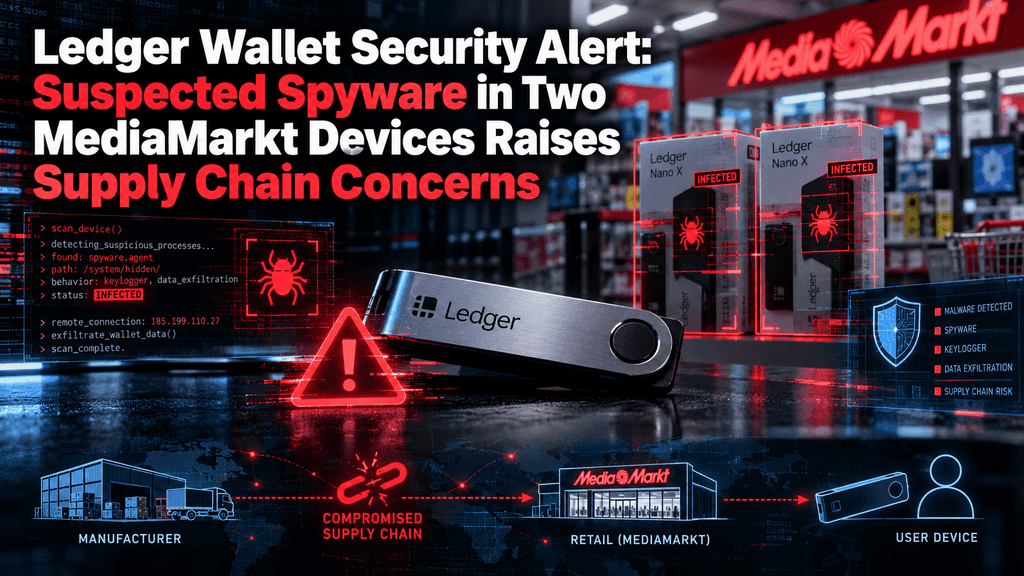
Could your brand-new, factory-sealed hardware wallet already be compromised before you ever enter a PIN? A major supply chain breach has hit the cryptocurrency sector following the discovery of suspected hardware spyware in two Ledger devices purchased from German retail giant MediaMarkt. This sophisticated attack physically intercepts private recovery phrases directly from the device screen via an internal display-sniffing circuit and transmits them to remote adversaries over cellular frequencies. Because this physical implant bypasses standard software integrity verifications—allowing tampered units to pass legitimate authenticity checks—it represents a severe systemic vulnerability for cold-storage security. Retail distribution channels across Europe now face intense scrutiny as on-chain analysts connect the incident to broader distribution compromises. Cryptocurrency holders must immediately re-evaluate cold-storage handling, audit device origins, and transition toward resilient custody architectures.
Key Takeaways
-
Critical Supply Chain Breach: Suspected hardware-level spyware was identified inside two separate Ledger Nano X units purchased from retail stores in Germany, confirming physical distribution tampering.
-
Flawed Authenticity Checks: The physical hardware modification targets the display assembly, allowing the compromised devices to successfully pass official cryptographic software attestation within official client apps.
-
Cellular Exfiltration Vector: Custom flex-PCB implants capture displayed 24-word recovery seeds directly from the screen and exfiltrate private key data through concealed cellular components.
-
Substantial Financial Impact: Forensic researchers trace this attack vector back to previous unauthorized merchant compromises, linking this campaign footprint to tens of millions of dollars in stolen digital assets.
-
Immediate Mitigation Protocol: Users who purchased hardware wallets through third-party retail distributors over recent months should migrate funds immediately to fresh, verifiable addresses and consider multi-signature configurations.
Anatomy of the MediaMarkt Security Incident
Physical Discovery and Retail Origin
The compromise of retail Ledger devices confirms that physical distribution networks represent a critical attack surface for cold-storage users. A customer identified as Johannes purchased two separate Ledger Nano X devices from two different MediaMarkt retail locations, only to discover identical, factory-grade physical modifications inside both units upon teardown. Forensic inspection revealed that neither device originated directly from the manufacturer's secure fulfillment facilities; instead, inventory logs traced their transit through intermediary European electronics distributor Aqipa GmbH. This indicates that tampering occurred during warehousing, shipping, or restocking stages before reaching store shelves.
The discovery highlights an alarming shift in threat modeling for cryptocurrency hardware. In conventional threat frameworks, attacks on hardware wallets are assumed to require physical theft after setup or digital compromise via malware-infected host computers. In this incident, adversaries intercepted factory-sealed units, carried out surgical hardware modifications, and resealed packaging with precision that defeated visual retail inspections. Consequently, standard retail assurances—such as shrink-wrap and tamper-evident packaging—proved completely ineffective at protecting end-users against motivated adversaries.
Technical Examination: The Screen-Sniffing Implant
Adversaries engineered an advanced hardware implant designed to harvest secret recovery phrases without breaking the microcontroller's primary cryptographic defenses. Independent hardware teardowns, corroborated by veteran cybersecurity researchers, revealed that attackers installed a custom, factory-printed flexible printed circuit board (flex-PCB) directly between the device's mainboard and OLED display connector. This ribbon acts as a silent hardware bus sniffer, recording every pixel rendered on the screen.
| Component | Technical Implementation | Malicious Functionality | Detection Risk |
| Flex-PCB Ribbon | Custom panelized connector bridge | Intercepts display bus signals | Zero software detection |
| Micro-Controller | Miniature low-power logic processor | Decodes pixel data into seed words | Bypasses secure element |
| Cellular Transmitter | Concealed low-power cellular antenna | Broadcasts seed phrases remotely | Bypasses local network |
| Battery Tap | Direct hook to internal battery cell | Powers persistent background transmission | Invisible to host PC |
Because the implant reads data downstream of the Secure Element chip, it avoids triggering firmware integrity alarms. When a user generates a new wallet, the Secure Element produces the 24-word mnemonic seed and pushes the text to the screen buffer. The malicious ribbon captures the visual stream, extracts the recovery phrase, and hands the data to a tiny cellular transmitter concealed above the internal battery assembly. This completely isolates the exfiltration mechanism from host computers, local Wi-Fi networks, and USB data monitoring, making perimeter firewalls and network sniffers blind to the data transfer.
Systemic Supply Chain Vulnerabilities
The Failure of Genuine Attestation Checks
Software-based genuine attestation mechanisms are incapable of detecting passive, downstream display modifications. When users connect a newly purchased Ledger device to official desktop or mobile companion applications, the software performs a cryptographic challenge-response handshake with the embedded Secure Element chip. In the case of these tampered MediaMarkt devices, the Secure Element itself was entirely genuine, and the installed firmware was authentic.
Because the cryptographic root of trust remained intact, the companion software declared the hardware "Genuine," misleading victims into believing their storage environment was secure. This structural blind spot demonstrates that cryptographic software checks only confirm firmware authenticity; they cannot verify physical enclosure purity or downstream display paths.
Cross-Regional Threat Linkage: From Southeast Asia to Europe
This European retail discovery is not an isolated event, but a direct expansion of an organized, industrial-scale hardware tampering campaign. Earlier operational footprints emerged across Southeast Asia, where unauthorized modifications affected hardware distributed through local electronics shops and online merchant storefronts. On-chain forensic investigations have connected the technical deployment signatures of the European units to historical attacks that drained more than three hundred individual wallets, totaling tens of millions of dollars in illicit transfers.
The sophistication of the panelized flex-PCBs confirms that these attacks are executed by heavily funded syndicates rather than lone hobbyists. Fabricating miniature flex-PCBs, sourcing specialized display bridge connectors, and assembling miniaturized cellular components requires professional engineering and dedicated assembly tooling. The transition from regional Asian marketplaces to primary European retail outlets confirms that physical distribution networks represent a sustained target for cryptocurrency theft syndicates.
Technical Implications for Digital Asset Custody
Limitations of Single-Signature Architecture
Relying entirely on a single hardware wallet creates an absolute point of failure that leaves digital assets vulnerable to hardware-level compromise. When an investor uses a standard single-signature setup, absolute authority over all stored assets resides in one single 24-word recovery phrase. If an attacker compromises the physical display interface during setup, the entire security model fails instantly.
Single-device cold storage assumes the device acts as a completely uncompromised fortress. However, as hardware-sniffing implants demonstrate, physical proximity to the generation process gives attackers total access. Even when users implement a passphrase (often referred to as the "25th word"), display sniffers capture the secondary passphrase as it is typed or confirmed across the screen, neutralizing typical single-device defenses.
Structural Comparison: Single-Signature vs. Multi-Signature
To survive physical supply chain interception, cryptocurrency custody models must remove single hardware dependencies. Decentralized custody protocols distribute signing power across varied hardware vendors, geographical locations, and software platforms.
| Security Dimension | Single Hardware Wallet | Multi-Signature (e.g., 2-of-3) | Air-Gapped Stateless Signer |
| Supply Chain Risk | Complete loss if unit is modified | Protected; 1 compromised key cannot move funds | Low; no embedded display-interception vectors |
| Software Attestation | Vulnerable to physical bus interception | Resilient; vendor diversity limits correlated risk | Dependent on microcode or QR validation |
| Physical Isolation | Requires USB/Bluetooth connectivity | Mixed connectivity across varied signers | Complete physical isolation via optical air-gaps |
| Mitigation Complexity | Low operational complexity | Moderate operational setup and maintenance | Moderate operational overhead |
Multi-signature architectures prevent catastrophic losses caused by hardware compromises. In a 2-of-3 multi-signature configuration, an attacker who intercepts a single seed phrase via an infected retail device cannot move assets without compromising a second, completely separate signing key stored on a different device from an independent manufacturer.
Practical Mitigation and Custody Hardening Protocols
Step-by-Step Security Remediation
Users who purchased hardware wallets from non-direct distribution channels must take proactive steps to safeguard their holdings. Following structured remediation processes mitigates the danger of undetected physical surveillance.
-
Perform an Emergency Asset Migration: If a hardware wallet was acquired via retail distributors, third-party marketplaces, or unauthorized resellers over recent months, treat the mnemonic seed as compromised. Generate a fresh, temporary software wallet on a clean operating environment and transfer funds away from the suspect hardware address.
-
Halt Immediate Physical Teardowns: While technical users may attempt physical disassembly to inspect internal ribbons, opening consumer hardware risks destroying delicate internal batteries and connectors, potentially obscuring diagnostic evidence needed by security teams.
-
Audit Device Acquisition Provenance: Review historical order invoices to verify whether devices were shipped directly from manufacturer factories or routed through third-party logistics firms.
-
Transition to Multi-Vendor Quorums: Construct multi-signature vaults utilizing devices sourced from multiple independent hardware manufacturers, ensuring that a single supply chain compromise cannot jeopardize stored reserves.
-
Implement Direct-Only Procurement Policies: Secure future hardware signers exclusively through direct factory orders, avoiding physical retail shelves, third-party logistics hubs, and open online marketplaces.
Evaluating Air-Gapped and Stateless Alternatives
The emergence of retail supply chain tampering has accelerated institutional and retail interest in stateless and optical air-gapped hardware designs. Devices that never contain persistent internal network components, cellular antennas, or rechargeable lithium power assemblies reduce the physical space available for covert hardware implants.
Optical air-gap architectures communicate transaction data strictly through animated QR codes or dynamic visual markers, eliminating physical cable connections and wireless interfaces. Furthermore, stateless designs avoid storing private seeds permanently in on-board memory chips; instead, users calculate keys dynamically from physical seed cards during signing operations. By reducing the physical volume inside device shells, stateless hardware makes unapproved physical modifications far easier to spot during basic inspections.
Supply Chain Integrity in Institutional Web3 Ecosystems
The Corporate Challenge: Hardware Whitelisting
Institutional digital asset custodians and corporate balance-sheet treasuries face stringent regulatory expectations regarding physical custody security. The MediaMarkt revelations demonstrate that standard procurement pipelines within conventional enterprise purchasing departments are poorly suited for high-value cryptocurrency operations. Purchasing hardware signers through generic business suppliers exposes treasury reserves to wholesale logistics tampering.
Enterprises must institute rigorous physical custody frameworks. This includes using tamper-evident transit containers with unique forensic identifiers, purchasing devices directly under non-disclosure factory dispatch agreements, and conducting destructive batch sampling where sample devices from every delivery are fully dissected in laboratory environments to verify internal circuitry before deployment.
Re-Evaluating Trust in Consumer Electronics Distribution
The presence of hardware spyware in mainstream European retail outlets demonstrates that consumer electronics supply chains cannot provide bank-grade security assurances for cryptographic hardware. Mass-market retail stores operate on logistics efficiency, frequent third-party warehousing, and complex return-and-restock policies. In retail operations, malicious actors can purchase legitimate units, carry out hardware modifications in laboratory environments, and return the tampered products for full refunds, allowing infected stock to be placed back on store shelves.
Cryptocurrency custody hardware represents an entirely different class of device compared to ordinary consumer electronics. While a compromised keyboard or wireless mouse poses modest data-theft risks, a compromised hardware wallet results in instantaneous, irreversible financial loss. As a result, the cryptocurrency industry must move away from mass-market retail shelves toward tightly controlled, end-to-end direct factory fulfillment models.
🔥 Beyond the Headlines: What KuCoin 5.0 Means for You
Market news moves fast — but where you act on it matters just as much. This October, KuCoin launches KuCoin 5.0, transforming KuCoin into a rebuilt platform. Here's what actually changes for you:
-
One account for everything. Older platforms split your money across separate "spot," "margin," and "futures" accounts and expected you to understand why. KuCoin 5.0's unified account removes that entirely — deposit once, and everything is simply there (only available to VIPs for now).
-
Stocks, indices, and commodities. KuCoin 5.0 expands beyond crypto into global markets. When crypto chops sideways and equities rally (or the reverse), you rotate in minutes instead of opening a brokerage account and waiting days for fiat rails.
-
Real-world assets (RWA). Tokenized exposure to traditional assets like commodities, right inside your crypto account. One of the fastest-growing segments in global finance is no longer reserved for institutions — you access it from the same balance you trade with.
-
Earn while you learn. Not ready to trade? KCUSD lets your stablecoins earn daily, auto-compounding interest. The lowest-stress way to put your idle deposit to work for 4% yield.
-
An AI assistant in plain language. Ask questions, get market context, understand what you're looking at — built into the platform, no jargon required.
-
An app that doesn't overwhelm. Faster, cleaner, and consistent — intuitive from the first tap, not after a tutorial.
-
Safety you can check, not just trust. A MiCAR-licensed EU entity, Proof of Reserves you can verify yourself, and internationally certified security (SOC 2 Type II, ISO 27001:2022).
Create your account in minutes — and start on the platform built for where crypto is going, not where it's been.
Conclusion
The discovery of suspected spyware implants within Ledger devices purchased from MediaMarkt represents a critical turning point for cryptocurrency hardware security. By placing custom hardware ribbons between internal processors and display panels, sophisticated attackers have demonstrated the ability to record private seed mnemonics while bypassing software-based authenticity verifications entirely. This covert extraction mechanism, combined with wireless cellular exfiltration, proves that single-device cold storage possesses critical vulnerabilities when physical distribution chains are compromised. While software attestation checks remain a useful layer of security, they cannot protect users from downstream hardware alterations. Cryptocurrency holders must adapt by strictly purchasing devices through verified direct-from-manufacturer channels, inspecting device histories, and migrating toward vendor-diversified multi-signature frameworks. In an environment where code alone cannot guarantee physical safety, establishing resilient, decentralized custody architectures remains the only reliable defense against modern supply chain threats.
FAQs
Can an attacker steal crypto assets from a hardware wallet without physical access after setup?
Yes. If an attacker installed a covert cellular or wireless transmitter inside the device prior to setup, the hardware can exfiltrate the recovery seed remotely the moment it is generated on the screen. Once the attacker possesses the recovery phrase, they can clone the wallet from any location on Earth and drain all assets without ever needing to touch the physical device again.
Does performing a firmware update remove hardware-level spyware?
No. Firmware updates only replace code running on the microcontroller and Secure Element chips. Hardware-level spyware consists of separate, physical components like custom printed circuit boards, display sniffers, or cellular antennas that operate outside the processor's reach. Because the implant exists at the physical circuit level, software updates have no impact on its operation.
Is purchasing a hardware wallet from an authorized retail distributor safe?
Authorized retail distributors carry higher physical tampering risks than buying directly from the manufacturer. Because retail devices move through third-party warehouses, shipping networks, and open store shelves, they are exposed to interception, inventory tampering, and fraudulent customer returns that slip past basic store evaluations.
How does a multi-signature setup protect against a compromised hardware wallet?
A multi-signature wallet requires valid signatures from several distinct private keys to authorize transactions, such as two out of three keys. Even if an attacker uses a modified hardware device to intercept one seed phrase, they cannot move any assets because they lack the secondary and tertiary keys held on different devices manufactured by entirely independent vendors.
What should I do if I previously purchased a hardware wallet from MediaMarkt or a similar retailer?
You should treat the wallet as potentially compromised. Immediately generate a fresh, secure wallet using a verified, uncompromised setup, and transfer your digital assets to those new addresses. Do not enter your existing 24-word recovery phrase into any other device, as the phrase itself may already be recorded in an attacker's database.
Disclaimer: This article is for informational purposes only and does not constitute financial or investment advice. Cryptocurrency investments carry significant risk. Always conduct your own research before trading.