

Why Is Justin Sun Seeking $264,000 in Sanctions Against World Liberty Financial Over UAE Ties?
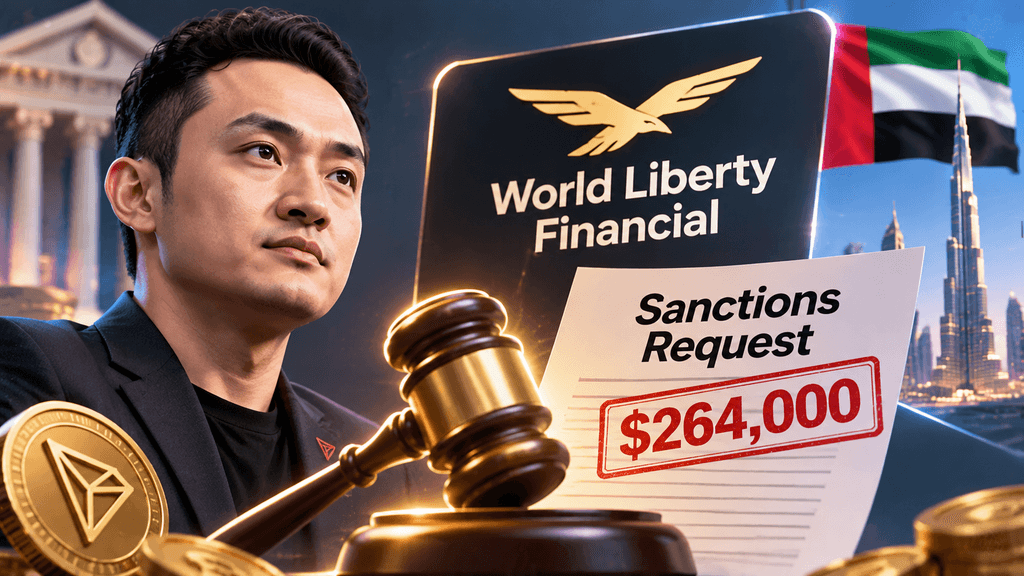
Tron founder Justin Sun is seeking approximately $263,821 in legal fees from World Liberty Financial (WLFI) and its lawyers, accusing the Trump-linked cryptocurrency venture of failing to disclose ownership connections to the United Arab Emirates until months into their ongoing lawsuit. The dispute centers on a revised corporate disclosure that identified 22 individuals and entities across four jurisdictions, potentially affecting whether the case can remain in federal court.
The latest development adds a significant legal dimension to Sun's dispute over his $45 million WLFI investment and frozen tokens. Filed on November 2, 2026, the sanctions motion argues that the delayed disclosure caused unnecessary litigation expenses. World Liberty's allegations and legal defenses remain subject to judicial review, and the court has not determined that the company intentionally withheld ownership information. The case now raises broader questions about corporate transparency, cross-border ownership, and investor protections in the cryptocurrency industry.
Key Takeaways
-
Justin Sun seeks $263,821.20 in legal fees from World Liberty Financial and its legal team over an allegedly incomplete initial ownership disclosure.
-
World Liberty amended its corporate disclosure on August 26, 2026, identifying 22 individuals and entities connected to Florida, Delaware, Puerto Rico, and the UAE.
-
The ownership dispute affects federal court jurisdiction because the citizenship of an LLC's members can determine whether diversity jurisdiction exists.
-
The original dispute involves approximately $45 million in Sun's WLFI investment, with Sun alleging that the project improperly restricted his token holdings.
-
A December 10, 2026, hearing is scheduled for the sanctions motion, while Sun has indicated that he intends to pursue the underlying case in California state court.
Why Is Justin Sun Seeking Sanctions Against World Liberty Financial?
Justin Sun is seeking court-imposed sanctions because he alleges that World Liberty Financial failed to provide complete ownership information when the original lawsuit began, only identifying UAE-related ownership connections several months later. Sun argues that the revised disclosure came after substantial legal work had already been completed to oppose the company's attempt to move the dispute into private arbitration. His November 2 motion asks the court to hold the company and its lawyers responsible for approximately $263,821.20 in associated legal expenses.
The central issue is not simply whether World Liberty has international ownership connections. Rather, Sun challenges the timing and completeness of the company's disclosures to the court. Its initial filing identified Florida as its citizenship, while the August 26 supplemental filing expanded the ownership chain to 22 individuals and entities and identified four jurisdictions: Florida, Delaware, Puerto Rico, and the United Arab Emirates. Sun contends that these details should have been available earlier because they were relevant to determining the court's jurisdiction from the beginning of the proceedings.
The requested amount represents legal expenses that Sun's team says it incurred while contesting World Liberty's arbitration request, rather than compensation for the underlying investment losses. The motion invokes the court's inherent authority, federal law governing unreasonable expansion of litigation proceedings, and procedural rules concerning representations made to courts. These are arguments submitted by Sun's legal team, not findings that World Liberty or its attorneys have violated the law. The court must independently evaluate the evidence and applicable legal standards before granting any requested relief.
How Did the $45 Million WLFI Investment Dispute Begin?
The legal conflict originated in Sun's investment in World Liberty Financial, a cryptocurrency venture associated with Donald Trump and his family. Sun initially agreed to purchase approximately $30 million worth of WLFI governance tokens in November 2024, later increasing his reported investment to approximately $45 million. His early involvement made him one of the project's significant investors, but the relationship subsequently deteriorated over token restrictions and the rights attached to his holdings.
In April 2026, Sun and two affiliated companies, Blue Anthem Limited and Black Anthem Limited, filed a lawsuit against World Liberty Financial in the U.S. District Court for the Northern District of California. The complaint alleged that the project had induced his investment through misleading conduct and subsequently restricted his ability to access or transfer his WLFI tokens. Sun also raised concerns about mechanisms that could prevent token transfers and the possibility of permanently destroying affected holdings. World Liberty has disputed his allegations and defended its actions regarding the restrictions.
The disagreement expanded in May 2026 when World Liberty filed a separate counterclaim against Sun, accusing him of damaging the project's reputation and engaging in improper conduct involving WLFI. The company characterized his public accusations as an attempt to create negative attention around the project. Consequently, the dispute developed into competing legal claims concerning investment agreements, token ownership, project governance, and the parties' contractual obligations. Neither side's allegations should be treated as established facts until the relevant courts resolve them.
Why Do World Liberty's UAE Ownership Ties Matter for Federal Court Jurisdiction?
World Liberty's revised ownership disclosure matters because the citizenship of an LLC's members can determine whether a U.S. federal court has diversity jurisdiction over a lawsuit. Under 28 U.S.C. § 1332, federal courts may hear certain civil disputes involving parties from different states or qualifying combinations of U.S. and foreign citizens, provided the other statutory requirements are satisfied. However, the presence of foreign citizens on both sides can prevent jurisdiction under this legal basis, making the company's ownership structure directly relevant to the case.
For federal jurisdiction purposes, an LLC generally takes the citizenship of every one of its members rather than simply the state in which it is registered. If an LLC has another LLC as a member, the citizenship analysis generally continues through the ownership chain until the relevant members' citizenship can be identified. This differs from the rules applicable to corporations, whose citizenship is generally determined by their state of incorporation and principal place of business. In this dispute, Sun argues that World Liberty's supplemental disclosure revealed foreign citizenship within its ownership structure, potentially creating foreign parties on both sides of the lawsuit. The legal framework is set out in the federal diversity jurisdiction statute and established court decisions interpreting LLC citizenship.
The timing of the disclosure is therefore central to Sun's argument. He contends that World Liberty should have identified the relevant ownership structure when the lawsuit was first filed, rather than introducing additional citizenship information after months of litigation. World Liberty's position, as described in reporting on the dispute, is that its lawyers learned about the UAE-related citizenship later. The court must assess when the relevant information became available, whether the original disclosure met applicable procedural requirements, and whether the revised information actually changes federal jurisdiction. A foreign ownership connection alone does not establish misconduct or determine the final outcome.
What Is Justin Sun Asking the Court to Do?
Sun's November 2 filing requests approximately $263,821.20 in legal fees and expenses, arguing that the allegedly incomplete disclosure forced his legal team to undertake unnecessary work. The amount is connected primarily to proceedings involving World Liberty's request to compel arbitration, including legal submissions and preparation for the August 20 hearing. It is not a demand for $263,821 in damages for frozen WLFI tokens, nor does it represent a court-approved payment.
The motion relies on three principal legal grounds. First, Sun invokes the federal court's inherent authority to address conduct that allegedly undermines the integrity of judicial proceedings. Second, he cites 28 U.S.C. § 1927, which can impose liability on attorneys who unreasonably and vexatiously multiply proceedings. Third, he refers to Federal Rule of Civil Procedure 11, which establishes standards for representations made in court filings and permits judicial action in appropriate circumstances. The application raises questions about whether the initial disclosure was adequately investigated and whether the subsequent litigation costs can legally be attributed to the challenged conduct.
An important procedural distinction is that Sun is requesting relief, not announcing an existing judgment. The court will need to determine whether the applicable requirements have been satisfied, whether the conduct warrants sanctions, and whether the requested amount is appropriately supported. Even if the court rejects the sanctions request, the underlying disagreement over WLFI token restrictions and contractual obligations may continue through other proceedings. Conversely, granting the motion would not automatically establish that every allegation in Sun's original complaint is correct.
How Could the Legal Dispute Affect WLFI Investors and Token Governance?
The lawsuit could increase scrutiny of WLFI's governance arrangements, particularly the extent to which the project can restrict token transfers and determine the rights of holders. Sun's allegations focus on the restrictions imposed on his holdings, but the broader issue extends to how governance-token agreements define investor protections, administrative permissions, and dispute-resolution procedures. For investors, the distinction between owning a token and having unrestricted control over its transferability is particularly important.
WLFI is a governance token associated with the World Liberty Financial ecosystem. Governance tokens can provide holders with participation rights under a project's rules, but those rights do not automatically establish ownership of the underlying company or unrestricted control over the protocol. Actual permissions depend on the token documentation, smart-contract design, applicable agreements, and any administrative controls retained by the project. In Sun's case, the central question is whether the restrictions placed on his holdings were consistent with the contractual arrangements and the project's disclosed rules. The court has not yet resolved that question.
The dispute also highlights several considerations for investors evaluating cryptocurrency projects. Token purchasers should examine whether transfer restrictions are disclosed, whether administrators retain freezing or other control capabilities, how governance decisions are implemented, and which dispute-resolution procedures apply. A project's public description of decentralization should not be treated as proof that every token holder has identical rights or that administrators cannot intervene. The outcome of Sun's case could provide additional context for how courts evaluate contractual protections and token-related rights in disputes involving digital-asset projects.
What Happens Next in the World Liberty Financial Lawsuit?
The immediate next step is the court's consideration of Sun's sanctions request. The hearing is scheduled for December 10, 2026, before Judge James Donato in the U.S. District Court for the Northern District of California. World Liberty will have an opportunity to respond to the allegations and contest the legal grounds for the requested fees. As of November 4, the court has not issued a final decision on the sanctions motion, and the allegations concerning the original ownership disclosure remain disputed.
A second important issue is whether the federal court can continue hearing the underlying lawsuit. If the court determines that diversity jurisdiction is unavailable because of the parties' citizenship, the case may need to proceed in another forum. Sun has indicated that he intends to refile the underlying claims in California state court after the sanctions issue is resolved. This possibility does not mean the investment dispute will end; rather, it could change the court responsible for handling the remaining claims. The parties may also continue to contest whether particular contractual claims are subject to arbitration.
The longer-term outcome will depend on several separate judicial decisions: whether the original disclosure complied with procedural requirements, whether the revised ownership information changes federal jurisdiction, whether sanctions are justified, and whether Sun can substantiate his claims concerning the frozen tokens. These questions should not be combined into a single judgment about the project's conduct. Even a decision on jurisdiction would not automatically determine whether World Liberty breached an investment agreement or whether Sun is entitled to recover his tokens or obtain financial compensation.
What Should WLFI Investors Watch While the Case Continues?
WLFI investors should focus on verified court developments rather than treating public accusations from either party as final findings. The most useful information will come from new court filings, judicial orders, updated ownership disclosures, and any formal statements explaining the project's token restrictions. These materials can help investors distinguish between allegations, procedural decisions, and findings that establish legal responsibility. The distinction is especially important in a case where the same ownership information may affect both the court's jurisdiction and the parties' litigation strategy.
Investors should also review the documentation governing WLFI tokens, including the terms of purchase, transfer limitations, governance provisions, and dispute-resolution clauses. Where a project retains administrative powers over token contracts, holders should understand the circumstances in which those powers may be exercised. Public blockchain records can help verify certain transfers and contract interactions, but they cannot independently establish whether a particular restriction violated a private agreement. Legal documents and on-chain evidence therefore serve different purposes and should be assessed together.
For the broader cryptocurrency market, the case offers a practical reminder that token ownership, corporate ownership, and protocol governance are distinct legal and technical concepts. A person may hold a governance token without owning an equivalent share of the company operating the project. Similarly, a project may have a decentralized technical component while retaining centralized administrative or contractual controls. The final court decisions may clarify some of these distinctions, but investors should avoid assuming that the outcome of one lawsuit will automatically establish a universal rule for all cryptocurrency projects.
What Does the Case Reveal About Corporate Transparency in Cryptocurrency?
The World Liberty dispute illustrates why accurate corporate disclosures matter beyond routine regulatory reporting. Ownership information can affect litigation, contractual accountability, investor due diligence, and the determination of which courts have authority to hear a case. For companies organized through multiple entities, tracing ownership and identifying the citizenship of every relevant member can require detailed legal and corporate records. The case demonstrates how an incomplete or amended disclosure can become a major procedural issue when the information directly affects jurisdiction.
The distinction between an international ownership structure and improper conduct is equally important. Having members or related entities in multiple jurisdictions is not, by itself, evidence of wrongdoing. The relevant questions are whether disclosures were required, whether they were accurate when submitted, when the company and its lawyers learned the relevant facts, and whether any delay caused legally recognizable harm. Those questions require evidence and judicial assessment rather than conclusions based solely on the presence of foreign ownership.
For cryptocurrency businesses, the practical lesson is that ownership documentation, token terms, and litigation disclosures should be consistent and carefully maintained. Projects that rely on layered entities or cross-border investment arrangements may face additional complexity when disputes arise. Clear documentation can help reduce uncertainty for investors and legal counterparties, while timely disclosures can prevent procedural disagreements from overshadowing the underlying commercial issues. The Sun–World Liberty case may become a useful example of how traditional corporate and procedural law applies to businesses operating in the digital-asset sector.
Conclusion
Justin Sun's request for approximately $263,821 in sanctions against World Liberty Financial introduces a new legal dimension to the dispute over his $45 million WLFI investment. The central issue is whether the project adequately disclosed its ownership structure before relying on its UAE-related citizenship to challenge federal court jurisdiction. Sun argues that the delayed disclosure created unnecessary legal expenses, while the company's position and the circumstances surrounding the revised filing remain subject to judicial examination.
The case also raises broader questions about corporate transparency, token-holder protections, and the legal responsibilities of cryptocurrency projects with complex international ownership structures. The December 10 hearing will be an important procedural milestone, although it will not necessarily resolve the underlying disagreement over frozen tokens. For WLFI investors and the wider digital-asset industry, the most significant outcome may be greater clarity about how ownership disclosures, contractual rights, and federal jurisdiction interact in cryptocurrency-related litigation.
FAQs
How much did Justin Sun invest in World Liberty Financial?
Justin Sun invested approximately $45 million in WLFI tokens, according to reports covering the original lawsuit. His initial purchase agreement was approximately $30 million in November 2024, followed by additional investment that increased the reported total.
Why did World Liberty Financial freeze Justin Sun's WLFI tokens?
Sun alleges that World Liberty restricted his token holdings and prevented him from freely accessing or transferring them. The company has defended its decision to impose restrictions. The legality of those actions remains part of the underlying dispute.
Does UAE ownership automatically prevent a company from operating in the United States?
No. Foreign ownership does not automatically prevent a company from operating in the United States. In this case, the issue concerns how the citizenship of an LLC's members affects federal court jurisdiction under applicable legal rules, rather than whether international ownership is inherently prohibited.
What is the difference between court sanctions and government economic sanctions?
Court sanctions are judicial measures that may address procedural misconduct, unreasonable litigation conduct, or violations of court rules. Government economic sanctions are separate measures imposed by public authorities under applicable laws. Sun's request concerns judicial sanctions and legal expenses in a private civil lawsuit.
When will the court decide Justin Sun's sanctions request?
A hearing is scheduled for December 10, 2026, before Judge James Donato in the Northern District of California. The hearing will address the sanctions request, but the court's decision and the subsequent handling of the underlying investment dispute remain uncertain.
Disclaimer: This general market information, possibly from third-party, commercial, or sponsored sources, is provided for reference and educational purposes only and does not constitute financial or investment advice, an offer, solicitation, or guarantee. We disclaim liability for its accuracy, completeness, reliability, and any resulting losses. Investments/trading are risky; past performance doesn’t guarantee future results. Users should research, judge prudently, and take full responsibility. For further details, please consult KuCoin’s Terms of Use and Risk Disclosure.