

NVIDIA Stock Decline Explained: Is the AI Boom Losing Momentum or Just Entering a New Phase?
2026/08/27 18:41:00
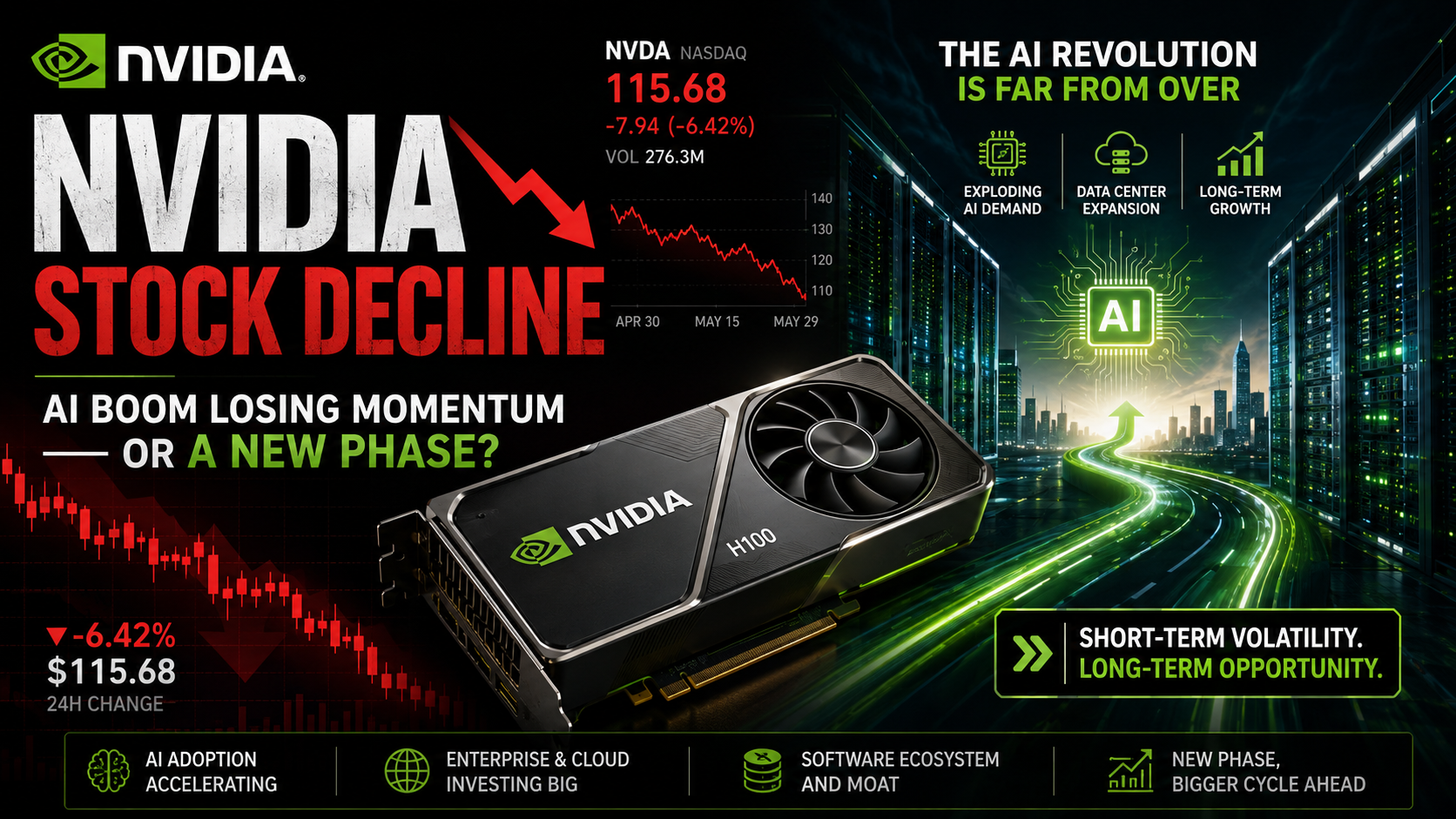
NVIDIA Corporation shares closed near $208.48 on August 24, 2026, after a seven-session losing streak that erased roughly 7 percent of value and left the stock more than 10 percent below its May 14 all-time closing high of $235.74. The pullback occurred even as analysts projected fiscal second-quarter revenue near $92 billion, nearly double the year-earlier figure, driven by data-center demand. Investors have grown cautious about circular financing arrangements, rising memory costs that prompted reported server price increases of up to 15 percent, competition from custom chips, and the sheer scale of hyperscaler capital spending. The company remains the dominant supplier of AI accelerators, with market capitalization still near $5 trillion and year-to-date gains around 12 percent.
Earnings due after the close on August 26 will test whether the numbers can restore confidence or reinforce doubts about the durability of the current spending cycle. The recent NVIDIA decline shows investor recalibration around financing risks, supply-chain costs, and competitive dynamics rather than a collapse in underlying AI demand; the boom is transitioning into a more capital-intensive, efficiency-focused phase in which leadership, product transitions such as Vera Rubin, and customer returns on investment will determine the next leg of growth.
Seven-Session Slide Caps Longer Retreat from May Peak
NVIDIA shares recorded their longest consecutive daily decline since September 2022, finishing August 24 at $208.48 after shedding about 7.5 percent across seven sessions. The move left the stock more than 10 percent below the May 14 closing high of $235.74 and contributed to a broader softening in the Philadelphia Semiconductor Index, which fell 2.7 percent on the same day. Year-to-date performance remained positive near 12 percent, and the company retained a market capitalization near $5 trillion, yet the streak shifted market psychology from near-certainty to visible caution ahead of the August 26 earnings release. Trading volume stayed elevated, with NVIDIA often among the most active names in the S&P 500. The decline followed earlier periods of relative underperformance against memory and other semiconductor peers, even as the company continued to post record quarterly revenue. Analysts noted that the stock had fallen after several recent earnings reports despite beats, suggesting elevated expectations already priced into the shares. The current level sits well above the 52-week low near $165, but the multi-week pressure from the May peak has raised questions about valuation support after years of extraordinary gains.
Market participants point to a combination of technical positioning and fundamental concerns. Pre-earnings caution has historically pressured the shares, and the latest streak coincided with reports of planned server price increases and large financing commitments. Broader risk sentiment also played a role as Treasury yields and geopolitical headlines weighed on high-multiple technology names. Despite the slide, the overwhelming majority of covering analysts maintain buy ratings, with average price targets still substantially above current levels. The gap between strong operational momentum and share-price vulnerability underscores how investor focus has shifted from pure growth rates toward sustainability metrics, capital intensity, and competitive durability. This environment sets the stage for the upcoming results to serve as a key test of whether the recent decline is a temporary recalibration or the start of a more prolonged reassessment.
Circular Financing Deals Draw Heightened Investor Scrutiny
Reports that NVIDIA helped arrange more than $500 billion in financing from six major U.S. financial institutions for customers building AI infrastructure, combined with a guarantee of up to $105 billion for an OpenAI data center lease in Ohio, intensified debate over circular arrangements. These structures allow customers to secure funding that ultimately flows back into NVIDIA chip purchases, supporting near-term demand while raising questions about the independence of that demand and potential future balance-sheet exposure. Critics argue that such backstops can artificially inflate spending signals and create interdependence that becomes problematic if customer economics weaken. NVIDIA has framed the activity as enabling the broader ecosystem rather than distorting it, yet the scale of the commitments has unsettled some long-term holders. The Ohio guarantee alone ranks among the company’s largest financing-related moves and arrived shortly before the earnings report, amplifying pre-release caution.
Investors are examining whether these arrangements merely accelerate genuine infrastructure needs or create a feedback loop that masks underlying profitability challenges at major AI model developers. OpenAI and similar firms remain heavily loss-making even as they scale, so supplier-provided financing support carries both opportunity and risk. Historical parallels in other capital-intensive industries show that supplier financing can sustain growth for extended periods when end-market demand is robust, yet it also concentrates risk if utilization rates or returns on invested capital disappoint. The market reaction, visible in the multi-day share decline, suggests participants are assigning higher probability to the risk side of the ledger in the near term. Management commentary on the August 26 call will likely address the economic rationale and risk controls around these commitments, providing clarity that current share prices appear to be seeking.
Memory Cost Pressures Prompt Reported Server Price Hikes
Bloomberg reported that NVIDIA informed major customers of planned price increases of as much as 15 percent next year for servers incorporating its AI chips, citing rising memory costs. The announcement reinforced how expensive the full AI supply chain has become and raised the possibility that higher input costs could temper demand elasticity among hyperscalers and enterprises. Memory shortages and elevated pricing have affected multiple semiconductor segments, and NVIDIA’s decision to pass through some of those costs protects margins while testing customer willingness to absorb them. Gross margins have remained robust near 75 percent in recent periods, but sustained memory inflation could pressure that profile or force further adjustments. The timing, just days before earnings, added to the cautious tone surrounding the stock.
Higher server prices may support NVIDIA’s profitability in the medium term, yet they also highlight the capital intensity of the AI buildout. Hyperscalers already face scrutiny over multi-hundred-billion-dollar annual capital expenditure plans; any material increase in per-unit costs complicates return-on-investment calculations. Some customers may accelerate purchases ahead of the hikes or explore alternative architectures, while others may simply absorb the increases given the performance advantages of NVIDIA platforms. The net effect on unit volumes and overall revenue growth will become clearer in coming quarters. For now, the price-hike reports have contributed to the narrative that the easy phase of unconstrained spending is giving way to a more cost-conscious environment, even as absolute demand remains elevated.
Comparison from Custom Silicon and Alternative Suppliers Intensifies
OpenAI’s unveiling of a custom AI chip designed with Broadcom, alongside Qualcomm supply agreements with Microsoft and Meta, has reminded investors that NVIDIA’s dominance, while still clear, faces incremental challenges. Major technology companies continue to invest in proprietary silicon for cost, power, and performance optimization on specific workloads. NVIDIA retains substantial advantages in software ecosystems, full-stack solutions, and the ability to serve the broadest range of models, and many large customers have already committed to next-generation Vera Rubin hardware. Nonetheless, any sustained share gains by alternatives could moderate the company’s growth trajectory relative to the most optimistic forecasts.
The competitive space remains asymmetric: NVIDIA still powers the majority of frontier training and a large share of inference workloads. Custom chips often target narrower use cases and require significant time and capital to reach volume production. Analysts expect NVIDIA to maintain leadership for the foreseeable future, particularly as Rubin ramps and improves AI-factory economics. The market’s sensitivity to competitive headlines, however, has increased as valuation multiples have compressed from earlier peaks. Evidence of sustained customer commitments to NVIDIA architectures in upcoming commentary will be important for restoring confidence that share erosion remains limited and manageable.
China Market Concession Removes a Former Growth Contributor
CEO Jensen Huang stated earlier in 2026 that NVIDIA had largely conceded the advanced AI chip market in China to Huawei. Data-center revenue from China effectively reached zero in the relevant quarter, compared with billions of dollars in the prior-year period. Huawei’s Ascend chips now command a majority of the domestic market, while NVIDIA’s share has fallen to single digits. Export controls and regulatory tightening have accelerated this outcome, removing what was once a meaningful incremental growth driver.
The loss of China revenue has been absorbed into current expectations and is no longer a primary near-term risk. It does, however, concentrate NVIDIA’s growth more heavily on the United States, Europe, and other accessible markets. Hyperscaler and enterprise demand in those regions has more than offset the China shortfall so far, yet the absence of a large alternative market reduces the company’s ability to diversify geographically. Future regulatory developments could further constrain or, less likely, reopen limited access. For valuation purposes, most models already exclude meaningful China recovery, so the focus has shifted to execution in remaining geographies and the success of new product cycles.
Hyperscaler Capital Expenditure Continues at Elevated Levels
Combined capital expenditure by Microsoft, Amazon, Alphabet, and Meta reached approximately $166 billion in the June 2026 quarter, up sharply year over year and sequentially. These outlays directly support demand for NVIDIA accelerators and networking solutions. Cloud revenue growth at the major providers has remained healthy, providing partial validation that AI investments are generating returns through higher utilization and new services. Still, investor patience with the absolute scale of spending has shortened, and any sign of deceleration or lower returns could pressure the entire ecosystem, including NVIDIA.
The relationship between hyperscaler capex and NVIDIA revenue is not one-to-one, yet the correlation remains strong. NVIDIA has noted growth in a broader set of AI-cloud, industrial, and enterprise customers that is expanding beyond the traditional hyperscalers. This diversification helps reduce concentration risk. The upcoming earnings report is expected to detail the split between hyperscaler and other customer categories, offering insight into whether demand is broadening or remaining concentrated. Sustained high capex without corresponding evidence of monetization progress would likely extend the current period of share-price caution.
Valuation Compression Brings Multiples Closer to Pre-Boom Levels
After the roughly $1 trillion decline in market value from the May peak, NVIDIA’s forward price-to-earnings multiple has compressed to levels last seen before the AI acceleration began. The stock trades at a discount to its own recent history even while revenue and earnings continue to grow at high rates. Some analysts view the lower multiple as creating an attractive entry point, arguing that many risks are now reflected in the price. Others contend that elevated absolute valuations still leave limited margin of safety if growth decelerates.
The compression has occurred against a backdrop of strong absolute performance: fiscal first-quarter revenue reached $81.6 billion, up 85 percent year over year. The second-quarter consensus near $92 billion implies continued rapid expansion. The market is therefore distinguishing between operational excellence and the price investors are willing to pay for that excellence. Buyback capacity remains large after earlier authorizations, providing a potential support mechanism. Whether the current multiple proves a floor or continues to adjust will depend heavily on the quality of guidance and qualitative commentary provided with the August 26 results.
Vera Rubin Transition Offers Next Growth Catalyst
Shipments of next-generation Vera Rubin processors are expected to begin in autumn 2026. Analysts estimate the platform could contribute nearly $9 billion in third-quarter sales and improve AI-factory economics relative to the already strong Blackwell generation. Management has positioned Rubin as unlocking further efficiency gains that should support continued customer investment. The successful ramp of prior architectures provides a template, yet execution risks around supply, software readiness, and customer qualification remain.
Product transitions historically create temporary uncertainty as older generations wind down and new ones scale. NVIDIA has managed previous handoffs effectively, maintaining overall growth. Investor focus will center on the pace of Rubin's qualification, early order visibility, and any commentary on total addressable opportunity. Positive signals on the transition could help shift attention from near-term financing and cost concerns toward the multi-year runway still available. Conversely, any delays or lower-than-expected initial traction would likely extend the current period of share-price pressure.
GPU Rental Price Softness Signals Supply-Demand Rebalancing
Hourly rental rates for flagship B200 GPUs on major platforms declined from peaks near $6.11 to approximately $4.22 within a short period earlier in 2026, a drop of roughly 30 percent. The movement suggests that available capacity has expanded relative to immediate demand in certain segments or that competition among cloud providers has intensified. While not a direct measure of NVIDIA’s own pricing power, rental softness can influence perceptions of utilization rates and the urgency of additional capital spending.
Rebalancing is a normal feature of rapid capacity buildouts. Earlier scarcity drove elevated rental rates and reinforced the urgency of new deployments. As supply catches up in some regions or for certain configurations, rates moderate. NVIDIA’s long-term opportunity depends more on the total volume of deployed accelerators and the software ecosystem that locks in customers than on short-term rental fluctuations. Still, sustained softness could temper the most aggressive forecasts for near-term unit growth and contribute to the cautious tone currently surrounding the shares.
The large majority of covering analysts continue to rate NVIDIA a buy, with consensus price targets well above the recent trading range. Many note that operational metrics remain robust and that the recent share decline has improved the risk-reward profile. Some firms have highlighted the potential for the company to grow faster than its hyperscaler customers through expansion into AI-specific clouds and enterprise segments. The constructive stance coexists with recognition that elevated expectations leave limited room for disappointment on either the print or the outlook.
The divergence between analyst ratings and near-term price action is not unusual for high-profile growth names after rapid runs. It does, however, create the possibility of sharp moves in either direction once the earnings details and management commentary are digested. Investors will parse not only the absolute numbers but also qualitative signals on demand visibility, inventory levels, competitive positioning, and the economics of the financing arrangements. A clean beat-and-raise quarter accompanied by confident guidance on the Rubin ramp could reverse the recent streak; any shortfall relative to the high bar would likely extend pressure.
Whole Semiconductor Sector Rotation Adds Pressure
NVIDIA has underperformed certain semiconductor peers, particularly memory-related names, during parts of 2026 even while delivering superior absolute growth. Sector rotation into areas perceived as earlier in their cycle or more leveraged to specific bottlenecks has diverted flows. The Philadelphia Semiconductor Index’s recent weakness shows that the pressure is not isolated, yet NVIDIA’s higher valuation and greater visibility have made it a more frequent target for profit-taking and risk reduction.
Rotation dynamics can reverse quickly if NVIDIA’s results reaffirm its central role in the AI buildout. For the moment, the relative performance gap has reinforced the narrative that the pure-play AI hardware trade has entered a more selective phase. Portfolio managers appear to be balancing continued exposure with greater diversification across the semiconductor value chain. This environment rewards clear communication of durable competitive advantages and multi-year visibility.
AI Infrastructure Returns Remain the Ultimate Test
The core question hanging over the recent share decline is whether the hundreds of billions of dollars being invested in AI infrastructure will generate adequate returns for the companies making those investments. Cloud providers have begun to show AI-related revenue contributions, yet the absolute scale of spending continues to outpace near-term monetization in the eyes of some investors. NVIDIA sits at the center of this debate because its growth is the most direct expression of that spending. Evidence that utilization is rising, token economics are improving, and new applications are scaling would support the view that the boom is maturing rather than peaking.
Management has repeatedly emphasized that compute capacity itself is becoming a profit center as models deliver productive work. Upcoming commentary on customer utilization trends, inference versus training mix, and enterprise adoption will be critical. The transition from pure training-focused buildouts to balanced training-and-inference deployments could alter growth rates and margin profiles. Investors are looking for signs that the current capital intensity is temporary and that operating leverage will eventually expand. Until those signs become clearer and more consistent, periods of share-price volatility are likely to persist even amid strong absolute results.
Product Cycle and Ecosystem Strength Provide Structural Support
NVIDIA’s full-stack approach, accelerators, networking, software, and systems, continues to differentiate it from pure silicon competitors. The CUDA ecosystem and associated libraries create switching costs that custom or alternative chips struggle to match for many workloads. Commitments already in place for Rubin systems among large customers provide a degree of visibility that pure unit forecasts cannot capture. These structural advantages have underpinned the company’s ability to grow through prior cycles of skepticism.
The current environment tests whether those advantages remain decisive as customers become more cost-conscious and as alternatives mature. Early indications from hyperscaler and enterprise roadmaps suggest continued heavy reliance on NVIDIA platforms. The company’s ability to deliver successive generations that improve performance per watt and total cost of ownership will determine how durable that reliance remains. Strong execution on the Rubin transition, combined with transparent discussion of financing economics and demand breadth, would reinforce the structural case even if near-term multiples stay compressed.
FAQs
What has driven the recent multi-day decline in NVIDIA shares?
The seven-session slide through August 24, 2026, reflects a combination of pre-earnings caution, reports of circular financing arrangements including large guarantees for customer data-center projects, planned server price increases linked to memory costs, broader semiconductor sector weakness, and ongoing questions about the sustainability and returns of elevated AI capital expenditure. The stock remains up year to date and well above its 52-week low, yet the streak has shifted sentiment from exuberance to greater scrutiny of risks that were previously overlooked.
Are NVIDIA’s fundamental results still strong despite the share-price weakness?
Yes. Consensus expectations for the fiscal second quarter call for revenue near $92 billion, roughly double the year-earlier period, with data-center sales expected to more than double. Prior-quarter results already showed record levels and high double-digit growth. The disconnect arises because investors are focusing more on financing structures, competitive developments, cost inflation, and valuation after years of rapid appreciation than on the absolute growth rates alone.
How significant are the circular financing deals for NVIDIA’s outlook?
The arrangements, including facilitation of more than $500 billion in external financing and a specific guarantee of up to $105 billion for an OpenAI facility, help customers fund infrastructure that ultimately purchases NVIDIA products. They support near-term demand visibility but introduce questions about demand quality and potential contingent exposure. Management is expected to address the economic rationale and risk management around these structures on the earnings call.
Will higher server prices hurt demand?
Reported increases of up to 15 percent for certain AI servers next year protect NVIDIA margins against memory cost inflation. Whether customers absorb the increases, accelerate purchases ahead of them, or explore alternatives will become clearer over coming quarters. Absolute demand remains robust given performance advantages, yet elasticity could moderate unit growth relative to an unconstrained pricing environment.
Has competition begun to erode NVIDIA’s market position meaningfully?
Custom silicon efforts by major technology companies and alternative suppliers represent incremental challenges, particularly for specific workloads. NVIDIA retains leadership in software ecosystems, broad model support, and full-stack solutions, and many customers have committed to the upcoming Rubin generation. Share shifts, if they occur, are expected to be gradual rather than abrupt, though the market has grown more sensitive to competitive headlines.
What role does the China market play in the current outlook?
NVIDIA has largely conceded advanced AI chip sales in China, with related data center revenue effectively zero in recent periods. The loss has been absorbed into forecasts. Growth is now more concentrated in accessible markets, which have so far more than compensated, but the absence of China reduces geographic diversification.
🔥 KuCoin Offers A More Stable Option in A Volatile Market
If you worry about the frequent ups and downs in the market, and pursue a more stable option to earn money passively, KuCoin is the right place to come:

Simple Earn: Deposit and withdraw tokens anytime, earning stable returns.
Kucoin Earn: Earn stable profits with professional asset management.
Hold to Earn: Earn rewards by holding assets in Funding, Trading, Margin, Futures, Mining, and Unified Accounts.
Staking: Unlock the earning potential of on-chain assets.
Advanced Investments: Advanced Investments offer a variety of structured products to help your money grow in any market.
Shark Fin: Principal Protection and Guaranteed Gains
Dual Investment: Buy low and sell high with transparent return calculations.
Snowball: High yields, with price protection.
Discount Buy: Buy crypto at discount prices.
KCS Loyalty: Level up to enjoy exclusive perks by staking ≥ 1 KCS.
KuCoin Wealth: Discover future value and begin your smart investing journey.
KCS Benefits: Hold and stake KCS to access benefits across the platform.
KCS Staking 2.0: Participate in KCS on-chain governance to earn yield.
Disclaimer: This content is for informational purposes only and does not constitute investment advice. Cryptocurrency investments carry risk. Please do your own research (DYOR).