

Strait of Hormuz Reopening: Why 1,500 Stranded Ships in Persian Gulf Will Take Weeks or Months to Clear
2026/05/31 11:28:08
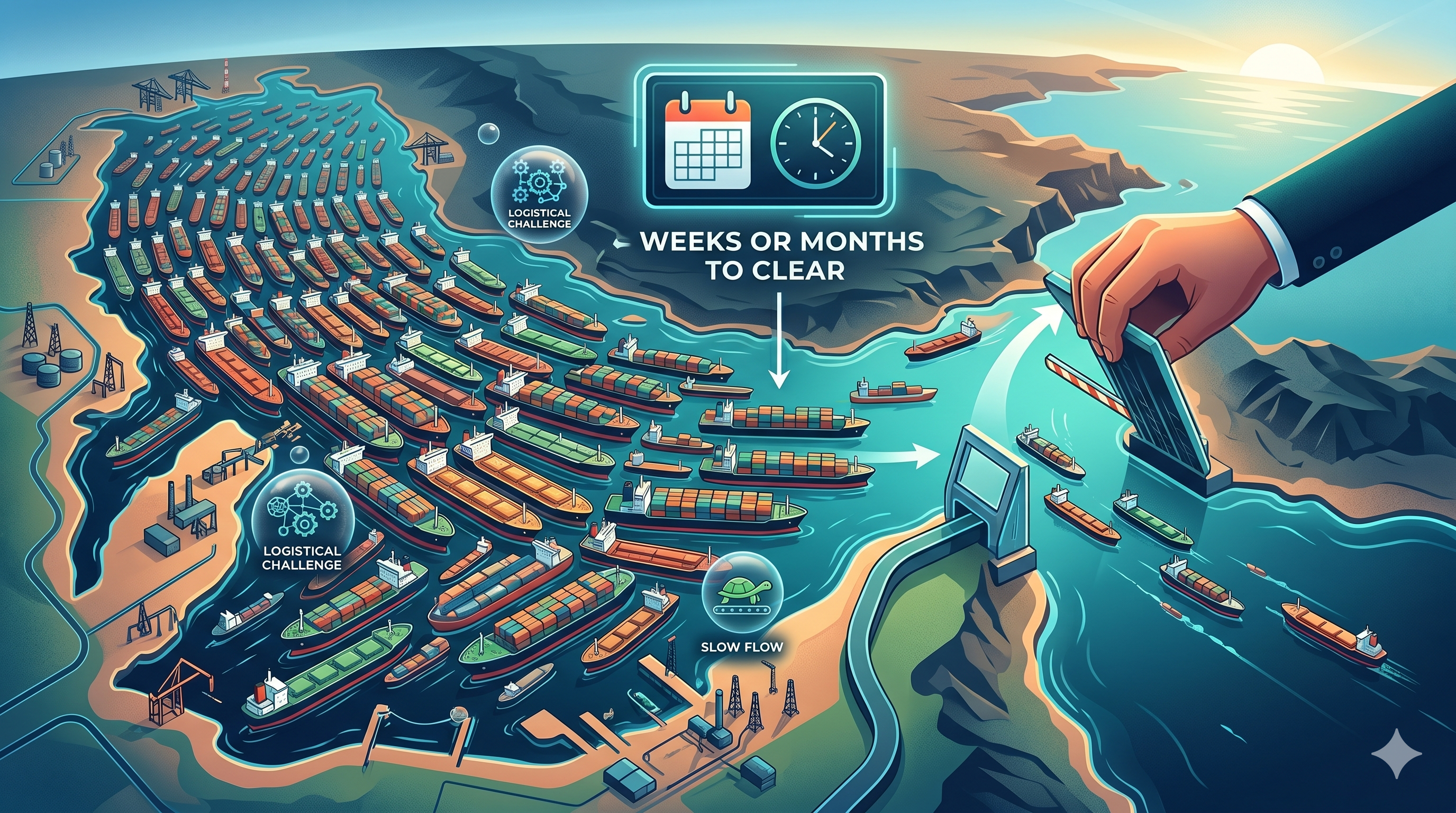
The Strait of Hormuz reopening may ease pressure on oil, LNG, global trade and crypto markets, but clearing around 1,500 stranded ships in the Persian Gulf could take weeks or months because of security risks, convoy limits, port congestion and insurance costs.
The Strait of Hormuz reopening is a major relief for global shipping and energy markets, but it does not mean the crisis is over. The waterway may be open again for limited movement, yet clearing around 1,500 stranded ships in the Persian Gulf is a much larger logistical challenge.
The Strait of Hormuz is not a normal sea lane. It is one of the world’s most important energy chokepoints, carrying about 20 million barrels per day of oil flows in 2024, equal to roughly one-fifth of global petroleum liquids consumption and more than one-quarter of global seaborne oil trade, according to the U.S. Energy Information Administration. Around one-fifth of global LNG trade also moved through the strait in 2024, mainly from Qatar.
That means the reopening matters far beyond the Middle East. It affects crude oil prices, LNG supply, tanker rates, shipping insurance, inflation expectations, global supply chains and even risk assets such as Bitcoin and cryptocurrencies.
Strait of Hormuz Reopening: Why the Persian Gulf Shipping Backlog Remains a Global Risk
The Strait of Hormuz reopening is a positive development for energy traders, shipping companies and governments, but it does not immediately remove the global risk created by the Persian Gulf shipping backlog. A reopening announcement may allow some ships to move, but normal maritime traffic depends on whether vessels can pass safely, consistently and at commercial scale.
The size of the backlog explains why the risk remains serious. Around 1,500 ships and their crews were reported trapped in the Gulf because of the Iranian blockade in the Strait of Hormuz, according to Gulf News, citing the International Maritime Organization’s chief. The IMO also said around 20,000 seafarers remained trapped and unable to leave, while several vessels had been seized or detained in the region.
This is not one simple queue of identical ships. The stranded vessels may include crude oil tankers, LNG carriers, refined-product tankers, container ships, chemical tankers, dry-bulk carriers and support vessels. Each category has different cargo priorities, port needs, insurance conditions and security requirements.
Hormuz is especially important because it connects the Persian Gulf with the Gulf of Oman and the Arabian Sea. The International Energy Agency says about 20 million barrels per day, or around 25% of world seaborne oil trade, transits the strait, with about 80% of that oil destined for Asia. The IEA also notes that about 93% of Qatar’s LNG exports and 96% of the UAE’s LNG exports transit through Hormuz.
That concentration turns a regional shipping disruption into a global market issue. If crude tankers are delayed, refiners may worry about supply. If LNG carriers are slowed, Asian buyers may face tighter delivery schedules. If war-risk insurance stays expensive, freight costs can remain elevated even after the waterway reopens.
Recent signs of movement are encouraging. The Financial Times reported that two LNG tankers crossed the Strait of Hormuz, while a crude oil tanker also passed through, suggesting a possible improvement in access during negotiations over a fragile ceasefire. Bloomberg also reported that three LNG tankers loaded in Qatar appeared to have crossed the strait in recent days as suppliers tried to move fuel to key buyers.
Still, a few successful crossings are not enough to prove that the crisis is over. Shipowners, insurers, charterers and naval authorities need confidence that the risk of mines, drones, missile threats, vessel seizures or renewed military escalation has fallen enough to support regular daily transit.
That is why the reopening should be viewed as the start of a recovery phase, not the end of the disruption. Until ships can move in large numbers without extraordinary security measures, the Persian Gulf shipping backlog will remain a risk for oil markets, LNG flows, freight rates and global supply chains.
Why 1,500 Stranded Ships in the Persian Gulf Could Take Weeks or Months to Clear
Clearing 1,500 stranded ships in the Persian Gulf is not as simple as reopening the Strait of Hormuz and allowing vessels to sail out one by one. The backlog is a complex maritime traffic problem involving security risks, convoy limits, naval coordination, insurance costs, port congestion, cargo priorities and crew welfare.
The first challenge is controlled transit capacity. If the strait has just reopened after a period of military tension or blockade, ships may not be allowed to move freely at normal speed. Naval authorities may require vessels to travel in organized convoys or follow approved routes to reduce the risk of mines, drone attacks, missile threats, small-boat attacks or vessel seizures.
That creates a hard capacity problem. Even if the route is technically open, only a limited number of vessels may be cleared safely each day. Priority will likely go to LNG carriers, crude tankers, refined-fuel tankers, humanitarian cargoes and vessels with urgent crew or safety needs. Lower-priority commercial vessels may wait longer.
The second problem is that the stranded fleet is not one single category of ship. Crude oil tankers, LNG carriers, container ships, chemical tankers and dry-bulk vessels do not all operate on the same schedule. LNG carriers need specialized loading and discharge terminals. Container ships may have missed port rotations. Oil tankers may need revised loading instructions or new charter agreements. Dry-bulk and general cargo vessels may face delayed berthing windows.
Another major bottleneck is port congestion inside the Gulf. Many ships need berths, pilots, tugboats, inspections, fuel, supplies, paperwork or crew changes before they can move. Even if the Strait of Hormuz is technically open, ships cannot leave or enter efficiently if ports are already crowded. The backlog can shift from the sea lane to terminals in Qatar, the UAE, Saudi Arabia, Kuwait, Bahrain, Iraq and Oman.
Insurance is another reason the process could take weeks or months. Shipowners and charterers need more than a political statement that the route is open. They need insurers to confirm that vessels can transit at an acceptable cost. If war-risk insurance premiums remain high, some operators may delay voyages, demand higher freight rates or wait for several days of safe crossings before committing vessels.
Security concerns can slow the queue even further. A Washington Post report described a Filipino crew that had been stranded for over a month in the Persian Gulf before attempting the passage; their ship was then attacked by gunfire from small boats, highlighting the kind of crew-safety risk still facing commercial vessels in the area.
There are also maintenance and welfare problems. The Financial Times reported that stranded ships have faced marine growth such as barnacles, algae and jellyfish in the Gulf’s warm waters, while crews have dealt with stress, shortages and limited access to parts and services. These operational issues can slow the restart because some ships may need inspection, cleaning, repair or crew relief before they can safely resume commercial voyages.
That is why the backlog could take far longer to clear than the reopening headline suggests. If security improves quickly, convoys operate smoothly, ports have enough capacity and insurers reduce premiums, the queue could shrink over several weeks. But if naval escorts are limited, port congestion builds, insurance costs remain high or political tensions return, clearing 1,500 stranded ships could take months.
The Strait of Hormuz reopening is only the beginning. The real test is whether ships can move safely, regularly and in large enough numbers to restore normal trade flows.
Oil, LNG and Global Trade Impact: How the Strait of Hormuz Reopening Affects Markets
The Strait of Hormuz reopening matters because the waterway sits at the center of global energy trade. Any disruption in this narrow passage can quickly affect oil prices, LNG supply, tanker rates, shipping insurance and global trade flows.
For oil markets, the first impact of reopening is usually relief. If crude tankers can move again, traders may reduce the risk premium that builds into prices during a blockade or military crisis. The EIA says flows through Hormuz in 2024 and the first quarter of 2025 made up more than one-quarter of global seaborne oil trade and about one-fifth of global petroleum liquids consumption. That is why even limited tanker movement can calm fears of a major supply shock.
But oil prices may remain volatile if the reopening is partial, if daily crossings stay below normal levels or if shipowners still require naval escorts before transiting. The biggest question for crude markets is not only whether the strait is open, but whether oil cargoes can move at scale. Refineries need predictable supply schedules. Producers need reliable export routes. Tanker operators need safe passage.
For LNG markets, the impact can be even more sensitive because liquefied natural gas depends on specialized vessels, terminals and delivery windows. Qatar is one of the world’s largest LNG exporters, and much of its outbound LNG traffic depends on the Strait of Hormuz. The IEA says a closure would strand LNG exports from Qatar and the UAE, which together represent almost 20% of global LNG exports.
Unlike crude oil, LNG cannot be rerouted or stored as easily across the global system. LNG carriers must match specific loading terminals, discharge terminals and contract windows. A backlog in the Persian Gulf can therefore create scheduling problems even after shipping resumes. That is why markets may react positively to early LNG tanker crossings, but still remain cautious until regular export flows are restored.
The reopening also affects shipping and freight markets. When a chokepoint like Hormuz is disrupted, tanker availability tightens, voyage schedules break down and charter rates can rise. Ships trapped inside the Gulf cannot serve other routes, while vessels outside the region may avoid Gulf calls unless freight rates are high enough to justify the risk. As the backlog clears, freight rates may ease, but the adjustment is likely to be uneven.
War-risk insurance is another key market signal. Even after the strait reopens, insurers may continue charging elevated premiums if they believe the threat of mines, drones, missile attacks or vessel seizures remains credible. Higher insurance costs can feed directly into shipping rates and cargo prices. Until premiums fall, the reopening remains incomplete from a commercial perspective.
The impact on global trade goes beyond energy. Container ships, dry-bulk carriers, chemical tankers and general cargo vessels also rely on Gulf ports. If port congestion continues, supply chains tied to the Middle East may face delays in industrial goods, chemicals, food commodities, construction materials and consumer products.
Markets will therefore watch several indicators before declaring the crisis over: rising daily vessel transits, successful crude and LNG shipments, lower insurance premiums, reduced port congestion and no renewed security incidents.
The Strait of Hormuz reopening is positive for oil, LNG and global trade, but it is not a complete market reset. The immediate effect may be lower fear and improved confidence, while the longer-term impact depends on how quickly the Persian Gulf shipping backlog clears.
Crypto Market Impact: 7 Ways the Strait of Hormuz Reopening Could Affect Bitcoin and Risk Assets
-
Oil Price Relief: The Strait of Hormuz reopening could reduce pressure on oil and LNG prices if energy shipments begin moving again. Lower energy prices may ease inflation fears, which can support risk assets such as Bitcoin, Ethereum and altcoins.
-
Inflation Expectations: If the Persian Gulf shipping backlog keeps oil prices elevated, investors may worry that inflation will stay high. Higher inflation expectations can lead markets to expect tighter central-bank policy, which may pressure the crypto market.
-
Bitcoin as a Risk Asset: Bitcoin often trades like a risk asset during geopolitical stress. If traders remain nervous about the Strait of Hormuz, Bitcoin could move alongside equities and other speculative assets instead of acting as a safe haven.
-
Bitcoin as an Inflation Hedge: Some investors may view Bitcoin as a hedge against inflation, currency weakness and geopolitical uncertainty. If the Hormuz crisis keeps energy prices volatile, this narrative could support long-term Bitcoin demand.
-
Altcoin Volatility: High-beta altcoins may be more vulnerable than Bitcoin. DeFi tokens, meme coins, gaming tokens, AI tokens and smaller Layer-1 coins usually depend heavily on liquidity and risk appetite. If markets turn defensive, altcoins could fall faster.
-
Stablecoin Flows: Stablecoins such as USDT and USDC could become important signals during the crisis. Rising stablecoin exchange balances may show that traders are waiting for better entry points, but they can also signal caution and reduced exposure to volatile crypto assets.
-
Market Indicators to Watch: Crypto investors should monitor Brent crude prices, U.S. dollar strength, Bitcoin dominance, stablecoin inflows, funding rates and liquidation data. If oil prices fall and risk appetite improves, Bitcoin and altcoins may benefit. If shipping risks return, traders may move back into defensive positions.
The Strait of Hormuz reopening could improve crypto market sentiment by reducing geopolitical and inflation pressure. However, it is not an automatic bullish signal. Bitcoin, Ethereum and altcoins will remain sensitive to oil prices, global risk sentiment and whether the Persian Gulf shipping backlog clears smoothly.
Conclusion
The Strait of Hormuz reopening is a positive signal for global markets, but it does not mean the Persian Gulf shipping crisis is over. With around 1,500 stranded ships still needing safe passage, the recovery could take weeks or months due to naval escorts, port congestion, insurance costs and security risks.
Until oil tankers, LNG carriers and commercial vessels move normally again, the Persian Gulf shipping backlog will remain a key risk for oil prices, global trade and crypto market sentiment.
FAQs
-
Why is the Strait of Hormuz important for global oil markets?
The Strait of Hormuz is one of the world’s most important oil chokepoints because a major share of global crude oil and LNG exports moves through this narrow waterway. Any disruption can quickly affect oil prices, fuel costs, tanker rates and global energy supply.
-
How many ships are stranded in the Persian Gulf?
Reports suggest around 1,500 ships may be stranded or delayed in the Persian Gulf shipping backlog. The exact number can change as some vessels move, others wait for clearance, and new ships arrive near the region.
-
Why will 1,500 stranded ships take weeks or months to clear?
The backlog could take weeks or months because ships may need naval escorts, security checks, port slots, insurance approval, crew changes and cargo rescheduling. Reopening the Strait of Hormuz does not mean every vessel can move at once.
-
Is the Strait of Hormuz fully reopened?
The Strait of Hormuz reopening may allow limited vessel movement, but full normalization depends on safe daily transits, lower war-risk insurance costs, reduced port congestion and no renewed military escalation.
-
How does the Strait of Hormuz reopening affect oil prices?
The reopening can reduce fears of a major oil supply shock, which may ease pressure on crude oil prices. However, prices may remain volatile if tanker movements are slow, insurance costs stay high, or security risks continue.
-
How does the Strait of Hormuz affect LNG supply?
The Strait of Hormuz is a key route for LNG exports, especially from the Gulf region. If LNG carriers are delayed, buyers may face tighter delivery schedules, higher spot prices and increased competition for replacement cargoes.
-
Can the Persian Gulf shipping backlog affect crypto markets?
Yes. The Persian Gulf shipping backlog can affect crypto indirectly through oil prices, inflation expectations, interest-rate outlook and global risk sentiment. Bitcoin, Ethereum and altcoins may react if energy-market stress increases volatility.
-
When will shipping return to normal in the Strait of Hormuz?
Shipping may take weeks to months to return to normal, depending on security conditions, convoy capacity, port congestion, insurance premiums and how quickly oil tankers, LNG carriers and commercial ships can resume regular movement.
Disclaimer: This article is for informational purposes only and is not financial advice. Always do your own research before buying or trading crypto.