

SpaceX Stock (SPCX) Surges Toward $230: Is a $2.5 Trillion Valuation Sustainable Post-IPO?
2026/06/16 18:13:00
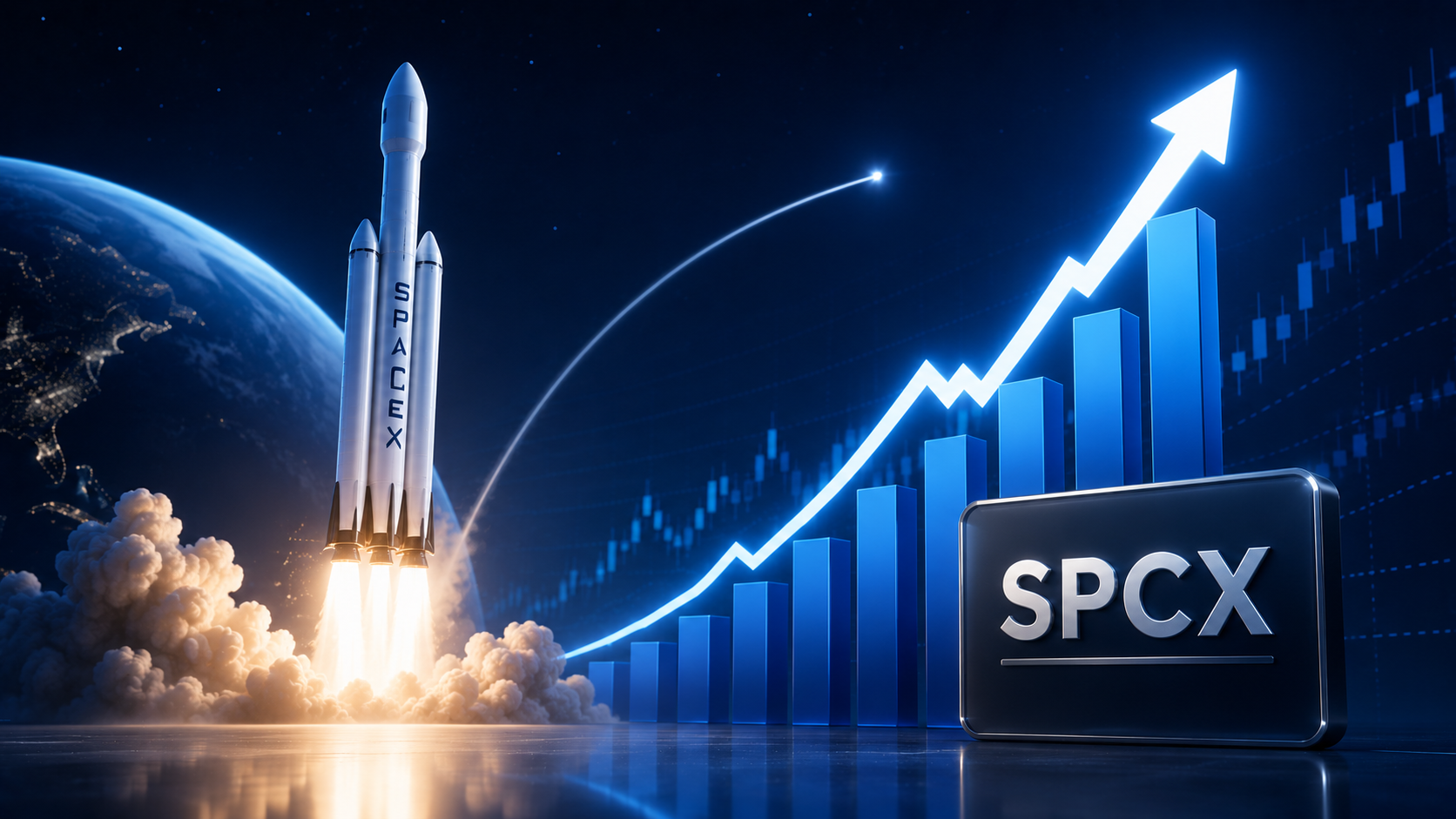
Did you know that SpaceX’s public debut shattered history by raising $75 billion—more than double the previous global record held by Saudi Aramco? Following its historic Nasdaq listing under the ticker symbol SPCX on June 12, 2026, the equity has experienced a staggering wave of institutional and retail accumulation. Investors are aggressively bidding up the asset, driving the stock toward the $230 threshold and pushing its market capitalization over the $2.5 trillion mark in post-IPO trading. This article analyzes the technical setup, structural market dynamics, and underlying fundamentals of the SpaceX public offering to determine whether the asset can maintain its upward trajectory.
Key Takeaways
-
Record-Breaking Debut: SpaceX (SPCX) went public on June 12, 2026, raising a historic $75 billion at an IPO price of $135 per share.
-
Supply Shock Dynamics: A restricted public float of just 4% coupled with an ironclad 180-day insider lockup period is creating an aggressive supply-demand imbalance, driving prices toward psychological resistance at $230.
-
Structural Catalyst: Immediate T+1 fast-track inclusion into MSCI benchmarks has legally forced passive index funds to aggressively accumulate shares.
-
Alternative Alpha: The S-1 filing revealed SpaceX holds 18,712 Bitcoin in its treasury, making the stock a dual play on aerospace, AI infrastructure, and crypto.
-
The Reality Check: While market momentum remains incredibly bullish, traditional analysts warn against an overextended 110x price-to-revenue multiple ahead of the company's first public earnings call on September 2, 2026.
What Caused the Post-IPO Surge in SpaceX Stock?
Institutional demand and retail fear of missing out—commonly known as FOMO—are the primary catalysts behind the monumental post-IPO price appreciation. According to a report by Themes ETF Trust in June 2026, the offering drew more than $250 billion in total indications of interest, representing an oversubscription rate of nearly four times the allocated shares. This overwhelming demand resulted in an immediate 11% premium on opening morning, with shares debuting at $150 compared to the initial $135 offering price.
A significant structural driver behind the upward price pressure is the highly constrained public float. Based on SpaceX SEC filings from June 2026, the company issued 638,888,888 Class A common shares, leaving a free float of only around 4% available for open-market trading. This extreme scarcity of shares, combined with an ironclad 180-day lockup agreement that prevents early employees and insiders from liquidating their equity until December 2026, has created a severe supply-demand imbalance that naturally forces the asset price upward.
Furthermore, speculative retail flows have been amplified by unique secondary trading innovations. The cryptocurrency trading platform Backpack recently launched a tokenized representation of the SPCX stock on the Solana blockchain, allowing international retail participants without direct access to the Nasdaq exchange to trade and redeem fractional shares. This decentralized on-chain access pool has funneled continuous global capital directly into the broader ecosystem, reinforcing the bullish momentum.
How Does the SPCX Technical Chart Shape Up for Traders?
The short-term technical chart for SPCX reveals a classic bullish consolidation pattern that signals strong underlying accumulation. According to data provided by TradingKey on June 15, 2026, SpaceX stock consolidated effectively in the $171.91 range on the 1-hour chart after its initial first-day trading session closed at $160.95. This price action confirms that the market is actively absorbing the post-IPO volatility rather than experiencing a sharp retracement.
Traders are closely monitoring the key Fibonacci retracement and extension levels to map out the next directional breakout. The $170.19 level represents the critical 0.236 Fibonacci retracement line, which buyers have successfully defended to establish a firm technical floor. With the Relative Strength Index (RSI) sitting in a highly favorable, neutral-bullish zone between 50 and 60, the asset remains clear of overbought territory—suggesting plenty of room for upward extension.
If buying volume pushes the price cleanly above the initial intraday peak of $176.52, the technical structure points toward an immediate continuation setup. Technical analysts at TradingKey project that a daily candle close above this resistance will open the door for a swift rally toward the next major Fibonacci targets situated between $183.96 and $185.00, with an ultimate psychological target sitting at $230.
What Structural Factors Are Forcing Institutional Buying?
Mechanical index tracking and structural fund mandates are legally compelling institutional managers to purchase massive blocks of SPCX regardless of its high valuation. According to a market announcement by MSCI, SpaceX stock was fast-tracked for index inclusion on a T+1 basis immediately following its debut. This unprecedented rapid inclusion meant that passive exchange-traded funds (ETFs) and mutual funds tracking global benchmarks were required to purchase millions of shares to prevent tracking error.
The liquidity landscape has been further compressed by the rapid deployment of specialized derivative products. Within the first week of listing, financial issuers introduced ten leveraged and inverse SpaceX ETFs to the market, providing traders with advanced tactical tools to express a directional view. The continuous rebalancing requirements of these leveraged products—seeking to deliver up to two times the daily return of SPCX—forces market makers to constantly buy or sell the underlying stock, adding massive daily volume and liquidity to the equity.
| Metric | SpaceX (SPCX) Official IPO Performance Data |
| IPO Offering Price | $135.00 per share |
| Nasdaq Opening Price | $150.00 per share |
| Day-One Closing Price | $160.95 per share |
| Total Primary Capital Raised | $75.00 Billion |
| Implied Market Capitalization | ~$2.10 Trillion to $2.50 Trillion |
Is the $2.5 Trillion Valuation Backed by Real Fundamentals?
Traditional fundamental metrics indicate that the current market valuation of SpaceX is exceptionally stretched, relying heavily on future growth projections rather than current profitability. According to recent analyst reports from Morningstar, the firm assigned a fundamental fair value estimate of approximately $780 billion to the company—less than half of its current market capitalization. Skeptics emphasize that despite generating billions in top-line revenue, the highly capital-intensive nature of aerospace manufacturing resulted in a net loss of roughly $4.9 billion for the 2025 fiscal year.
The bull case, however, treats SpaceX as a multi-pronged technology monopoly spanning global telecommunications, aerospace infrastructure, and advanced artificial intelligence. Data published by Defiance ETFs indicates that the Starlink satellite connectivity division alone generated $11.4 billion in revenue for the year ended December 31, 2025, representing a massive 49.8% year-over-year growth rate. Starlink now serves over 10.3 million active subscribers across 164 countries, providing a highly predictable, high-margin recurring revenue stream that helps offset rocket development costs.
Furthermore, investors are pricing in massive upside from the company's unexpected corporate treasury assets and recent strategic acquisitions. The company's S-1 registration statement confirmed that SpaceX holds 18,712 Bitcoin in its corporate treasury, worth over $1.2 billion at current market prices. Additionally, following the structural absorption of xAI earlier in the year, the company plans to utilize its expanding Starlink constellation to construct orbital AI data centers—positioning SPCX as a primary infrastructure beneficiary of the ongoing global artificial intelligence boom.
What Are the Key Structural Risks Facing SPCX Investors?
The primary risk facing market participants is the severe valuation premium coupled with upcoming regulatory and financial milestones. Trading at a price-to-revenue ratio exceeding 100x based on its historical financials, the stock has zero margin for operational error. Any unexpected delay in the commercial launch cadence of the Starship reusable rocket system or an unexpected decline in global Starlink subscriber growth could trigger an aggressive institutional sell-off.
| Analysis Pillar | Bullish Factors | Bearish Risks |
| Market Structure | 4% restricted float, immediate MSCI index inclusion, global tokenized retail trading. | Lock-up expiration in December 2026, high price volatility. |
| Core Financials | Starlink revenue grew 49.8% year-over-year to $11.4 billion in 2025. | Net loss of $4.9 billion for FY2025, capital-intensive infrastructure. |
| Strategic Assets | 18,712 Bitcoin treasury allocation, orbital xAI data center integration. | High dependency on speculative AI valuation multiples. |
Furthermore, the market faces a looming reality check as the initial post-IPO momentum phase transitions into formal corporate compliance. According to confirmed financial calendars, SpaceX will release its first official quarterly earnings report as a public company on September 2, 2026. This date will serve as the first time the public can audit the company's exact operational expenditure, margins, and revenue allocation—potentially forcing a sharp reconciliation between speculative hype and hard corporate data.
How to Trade and Gain Exposure to the Aerospace Sector on KuCoin?
If you are looking to capitalize on high-growth technology trends, exploring macro assets on leading cryptocurrency exchanges offers a highly effective pathway. While the direct equities market handles traditional stock listings, top-tier digital asset platforms like KuCoin enable users to gain direct exposure to the broader decentralized technologies that are increasingly overlapping with mega-cap corporate treasuries.
For instance, with SpaceX publicly disclosing a corporate holding of 18,712 Bitcoin, major corporate movements are becoming directly intertwined with the digital asset economy. By opening an account on KuCoin, you can instantly access the spot and futures markets for Bitcoin, Solana, and other core protocol tokens that are powering decentralized tokenized stock ecosystems. This allows you to position your portfolio ahead of macro capital shifts as traditional aerospace and artificial intelligence infrastructure converge with global blockchain networks.
Conclusion
The historic public listing of SpaceX under the ticker SPCX has structurally altered the global equity markets, instantly establishing the aerospace giant as a multi-trillion-dollar market force. While traditional fundamental analysts caution that a $2.5 trillion valuation is incredibly stretched relative to the company's $4.9 billion net loss in fiscal year 2025, market momentum is being heavily supported by severe float constraints and mandatory institutional index tracking. The robust expansion of the Starlink network—which generated $11.4 billion in revenue—combined with pioneering initiatives in orbital artificial intelligence data centers, provides an incredibly compelling growth narrative for long-term tech investors. Short-term technical indicators show strong accumulation above the $170.19 Fibonacci floor, pointing to a potential test of higher extension targets as the market marches toward the highly anticipated September 2, 2026 earnings release. To position your portfolio alongside these massive technological shifts, you can easily monitor capital flows and gain direct exposure to foundational crypto assets by utilizing the professional trading tools available on KuCoin.
FAQs
When did SpaceX stock complete its initial public offering?
SpaceX officially priced its historic initial public offering on the evening of June 11, 2026, and the shares commenced public trading on the Nasdaq exchange under the ticker symbol SPCX on June 12, 2026.
How much capital did SpaceX raise during its Nasdaq listing?
SpaceX raised a record-breaking $75 billion by selling 638,888,888 Class A common shares at an official offering price of $135.00 per share, making it the largest IPO in global corporate history.
Does SpaceX hold any digital assets on its balance sheet?
Yes, according to the official S-1 registration statement filed with the SEC, SpaceX holds 18,712 Bitcoin in its corporate treasury, establishing a direct fundamental link between the company's valuation and the digital asset market.
When is the first official SpaceX earnings report scheduled?
SpaceX is scheduled to release its first public quarterly earnings report on September 2, 2026, which will provide the market with its first transparent look at Starlink's precise margins and xAI capital expenditures.
Can international retail investors access tokenized versions of SPCX?
Yes, the decentralized crypto platform Backpack launched a tokenized version of the SPCX equity on the Solana blockchain, enabling global fractional trading and secondary market liquidity outside of traditional US brokerage hours.