

September 2026 FOMC Decision: Will the Fed Hike Rates or Hold?
Introduction
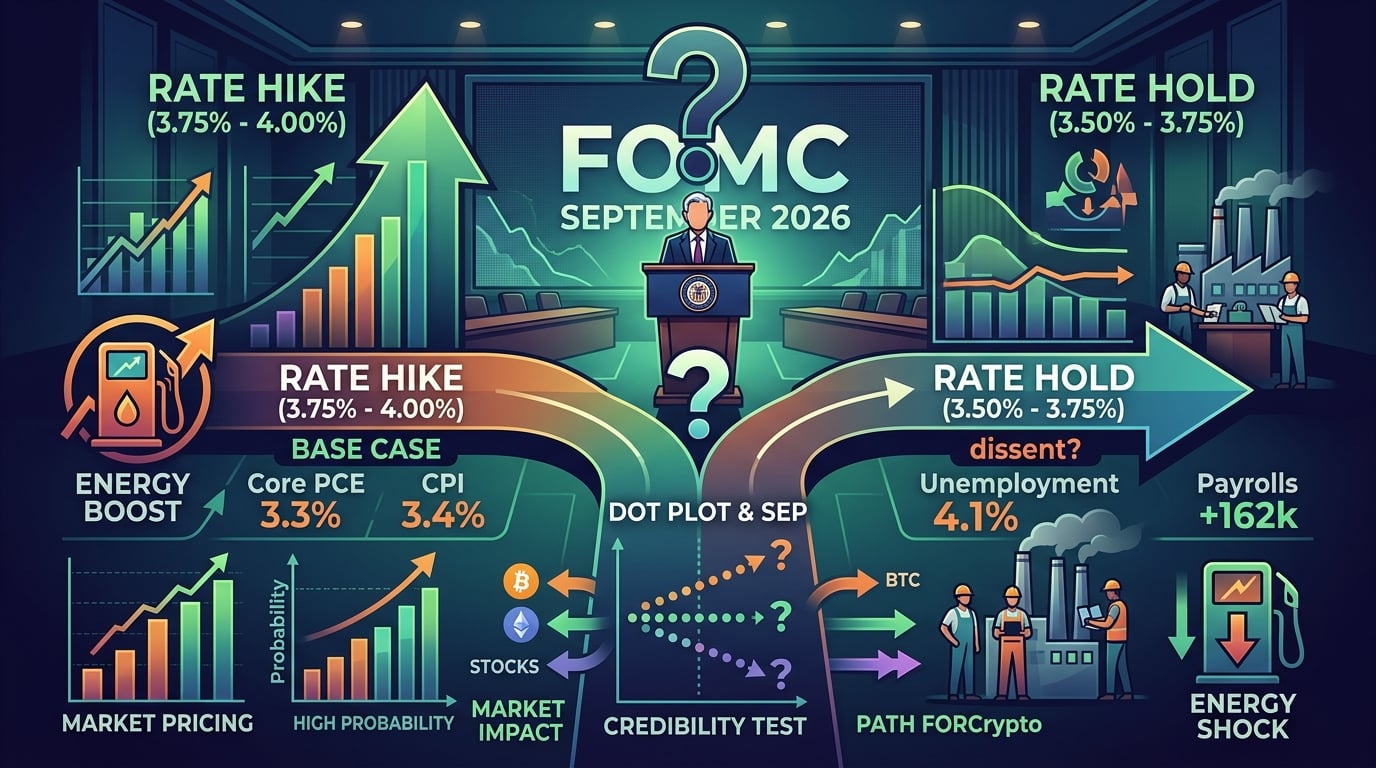
Markets are pricing a high chance that the Federal Reserve will raise rates this week — and that pricing itself is the story. The FOMC meets September 15–16, 2026, with the policy statement due at 2:00 p.m. ET on Wednesday, September 16, followed by Chair Kevin Warsh’s press conference at 2:30 p.m. ET, according to the Federal Reserve’s official calendar.
The Committee has held the federal funds target range at 3.50%–3.75% since December 2025. The latest official inflation and labor reports still leave policy in a bind: headline prices remain well above the 2% PCE goal, energy is driving much of the monthly CPI increase, and the labor market is not collapsing. A 25-basis-point hike is the market base case. A hold would not be a quiet non-event. It would force investors to decide whether the Fed is looking through a supply shock — or whether its inflation credibility is starting to slip.
What Is the September 2026 FOMC Meeting and Why Does It Matter?
The September meeting is a full projections meeting, not just a rate vote. The Committee will release a new Summary of Economic Projections and an updated dot plot alongside the statement.
That combination matters more than a single 25-basis-point move. The June 2026 SEP already raised the median 2026 PCE inflation forecast to 3.6% from 2.7% in March and lifted the median year-end funds-rate projection to 3.8% from 3.4%, according to the Federal Reserve’s June 17, 2026 Summary of Economic Projections. Nine of 18 participants penciled in at least one hike for 2026. Chair Warsh did not submit a projection at that meeting.
September is also the last SEP before the November 3 midterm elections. CME Group economic research notes that the Fed has often avoided policy changes in the weeks closest to elections, but it has acted when inflation or a crisis is the dominant constraint. The credibility question is therefore not abstract. The Committee must show that the 2% PCE target still governs the reaction function.
What Did the Latest Official Data Say About Inflation?
Official inflation data still sit above the Fed’s target, even after stripping out some of the energy noise. According to the U.S. Bureau of Labor Statistics CPI release dated September 11, 2026, the CPI-U rose 0.4% seasonally adjusted in August and 3.4% over the 12 months ending August. Core CPI, excluding food and energy, rose 0.3% on the month and 2.4% over the year.
Energy, not a broad goods boom, did most of the monthly damage. The BLS said the gasoline index rose 3.9% in August and accounted for more than one-third of the monthly all-items increase. Energy was up 16.3% over 12 months. Food rose 2.7% over the year. Shelter rose 0.3% in August after 0.1% in July.
The Fed’s preferred gauge is still hotter than CPI core. According to the U.S. Bureau of Economic Analysis Personal Income and Outlays release dated August 26, 2026, the PCE price index rose 3.7% over the 12 months ending July, and core PCE rose 3.3%. From June to July, both headline and core PCE prices increased 0.2%.
That split is the policy puzzle. Headline CPI is being lifted by energy. Core CPI is closer to target on a 12-month basis. Core PCE, the mandate measure, is not. A hike can cool demand. It cannot pump more oil. That is why the statement language on “supply shocks” and the Chair’s explanation of energy versus core will move markets as much as the rate decision itself.
How Strong Is the Labor Market Ahead of the Vote?
The labor market is stable enough that officials cannot claim they must ease to protect jobs. According to the BLS Employment Situation report for August 2026, nonfarm payrolls rose 162,000 and the unemployment rate was unchanged at 4.1%. Private payrolls rose 127,000. The labor force participation rate ticked up to 61.6%.
The 12-month hiring backdrop is weaker than the August print. BLS data show the prior 12-month average monthly gain was about 31,000. July’s gain was only 21,000. August therefore looks like a rebound, not a runaway boom.
Governor Christopher J. Waller, in a September 3, 2026 speech published by the Federal Reserve, said unemployment was 4.1% in July and described the labor market as historically tight relative to participants’ longer-run estimates, while also arguing that three-month core inflation had begun to ease from earlier 2026 highs. That is the hold case in one paragraph: inflation is too high, but the near-term impulse may be softening, and jobs are not overheating in a classic 2022-style way.
The hike case uses the same file. Payrolls just printed well above the recent average, unemployment is below the June SEP median of 4.3% for 2026, and inflation has missed the 2% PCE goal for years. If the Committee wants to show that “the Committee will deliver price stability” — the line used in recent FOMC statements — waiting for a cleaner energy fade is the riskier signal.
What Are Markets Pricing for the September Rate Decision?
Futures markets have shifted from a coin-flip to a hike-heavy distribution. According to CME FedWatch snapshots reported from CME Group tools in the days after the August CPI release, traders have priced a large majority probability of a move from 3.50%–3.75% to 3.75%–4.00% on September 16, with a cut at this meeting effectively at 0%.
The path after September is less settled. Year-end pricing has often implied one or two 25-basis-point increases rather than a full hiking cycle. That distinction is the live trade. A one-and-done insurance hike can support risk assets if the new dots do not march higher. A second and third hike priced into October and December would tighten financial conditions through the dollar, real yields, and crypto liquidity even if Wednesday’s move is only 25 basis points.
StreetStats data as of September 11, 2026 put the effective federal funds rate near 3.63% and showed futures implying a move toward about 4.1% by December. That is a tightening path, not a pause path.
Economists are less hawkish than futures. A Reuters poll conducted September 4–9 found that 65 of 93 economists still expected a hold next week, even as the share expecting at least one 2026 hike more than doubled from the prior month. Markets and models can both be wrong. The gap is the volatility source.
Did July’s 9–3 Vote Change the September Bar?
Yes. July showed the Committee is no longer unanimous, but it also showed that hawks do not yet control the vote. According to the official minutes of the July 28–29, 2026 FOMC meeting, the Committee voted 9–3 to keep the target range at 3-1/2 to 3-3/4 percent. Beth M. Hammack, Neel Kashkari, and Lorie K. Logan dissented in favor of a hike.
The statement still blamed elevated inflation “in part” on supply shocks, including energy, and repeated that the Committee will deliver price stability. It also kept the ample-reserves framework unchanged.
A second straight hold after a hawkish Jackson Hole message from Chair Warsh would widen that gap between words and deeds. A 25-basis-point hike after a 9–3 hold would look like the Committee catching up to its own inflation forecasts rather than launching a new cycle. The vote count on Wednesday will tell investors which description is true.
What Should Crypto and Risk Markets Watch After the Decision?
Crypto does not trade the federal funds rate in isolation. It trades the expected path of real yields, the dollar, and whether liquidity is getting tighter or easier over the next two meetings.
A 25-basis-point hike that is fully priced, paired with dots that stop at one 2026 increase, is the least disruptive outcome for bitcoin, ether, and major exchange tokens. Implied volatility can fall if the press conference removes the left tail of “the Fed has lost the inflation plot.”
A hold with hawkish dots can still tighten conditions. Traders would then fade the first risk-on spike and watch U.S. 10-year yields. If the long end sells off on a credibility scare, crypto often follows equities with a lag rather than decoupling.
A hike plus a higher 2026 median dot is the tightest mix. That path would align with futures that have already sketched a move toward 4% by year-end. In that case, funding costs, stablecoin treasury yields, and the opportunity cost of holding non-yielding assets all rise together.
The three tells after 2:00 p.m. ET are mechanical:
-
The 2026 median funds-rate dot versus June’s 3.8%.
-
Whether the statement still calls energy a passing supply shock.
-
The immediate reaction in the 10-year yield and the U.S. dollar index, not the first five-minute move in the S&P 500.
Beyond the Headlines: What KuCoin 5.0 Means for You
Market news moves fast — but where you act on it matters just as much. This October, KuCoin launches KuCoin 5.0, transforming KuCoin into a rebuilt platform. Here's what actually changes for you:
-
One account for everything. Older platforms split your money across separate "spot," "margin," and "futures" accounts and expected you to understand why. KuCoin 5.0's unified account removes that entirely — deposit once, and everything is simply there.
-
Stocks, indices, and commodities. KuCoin 5.0 expands beyond crypto into global markets. When crypto chops sideways and equities rally (or the reverse), you rotate in minutes instead of opening a brokerage account and waiting days for fiat rails.
-
Real-world assets (RWA). Tokenized exposure to traditional assets like commodities, right inside your crypto account. One of the fastest-growing segments in global finance is no longer reserved for institutions — you access it from the same balance you trade with.
-
Earn while you learn. Not ready to trade? KCUSD lets your stablecoins earn daily, auto-compounding interest. The lowest-stress way to put your idle deposit to work for 4% yield.
-
An AI assistant in plain language. Ask questions, get market context, understand what you're looking at — built into the platform, no jargon required.
-
An app that doesn't overwhelm. Faster, cleaner, and consistent — intuitive from the first tap, not after a tutorial.
-
Safety you can check, not just trust. A MiCAR-licensed EU entity, Proof of Reserves you can verify yourself, and internationally certified security (SOC 2 Type II, ISO 27001:2022).
Create your account in minutes — and start on the platform built for where crypto is going, not where it's been.
Conclusion
The September 15–16 FOMC meeting is a credibility test more than a 25-basis-point math problem. Official BLS data show August CPI up 0.4% on the month and 3.4% on the year, with gasoline doing a large share of the monthly work. Official BEA data show July PCE inflation at 3.7% and core PCE at 3.3%. Official BLS labor data show unemployment at 4.1% and August payrolls at 162,000. The Federal Reserve’s June SEP already moved the 2026 inflation and rate dots higher. July’s 9–3 hold showed disagreement, not a new consensus.
Markets have treated a move to 3.75%–4.00% as the likely outcome. That does not settle the trade. A priced hike with contained dots can clear risk premia. A hold that looks like a concession to politics can lift long-term yields even if the policy rate does not change. The statement, the new SEP, and Chair Warsh’s explanation of energy versus core inflation will decide which regime investors are in.
For crypto and other high-beta assets, watch the path, not the print. One insurance hike is not a cycle. A higher 2026 median dot is. Use that distinction, not the headline, when mapping the decision onto bitcoin, ether, and related markets.
FAQs
When will the September 2026 FOMC decision be released?
Wednesday, September 16, 2026, at 2:00 p.m. ET, with the Chair’s press conference at 2:30 p.m. ET, according to the Federal Reserve calendar.
What is the current federal funds target range?
3.50%–3.75%. The Committee has held that range since December 2025, including the 9–3 July decision recorded in the official minutes.
Is core inflation already back at the Fed’s target?
No. Core CPI was 2.4% year over year in August, according to the BLS, but core PCE — the Fed’s mandate measure — was 3.3% year over year in July, according to the BEA.
Would a September hike automatically mean more hikes in October and December?
No. Futures have priced additional tightening as a possibility, not a lock. The new 2026 median dot is the cleaner signal of whether officials see one move or a sequence.
How can a Fed hold hurt risk assets if lower rates are usually bullish?
If investors read a hold as a weaker inflation reaction function, long-term yields and the dollar can rise even while the funds rate stays unchanged. That mix tightens financial conditions for equities and crypto.
Disclaimer: This article is for informational purposes only and does not constitute financial, legal, or investment advice. Always conduct your own research before interacting with digital assets.