

SEC Crypto Custody Rule Heads to White House Review: What It Means for Bitcoin, Advisers, and Institutions
2026/08/27 18:28:00
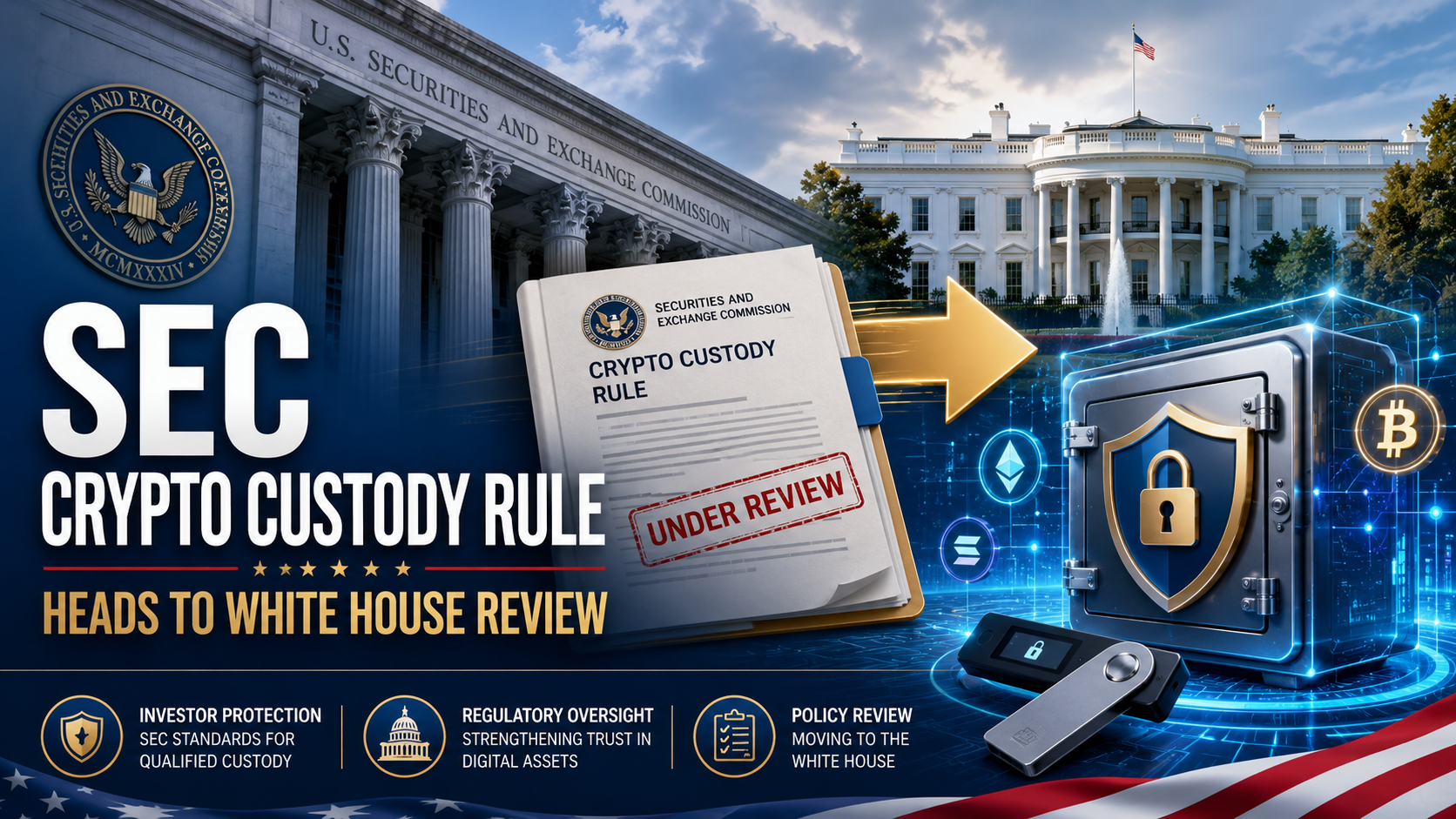
The U.S. Securities and Exchange Commission is moving toward a new framework for how regulated investment firms can safeguard crypto assets. On August 25, 2026, a proposed rule titled “Amendments to the Custody Rules” was submitted to the White House Office of Information and Regulatory Affairs, or OIRA, for review. The proposal is economically significant and remains in the proposed-rule stage, meaning no new custody requirements have taken effect yet.
The development could eventually affect registered investment advisers, regulated funds, banks, trust companies and specialized crypto custodians. It also reaches beyond Bitcoin: the SEC has identified tokenized securities and on-chain financial markets as important areas for regulatory modernization. The central issue is therefore larger than whether Wall Street can hold crypto. It is whether regulators can create a workable institutional custody system without weakening safeguards against theft, loss, misuse or insolvency.
What Did the SEC Just Send to the White House?
The proposal is officially known as Amendments to the Custody Rules, with regulatory identification number 3235-AN46. OIRA records show that the proposal was received for review on August 25 and is currently marked Pending Review. It is classified as a proposed rule and economically significant, while the SEC’s regulatory agenda also labels the initiative deregulatory.
The phrase “White House review” can be misleading. The proposal has not been personally approved by the president, nor has the SEC published a final crypto custody framework. OIRA, which sits within the Office of Management and Budget, reviews significant federal regulations before agencies move forward with publication. The SEC’s own agenda says the rulemaking is intended to modernize custody rules for investment adviser client assets and fund assets, including crypto assets, while removing burdens associated with provisions the agency believes have become outdated.
| Regulatory Stage | Current Status |
| SEC develops draft | Completed for OIRA submission |
| OIRA review | Pending |
| SEC public proposal | Not yet published |
| Public comment period | Not yet started |
| Final SEC rule | Not adopted |
| Compliance date | Unknown |
That distinction matters for investors and crypto companies. The most consequential details—such as which firms might qualify to custody crypto for advisers and what technical safeguards they would need—are still unknown because the actual proposed rule has not yet been published.
Why Does Crypto Need New Custody Rules?
Custody is relatively familiar in traditional finance. Investment assets may be held by banks, broker-dealers or other regulated financial institutions that maintain customer accounts, records and asset-segregation systems. Crypto introduces a different operational model because effective control of a digital asset is often closely tied to control of a private key.
That creates questions that traditional rules were not originally designed to answer. A regulator must consider how private keys are controlled, whether client crypto is properly segregated from the custodian’s own property, how assets are treated if the custodian fails, and whether newer technologies such as multisignature wallets or multi-party computation can satisfy legal custody requirements. Crypto transfers may also be irreversible, meaning operational failures can have different consequences than errors in conventional securities settlement.
The SEC’s current regulatory agenda acknowledges this problem directly. It says investment advisers and investment companies have raised questions about how crypto assets can be held while complying with existing custody requirements. The proposed modernization is intended to provide a clearer framework rather than forcing digital assets into rules built entirely around older market infrastructure.
What Is a Qualified Custodian?
For registered investment advisers, one of the most important concepts is the qualified custodian. Under Rule 206(4)-2 of the Investment Advisers Act, advisers with custody of client funds or securities generally must maintain those assets with an eligible institution. Existing categories include certain banks and savings associations, registered broker-dealers, futures commission merchants in specified circumstances and qualifying foreign financial institutions.
This framework works relatively naturally when an adviser is holding conventional securities in established financial accounts. Crypto raises a harder question: which institutions should satisfy the legal standard when the underlying asset is controlled through blockchain infrastructure and cryptographic keys?
That question has major commercial implications. If only a narrow group of institutions can qualify, advisers may face limited choice and higher costs. If regulators recognize a much wider group of crypto-native custodians, competition could increase—but so could concerns about whether every provider has comparable capital, cybersecurity, asset-segregation and insolvency protections. The qualified custodian definition may therefore become one of the most important parts of the eventual SEC proposal.
Why the Current Custody Rule Does Not Fit Crypto Well
The existing adviser custody framework was developed long before Bitcoin, smart contracts or tokenized securities became meaningful parts of financial markets. Its traditional focus on client funds and securities assumes infrastructure in which financial institutions, transfer agents and centralized records play a major role in establishing and protecting ownership.
Crypto changes that operational structure. A blockchain may provide the ownership record, while a custodian’s security architecture determines who can authorize a transaction. A sophisticated institution might use offline cold storage, multiple signing parties or MPC technology rather than a conventional securities account. Determining who has “possession” or “control” of the asset can therefore become technically and legally complicated.
These differences do not make custody regulation unnecessary. They make the design of the rules more difficult. The challenge for the SEC is to preserve the underlying purpose of custody regulation—preventing unauthorized access, loss and misuse—without requiring every digital asset to behave exactly like a traditional security.
How the Gensler-Era Proposal Tried to Regulate Crypto
The SEC already attempted a major custody overhaul in February 2023. The proposed Safeguarding Advisory Client Assets Rule would have expanded the scope of the existing adviser custody requirements beyond “funds or securities” to cover essentially all client assets over which an adviser had custody. That expansion would have brought a much broader range of crypto assets directly into the safeguarding framework.
The proposal also sought stronger requirements around qualified custodians, client-asset segregation and written assurances from custodians. The policy motivation was investor protection. The SEC was responding to concerns that digital assets could be lost, misappropriated or caught in bankruptcy proceedings when stored with platforms whose legal and operational arrangements did not resemble traditional regulated custody.
For the crypto industry, however, the proposal created a difficult compliance question. If many existing crypto platforms could not meet the qualified custodian standard, registered advisers might find it difficult to obtain compliant access to certain assets. The rule therefore became a major debate over how far traditional custody protections could be extended into a market built around fundamentally different technology.
Why the 2023 Crypto Custody Proposal Failed
The 2023 proposal was never finalized. Critics questioned whether its scope was too broad, whether the qualified custodian framework would be workable for crypto and whether advisers would have enough time or sufficiently competitive custody options to comply. Technical questions around private keys and asset control also made the proposal harder to apply neatly to digital assets.
The debate illustrated a central policy trade-off. A narrow list of eligible custodians may offer stronger standardization and oversight, but it can also concentrate institutional crypto custody in a small number of firms. That can reduce competition and raise costs. A broader framework may improve access, but it requires regulators to decide how much variation in institutional structure and supervisory standards is acceptable.
In June 2025, the SEC formally withdrew the Safeguarding Advisory Client Assets proposal along with several other unfinished rulemakings. The agency stated that it did not intend to finalize those proposals and would issue a new proposed rule if it chose to pursue future regulatory action.
How the New SEC Approach Could Be Different
The new initiative appears to start from a different regulatory philosophy. The SEC’s 2026 agenda classifies Amendments to the Custody Rules as deregulatory and says the agency wants to modernize the framework while removing burdens from provisions that may no longer be necessary in light of changes in markets and asset-holding practices.
That does not mean the SEC is abandoning custody protections. Chairman Paul Atkins has repeatedly framed the agency’s crypto strategy around clearer rules that encourage innovation while maintaining investor-protection guardrails. In July, he said the SEC wants to provide clarity on how market participants can custody and facilitate the trading of tokenized securities on-chain.
| Gensler-Era Proposal | Current Atkins-Era Direction |
| Broad expansion of safeguarding requirements | Modernization of existing rules |
| Strong focus on expanding asset coverage | Strong focus on crypto clarity |
| Major concerns over custodian eligibility | Potentially more flexible pathways |
| Never finalized | New proposal under OIRA review |
| Primarily framed around tighter safeguards | Also framed as reducing outdated burdens |
The eventual text will determine how significant that change really is. Until it is published, claims that the SEC has already approved self-custody models, specific crypto firms or new categories of qualified custodians would be premature.
State Trust Companies Could Become a Major Issue
One clue to the SEC’s evolving approach came in September 2025, when the Division of Investment Management issued no-action relief involving certain state-chartered trust companies. Under specified conditions, staff said it would not recommend enforcement action against registered advisers or regulated funds for treating qualifying State Trust Companies as banks for purposes of holding certain crypto assets and related cash.
The relief was important because advisers and funds had long faced uncertainty over whether state-chartered crypto trust companies could satisfy custody requirements. Commissioner Hester Peirce said the move helped bring firms out of a regulatory “gray zone” and argued that custody rules should continue to be modernized.
However, Commissioner Caroline Crenshaw criticized the decision, warning that state trust companies may not necessarily be subject to the same protections associated with federally regulated banks. Her concern highlights the central dispute likely to surround the new rule: expanding custody options may improve competition and access, but regulators must decide whether different types of institutions provide equivalent protection against theft, loss and misappropriation.
Could Coinbase and Crypto Custodians Benefit?
Large crypto custody providers could potentially benefit from clearer SEC rules, but it is too early to identify winners. The unpublished proposal has not yet established which institutional structures will qualify or what operational requirements will apply.
It is also important to distinguish between a crypto exchange and a qualified custodian. A company may be able to offer retail customers Bitcoin trading and wallet services without automatically satisfying the legal requirements for safeguarding assets belonging to clients of registered investment advisers. Institutional custody can involve additional requirements related to legal status, account segregation, internal controls, cybersecurity and recordkeeping.
If the new rule ultimately creates clearer paths for regulated crypto-native trust companies or specialized custodians, those firms could compete more directly with banks for institutional business. But the effect on any particular company will depend on the actual eligibility language in the SEC proposal.
What Could the Rule Mean for Investment Advisers?
Registered investment advisers may be among the biggest practical beneficiaries of regulatory clarity. Today, advisers considering digital assets must evaluate not only whether an investment is appropriate for a client but also whether the asset can be held in a manner consistent with federal custody requirements.
A clearer framework could reduce uncertainty over custodian eligibility, asset segregation, private-key controls and required due diligence. The 2025 State Trust Company relief already requires advisers or regulated funds relying on it to conduct due inquiry into whether the custodian is authorized to provide crypto custody and whether it maintains safeguards addressing risks such as private-key theft, loss, misuse and cybersecurity failures.
Lower regulatory uncertainty, however, should not be confused with lower investment risk. Crypto remains volatile, and advisers would still need to consider client objectives, suitability, internal policies and portfolio risk. A custody rule can make regulated access more workable without making Bitcoin or other crypto assets less volatile.
Why Tokenized Securities Make Custody Reform Bigger Than Bitcoin
The longer-term importance of the rule may extend far beyond native crypto assets. The SEC has increasingly emphasized tokenized securities—traditional financial claims represented on blockchain networks—as part of its broader modernization agenda. Atkins has specifically identified clearer rules for custody and on-chain trading of tokenized securities as a policy objective.
That matters because tokenization could eventually affect stocks, bonds, funds, private credit and other financial assets. Traditional market infrastructure relies heavily on centralized intermediaries and securities records. Tokenized finance may instead combine regulated intermediaries with blockchain settlement, smart contracts and cryptographic wallet systems.
Custody therefore becomes foundational market infrastructure. A rule designed today to clarify crypto custody could eventually help determine how a much wider range of Wall Street assets are held, transferred and protected on-chain. This makes the proposal more significant than a narrow Bitcoin regulation.
Investor Protection Is Still the Hardest Question
A more flexible custody framework offers clear potential advantages. More eligible providers could increase competition, reduce institutional costs and make it easier for advisers and funds to access crypto markets. Specialized firms may also have technical expertise in cold storage, private-key management and blockchain operations that traditional institutions are still developing.
But custody failures can be catastrophic. If private keys are lost or stolen, assets may be irrecoverable. If a custodian mixes client property with its own assets, bankruptcy can create legal uncertainty. If the same company combines trading, custody and other financial services, conflicts of interest may emerge. These risks explain why SEC officials on both sides of the crypto debate continue to focus on safeguards even when they disagree about which institutions should be permitted to provide custody.
The real regulatory question is therefore not whether crypto custody should be easier. It is what minimum protections every institutional custodian should satisfy. The credibility of the final framework will depend on how well it balances innovation with asset segregation, cybersecurity, operational resilience and clear legal treatment of customer property.
Could the Rule Boost Institutional Crypto Adoption?
Clearer custody rules could become a structural catalyst for institutional adoption. Large investment firms often need more than investment conviction before entering a market; they also need legal certainty around asset handling, compliance and operational risk. If the SEC creates a predictable custody pathway, one significant barrier to regulated crypto exposure could be reduced.
The potential transmission mechanism is straightforward: clearer standards could reduce compliance uncertainty, encourage more custody providers to compete, give advisers more confidence in their operational arrangements and make digital assets easier to integrate into regulated investment products. The same framework could support tokenized securities and other blockchain-based financial instruments.
That does not mean the rule would automatically send Bitcoin or Ether prices higher. The proposal remains unfinished, and market impact will depend on how broad the eligible custodian framework becomes, what compliance obligations remain and which assets are covered. The custody reform is better understood as potential market infrastructure than as a short-term trading catalyst.
How Does This Fit Into the SEC’s Bigger Crypto Strategy?
The custody proposal is part of a broader shift in the SEC’s approach to digital assets. Atkins has described clear rules for issuance, custody and trading as core priorities, while the agency has also pursued token classification and frameworks for bringing more crypto-related activity within formal securities regulation.
This represents a move toward formal rulemaking rather than relying primarily on enforcement actions to establish regulatory boundaries after market participants have already acted. For institutions, that difference can be important. Strict but predictable rules can often be easier to build around than uncertainty over how existing law might later be interpreted.
The emerging policy direction should not be mistaken for an absence of regulation. The SEC continues to emphasize investor protection and enforcement against misconduct. The larger change is that digital assets are increasingly being treated as a market structure problem that needs explicit rules.
What Happens After the White House Review?
OIRA review is only one step in a longer process. Once the review is completed, the SEC could move toward formally publishing a Notice of Proposed Rulemaking. That proposal would reveal the actual custody standards and give the public, financial institutions, crypto firms, advisers and investor groups an opportunity to submit comments.
The SEC could then revise the proposal based on those comments before considering a final rule. Depending on the regulatory process, later versions may also undergo additional review. Only after a final rule is adopted would the industry receive a definitive compliance framework and implementation schedule.
The SEC’s current agenda targets October 2026 for a Notice of Proposed Rulemaking, but the same official agenda states that there is no legal deadline. The October date should therefore be treated as a regulatory target rather than a guaranteed publication date.
What Should the Crypto Industry Watch Next?
The eventual definition of eligible custodians will be the most important detail. Markets will want to know whether the SEC gives state trust companies a clearer permanent role, whether specialized crypto institutions gain new pathways and how traditional banks fit into the framework.
Technical requirements will matter just as much. Rules addressing private-key management, MPC, multisignature arrangements, cybersecurity, asset segregation and bankruptcy protection could determine whether the proposal is truly workable for blockchain-based assets. The industry will also watch whether the framework applies differently to native crypto assets and tokenized securities.
The headline “White House review” is therefore only the beginning. The real impact will become visible when the SEC publishes the text and market participants can see exactly how the agency defines custody, control and investor protection.
Is the SEC Becoming More Crypto-Friendly?
The SEC’s current direction is clearly more open to incorporating crypto into regulated financial markets than the approach reflected in the abandoned 2023 custody proposal. The new rulemaking is officially classified as deregulatory, the agency has provided limited relief for certain state trust companies, and Atkins has repeatedly emphasized clearer rules for crypto custody and tokenized securities.
That does not mean crypto custody will become unregulated. The most important parts of the final proposal are likely to concern exactly how custodians protect assets, manage private keys, segregate client property and demonstrate that advisers can rely on them safely.
The broader shift is therefore better described as a movement from regulatory uncertainty toward regulated integration. Whether that approach succeeds will depend on whether the SEC can make institutional crypto custody practical without undermining the protections that custody rules were designed to provide.
Conclusion
The SEC’s decision to send its new Amendments to the Custody Rules proposal to OIRA marks an important step in the evolution of U.S. crypto regulation. The proposal remains under review, has not been published for public comment and is far from becoming an effective final rule.
Its potential significance, however, is substantial. Clearer standards could help investment advisers and regulated funds understand who can safeguard digital assets, how those assets must be protected and how crypto can fit into existing financial regulation. The same framework could eventually become important for tokenized stocks, bonds and other on-chain securities.
The central challenge will be balancing institutional access with investor protection. A successful rule will not be measured simply by how “crypto-friendly” it appears. It will be measured by whether it creates a custody framework that banks, advisers, funds and digital-asset firms can actually use while keeping client assets protected from theft, misuse and institutional failure.
FAQs
Does the SEC custody rule apply to individual crypto holders?
The rulemaking is focused on custody requirements involving registered investment advisers and regulated funds rather than ordinary individuals holding crypto in their own personal wallets. Retail users managing assets directly are operating in a different legal context from an adviser safeguarding assets on behalf of clients.
Can investors still self-custody Bitcoin?
Individual investors can generally hold Bitcoin through wallets they control themselves, subject to applicable law. Institutional advisers face different regulatory obligations because they may be exercising custody over assets belonging to clients. The SEC proposal is aimed primarily at that regulated relationship rather than banning personal self-custody.
What is the difference between crypto custody and a crypto wallet?
A crypto wallet is a technical system for managing cryptographic credentials and authorizing blockchain transactions. Custody is a broader legal and operational concept involving who controls the assets, who owes duties to the owner, how assets are safeguarded and what happens if the service provider fails.
What is cold storage in institutional crypto custody?
Cold storage generally refers to keeping private-key material in systems that are isolated from continuously connected online environments. Institutions often use it to reduce exposure to remote cyberattacks, although cold storage still requires strong procedures for access control, backups, transaction authorization and recovery.
What is MPC custody?
Multi-Party Computation, or MPC, allows several parties or systems to participate in generating a valid transaction authorization without one party necessarily holding a complete private key in a single location. It can reduce certain single-point-of-failure risks, but whether a particular MPC structure satisfies regulatory custody requirements depends on the legal framework and operational controls.
Does FDIC insurance protect crypto held by custodians?
FDIC deposit insurance generally protects qualifying bank deposits within applicable limits; it does not automatically insure the market value of Bitcoin or other crypto assets simply because they are held by a bank or custodian. Investors should distinguish between insured cash deposits and digital assets held in custody.
Can a crypto custodian use client assets for staking?
That depends on the custodian agreement, the asset, the structure of the staking service and applicable regulation. Staking can introduce additional operational, liquidity and legal risks, so an institutional custodian cannot assume that custody authority automatically permits every form of asset deployment. Future SEC rules may provide additional clarity on how such activities interact with custody obligations.
🔥 KuCoin Offers A More Stable Option in A Volatile Market
If you worry about the frequent ups and downs in the market, and pursue a more stable option to earn money passively, KuCoin is the right place to come:

Simple Earn: Deposit and withdraw tokens anytime, earning stable returns.
Kucoin Earn: Earn stable profits with professional asset management.
Hold to Earn: Earn rewards by holding assets in Funding, Trading, Margin, Futures, Mining, and Unified Accounts.
Staking: Unlock the earning potential of on-chain assets.
Advanced Investments: Advanced Investments offer a variety of structured products to help your money grow in any market.
Shark Fin: Principal Protection and Guaranteed Gains
Dual Investment: Buy low and sell high with transparent return calculations.
Snowball: High yields, with price protection.
Discount Buy: Buy crypto at discount prices.
KCS Loyalty: Level up to enjoy exclusive perks by staking ≥ 1 KCS.
KuCoin Wealth: Discover future value and begin your smart investing journey.
KCS Benefits: Hold and stake KCS to access benefits across the platform.
KCS Staking 2.0: Participate in KCS on-chain governance to earn yield.
Disclaimer: This content is for informational purposes only and does not constitute investment advice. Cryptocurrency investments carry risk. Please do your own research (DYOR).