

Russia Starts Paying Government Salaries in Digital Rubles: Everything You Need to Know
Introduction
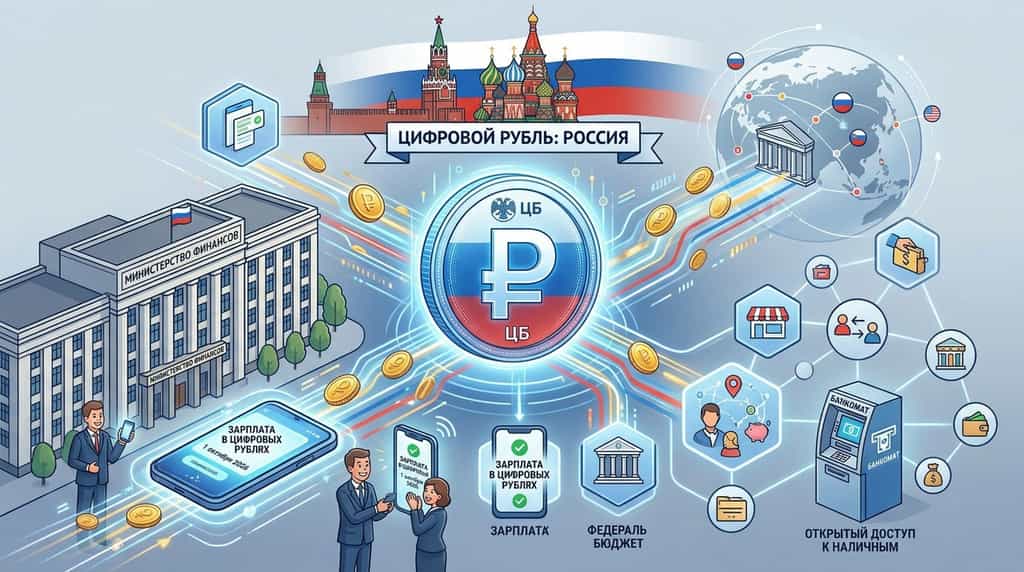
Russia has officially entered a new phase of its Central Bank Digital Currency (CBDC) adoption, as government employees in the Ministry of Finance began receiving salaries in digital rubles on October 1, 2026. According to official disclosures from the Ministry of Finance of the Russian Federation, participation remains voluntary, requiring employees to open individual digital wallets directly on the Bank of Russia’s proprietary platform. This step follows initial pilot testing conducted throughout 2025 by the Ministry of Finance and the Federal Treasury, which processed nearly 16 million rubles in experimental payments—including government contract settlements, public worker wages, and student stipends. As Russia shifts from small-scale sandbox testing to institutional integration, the wider implementation of the digital ruble marks a significant transition in sovereign monetary infrastructure.
What Is the Digital Ruble and How Does Russia's CBDC Platform Work?
The digital ruble represents the third official form of Russia's national currency, existing alongside physical cash and electronic bank deposits as a unique digital token issued directly by the Bank of Russia. According to public specifications from the Central Bank of the Russian Federation (CBR), the digital ruble functions on a specialized hybrid platform managed exclusively by the monetary authority. Unlike commercial bank deposits held in private financial institutions, digital ruble funds reside in sovereign digital wallets hosted on the central bank's infrastructure.
Commercial banks act strictly as financial intermediaries rather than liability holders. Citizens access their digital wallets using existing mobile applications provided by their primary commercial banks; however, the actual assets remain directly on the Central Bank's ledger. This structure eliminates third-party commercial credit risk while ensuring instantaneous settlement for peer-to-peer transfers, retail purchases, and public administration payments across the domestic economy.
Why Is the Russian Government Paying Civil Servants in CBDCs?
The decision to disburse state salaries via the digital ruble serves as an operational strategy to test real-world transaction velocity and build public trust in state-issued digital assets. According to statements from the Ministry of Finance, introducing the CBDC to Ministry of Finance staff establishes a direct showcase for government employees to evaluate the national digital currency's security, accessibility, and speed.
By utilizing public sector payrolls, the Russian government generates controlled, recurring transaction volume within the Central Bank's platform. This real-world usage allows system engineers to monitor network scalability, transaction throughput, and user experience ahead of a broader consumer rollout. Furthermore, paying state workers in CBDCs establishes a blueprint for future public sector disbursements, including social welfare payments, pensions, and public procurement contracts.
How Does the Digital Ruble Rollout Impact Russia's Banking Infrastructure?
The nationwide integration of the digital ruble imposes strict compliance mandates on Russia's top-tier financial institutions and major commercial retailers. According to regulations established by the Bank of Russia, major banks and large retail businesses were legally required to open their technical infrastructure to support digital ruble transfers and retail payments starting September 1, 2026.
This infrastructure mandate ensures that citizens who receive salaries in digital rubles can spend their funds seamlessly across consumer outlets. Additionally, federal budget institutions, autonomous agencies, and public corporations can execute budget expenditures in digital rubles without arbitrary limits. To further encourage adoption, the Central Bank has mandated zero transaction fees for peer-to-peer (P2P) transfers between individuals, while capping commercial transaction fees at 0.3%—significantly lower than standard merchant acquiring rates offered by traditional payment networks.
What Are the Key Regulatory and Consumer Features of the Digital Ruble?
The regulatory framework governing Russia's digital ruble balances state control with consumer convenience, ensuring the digital currency fits into existing financial habits. According to public statements from Central Bank Deputy Governor Zulfiya Kakhrumanova, the monetary authority is preparing functionality that allows citizens to withdraw physical cash directly from standard ATMs using their digital ruble wallets.
President Vladimir Putin recently directed the Ministry of Finance and the Bank of Russia to expand public information campaigns outlining the specific benefits of the digital ruble. Crucially, participation remains voluntary: no civil servant or private citizen can be forced to receive wages or process payments in CBDCs. Users retain total autonomy to convert their digital rubles into physical cash or traditional commercial bank deposits at a 1:1 parity at any time without incurring conversion penalties.
How Does Russia's CBDC Compare to Global Digital Currency Initiatives?
Russia's accelerated deployment of the digital ruble aligns with a growing global trend toward central bank digital currencies aimed at modernizing payment rails and enhancing sovereign monetary control. According to tracking data from the Atlantic Council's Geoeconomics Center, over 130 countries—representing 98% of global Gross Domestic Product (GDP)—are actively exploring or deploying CBDCs.
Russia's focus on integrating CBDC payments into government payrolls closely parallels China's ongoing pilot of the digital yuan (e-CNY), where several municipal governments pay public servants using digital currency. However, Russia's effort is distinct due to its focus on bypassing international financial messaging systems and reducing dependence on foreign clearing mechanisms amid international economic sanctions.
What Are the Key Advantages and Risks of Using Digital Rubles?
The adoption of the digital ruble offers structural financial efficiencies alongside potential privacy and centralization challenges for end users.
Operational Advantages
-
Instantaneous Settlement: Transactions execute in real time directly on the Central Bank's ledger, bypassing private clearing houses.
-
Zero Transfer Fees: Individuals send funds to other users across Russia completely free of charge.
-
Enhanced Security: Direct central bank backing eliminates commercial bank bankruptcy risks for stored balances.
-
Targeted Government Spending: Smart contract capabilities allow state agencies to track budget allocations and prevent fund diversion.
Potential Risks and Limitations
-
Centralization & Privacy Concerns: The Bank of Russia maintains full visibility over all transactions, raising personal financial privacy considerations.
-
Bank Disintermediation: A shift of commercial deposits to sovereign digital wallets could reduce liquidity within the commercial banking sector.
-
No Interest Yield: Digital ruble accounts do not accrue interest or yields, making them unsuitable for long-term savings compared to traditional savings deposits.
How Does CBDC Adoption Impact Crypto Trading and Digital Assets?
The rapid expansion of sovereign CBDCs fundamentally reshapes how retail users and institutional participants interact with non-state cryptocurrencies such as Bitcoin (BTC) and Tether (USDT). While CBDCs offer digital efficiency for domestic settlements, they remain centralized fiat assets subject to governmental oversight, supply controls, and capital restrictions.
As central banks push digital monetary infrastructure into mainstream daily use, broader public familiarity with digital wallets, private keys, and mobile token transfers increases significantly. For crypto traders, CBDCs highlight the stark contrast between state-controlled digital fiat—which offers no yield and full government surveillance—and permissionless decentralized crypto assets available on global exchanges like KuCoin. Investors seeking inflation hedges, high-yield staking opportunities, or privacy-focused transactions continue to turn to open public blockchains.
Beyond the Headlines: What KuCoin 5.0 Means for You
Market news moves fast — but where you act on it matters just as much. This October, KuCoin launches KuCoin 5.0, transforming KuCoin into a rebuilt platform. Here's what actually changes for you:
-
One account for everything. Older platforms split your money across separate "spot," "margin," and "futures" accounts and expected you to understand why. KuCoin 5.0's unified account removes that entirely — deposit once, and everything is simply there (only available to VIPs for now).
-
Stocks, indices, and commodities. KuCoin 5.0 expands beyond crypto into global markets. When crypto chops sideways and equities rally (or the reverse), you rotate in minutes instead of opening a brokerage account and waiting days for fiat rails.
-
Real-world assets (RWA). Tokenized exposure to traditional assets like commodities, right inside your crypto account. One of the fastest-growing segments in global finance is no longer reserved for institutions — you access it from the same balance you trade with.
-
Earn while you learn. Not ready to trade? KCUSD lets your stablecoins earn daily, auto-compounding interest. The lowest-stress way to put your idle deposit to work for 4% yield.
-
An AI assistant in plain language. Ask questions, get market context, understand what you're looking at — built into the platform, no jargon required.
-
An app that doesn't overwhelm. Faster, cleaner, and consistent — intuitive from the first tap, not after a tutorial.
-
Safety you can check, not just trust. A MiCAR-licensed EU entity, Proof of Reserves you can verify yourself, and internationally certified security (SOC 2 Type II, ISO 27001:2022).
Create your account in minutes — and start on the platform built for where crypto is going, not where it's been.
Conclusion
The initiation of salary payments in digital rubles to Russian Ministry of Finance employees represents a pivotal milestone in national CBDC deployment. Moving beyond the 16 million ruble experimental pilots of 2025, Russia has successfully established mandatory retail banking infrastructure, budget payment capabilities, and planned ATM cash access to support its third currency format. While voluntary participation, fee-free transfers, and direct central bank safety offer practical benefits to civil servants, the digital ruble remains a centralized, non-yield-bearing state payment instrument. As sovereign nations continue digitizing their financial systems, global investors increasingly rely on platforms like KuCoin to access decentralized cryptocurrencies, secure stablecoins, and non-custodial digital wealth opportunities.
Frequently Asked Questions (FAQs)
Is receiving a salary in digital rubles mandatory for Russian government workers?
No, receiving a salary in digital rubles is entirely voluntary for civil servants and government workers. Employees must choose to open a digital ruble wallet on the Bank of Russia’s platform to participate, and they retain the right to continue receiving wages in standard bank deposits or physical cash.
Can digital rubles be converted directly into physical cash?
Yes, digital rubles can be converted into physical cash at a 1:1 exchange rate without conversion fees. The Central Bank of the Russian Federation is actively developing functionality to enable direct cash withdrawals from standard commercial ATMs via digital wallets.
Do digital ruble wallets pay interest on stored balances?
No, digital ruble wallets held on the Bank of Russia platform do not earn interest, yields, or promotional cashbacks. The digital ruble is designed strictly as a secure payment medium and transaction settlement unit rather than a wealth storage or interest-bearing deposit vehicle.
How much did Russia process in pilot digital ruble payments prior to 2026?
According to official figures from the Ministry of Finance, the pilot testing phase conducted throughout 2025 processed approximately 16 million rubles in total transaction volume across public worker salaries, student stipends, and government procurement contracts.
What is the main difference between the digital ruble and decentralized cryptocurrencies?
The digital ruble is a centralized digital fiat currency issued, managed, and backed directly by the Bank of Russia with a fixed 1:1 value against physical rubles. Decentralized cryptocurrencies operate on public, permissionless blockchains without central authority control, offering market-driven valuation, global accessibility, and privacy.
Disclaimer
This article is for informational purposes only and does not constitute financial, legal, or investment advice. Always conduct your own research before interacting with digital assets or financial payment platforms.