

OpenAI Q2 Revenue Growth Disappoints Investors, Sparking Broad Sell-Off Across AI-Related Stocks
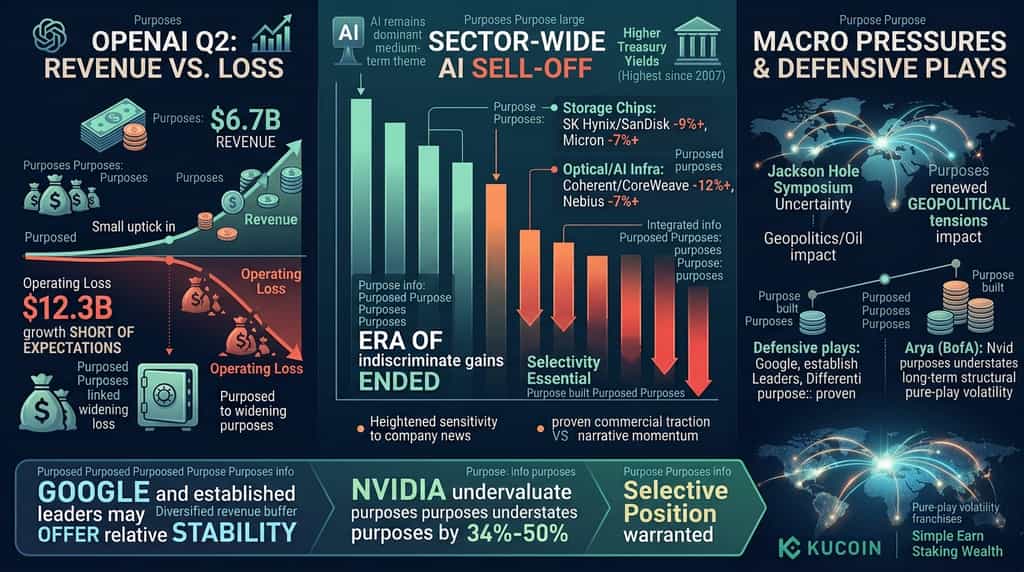
OpenAI’s second-quarter revenue rose 18% sequentially to $6.7 billion from $5.7 billion in the first quarter, yet the figure still fell short of elevated investor expectations tied to its lofty valuation and IPO pathway. Operating losses widened more sharply, climbing from $9.3 billion to $12.3 billion and outpacing revenue growth, largely due to stock-based compensation.
The disclosure triggered an immediate and sweeping sell-off across AI-linked equities. Storage-chip makers SanDisk and SK Hynix dropped more than 9%, Micron fell over 7%, while optical and AI-infrastructure names Coherent and CoreWeave plunged more than 12% and Nebius declined over 7%. Nearly every stock connected to the AI narrative shared the same fate.
Higher U.S. Treasury yields—30-year yields reaching approximately 5.3%, the highest since 2007—added pressure by raising the cost of capital for capital-intensive AI research and development. Market uncertainty ahead of the Jackson Hole symposium and renewed geopolitical tensions further amplified risk aversion.
Although AI remains a dominant medium-term theme for U.S. equities, the era of indiscriminate gains has clearly ended. Storage chips and optical modules now exhibit heightened sensitivity to company-specific news. Investors seeking greater stability may prefer established leaders such as Google, while Bank of America analyst Vivek Arya argues that Nvidia’s current valuation understates its long-term potential by 34% to 50%.
OpenAI’s sequential revenue increase of 18% delivered nearly $7 billion in a single quarter—an impressive absolute scale for any private company—yet it proved insufficient against the growth trajectory implied by its valuation and pre-IPO financing plans.
Investors had priced in faster acceleration. The simultaneous expansion of operating losses to $12.3 billion, driven in part by equity incentives, signaled that the path to sustainable profitability remains longer than previously anticipated. This combination of slower-than-hoped revenue growth and widening losses prompted an immediate reassessment of OpenAI’s financial trajectory ahead of any public listing.
The market reaction was swift and indiscriminate. Shares of memory-chip producers SanDisk and SK Hynix each declined more than 9%, Micron dropped over 7%, Coherent and CoreWeave each fell more than 12%, and Nebius lost more than 7%. Virtually every company with meaningful exposure to AI infrastructure, compute, storage, or optical networking experienced sharp losses.
Traders interpreted the OpenAI figures as evidence that even the sector’s most prominent private player faces execution and profitability challenges. The sell-off reflected a rapid shift from optimism about unlimited AI demand toward greater scrutiny of capital intensity and near-term returns.
Rising long-term U.S. Treasury yields compounded the company-specific disappointment. The 30-year yield climbed to around 5.3%, the highest level since 2007. Higher benchmark rates increase the cost of debt financing that many AI companies rely on to fund research, data-center construction, and chip procurement.
Additional uncertainty stemmed from the Jackson Hole central-bank gathering—the first under the new Federal Reserve Chair—and from geopolitical developments that lifted oil prices and inflation expectations. Together these factors encouraged investors to reduce exposure to high-growth, high-valuation AI names.
While the AI narrative continues to dominate medium-term equity themes, the period in which almost any AI-related stock rose indiscriminately has passed. Storage chips and optical-module suppliers, in particular, now display greater sensitivity to individual company announcements and shifts in investor risk appetite.
Selectivity has become essential. Investors are differentiating between companies with proven commercial traction and those still primarily benefiting from narrative momentum.
Established technology giants such as Google offer more stable exposure to AI demand. Their diversified revenue streams, strong balance sheets, and existing cloud and advertising businesses provide a buffer against pure-play volatility. Following the approach of long-term investors who favor proven franchises can reduce portfolio drawdowns during periods of sector rotation.
Bank of America analyst Vivek Arya maintains that the market has overpriced near-term risks to the AI investment cycle. He estimates Nvidia’s valuation may be undervalued by 34% to 50%. Arya reaffirmed a Buy rating and a $350 price target, citing Nvidia’s central role in AI compute infrastructure, its GPU and software ecosystem advantages, and its partnerships with major cloud providers.
Despite broader AI-stock weakness driven by concerns over infrastructure spending slowdowns, commercialization timelines, and elevated valuations, Arya argues these fears obscure Nvidia’s longer-term growth potential.
If you worry about the frequent ups and downs in the market, and pursue a more stable option to earn money passively, KuCoin is the right place to come:
-
Simple Earn: Deposit and withdraw tokens anytime, earning stable returns.
-
Kucoin Earn: Earn stable profits with professional asset management.
-
Hold to Earn: Earn rewards by holding assets in Funding, Trading, Margin, Futures, Mining, and Unified Accounts.
-
Staking: Unlock the earning potential of on-chain assets.
-
Advanced Investments: Advanced Investments offer a variety of structured products to help your money grow in any market.
-
Shark Fin: Principal Protection and Guaranteed Gains
-
Dual Investment: Buy low and sell high with transparent return calculations.
-
Snowball: High yields, with price protection.
-
Discount Buy: Buy crypto at discount prices.
-
KCS Loyalty: Level up to enjoy exclusive perks by staking ≥ 1 KCS.
-
KuCoin Wealth: Discover future value and begin your smart investing journey.
-
KCS Benefits: Hold and stake KCS to access benefits across the platform.
-
KCS Staking 2.0: Participate in KCS on-chain governance to earn yield.

OpenAI’s second-quarter revenue of $6.7 billion represented solid sequential growth yet disappointed investors focused on the company’s valuation and IPO timeline. Widening operating losses to $12.3 billion further highlighted the capital intensity of frontier AI development. The disclosure, combined with rising long-term Treasury yields and macro uncertainty, produced a broad sell-off across storage chips, optical components, and AI infrastructure stocks.
The indiscriminate gains phase of the AI trade has given way to greater selectivity. Storage and optical names remain particularly vulnerable to news flow, while established platforms such as Google may offer relative stability. Bank of America’s analysis suggests Nvidia’s current pricing may still understate its structural advantages. Overall, AI remains a core equity theme, but success now depends more on careful stock selection and risk management than on simple thematic exposure.
FAQs
What was OpenAI’s exact Q2 revenue figure?
OpenAI reported second-quarter revenue of $6.7 billion, an 18% sequential increase from $5.7 billion in the first quarter.
Why did operating losses expand faster than revenue?
The larger losses reflected higher operating costs, including significant stock-based compensation expenses that pushed the quarterly operating loss to $12.3 billion.
Which AI-related stocks fell the most after the OpenAI update?
Coherent and CoreWeave each declined more than 12%, SanDisk and SK Hynix dropped over 9%, Micron fell more than 7%, and Nebius declined over 7%.
How do higher Treasury yields affect AI companies?
Elevated long-term rates raise the cost of borrowing that many AI firms use to finance data centers, research, and chip purchases, increasing pressure on capital-intensive business models.
Disclaimer: This content is for informational purposes only and does not constitute investment advice. Cryptocurrency investments carry risk. Please do your own research (DYOR).