

MemeBitcoin Raises $8M to Race Quantum Computers Toward Satoshi’s Bitcoin Wallet
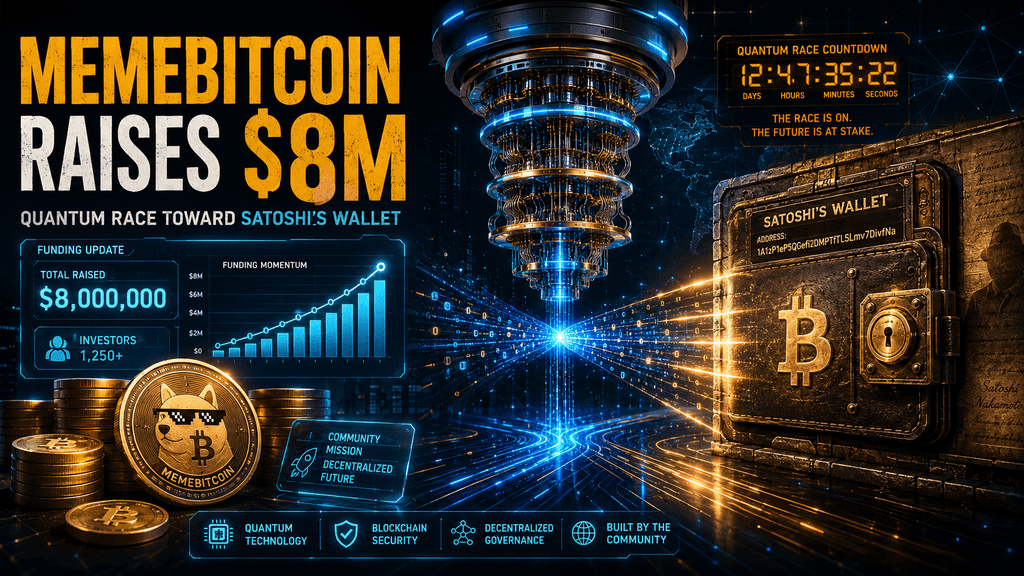
MemeBitcoin has raised $8 million for one of the more unusual crypto narratives of 2026: turning the future quantum-computing threat to early Bitcoin wallets into a community-driven race centered on Satoshi Nakamoto’s dormant coins.
The strategic round, announced on September 1, was backed by Gemhead Capital, Archer Capital, M2M Capital and Mayer Venture. MemeBitcoin says the capital will support its public launch, global community expansion and preparations for future exchange listings. DefiLlama independently lists the transaction as an $8 million strategic funding round in the meme category.
What makes MemeBitcoin different from a conventional meme coin, however, is the story behind its MBTC token. The project encourages users to participate in what it describes as a public race toward Satoshi-era Bitcoin wallets before future quantum computers become powerful enough to threaten vulnerable cryptographic keys. That premise touches a real debate inside Bitcoin—but it is important to separate the long-term quantum-security problem from the idea that Satoshi’s wallet is close to being cracked today.
What Is MemeBitcoin and Why Did It Raise $8 Million?
MemeBitcoin, or MBTC, describes itself as a Bitcoin-native meme project built around the idea of making Bitcoin’s future quantum-security problem accessible to ordinary crypto users. Despite the branding, MBTC runs on BNB Smart Chain rather than the Bitcoin base layer. The project reports a total token supply of 210 billion MBTC, exactly 10,000 times Bitcoin’s 21 million maximum supply, and uses a 10-minute emission schedule with reward halvings every four months as an intentional reference to Bitcoin’s monetary design.
The September financing is a strategic equity or project funding round rather than an $8 million MBTC token presale. According to the project announcement, the money will finance whitelist access, a wider public launch, community and influencer campaigns, and preparation for centralized-exchange spot and futures listings. MemeBitcoin also says no tokens were pre-allocated to the team and that distribution is tied to participation in its ecosystem. Because several of these details come from company-supplied promotional material, they should be treated as project claims rather than independently audited operational metrics.
The funding matters because it gives MemeBitcoin more resources to scale a narrative that combines three of crypto’s strongest themes: Bitcoin, Satoshi Nakamoto and quantum computing. The size of the round does not validate the project’s technical ability to reach Satoshi’s private keys, but it does show that investors are willing to back a product built around one of Bitcoin’s most difficult long-term security questions.
What Is the Race Toward Satoshi’s Bitcoin Wallet?
MemeBitcoin’s main product concept is a gamified public effort built around Satoshi-era Bitcoin. Through its web application, users participate in missions, generate and test candidate keys, share content and accumulate records of participation. The project says these activities have produced more than 2.4 million “wallet decryption attempts” and that it had 23,700 registered users and 18,350 daily active users by late August 2026. Those figures were reported by MemeBitcoin itself and have not been independently verified.
The project frames its mission in two ways. First, it wants the public attention created by the campaign to increase pressure on the Bitcoin ecosystem to take quantum migration seriously. Second, if Satoshi-era coins are never moved to safer cryptographic structures, MemeBitcoin presents its community as participating in a race to reach those wallets before future quantum hardware does. The second part is deliberately provocative and raises obvious legal, ethical and property-right questions if it were ever technically feasible.
For now, however, the activity is better understood as a gamified representation of an enormous cryptographic search problem rather than a realistic path to recovering Satoshi’s coins. The more important question is why the threat from quantum computing has become credible enough that such a narrative can attract both users and millions of dollars in funding.
Can MemeBitcoin Actually Crack Satoshi’s Wallet Today?
No. Nothing in MemeBitcoin’s disclosed activity suggests that conventional computing is approaching a practical method for recovering Satoshi Nakamoto’s Bitcoin private keys.
Bitcoin private keys exist within an extraordinarily large cryptographic search space. Millions—or even billions—of random attempts are negligible compared with the number of potential keys. As a result, MemeBitcoin’s reported 2.4 million attempts should not be interpreted as measurable progress toward discovering a valid Satoshi key. The project itself may use the number as a participation metric, but it does not mean Satoshi’s wallet is 2.4 million steps closer to being opened.
The reason quantum computing changes the discussion is that the threat does not rely on simply guessing every possible private key one by one. A sufficiently powerful cryptographically relevant quantum computer could theoretically use algorithms such as Shor’s algorithm against the mathematical relationship between a public key and its corresponding private key. That is a fundamentally different problem from conventional brute-force guessing—and the reason Bitcoin developers and cryptographers are now discussing migration long before such hardware exists.
Why Is Quantum Computing a Real Bitcoin Debate Now?
Bitcoin’s ownership system relies heavily on elliptic-curve cryptography. Under today’s classical computing assumptions, deriving a private key from a public key is considered computationally infeasible. A sufficiently capable quantum computer could change that assumption for outputs whose public keys are already visible on-chain.
This does not mean all Bitcoin would suddenly become vulnerable at the same time. The current debate focuses especially on coins associated with already exposed public keys, including early Pay-to-Public-Key outputs and other outputs whose keys have been revealed through spending or specific script structures. BIP 361, a draft proposal focused on post-quantum migration, states that as of March 1, 2026, more than 34% of Bitcoin had revealed a public key on-chain and could therefore face a future threat from a sufficiently powerful quantum computer.
Other industry estimates place the amount potentially exposed under different assumptions at several million BTC. CoinDesk reported in April that approximately 6.9 million BTC could fall into categories exposed to future quantum attacks, while a Coinbase-convened group of cryptographers later stressed that quantum computers are not currently a threat to Bitcoin but that technical preparation should begin now.
That distinction is essential: the quantum threat is a legitimate long-term security issue, not evidence that Bitcoin’s cryptography is broken today.
Why Satoshi’s Coins Are the Hardest Part of the Quantum Problem
Active Bitcoin users have an obvious theoretical response to a future cryptographic transition: move their BTC into outputs protected by quantum-resistant signatures once the Bitcoin network and wallets support them.
Satoshi-era coins are more complicated. If Satoshi Nakamoto is no longer alive, has lost access to the keys or simply chooses never to move the coins, those outputs cannot voluntarily migrate. The same problem applies to permanently lost Bitcoin and other dormant early holdings. These coins could remain sitting in structures that become vulnerable if cryptographically relevant quantum computing eventually arrives.
That creates a governance dilemma. Should Bitcoin continue allowing those coins to be spent under legacy rules, even if a future quantum attacker may be able to forge ownership? Or should the network eventually restrict vulnerable legacy spending, potentially making legitimately owned but unmigrated Bitcoin inaccessible? A Coinbase-convened panel of cryptographers acknowledged the problem in June but did not agree on whether vulnerable coins such as those associated with Satoshi should eventually be frozen or otherwise constrained.
This is where MemeBitcoin’s marketing narrative connects to a genuine Bitcoin policy debate. The problem is real; the project’s proposed public “race” is simply not the protocol-level solution to it.
How Bitcoin Is Preparing for a Post-Quantum Future
Bitcoin developers and researchers are exploring technical approaches that look very different from MemeBitcoin’s gamified key-search model. The actual challenge is to introduce cryptographic tools that remain secure against quantum attacks while giving users, exchanges, wallets, custodians and miners enough time to migrate.
One of the clearest examples is BIP 361: Post Quantum Migration and Legacy Signature Sunset. The proposal is currently in draft status and has not been adopted into Bitcoin. It imagines a phased transition after a post-quantum output type becomes available. Under the proposal, the network would first stop allowing new funds to be sent to quantum-vulnerable address types, then later place tighter restrictions on legacy ECDSA and Schnorr spending.
Another draft, BIP 360, proposes Pay-to-Merkle-Root, or P2MR, as an output structure designed partly to reduce exposure to long-range quantum attacks and make future integration of post-quantum signatures easier. It does not by itself make Bitcoin fully quantum-resistant, but it shows that the technical community is already thinking about migration architecture rather than waiting for a crisis.
This is the key distinction for readers evaluating MemeBitcoin: MBTC is not a post-quantum security upgrade to Bitcoin. Bitcoin’s actual defense will require cryptography, protocol changes, wallet migration and network-wide coordination.
What Is MBTC and How Does Proof of Viral Work?
MemeBitcoin’s token design borrows heavily from Bitcoin symbolism. Its white paper specifies a total supply of 210 billion MBTC, a 10-minute issuance rhythm and halvings every four months. The document presents these choices as deliberate references to Bitcoin’s 21 million supply, roughly 10-minute block interval and four-year halving schedule.
Its more unusual concept is Proof of Viral, or PoV. MemeBitcoin’s white paper describes viral activity—such as spreading memes, stories and Bitcoin-related ideas—as a form of “memetic work.” Participation and community propagation are used as part of the project’s distribution and consensus narrative. The project announcement says its upcoming full platform will activate Proof of Viral alongside forums, wallet connectivity and broader participation features.
It is important not to equate this directly with Bitcoin’s Proof of Work. Bitcoin’s PoW is a battle-tested consensus and network-security mechanism that determines block production and protects transaction history through computational cost. Proof of Viral is an experimental mechanism created by MemeBitcoin around community behavior and token distribution. The similarity in language is part of the project’s branding, not evidence that PoV provides the same security guarantees as Bitcoin mining.
Why Did Investors Back the MemeBitcoin Narrative?
The strongest explanation may be that MemeBitcoin combines several highly marketable crypto narratives into a single product.
Memecoins already demonstrate how culture and online communities can create liquidity, attention and token demand without traditional cash-flow models. Bitcoin provides the strongest brand in digital assets. Satoshi Nakamoto remains crypto’s most recognizable mystery. Quantum computing adds an emerging technological threat that has moved from niche cryptography discussions into mainstream Bitcoin research during 2026.
MemeBitcoin packages all of these into one story: Meme culture + Bitcoin history + Satoshi’s dormant wealth + future quantum risk.
That combination can be powerful from a user-acquisition perspective even if the project does not solve Bitcoin’s underlying cryptographic problem. The $8 million round therefore looks less like a bet that MemeBitcoin can literally discover Satoshi’s key with conventional computers and more like a bet on the project’s ability to turn a complex security debate into a viral crypto product.
Still, funding should not be confused with technical validation. The strategic round confirms that investors were willing to provide capital. It does not prove that MBTC will gain sustainable liquidity, that its user metrics will persist, or that its quantum narrative will translate into lasting token demand.
What Happens After the $8 Million Raise?
MemeBitcoin says the capital will finance its next expansion phase, beginning with whitelist early access and followed by a global KOL campaign, a full public launch and preparations for centralized-exchange spot and futures listings. The project also plans to open more of its site, forum and wallet-connect infrastructure while activating its Proof of Viral system.
The word preparation is important. The September announcement does not mean that a specific major exchange has confirmed an MBTC listing. Crypto projects frequently discuss exchange-listing plans before venues make final decisions, and readers should distinguish between project ambitions and official exchange announcements.
The more meaningful questions after the funding round are whether MemeBitcoin can maintain user activity beyond the initial campaign, how concentrated token ownership becomes, what actual circulating liquidity looks like, whether its technical infrastructure receives independent security review and whether interest in Bitcoin’s quantum problem continues to grow. Any major development around BIP 360, BIP 361 or competing post-quantum proposals could also change the narrative on which MemeBitcoin is built.
Is MemeBitcoin a Quantum Security Project or a Meme Coin?
MemeBitcoin is better understood as a meme and community project built around a real cybersecurity narrative than as a technical solution to Bitcoin’s quantum problem.
The project may have value as a way to draw attention to an issue that many Bitcoin holders previously ignored. Quantum migration is complex, and crypto markets are often far more effective at spreading narratives than technical committees are. Turning the subject into a participatory campaign could therefore expand awareness of why Satoshi-era outputs, lost coins and public-key exposure matter.
But the distinction between awareness and security is important. Protecting Bitcoin from future quantum attacks requires post-quantum signatures, new output structures, migration tooling, wallet and exchange upgrades, and consensus around what happens to legacy coins. Generating millions of candidate keys through a community game does not replace any of those measures.
The most accurate description is therefore that MemeBitcoin is using Bitcoin’s quantum-security debate as the foundation for a gamified token ecosystem. Its narrative value and its technical security value should be evaluated separately.
What Does MemeBitcoin’s $8M Raise Really Mean?
MemeBitcoin’s funding round shows how quickly Bitcoin’s quantum problem has evolved from an obscure research topic into something capable of supporting a commercial crypto narrative. The project secured $8 million by combining meme culture with two of the industry’s most powerful ideas: Satoshi Nakamoto’s dormant fortune and the possibility that future quantum machines could challenge the cryptography protecting early Bitcoin.
The underlying security issue should not be dismissed. Bitcoin researchers are actively discussing post-quantum output structures and migration strategies, and BIP 361 explicitly warns about the large amount of BTC whose public keys have already been exposed. But today’s quantum computers have not demonstrated the ability to steal Satoshi’s Bitcoin, and millions of conventional key guesses do not meaningfully change that reality.
MemeBitcoin may not be the solution to Bitcoin’s quantum problem. Its $8 million raise does, however, show that the problem has moved beyond cryptography circles and into mainstream crypto storytelling—and that investors believe there may be value in turning that anxiety into a community-driven market.
FAQs
How Much Bitcoin Is Believed to Belong to Satoshi Nakamoto?
Estimates commonly place Satoshi Nakamoto’s holdings at around 1 million BTC, although no exact figure has ever been confirmed.
What Would Happen If Satoshi’s Bitcoin Moved?
Any confirmed movement would likely trigger intense market attention, speculation about Satoshi’s identity and questions about whether the coins were being sold or had been compromised.
Does Bitcoin Already Support Quantum-Resistant Addresses?
Not yet at the network level. Developers are discussing post-quantum migration proposals, but Bitcoin’s widely used signature systems are still based on cryptography that could theoretically face future quantum risk.
What Is the Difference Between P2PK and Modern Bitcoin Addresses?
P2PK exposes the public key directly on-chain, while some newer address structures can keep it hidden until the coins are spent. This matters because exposed public keys are more relevant to future quantum attacks.
Is BIP 361 Already Part of Bitcoin?
No. BIP 361 is still a draft proposal and has not been activated as part of Bitcoin’s consensus rules.
Does MemeBitcoin’s $8 Million Raise Guarantee an MBTC Exchange Listing?
No. MemeBitcoin says it is preparing for future spot and futures listings, but any exchange listing still depends on the platform’s own review and approval process.
🔥 KuCoin Offers A More Stable Option in A Volatile Market
If you worry about the frequent ups and downs in the market, and pursue a more stable option to earn money passively, KuCoin is the right place to come:
Simple Earn: Deposit and withdraw tokens anytime, earning stable returns.
Kucoin Earn: Earn stable profits with professional asset management.
Hold to Earn: Earn rewards by holding assets in Funding, Trading, Margin, Futures, Mining, and Unified Accounts.
Staking: Unlock the earning potential of on-chain assets.
Advanced Investments: Advanced Investments offer a variety of structured products to help your money grow in any market.
Shark Fin: Principal Protection and Guaranteed Gains
Dual Investment: Buy low and sell high with transparent return calculations.
Snowball: High yields, with price protection.
Discount Buy: Buy crypto at discount prices.
KCS Loyalty: Level up to enjoy exclusive perks by staking ≥ 1 KCS.
KuCoin Wealth: Discover future value and begin your smart investing journey.
KCS Benefits: Hold and stake KCS to access benefits across the platform.
KCS Staking 2.0: Participate in KCS on-chain governance to earn yield.
Disclaimer: This content is for informational purposes only and does not constitute investment advice. Cryptocurrency investments carry risk. Please do your own research (DYOR).