



How to Spot Altcoin Season Signals in Real Time?
2026/04/26 00:18:45
Introduction
Every major crypto bull cycle since 2017 has been accompanied by an altcoin season, when altcoins significantly outperform Bitcoin. Yet timing this rotation remains one of the most difficult challenges in crypto trading. Most traders miss the early signals and buy at the top, just before the rally reverses.
The good news: altcoin seasons leave measurable evidence. Technical indicators, on-chain metrics, and market structure signals provide real-time evidence of incoming rotations. Understanding these signals helps traders position ahead of the crowd rather than chasing after the move has already occurred.
For readers seeking deeper context on the dynamics driving altcoin seasons, two key areas warrant exploration:
-
Altcoin Season 101 provides a comprehensive breakdown of what altcoin season actually is and identifies top altcoin candidates for 2026.
-
Altcoin Outlook 2026 analyzes whether the window for 100x returns is closing as markets mature.
What Is Altcoin Season and Why It Matters
Altcoin season represents a specific market regime where capital rotates from Bitcoin into alternative cryptocurrencies. Rather than Bitcoin leading the rally, other tokens outperform by significant margins. The defining characteristic: altcoins collectively gain against Bitcoin, measured over a 90-day period.
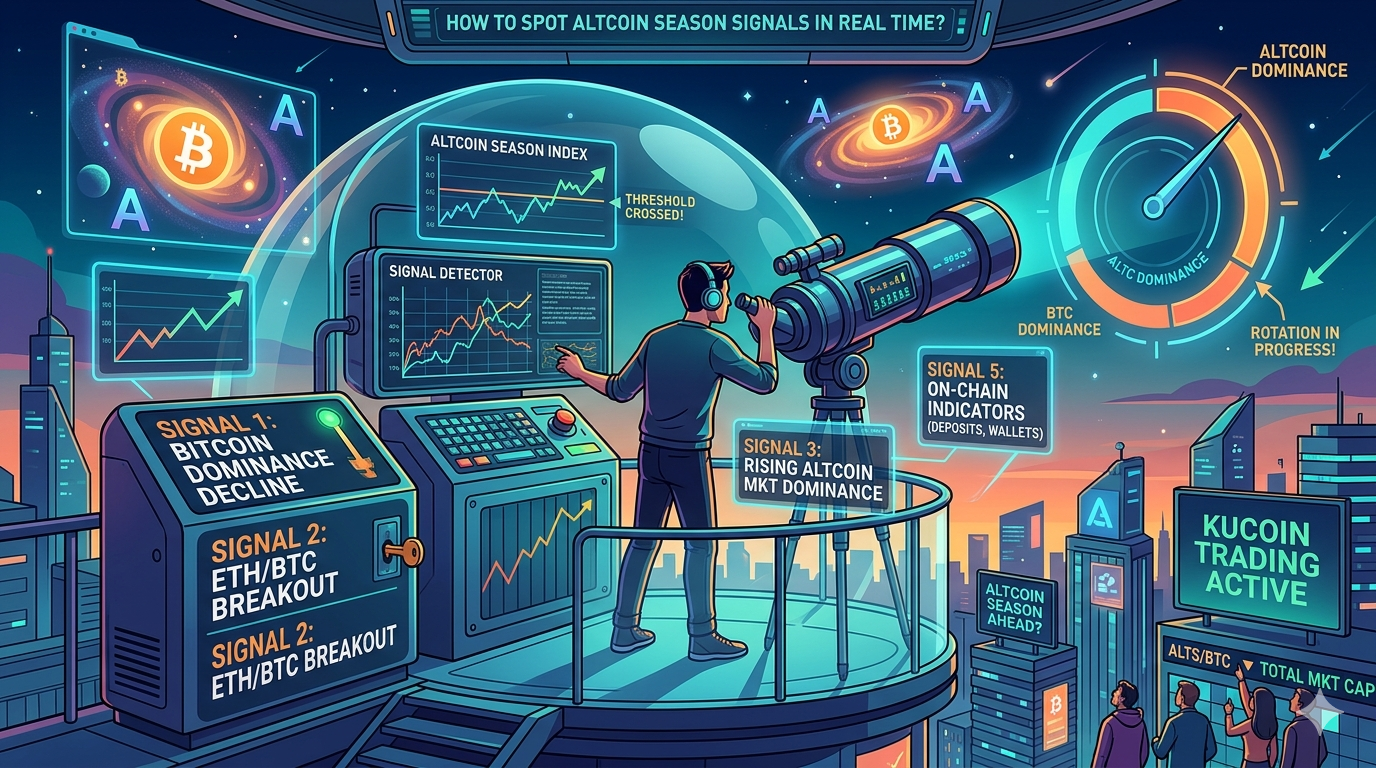
Three specific market signals have been widely used to identify an imminent altcoin season:
-
Bullish divergences on weekly altcoin charts, where price hits lower lows while indicators suggest upward momentum
-
Rising ALTS/BTC ratio, signaling capital rotation back into alternative tokens
-
Declining Bitcoin dominance, with the metric falling below 50% during broad altcoin seasons
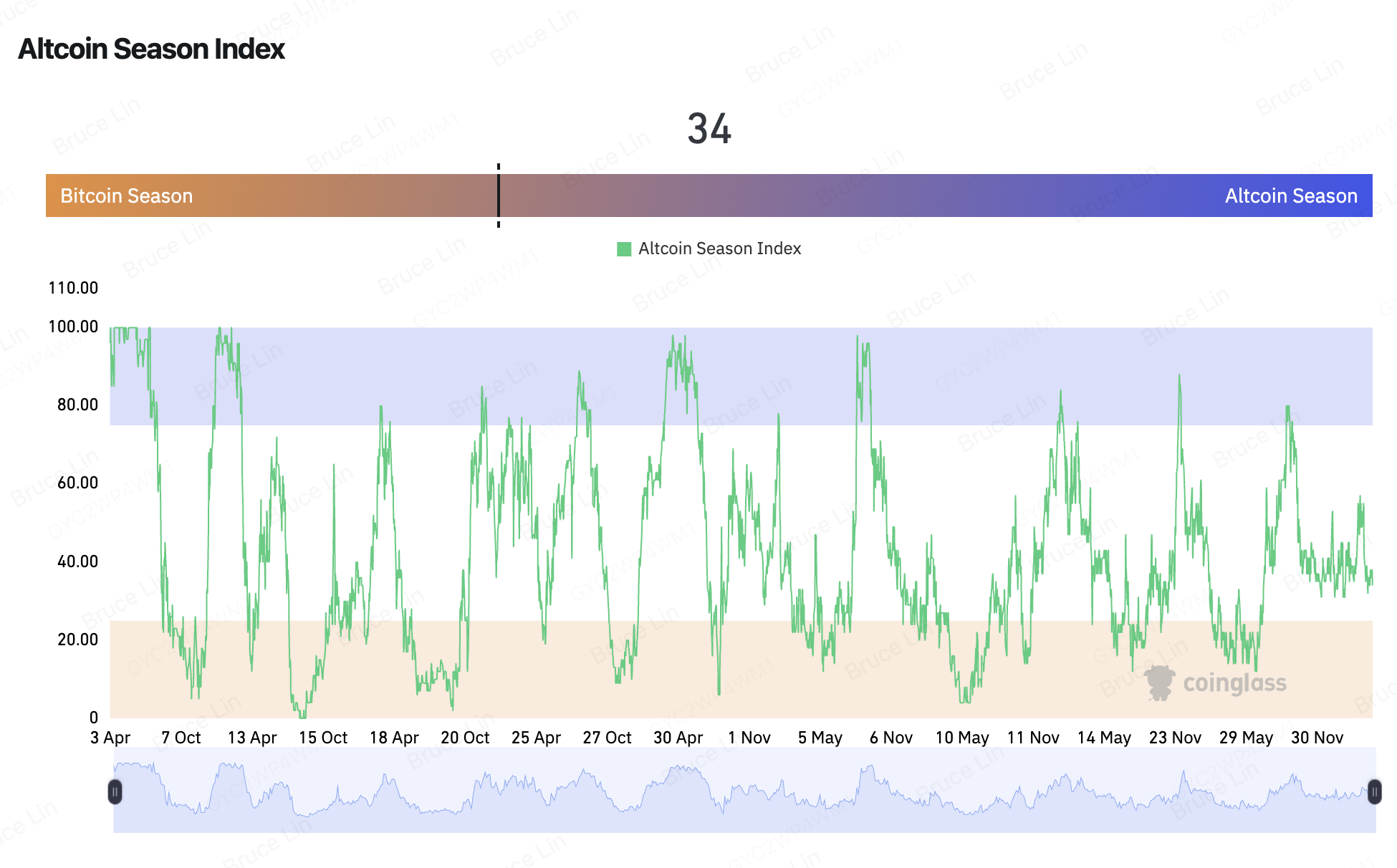
The Altcoin Season Index quantifies this rotation. When 75% of the Top 50 coins perform better than Bitcoin over the last 90 days, the index registers above 75 and confirms altcoin season. As of April 2026, the index hovers around 27-35, firmly in "Bitcoin season" territory.
Understanding these signals helps traders recognize the early stages of rotation before the masses pile in.
The Five Key Signals for Real-Time Detection
Signal 1: Bitcoin Dominance Decline
The most widely watched indicator for altcoin season timing is Bitcoin dominance. When this metric begins declining from resistance levels, it signals that capital is beginning to rotate into altcoins.
The key levels to watch:
-
Resistance: 58-60% dominance, where Bitcoin absorbs most new capital
-
Support: 52-54% dominance, the critical breakdown zone for altcoin rotation
-
Historical pattern: dominance peaks in 2021 and 2019 preceded significant altcoin rallies
Traders monitor daily and weekly Bitcoin dominance charts for breakdowns below these support levels. A sustained break below 52% with increasing altcoin volume confirms the rotation has begun.
Signal 2: ETH/BTC Ratio Breakout
Ethereum's performance against Bitcoin serves as a leading indicator for broader altcoin strength. The ETH/BTC ratio breaking above 0.05 has historically signaled incoming altcoin seasons.
The ratio measures Ethereum's relative strength against the market's largest asset. When ETH begins outperforming Bitcoin, other altcoins typically follow. The mechanism reflects capital flowing from Bitcoin into larger-cap altcoins before rotating into smaller tokens.
Traders watch for sustained breaks above 0.05 on weekly charts. Daily fluctuations can create false signals; weekly closes above the level provide more reliable confirmation.
Signal 3: Rising Altcoin Market Dominance
Beyond Bitcoin dominance, altcoin-specific market share provides additional confirmation. Total altcoin market cap as a percentage of overall crypto market cap reveals the breadth of rotation.
When altcoin market dominance rises above 30-35% and continues climbing, the rotation has broad base support. This differs from altcoin rallies driven by a single token; rising altcoin dominance indicates sector-wide participation.
Traders monitor total crypto market cap charts separated between Bitcoin and altcoin components. The separation provides clarity on which assets are absorbing capital.
Signal 4: Altcoin Season Index Threshold
The Altcoin Season Index aggregates performance across the Top 50 cryptocurrencies. When the index crosses above 50, it signals that a majority of altcoins are outperforming Bitcoin.
The current index reading of 27-35 (as of March 2026) places markets firmly in "Bitcoin season." The key threshold is 50 on the 0-100 scale. Crossing above this level confirms altcoin season has begun.
However, the index operates as a confirmation tool rather than a leading indicator. By the time the index confirms altcoin season, the best entry points have often passed. Using the index alongside leading indicators (dominance, ETH/BTC ratio) provides better timing.
Signal 5: On-Chain Rotation Indicators
On-chain metrics provide additional signals for rotation detection. Exchange deposit patterns, wallet growth on altchains, and stablecoin rotation all provide real-time data.
Key on-chain signals include:
-
Decreasing exchange deposits for altcoins relative to Bitcoin, suggesting holding behavior
-
Rising addresses on altcoin networks, indicating new user adoption
-
Stablecoin flows into altcoin-focused exchanges preceding price rallies
These signals complement technical indicators. When multiple on-chain metrics align with technical breakdowns in Bitcoin dominance, the rotation signal strengthens significantly.
Why 2026 Presents a Unique Opportunity
Institutional Participation Changes the Math
The 2025-2026 cycle differs fundamentally from previous cycles due to institutional participation. With over $80 billion in spot Bitcoin ETFs and corporate treasuries holding over 1 million BTC collectively, the market structure has fundamentally changed.
This institutional presence creates both opportunity and challenge. Capital from ETFs and corporate treasuries flows primarily into Bitcoin, maintaining elevated dominance levels. Yet when these entities eventually allocate to altcoins, the size of those allocations dwarfs retail-driven previous cycles.
The window for 100x altcoin returns may be narrowing, but the absolute dollar returns from institutional allocations could exceed previous cycle gains.
Historical Context: Lessons from Previous Cycles
Every major altcoin season since 2017 followed similar patterns. The 2017 cycle saw Bitcoin dominance fall from over 80% to approximately 35%, with numerous altcoins achieving 10-100x gains. The 2020-2021 cycle, though complicated by DeFi summer, saw similar dominance declines.
What differs in 2026 is the institutional presence. Previously, altcoin seasons emerged organically from retail capital flows. Now, structural changes from ETFs and corporate treasuries may slow or compress traditional rotation patterns.
The key insight: altcoin seasons remain possible but may require more patience and better signal identification than previous cycles.
Why Timing Matters More Than Ever
The altered market structure makes precise timing more valuable. With institutional capital absorbing much of the new money flowing into crypto, retail traders face increased competition for altcoin gains. Being early to the rotation provides cushion against institutional traders who enter later.
The cost of mistiming an altcoin season has also increased. Late entries during previous cycles might result in missed gains. In 2026, incorrect timing could result in buying at the top just before institutional profit-taking.
Trading the Signals on KuCoin
Position Building for Altcoin Rotations
KuCoin provides multiple pathways for traders positioned for potential altcoin seasons. Understanding these pathways helps traders implement rotation strategies.
For broad altcoin exposure, the ALTS index and related trading pairs provide diversified access. Traders can access multiple altcoins through spot trading against USDT, capturing sector-wide movements without selecting individual tokens.
For ETH-focused exposure, the ETH/USDT pair provides direct Ethereum exposure. As the second-largest cryptocurrency, Ethereum often leads broader altcoin rotations. The pair offers liquidity and tight spreads for position building.
For selective altcoin exposure, KuCoin lists numerous altcoin pairs including SOL/USDT, XRP/USDT, and ADA/USDT. Selective token selection allows traders to target specific altcoins while managing position size relative to volatility expectations.
Timing Considerations
The signals discussed above provide frameworks for monitoring rather than guaranteed timing. Key principles for position building:
-
Accumulate positions gradually as signals develop, rather than waiting for full confirmation
-
Size positions to survive false signals and extended waiting periods
-
Maintain diversification across multiple altcoins rather than concentrating in single tokens
-
Use stop-losses to manage risk if signals reverse
The altcoin season may arrive in 2026 or may require patience through extended Bitcoin dominance periods. The frameworks help traders remain prepared.
Conclusion
Detecting altcoin season signals in real time requires monitoring multiple indicators simultaneously. Bitcoin dominance declining below 52-54%, ETH/BTC ratio breaking above 0.05, and the Altcoin Season Index crossing above 50 provides structural confirmation of capital rotation.
The current market context shows Bitcoin dominance at 56-59%, with the Altcoin Season Index at 27-35. These readings confirm Bitcoin season rather than altcoin season. Yet historical patterns suggest that elevated dominance levels often precede significant altcoin rallies when eventually broken.
Whether through broad altcoin exposure or selective token selection, understanding the signals matters more than predicting exact timing. The disciplined approach: monitor, prepare, and execute when confirmation arrives.
FAQs
Q: What is the Altcoin Season Index?
A: The Altcoin Season Index measures whether 75% of the Top 50 cryptocurrencies outperform Bitcoin over the last 90 days. When the index reads above 75, altcoin season is confirmed. The index sits at 27-35 as of April 2026, indicating Bitcoin season.
Q: What Bitcoin dominance level signals altcoin season?
A: Historically, altcoin seasons begin when Bitcoin dominance breaks below 52-54%. The current dominance at 56-59% remains above this threshold, suggesting patience is required before the rotation confirmed.
Q: How reliable are these signals?
A: No signal is 100% reliable. The indicators provide probability frameworks rather than guarantees. Using multiple signals together (dominance, ETH/BTC ratio, index, on-chain data) improves reliability through convergence.
Q: Is the 100x altcoin return window closing?
A: Institutional participation has changed market structure, potentially compressing retail-driven altcoin returns. However, institutional allocation to altcoins could create new opportunities that exceed previous cycles in absolute dollar terms.
Q: When might altcoin season arrive in 2026?
A: No guaranteed timing exists. Monitoring the key levels (Bitcoin dominance below 52%, ETH/BTC above 0.05, index above 50) provides frameworks for tracking rather than predictions.
Disclaimer: This article is for informational purposes only and does not constitute financial or investment advice. The technology and crypto markets are highly volatile; always conduct your own research.