

Trading 101: Crypto Guide for Beginners - Choosing Tokens to Start your Crypto Journey in 2026
Introduction
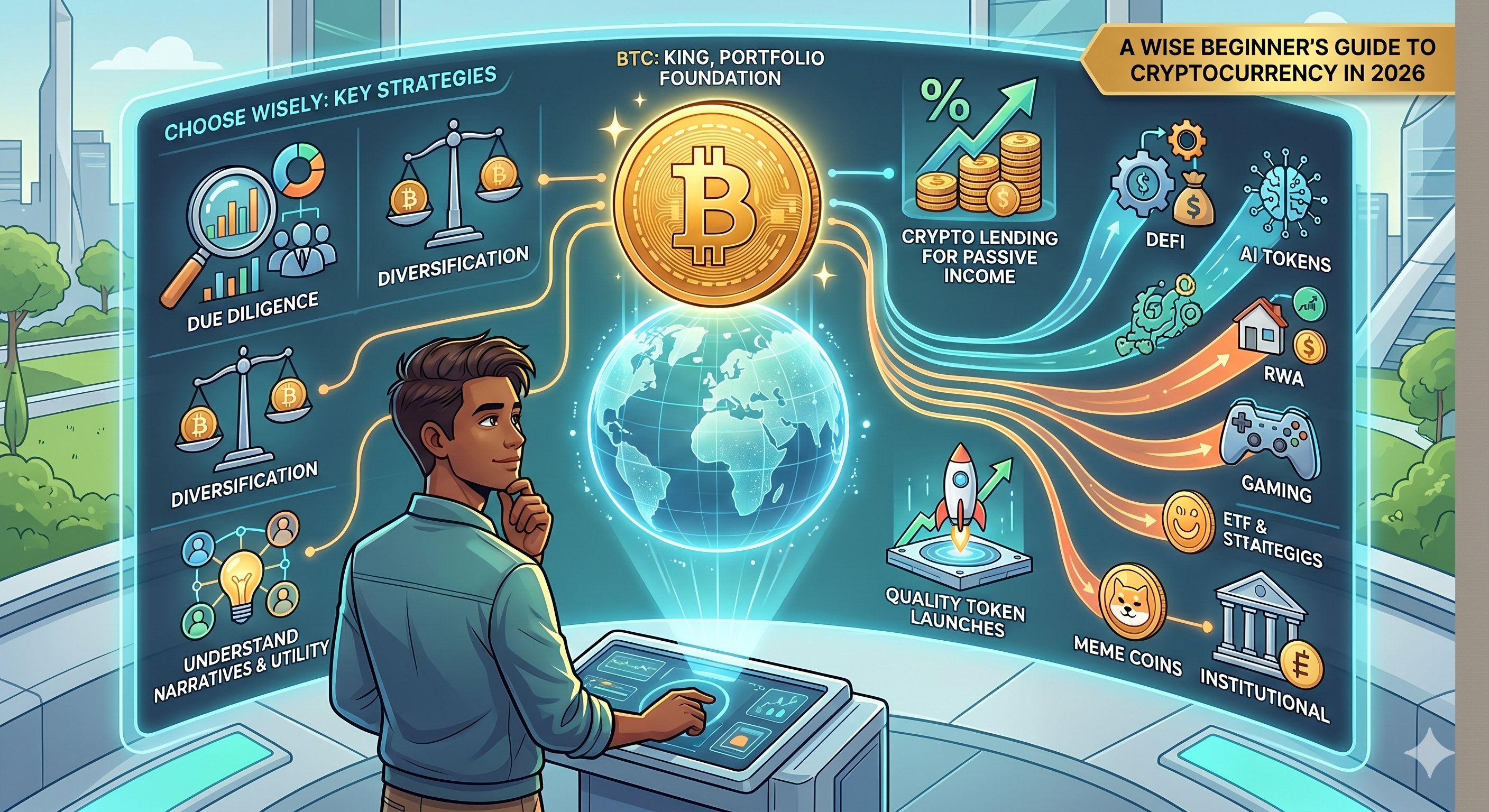
The cryptocurrency market has evolved dramatically over the past few years. What was once considered a niche industry dominated by Bitcoin enthusiasts has now become a global financial ecosystem covering decentralized finance (DeFi), artificial intelligence (AI) tokens, real-world asset (RWA) tokenization, blockchain gaming, meme coins, and institutional crypto investment products.
As of 2026, the total crypto market capitalization has fluctuated in the multi-trillion-dollar range, while Bitcoin exchange-traded funds (ETFs), stablecoins, and on-chain financial applications continue attracting both retail and institutional investors. At the same time, thousands of new crypto projects are launched every year, making it increasingly difficult for beginners to distinguish high-potential assets from unsustainable hype.
For novice investors, choosing the right cryptocurrency is no longer just about buying Bitcoin or chasing trending tokens on social media. Successful crypto investing now requires understanding market narratives, token utility, ecosystem adoption, liquidity, tokenomics, and long-term sustainability.
This guide explains how beginners can choose cryptocurrencies more wisely in today’s market environment while avoiding common mistakes that often lead to unnecessary losses.
Always Have BTC in Your Portfolio
When it comes to the crypto market, Bitcoin is king. Bitcoin could be compared to growth stocks. Several financial regulators globally, including the US SEC, have classified BTC as an asset. You can always count on it to appreciate in the long term despite its short-term fluctuations.
Understand Crypto Market Narratives Before Investing
In today’s crypto market, narratives play a major role in determining capital flow and token performance. Different market cycles often favor different sectors. For example, previous bull cycles were dominated by DeFi, NFTs, and metaverse tokens, while recent cycles have seen growing attention on AI-related crypto projects, decentralized physical infrastructure networks (DePIN), Bitcoin ecosystem projects, and real-world asset (RWA) tokenization.
For beginners, understanding narratives can help identify where liquidity and investor attention are flowing. However, it is important to distinguish between sustainable narratives and short-term speculation. Projects with real users, active developers, strong ecosystems, and practical utility tend to survive long after market hype fades away.
Instead of blindly buying trending tokens on social media, investors should study why a specific narrative is gaining traction and whether the underlying projects are solving real problems within the blockchain ecosystem.
Look for High-Quality Token Launches Instead of Blind Speculation
Token launches remain one of the most attractive opportunities in the crypto market, but the landscape has changed significantly since the ICO boom of 2017. Today, investors can access new projects through Initial Exchange Offerings (IEOs), launchpads, community sales, staking campaigns, and ecosystem incentive programs.
While early-stage investments can generate strong returns, they also carry substantial risks. Many low-quality projects rely heavily on influencer marketing and unrealistic promises rather than actual technological innovation or user adoption. Beginners should carefully evaluate a project's team, tokenomics, funding background, roadmap, and community activity before investing.
One useful approach is to monitor reputable crypto launch platforms such as KuCoin Spotlight, where projects typically undergo stricter review processes before listing. Investors should also pay attention to token unlock schedules, circulating supply, and long-term ecosystem incentives, as these factors often affect price performance after launch.
Most importantly, avoid projects that promise guaranteed profits or unrealistic returns. In crypto, high reward always comes with high risk.
Consider Crypto Lending
The mainstream explosion of DeFi has unlocked unlimited earning potential for newbies, who only want to earn passive income from the crypto market. Since DeFi is built on the Ethereum platform, you should consider investing in tokens that are ERC-20 compatible.
Crypto lending is also an ideal way of earning passive income while maintaining your crypto portfolio. You can earn interest by lending your cryptos via several crypto lending platforms or crypto exchanges. KuCoin offers daily interest rates of up to 2%. Crypto lending has become rampant with the growth of crypto derivatives. This way, your portfolio earns interest while you hold for the long haul.
Only Invest in Crypto Projects That Have Utility
When considering which token offerings (ICOs, IEOs, IDOs) to invest in, always consider the purpose of the crypto project. The ability to generate a token on Ethereum (ETH) has existed since the invention of Ethereum and is not a new phenomenon compared to DeFi. Over time, so many different variants of tokens have emerged. From utility tokens sold via an Initial Coin Offering (ICO) to non-fungible tokens (NFT) to the governance tokens widely used in the DeFi space or even meme coins, the Ethereum community has already experienced all sorts of token experiments. It is already possible today that token holders of DeFi protocols will share in the revenues of a DeFi project.
If you are new to cryptos, you are better off investing in well-established and mainstream cryptos. If you'd want to invest in something exotic, then you better be ready to do some serious due diligence.
Take Ethereum, for example. Its massive success can be attributed to its contribution to the kick-starting and furthering development of decentralized finance. Ethereum gave crypto developers globally a platform to build their own decentralized applications. Ethereum gave us smart contracts! By some measure, every altcoin brings some utility to the DeFi ecosystem. For example, the crypto community is continually addressing problems with scalability, absolute privacy, and interoperability. These issues can be used as a yardstick to measure the usefulness of an altcoin. If it doesn't address at least one of them, then do not bother investing. Chances are, you'll be parking your fund in dud crypto.
Pay Attention to Token Utility and Revenue Models
The crypto market has matured considerably, and investors are now paying closer attention to whether a blockchain project can generate sustainable revenue and long-term demand for its token.
Many modern crypto projects incorporate token utility into their ecosystems through staking, governance, fee discounts, liquidity incentives, decentralized computing, gaming economies, or revenue-sharing mechanisms. Projects that successfully create consistent on-chain activity and real user demand often have stronger long-term potential compared to purely speculative assets.
For example, some exchange ecosystem tokens provide trading fee discounts and staking rewards, while DeFi protocols may distribute protocol revenue to token holders. AI-focused blockchain projects may use tokens for decentralized GPU computing or data verification.
Before investing, beginners should ask several important questions:
-
Does the token have a real use case?
-
Is there genuine demand for the token?
-
Are users actively using the product?
-
Can the ecosystem sustain long-term growth?
A cryptocurrency without utility or adoption may struggle to maintain value once speculative hype disappears.
Avoid Emotional Trading and Social Media Hype
One of the biggest mistakes new crypto investors make is allowing emotions to drive investment decisions. Social media platforms can amplify fear and greed extremely quickly, causing inexperienced traders to buy near market tops or panic sell during temporary corrections.
In recent years, meme coins and influencer-driven tokens have repeatedly demonstrated how quickly speculative assets can rise and collapse. Some projects experience massive short-term rallies fueled by online hype, only to lose most of their value once liquidity dries up.
This does not necessarily mean every trending token is bad. However, beginners should avoid making investment decisions solely based on viral posts, celebrity endorsements, or fear of missing out (FOMO). A sustainable investment strategy should always include proper research, portfolio diversification, and risk management.
Dollar-cost averaging (DCA), setting realistic profit targets, and maintaining long-term conviction are often more effective strategies than constantly chasing the latest trending coin.
Conclusion
Choosing the right cryptocurrency as a beginner can feel overwhelming, especially in a market filled with constant innovation, rapid price movements, and thousands of competing projects. However, successful investing is rarely about chasing the fastest pump. Instead, it often comes down to understanding market cycles, identifying projects with real utility, managing risk properly, and maintaining a long-term perspective.
Bitcoin and Ethereum continue to serve as foundational assets for many crypto portfolios, while emerging sectors such as AI, DePIN, gaming, and RWA tokenization may offer additional growth opportunities for investors willing to conduct proper research.
Beginners should focus on learning the fundamentals of blockchain technology, avoiding emotional trading decisions, and using trusted platforms that provide strong security, liquidity, and educational resources.
As one of the world’s leading crypto exchanges, KuCoin offers access to hundreds of cryptocurrencies, advanced trading tools, passive income products, and early-stage token opportunities through platforms like KuCoin Spotlight. Whether you are a first-time investor or looking to expand your crypto portfolio, having access to a reliable exchange can significantly improve your overall trading experience.
FAQs
What is the safest cryptocurrency for beginners?
Bitcoin (BTC) and Ethereum (ETH) are generally considered the safest cryptocurrencies for beginners due to their strong adoption, liquidity, institutional support, and long-term market presence.
How much money should beginners invest in crypto?
Beginners should only invest money they can afford to lose. Many investors start with small amounts and gradually build positions using dollar-cost averaging (DCA) strategies.
Is it still worth investing in cryptocurrency in 2026?
Many investors still see long-term potential in cryptocurrency due to increasing institutional adoption, blockchain innovation, and growing real-world use cases. However, the market remains highly volatile and requires proper risk management.
How can I identify a good crypto project?
A strong crypto project usually has real utility, active developers, transparent tokenomics, strong community engagement, and sustainable ecosystem growth rather than relying solely on hype.
What are the biggest mistakes new crypto investors make?
Common mistakes include investing based on hype, using excessive leverage, failing to diversify, panic selling during volatility, and ignoring project fundamentals.