

Cronos Tectonic Exploit Explained: How TONIC Price Manipulation Triggered a $75M DeFi Crisis
2026/08/31 17:30:00
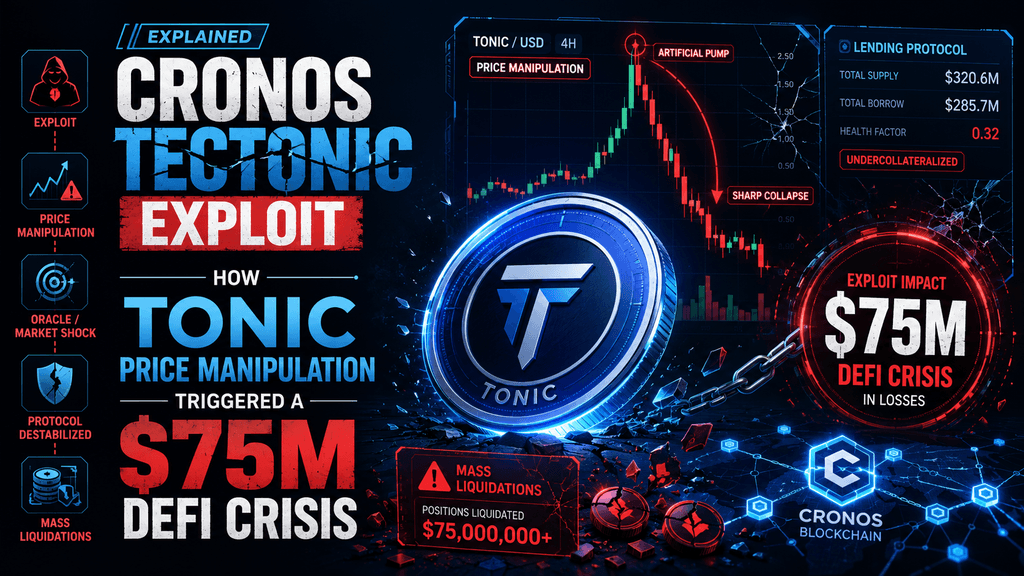
The incident is significant for reasons beyond its headline loss. TONIC reportedly had only about $1.34 million in liquidity and roughly $11,000 in daily trading volume before its price was pushed approximately 100-fold in about 20 minutes. The attack raises a fundamental question for decentralized lending: how can a token with such limited market depth support millions of dollars in borrowing? The subsequent Cronos shutdown adds a second debate—whether stopping a blockchain to contain losses is responsible emergency management or evidence of limited decentralization.
What Happened to Tectonic and Cronos?
Tectonic operates as a decentralized lending market on Cronos, allowing users to deposit crypto assets and borrow other tokens against their collateral. Before the incident, it was one of the network’s most important DeFi applications. DefiLlama data cited by CoinDesk showed approximately $121.7 million locked in Tectonic on August 26, representing close to half of the capital deposited across Cronos DeFi at the time. That figure had fallen to roughly $3 million by August 31.
The apparent attack centered on TONIC, Tectonic’s own ecosystem token. Blockchain analysis indicates that an attacker pushed its market price sharply higher, deposited the newly inflated TONIC into the lending protocol and then borrowed liquid assets against it. Once the scale of the exploit became clear, Cronos validators coordinated a network halt, preventing new transactions from being processed. Tectonic also told users not to interact with the protocol while the incident was being investigated.
Early estimates placed the exploit around $66 million before additional attacker-linked assets reportedly pushed the estimated amount toward $75 million. That number remains an estimate rather than a finalized accounting. As of Monday morning, Cronos and Tectonic had not publicly confirmed the ultimate losses or announced a timetable for restarting normal network activity.
How Did the TONIC Price Manipulation Work?
The apparent exploit is easier to understand as a borrowing problem than as a traditional software hack. A DeFi lending protocol must decide how much collateral a user owns and how much another asset that collateral should allow the user to borrow. If the collateral is ETH or BTC, deep global liquidity makes it comparatively difficult for one trader to move the market price by an extreme amount. TONIC was very different. With limited liquidity and trading activity, its quoted price could apparently be moved far more aggressively with comparatively little capital.
Blockchain data cited by CoinDesk indicate that the attacker pushed TONIC up roughly 100-fold in about 20 minutes. Once the token carried a dramatically higher market valuation, the attacker deposited the TONIC into Tectonic. The protocol then treated those tokens as significantly more valuable collateral and allowed the account to borrow liquid assets against them. TONIC had a collateral factor of 20%, meaning every $100 of value recognized by the protocol could support roughly $20 of borrowing.
A simplified example shows why that can become dangerous. Imagine a token position that is realistically worth $1 million in a normal market. If its quoted price is temporarily manipulated 100 times higher, the protocol may suddenly value the same position at $100 million. Even with a conservative 20% collateral factor, that artificial valuation could create $20 million of borrowing capacity. When the token price later falls back toward reality, the protocol is left with collateral that cannot cover the valuable assets already borrowed.
Why Was TONIC So Vulnerable?
The core issue appears to be market depth. Before the exploit, TONIC reportedly had approximately $1.34 million in liquidity and only around $11,000 of daily trading volume. Those figures are extremely small relative to the tens of millions of dollars in borrowing that the manipulated collateral ultimately appears to have supported. Tectonic’s own documentation had warned that low-liquidity assets can be particularly vulnerable to price manipulation.
This highlights one of the most important distinctions in DeFi lending: price is not the same as liquidity. A token might show a market price of $1, but that does not mean a protocol could liquidate $20 million worth of that token at anything close to $1. Prices usually represent marginal trades—the latest amount paid for a relatively small quantity. Liquidating a large position can move through an order book or liquidity pool quickly, causing severe slippage.
A lending market therefore needs to ask more than “What is this token worth right now?” It also needs to ask, “How much of this token could realistically be sold if a large borrower had to be liquidated?” An asset can have a valid quoted price and still be unsuitable for supporting large amounts of debt.
Why Didn’t a 20% Collateral Factor Stop the Attack?
At first glance, a 20% collateral factor looks cautious. If $100 worth of collateral can support only $20 of debt, the protocol appears to have a large safety buffer. Under ordinary market conditions, that buffer can help protect lenders from moderate price declines and give liquidators time to close unhealthy positions.
The problem is that a conservative risk parameter cannot fully compensate for a wildly distorted input price. If a token’s real economic value is $1 million but its recognized collateral value temporarily becomes $100 million after price manipulation, a 20% factor still generates $20 million of borrowing capacity. The system is applying a prudent percentage to an unreliable valuation.
This is why collateral factors cannot be considered in isolation. Borrow caps, market liquidity, oracle construction, concentration limits and expected liquidation depth all matter. A protocol can use a low loan-to-value ratio and still become vulnerable if the collateral itself can be repriced far more quickly than the protocol’s risk controls can react.
Was This an Oracle Hack or an Economic Exploit?
Calling the Tectonic incident an “oracle hack” may be premature. Public reporting has not established that an attacker compromised oracle software or directly altered the code responsible for delivering prices. Instead, the available evidence points toward manipulation of the underlying market from which the protocol derived or validated TONIC’s price.
That difference matters. An oracle can accurately report that a token is trading at a certain price while the price itself is economically unreliable because the underlying market is extremely thin. If an attacker can spend a relatively small amount of capital to push a token from one price to another, an oracle may faithfully deliver the manipulated price to the lending protocol. The oracle is not necessarily broken; the market feeding it has become the attack surface.
| Failure Type | What Happens |
| Oracle compromise | The price-reporting system itself is manipulated or breached |
| Market manipulation | The attacker moves the underlying token market and the new price reaches the protocol |
| Economic exploit | Protocol rules function as designed but produce an exploitable financial outcome |
Based on currently available information, the Tectonic incident is better described as an alleged price-manipulation or economic exploit until the protocol publishes a complete root-cause analysis. This distinction is important because preventing an economic exploit often requires changes to market-risk design rather than simply patching software.
Why Did Cronos Halt the Entire Blockchain?
Once the attack was identified, Cronos validators made an unusually aggressive intervention: they stopped block production for the entire network. A blockchain halt prevents new transactions from being finalized. That means the attacker cannot continue swapping, bridging or dispersing assets—but it also means ordinary users temporarily lose the ability to move their own funds.
The immediate security logic is straightforward. Once stolen or improperly borrowed assets are bridged to another chain, they become much harder for the original network to contain. The attacker can divide the funds across wallets, exchange them into other assets or route them through multiple protocols. By stopping the underlying chain, validators can freeze the situation before all of those actions occur.
In this case, the halt reportedly left most of the exploit-linked funds stranded on Cronos rather than allowing them to leave the ecosystem. That could materially improve the prospects for containment or recovery. But it is essential to distinguish stranded from recovered. Assets remaining at attacker-controlled addresses on Cronos do not automatically return to Tectonic depositors simply because the network stopped.
Did the Chain Halt Protect Users or Hurt Decentralization?
The emergency intervention immediately created a broader debate over what users should expect from a blockchain. Cronos software caps the validator set at 100, a structure that made rapid coordination possible. According to CoinDesk, the relatively limited validator group was able to coordinate the shutdown within minutes.
From a loss-containment perspective, that capability can be valuable. If the choice is between allowing an attacker to remove tens of millions of dollars or temporarily stopping the chain, many depositors may prefer intervention. BNB Chain faced a similar decision following its 2022 bridge exploit, when validators paused the network after an attack involving roughly $570 million. CoinDesk notes that close to $470 million was eventually recovered or prevented from escaping.
The cost is philosophical as well as operational. Blockchains are often marketed around censorship resistance, credible neutrality and the idea that no central party controls settlement. A network that can be deliberately switched off demonstrates that human coordination can override continuous operation during emergencies. That does not automatically make the decision wrong, but it exposes a real trade-off: greater intervention capacity can improve emergency security while weakening assumptions about unstoppable settlement.
How Bad Is the Damage to Tectonic?
The impact on Tectonic’s public DeFi metrics has been severe. DefiLlama data cited by CoinDesk show that total value locked fell from approximately $121.7 million on August 26 to roughly $3 million by August 31. That represents a collapse of more than 95% in reported TVL over a very short period.
It would be incorrect, however, to interpret the entire drop as money stolen by the attacker. TVL can decline because of several factors, including protocol losses, asset-price movements, withdrawals, changes in contract accounting and the network halt itself. The estimated exploit size remains around $75 million rather than the full decline in Tectonic’s reported locked value.
The more durable damage may be confidence. Lending applications depend on depositors believing that collateral is conservatively valued and that borrowers cannot extract valuable assets against positions that cannot be liquidated. Once that assumption breaks, users may withdraw even if their individual deposits were not directly affected. For Tectonic, restoring confidence may therefore require more than recovering funds; it may require a redesigned collateral framework and a transparent explanation of how the exploit was possible.
Why This Looks Like the Mango Markets Exploit
The attack has drawn comparisons with the 2022 Mango Markets incident because the basic economic structure is similar. In both cases, a relatively thinly traded asset was used to create a much larger apparent collateral value, which then supported borrowing from a DeFi protocol. The critical vulnerability was not simply possession of the token—it was the ability to influence the price at which the lending system valued that token.
The comparison is important because it shows that pump-and-borrow attacks are not a new theoretical risk. DeFi has had years to study the relationship between illiquid collateral and lending-market security, yet protocols still face pressure to support emerging assets because users want additional borrowing utility and ecosystems want their native tokens to become more useful.
That creates a structural tension. If lending protocols accept only BTC, ETH and major stablecoins, they reduce economic attack surfaces but limit the range of assets users can employ productively. If they accept smaller ecosystem tokens, they increase capital efficiency and token utility but potentially expose lenders to markets whose prices can be moved more easily than the debt those prices support.
Low-Liquidity Collateral Is Becoming a Bigger DeFi Risk
Tectonic also arrives amid several incidents that have renewed concern about thin collateral markets. CoinDesk reported that Moonwell suffered a similar exploit the previous week in which an attacker manipulated a thinly traded token used as collateral. In another episode, a roughly 3% move in a low-liquidity Pendle market triggered approximately $36 million in liquidations on Morpho.
These events point toward a broader change in how DeFi security should be understood. Traditional security discussions often focus on smart-contract bugs, compromised private keys, faulty bridges and governance attacks. Those risks remain important, but decentralized finance can also fail even when every contract performs exactly the actions its developers intended.
Economic security therefore deserves equal attention. A protocol may be technically secure but financially fragile because of weak collateral selection, concentrated liquidity, aggressive borrow caps or oracle assumptions that work only in normal markets. The Tectonic incident reinforces a simple lesson: correct code cannot rescue an unsafe market design.
What Can DeFi Lending Protocols Learn From Tectonic?
One lesson is that collateral limits need to reflect executable liquidity rather than headline market capitalization. If liquidators could realistically sell only a few hundred thousand dollars of a token before severe slippage occurs, the protocol should be cautious about allowing that asset to support tens of millions of dollars in borrowing. Borrow caps and collateral factors should therefore respond not only to volatility but also to changing market depth.
Oracle design also needs multiple safeguards. Time-weighted prices, independent data sources and anomaly detection can make short-lived manipulation more difficult to translate directly into borrowing power. Yet oracle improvements alone cannot eliminate the risk if an asset’s legitimate market is itself too shallow. Riskier collateral may need isolated markets so that problems with one long-tail token cannot drain pools containing major stablecoins or blue-chip assets.
The larger principle is straightforward: collateral should be valued by what it could realistically realize during liquidation, not simply by its latest quoted price. For lending protocols, liquidity is part of valuation. Treating those two concepts separately can create exactly the kind of mismatch that an economic attacker is looking for.
What Happens Next for Cronos and Tectonic?
The incident remains unresolved. As of the latest August 31 reporting, Cronos and Tectonic had not announced a confirmed accounting of losses or a timetable for restarting the network. That means several of the most important questions cannot yet be answered definitively, including how much money can be recovered, whether attacker-controlled assets will remain frozen and what changes will be made to Tectonic’s risk parameters.
A credible recovery plan will likely need to address both financial and technical issues. Users will want clarity on affected deposits and any compensation mechanism, while developers will need to explain how TONIC’s collateral treatment changes after the attack. The network itself will also need to explain the conditions for restarting block production and whether any additional intervention is required before transactions resume.
The long-term verdict will therefore depend on more than the final exploit number. Three questions matter most: How much can be recovered? How substantially does Tectonic redesign its collateral-risk model? And will depositors return once the protocol and network resume normal operation?
Conclusion: Tectonic Shows Why DeFi Risk Is More Than Code
The Tectonic exploit demonstrates how a relatively obscure market can create system-wide consequences when an illiquid token becomes collateral inside a large lending protocol. According to current reporting, TONIC’s price was pushed roughly 100-fold in about 20 minutes before the inflated tokens were deposited into Tectonic and used to borrow more liquid assets. The resulting exposure has been estimated at around $75 million, though the final loss remains unconfirmed.
Cronos’ decision to halt the blockchain may have prevented much of the affected capital from leaving the network, but it also revived an old debate over emergency intervention and decentralization. More importantly, the incident shows that DeFi security cannot be reduced to smart-contract audits.
A token can have a visible market price without having enough liquidity to safely support that price as collateral. The lasting lesson from Tectonic may therefore be less about one attacker than about the design of decentralized credit itself: protocols must understand not only what an asset is quoted at, but what that asset could actually be sold for when a lending market is under extreme stress.
FAQs
Was Crypto.com Hacked in the Tectonic Exploit?
There is no indication that the Crypto.com exchange or its main application was compromised in the Tectonic incident. Cronos is closely associated with the Crypto.com ecosystem, but Tectonic is a separate DeFi lending application operating on the blockchain. The exploit concerned Tectonic’s collateral and lending system rather than customer balances inside the centralized Crypto.com exchange.
What Is TONIC and What Is It Used For?
TONIC is the ecosystem token associated with Tectonic. Like many DeFi protocol tokens, it has been used within the project’s broader governance and incentive structure. Its role in the August exploit is notable because Tectonic also accepted TONIC as collateral, creating a financial link between the value of the protocol’s own ecosystem token and the borrowing capacity available inside its lending markets.
Can a Blockchain Halt Reverse Transactions?
No. Halting block production normally prevents new transactions from being confirmed; it does not automatically erase transactions that were already finalized before the halt. Reversing or redistributing assets would require separate technical, governance or legal actions. This is why exploit-linked funds remaining on Cronos should not automatically be described as recovered.
Why Would an Attacker Bridge Funds to Ethereum?
Moving assets to another blockchain can reduce the original network’s ability to contain them. Once funds reach Ethereum, an attacker may have access to deeper decentralized exchanges, additional bridges and more routes for splitting or exchanging assets. Cross-chain movement can therefore make tracing and recovery more difficult, which helps explain why Cronos validators had an incentive to stop further transactions quickly.
Are Funds Still on Cronos Automatically Recoverable?
No. An attacker may still control the private keys to addresses holding the assets even if those assets cannot currently move because the chain is paused. Recovery depends on what happens when the network restarts, whether addresses are restricted, whether the attacker cooperates and what technical or governance actions Cronos and Tectonic ultimately choose.
How Can Users Identify Risky Collateral in a DeFi Lending Protocol?
Users can look beyond headline APYs and TVL by checking which assets a lending protocol accepts as collateral, how much liquidity those assets have, their trading volume, collateral factors, borrow caps and oracle methodology. A token with a large market capitalization but very shallow liquidity may still be difficult to liquidate during stress. Protocol risk documentation and independent audits can provide additional context, but they do not eliminate market and economic risk.
🔥 KuCoin Offers A More Stable Option in A Volatile Market
If you worry about the frequent ups and downs in the market, and pursue a more stable option to earn money passively, KuCoin is the right place to come:
Simple Earn: Deposit and withdraw tokens anytime, earning stable returns.
Kucoin Earn: Earn stable profits with professional asset management.
Hold to Earn: Earn rewards by holding assets in Funding, Trading, Margin, Futures, Mining, and Unified Accounts.
Staking: Unlock the earning potential of on-chain assets.
Advanced Investments: Advanced Investments offer a variety of structured products to help your money grow in any market.
Shark Fin: Principal Protection and Guaranteed Gains
Dual Investment: Buy low and sell high with transparent return calculations.
Snowball: High yields, with price protection.
Discount Buy: Buy crypto at discount prices.
KCS Loyalty: Level up to enjoy exclusive perks by staking ≥ 1 KCS.
KuCoin Wealth: Discover future value and begin your smart investing journey.
KCS Benefits: Hold and stake KCS to access benefits across the platform.
KCS Staking 2.0: Participate in KCS on-chain governance to earn yield.
Disclaimer: This content is for informational purposes only and does not constitute investment advice. Cryptocurrency investments carry risk. Please do your own research (DYOR).