

Coinbase Bitcoin Premium Index Plunges: Why US Buying Power Is Drying Up Fast in June 2026
2026/06/03 11:44:00
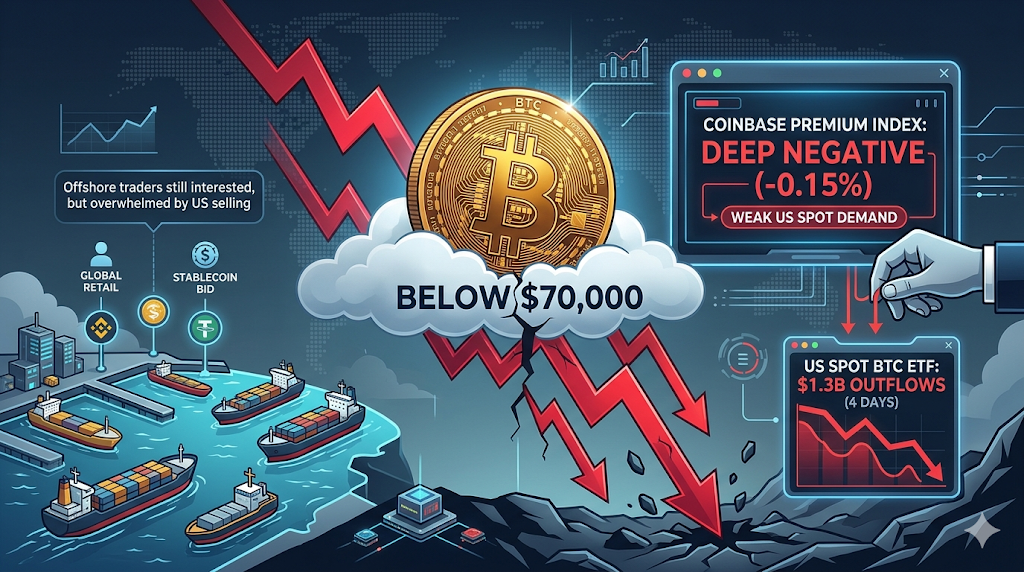
Bitcoin has slipped below $70,000 even as leveraged traders pile in — but the most alarming signal is hiding in a single metric. The Coinbase Bitcoin Premium Index remains deeply negative around -0.15%, highlighting a disconnect between leveraged bullish positioning and weak spot-market demand. Translation: US institutions and spot buyers are not showing up to defend this market.
This matters because Coinbase is the primary venue for American institutional capital and the custodian for nearly every US spot Bitcoin ETF. A persistently negative Coinbase Premium means BTC is trading cheaper in the world's largest economy than it is offshore — a textbook sign that domestic demand is exhausted. Combined with the recent ETF outflows and open interest at multi-year highs, the setup looks structurally fragile.
This article breaks down what the Coinbase Premium Index is signaling right now, why US buying power is fading, and how traders should position around the divergence.
The Coinbase Premium Index is flashing one of its strongest sell signals of the cycle. On June 2, 2026, Bitcoin slipped below the psychologically important $70,000 level on Tuesday, trading around $67,000, as derivatives positioning reached elevated levels, while the Coinbase Premium Index remains deeply negative around -0.15%, highlighting a disconnect between leveraged bullish positioning and weak spot-market demand.
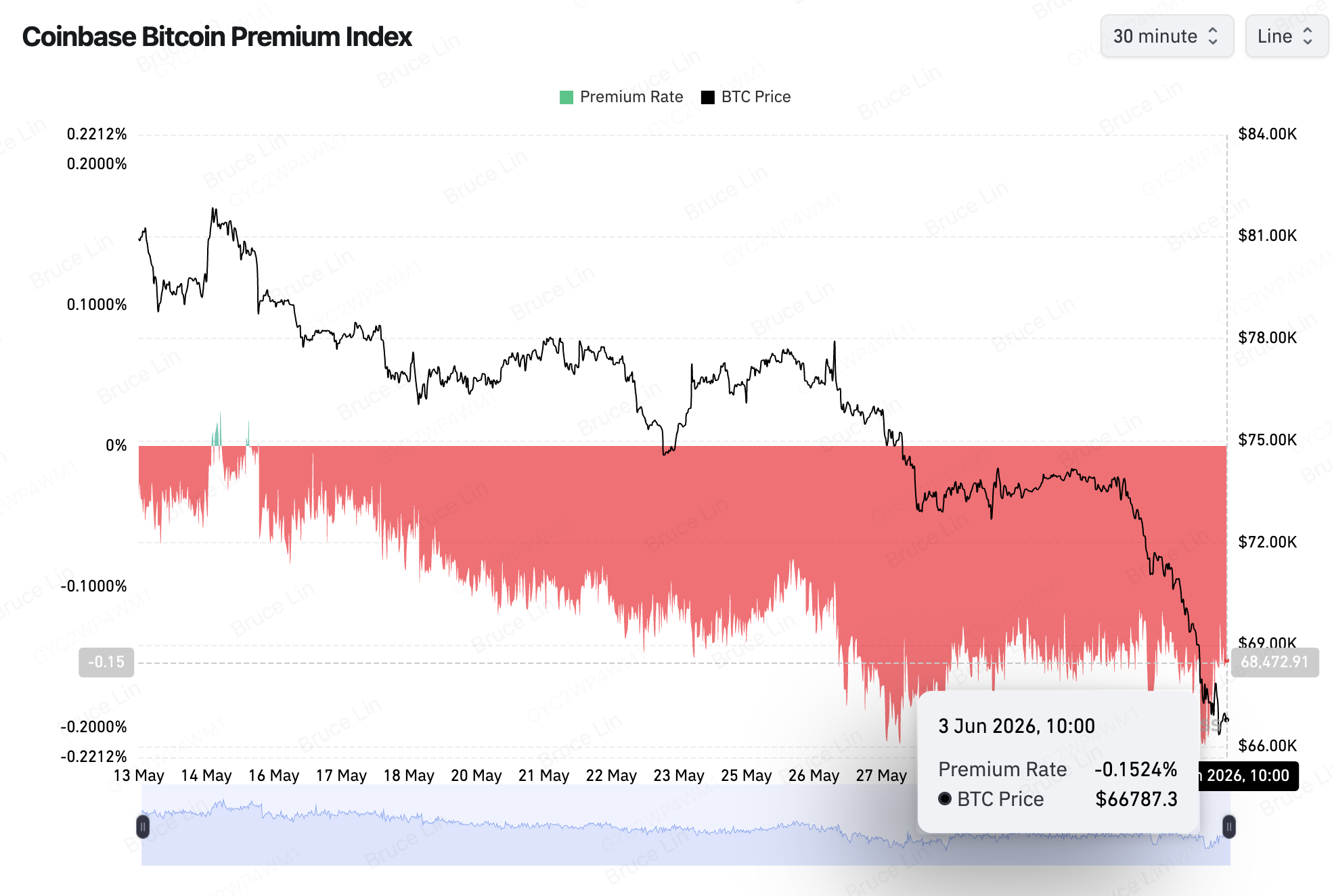
The metric is one of the cleanest reads on US capital availability. The metric measures the price difference between bitcoin on Coinbase and offshore exchanges, with a negative reading often indicating weaker demand from U.S. institutional and spot investors — a trend clearly reflected in the continuing outflows from the U.S.-based spot BTC ETFs.
In plain terms: when BTC trades cheaper on Coinbase than on Binance, it means American buyers are stepping back while offshore traders are still bidding. That gap is now persistent — not a one-day blip.
US buying power is fading because three forces are pulling capital out of crypto simultaneously: ETF outflows, equity rotation, and macro hawkishness from the Fed.
Spot ETF Outflows Are Confirming the Story
ETF flows are the cleanest proxy for institutional appetite, and they are bleeding. Data from CoinGlass shows U.S. spot Bitcoin ETFs have recorded four consecutive trading days of outflows since May 14, totaling roughly $1.3 billion, while analysts at Bitfinex noted that Bitcoin's open interest has dropped by roughly $1.5 billion this week, wiping out much of the leverage that had built up during Bitcoin's rally toward $82,000.
The ETF wrapper was supposed to be the structural bid that supported BTC in drawdowns. Instead, it has become a transmission mechanism for institutional selling, with redemptions translating directly into spot supply.
Institutional Profit-Taking Is Intensifying
The Coinbase bitcoin premium index has fallen to its lowest level in a month, with analysts warning that intensified institutional selling is adding significant weight to BTC's near-term price outlook — Coinbase's bitcoin premium index has been slipping for months, suggesting reduced institutional accumulation, and the uncertainty surrounding the current macro environment appears to be pushing institutions toward hedging strategies while waiting for greater clarity.
Nick Ruck, research director at LVRG, offered a parallel reading, claiming the decline could be indicative of "institutional profit-taking and repositioning," further adding that such a shift could weigh on near-term price momentum across major crypto assets — the macro uncertainty seems to emanate from one specific catalyst, namely Federal Reserve Chair Kevin Warsh, who was sworn into office this week and struck a notably hawkish tone in early remarks, with markets now beginning to price in the possibility of rate hikes in 2026 rather than the cuts that had been anticipated.
This is the macro pivot that broke the bull case. Pricing in hikes instead of cuts removes the liquidity tailwind that supported risk assets through the first quarter.
Capital Is Rotating to Equities
According to The Coin Republic reporting on May 22, 2026, the selling pressure intensified while traditional markets recovered — gold weakened during the same period, while the S&P 500 and Dow Jones Industrial Average trended upward since early April, and that rotation suggested institutions favored equities instead of defensive or alternative assets.
The divergence between leveraged bullish positioning and deteriorating spot demand comes as bitcoin remains largely uncorrelated to broader risk assets, with AI and software stocks continuing to push to fresh highs.
That is the painful read: BTC is not benefiting from the broader risk-on bid. Institutions are choosing AI equities over Bitcoin.
The Coinbase Premium Index measures the percentage price gap between BTC on Coinbase and BTC on Binance. It is built on the assumption that Coinbase traffic represents US institutional and dollar-denominated flow, while Binance represents global retail.
This indicator tracks the percentage difference between the BTC spot price listed on Coinbase (USD pair) and that on Binance (USDT pair), so in short, what this metric tells us about is how the trader's buying and selling behaviors compare between Coinbase and Binance.
Coinbase's main traffic is made up of US-based investors, with institutional entities from the nation being prominent customers for the platform — the spot exchange-traded funds, which have been around for nearly 2.5 years now and have acted as a gateway for institutions, also use the exchange as a custodian, and in recent years, the price has often tended to correlate with the Coinbase Premium Index, suggesting that American whales have driven the market.
What Negative vs Positive Premium Means
|
Reading
|
What It Signals
|
Typical Market Behavior
|
|
Strongly positive (>0.05%)
|
Aggressive US buying, ETF inflows, institutional accumulation
|
Bullish momentum, often precedes rallies
|
|
Neutral (around 0)
|
Balanced cross-border flow
|
Range-bound consolidation
|
|
Persistently negative
|
US selling pressure, ETF outflows, institutional exit
|
Bearish bias, often precedes corrections
|
|
Deeply negative (<-0.1%)
|
Severe US demand exhaustion
|
High risk of breakdown without offshore bid
|
Historically, a shift from sustained negative readings to sustained positive premiums reflects a more definitive change in market structure, and a confirmed move into positive territory has often preceded 4–8 weeks of upward price momentum.
The current setup is the opposite of that — sustained negative readings that have historically preceded extended downside.
The honest answer is both — but timing matters, and right now it is a warning, not a buy signal.
The contrarian case has merit historically. Negative Coinbase Premium spikes have led to bottoms in past cycles. When US selling exhausts, the resulting capitulation often marks a durable low.
For the negative premium to mark a bottom, three things typically need to align:
-
Realized losses must peak. According to CoinDesk reporting from late April 2026, Bitcoin Realized Loss 7-day Sum, which tracks the total dollar value of coins moved at a loss across the network, spiked to $5.97 billion on April 24 as bitcoin traded near $78,000, and a print near $6 billion at $78,000 means the sellers were buyers at higher prices.
-
Funding rates must reset lower. Currently they remain elevated, signaling leveraged longs still expect a rebound — the exact positioning that gets liquidated on the next leg down.
-
ETF outflows must stabilize. The Coinbase Premium decline aligned with weaker Bitcoin exchange-traded fund demand across U.S. markets — CoinGlass data showed spot Bitcoin ETFs recorded four consecutive trading sessions of net outflows after mid-May, and that trend suggested institutional investors reduced direct exposure despite Bitcoin stabilizing near short-term support levels.
KuCoin gives traders the tools to position around the US-versus-global demand divergence — whether you want to hedge spot exposure, short the leverage unwind, or accumulate on capitulation.
To get started:
-
Create a KuCoin account — registration takes minutes, and KYC verification unlocks higher deposit and trading limits.
-
Fund with USDT or USDC — stablecoin deposits let you deploy quickly when the Coinbase Premium flips or BTC tags a key support level.
-
Trade BTC/USDT spot — use limit orders to layer bids at major support zones rather than chasing volatility.
-
Use BTC perpetual futures — KuCoin's deep futures liquidity lets you short into elevated funding or hedge spot exposure during ETF outflow periods.
-
Monitor funding and open interest — KuCoin's derivatives dashboard surfaces the same leverage signals that are flashing red across the broader market.
KuCoin's global liquidity profile is a structural advantage during periods when US-specific venues are bleeding. Offshore bid flows often run through KuCoin's order book first, making it a useful read on whether the global market is willing to absorb US selling — or whether the divergence is about to resolve to the downside.
New users can now register at KuCoin and Get Up to 11,000 USDT in New User Rewards.

The Coinbase Bitcoin Premium Index plunging to -0.15% is not a rounding error — it is a structural warning that US institutional and spot buyers have stepped away from the market while leveraged longs continue to bet on a rebound. That divergence is the most dangerous configuration in derivatives-driven markets, because it sets up violent liquidation cascades when price breaks support.
The supporting data confirms the read: $1.3 billion in spot ETF outflows since mid-May, open interest near record highs, funding rates still elevated despite weak spot demand, and a Fed Chair signaling rate hikes instead of cuts. Capital is rotating into AI equities while Bitcoin remains uncorrelated from the broader risk-on bid.
The contrarian case — that deeply negative premium prints mark bottoms — has historical support, but the conditions for that reversal are not yet in place. Realized losses, funding rates, and ETF flows all need to confirm. Until they do, the smarter posture is defensive. KuCoin offers the spot and futures infrastructure to trade either resolution of this divergence as it plays out.
1. What is a normal range for the Coinbase Bitcoin Premium Index?
The index typically oscillates between -0.10% and +0.10% during balanced market conditions. Readings beyond that range signal extreme one-sided flow. Sustained positive premiums above 0.05% historically correlate with bullish institutional accumulation, while persistent negative readings below -0.08% reflect significant US selling pressure or absent demand.
2. How is the Coinbase Premium different from the Coinbase Premium Gap?
The Premium Index is expressed as a percentage difference, while the Premium Gap is the absolute dollar difference between Coinbase and Binance BTC prices. Both measure the same underlying phenomenon — US versus global pricing divergence — but the Gap is more sensitive to absolute price levels. Recent data showed the Coinbase Premium Gap fall sharply to -$77, according to CryptoQuant analysts, signaling weakening buying activity on Coinbase.
3. Does a negative Coinbase Premium always mean Bitcoin will drop?
No. The index reflects regional demand differences, not a guaranteed price direction. Bitcoin has rallied during negative premium periods when offshore demand or stablecoin inflows compensated. However, when negative premium aligns with ETF outflows, elevated open interest, and macro tightening — as in June 2026 — the probability of downside resolution rises materially.
4. How quickly can the Coinbase Premium Index flip from negative to positive?
It can flip within a single trading session if a major catalyst hits — for example, a surprise Fed pivot, a large institutional ETF buy, or a major regulatory approval. Sustained reversals, however, typically take multiple days of confirmed inflows. Traders should look for 3+ consecutive sessions of positive readings before treating a flip as durable rather than noise.
5. Where can I track the Coinbase Premium Index in real time?
Coinglass provides the most widely referenced real-time chart for the Coinbase Bitcoin Premium Index, updated continuously throughout trading sessions. CryptoQuant also publishes the metric with longer historical context and on-chain overlays. Both sources are commonly cited in institutional research, including the reports referenced throughout this article.