

CLARITY Act Stablecoin Yield Ban: Why CRCL Share Price May Eye $150
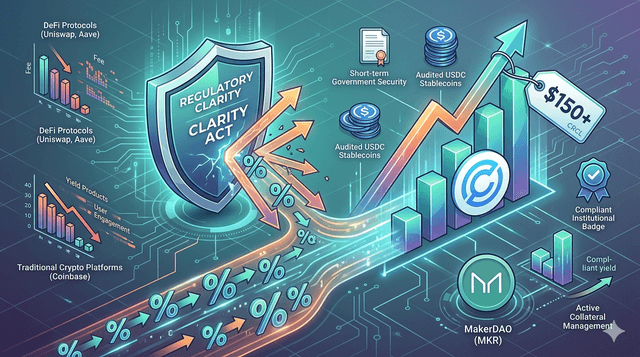
The CLARITY Act could fundamentally reshape how value flows through the cryptocurrency ecosystem. If passed, this legislation would ban stablecoin yield payments to retail holders, effectively redirecting billions in interest income from crypto-native platforms to traditional banks and regulated financial institutions. This single regulatory change may determine which crypto stocks thrive and which face existential pressure in the coming years.
Circle Internet Group (CRCL) stands at the center of this transformation. The company behind USDC, the second-largest stablecoin by market cap, has already seen its stock recover 150% from February lows amid growing institutional adoption. Now, the CLARITY Act's stablecoin yield prohibition could provide additional structural tailwinds that push CRCL share price toward $150 and beyond.
To understand the full investment thesis, here is essential background on related topics:
-
CRCL Stock Price Prediction - This analysis examines whether Circle Internet Group can hit $120+ after its latest rally and what catalysts may drive further gains
-
CRCL vs Other Crypto Stocks - This comparison evaluates where Circle stands relative to other cryptocurrency stocks in 2026 market conditions
-
CLARITY Act Overview - This analysis explains what the CLARITY Act is and examines its potential impact on the cryptocurrency industry
The CLARITY Act represents the most significant attempt to regulate stablecoins in United States history. Passed by the House in a 294-134 vote in July 2025, the legislation seeks to establish comprehensive digital asset regulations. However, the most contentious provision involves banning yield payments on idle stablecoin holdings.
Under the current draft, stablecoin issuers would be prohibited from paying interest or rewards on stablecoin balances held by users. This effectively transforms stablecoins from interest-bearing savings accounts into pure payment instruments. The income that would have flowed to stablecoin holders becomes isolated within banking infrastructure and regulated financial products instead.
The legislation operates through four key provisions: reserve requirements mandating 1:1 backing, yield prohibition on idle balances, active yield distinction allowing transaction-linked returns, and enhanced transparency requirements.
The following table summarizes the key provisions under the CLARITY Act framework:
|
Provision
|
Description
|
Impact on Stablecoin Holders
|
|
Reserve Requirements
|
1:1 backing with eligible assets
|
Ensures solvency but eliminates yield opportunity
|
|
Yield Prohibition
|
Bans interest in idle balances
|
Redirects income to banks and regulated products
|
|
Active Yield Distinction
|
Allows transaction-linked returns
|
Permits some yield for active users
|
|
Transparency
|
Enhanced disclosure requirements
|
Increases operational burden for issuers
|
The legislation builds upon the GENIUS Act framework, signed into law in July 2025, which already requires stablecoin issuers to maintain reserves. The political dynamics remain complex with ongoing bank lobbying efforts.
Circle Internet Group represents perhaps the most direct beneficiary of the CLARITY Act's stablecoin yield ban. The reasoning stems from how value would flow under the new regulatory framework.
When stablecoin yield becomes prohibited for retail holders, the economic advantage of holding stablecoins shifts toward issuers and institutional participants. Circle maintains USDC reserves in conservative instruments including short-term government securities. The yield generated from these reserves flows to Circle's bottom line rather than being distributed to retail holders as is currently the case with many competing stablecoin products.
This structural advantage means Circle can retain earnings that competitors must surrender. Competitors that currently offer yield to attract stablecoin holders would lose this marketing tool. Circle, with its compliant structure, can grow USDC supply without needing to offer competitive yields. The company's margins improve as USDC supply expands, creating a self-reinforcing growth cycle.
The analysis of Circle's financials reveals compelling upside potential. For fiscal year 2026, Circle expects other revenue of $150-170 million with an adjusted operating margin of 38-40%. As USDC supply continues expanding at 40% compound annual growth rate projections, these revenue figures could multiply substantially.
While Circle benefits structurally from the CLARITY Act, MakerDAO's MKR token presents a different but equally compelling investment case. The distinction lies in how each protocol generates and distributes yield.
MakerDAO operates through a lending protocol structure where users deposit collateral to generate DAI stablecoin. The protocol earns interest through vault stability fees, and MKR token holders participate in governance decisions that determine how protocol revenue flows. Crucially, this structure involves active collateral management rather than passive yield accumulation.
Under the CLARITY Act's framework, MakerDAO's structure may qualify for different regulatory treatment. The protocol generates yield through productive collateral deployment, not through payments on idle stablecoin balances. If regulators distinguish between active yield generation and passive yield accumulation, MakerDAO's model could operate compliantly while competitors face restrictions.
The implications for MKR token holders remain nuanced. MKR serves as the governance token for MakerDAO, with holders voting on protocol parameters including stability fees and collateral types. The token does not directly distribute yield to holders. However, as the protocol captures more market share from compliant-constrained competitors, MKR token utility and scarcity increase.
The CLARITY Act's stablecoin yield ban would create significant challenges for decentralized finance protocols that depend on stablecoin liquidity and yield distribution mechanisms.
Uniswap (UNI) and Aave (AAVE) represent two protocols facing substantial regulatory pressure. Both protocols generate fee income partly through stablecoin trading pairs and lending markets. If stablecoin holders face yield prohibition, the incentive to hold stablecoins outside of DeFi protocols diminishes.
The regulatory impact manifests through multiple channels:
-
Reduced stablecoin liquidity in DeFi markets compresses fee revenue
-
Protocol frontends face restrictions in implementing jurisdictions
-
Institutional participants avoid DeFi protocols due to regulatory uncertainty
-
Governance token holders face securities-law scrutiny
The following table compares how different crypto protocols may position under the CLARITY Act:
|
Protocol/Company
|
Yield Model
|
CLARITY Act Impact
|
Position
|
|
Circle (USDC)
|
Reserve yield retention
|
Direct beneficiary
|
Winner
|
|
MakerDAO (MKR)
|
Active collateral yield
|
Potential exemption
|
Mixed
|
|
Uniswap (UNI)
|
Fee-based, no yield
|
No direct yield ban
|
Neutral
|
|
Aave (AAVE)
|
Lending fee revenue
|
Stablecoin usage decline
|
Headwind
|
|
Coinbase
|
Yield product distribution
|
Growth lever removed
|
Loser
|
|
BitGo
|
Custody infrastructure
|
Compliant structure
|
Neutral
|
The competitive dynamics shift toward regulated alternatives. Protocols with clear regulatory compliance pathways, like MakerDAO, attract capital seeking yield within the new legal framework. Unregulated protocols face potential user flight or regulatory enforcement actions that further diminish their competitive positions.
Coinbase, the largest United States cryptocurrency exchange, faces a more complicated situation under the CLARITY Act. While the exchange would remain operational, its ability to offer stablecoin yield products represents a meaningful growth lever that disappears.
Coinbase has previously offered yield products allowing users to earn returns on stablecoin holdings. These products served as acquisition tools, attracting new users seeking to maximize returns on crypto holdings. Under the CLARITY Act's framework, such products become illegal for retail users, eliminating a competitive advantage Coinbase held over traditional banking alternatives.
The structural challenge extends beyond yield products. Coinbase's business model depends on trading volume and user growth. Stablecoin yield offerings historically drove user engagement by giving holders additional reasons to maintain balances on the platform. Without these incentives, platform stickiness potentially decreases, affecting trading volume and revenue.
BitGo presents a different profile as a regulated custody infrastructure provider. The company operates under comprehensive regulatory frameworks rather than offering consumer-facing yield products. This positioning makes BitGo structurally compatible with CLARITY Act requirements but potentially limits growth ceiling compared to consumer-focused platforms like Coinbase or Circle.
The interaction between Tether (USDT) and Circle (USDC) creates interesting dynamics under the CLARITY Act framework. Both stablecoins compete for the same fundamental use cases: digital dollar representation for crypto trading, DeFi liquidity, and cross-border payments.
Tether currently dominates stablecoin market share with USDT supply far exceeding USDC. However, Tether operates under less transparent reserve conditions compared to Circle's regularly audited USDC. If the CLARITY Act improves regulatory clarity around stablecoins, Circle's compliance-first approach could narrow the competitive gap.
The stablecoin sector competition involves several key dimensions: reserve transparency, regulatory compliance, institutional adoption, and cross-border payment infrastructure.
Should Tether enhance its audit transparency in response to regulatory pressure, competition between the two stablecoin giants intensifies. This dynamic could drive innovation across the stablecoin sector while validating the broader narrative that stablecoins represent core financial infrastructure rather than speculative vehicles.
Both outcomes benefit Circle's long-term positioning. Tether transparency improvements validate the stablecoin-as-infrastructure thesis. Continued opacity creates space for USDC to capture market share fleeing regulatory uncertainty.
Step 1: Create Your KuCoin Account
New users can register on KuCoin and receive up to $11,000 in rewards. The process involves completing identity verification to unlock full trading capabilities and promotional benefits. Simply visit the KuCoin website or download the mobile app to begin registration.

Step 2: Execute Your Trade
Circle Internet Group trades under the CRCL ticker symbol on major exchanges. On KuCoin, users can access CRCL/USDT. The trading interface provides multiple order types including market orders for immediate execution and limit orders for price-controlled entries.
Step 3: Position Management
For CRCL investment, establishing clear profit targets and stop-loss levels before entering positions helps manage risk effectively. Monitoring CLARITY Act developments and quarterly earnings reports provides ongoing decision-making context. Consider position sizing relative to total portfolio allocation, as regulatory outcomes carry substantial uncertainty.
The CLARITY Act's stablecoin yield ban represents a pivotal regulatory moment for the cryptocurrency industry. If implemented, this legislation would redirect billions in interest income from crypto-native platforms toward traditional banking infrastructure, fundamentally altering competitive dynamics across the sector.
Circle Internet Group emerges as a structural beneficiary through multiple mechanisms. USDC reserve yields flow to the company rather than distributed to holders, improving margins as USDC supply expands. The compliant structure positions Circle as the preferred stablecoin for institutional adoption under tightened regulatory frameworks. Consensus price targets ranging from $123 to $250 reflect growing recognition of these structural advantages.
MakerDAO presents a different but equally compelling case as a compliant yield-generation mechanism. The protocol's active collateral management structure may avoid CLARITY Act restrictions that prohibit passive yield accumulation on stablecoin balances. As competitors face compliance constraints, MakerDAO captures market share seek-ing regulated yield pathways.
DeFi protocols face substantial headwinds. Uniswap, Aave, and similar protocols depend on stablecoin liquidity and yield distribution mechanisms that the CLARITY Act restricts. Compliance challenges at multiple levels potentially accelerate capital migration toward regulated alternatives.
Coinbase loses a meaningful growth lever through stablecoin yield product prohibition. The exchange remains operational but faces structural pressure as competitive advantages erode. BitGo operates compatibly with new regulations but potentially lacks growth ceiling compared to consumer-focused platforms.
The stablecoin yield prohibition timeline remains uncertain given ongoing bank lobbying and Senate markup delays. However, the direction appears clear: regulatory frameworks increasingly favor compliant stablecoin structures like Circle's over yield-distribution models prevalent in current DeFi ecosystems.
Q: How might the CLARITY Act affect USDC and Circle's business model?
A: The CLARITY Act could benefit Circle by preventing yield distribution to retail stablecoin holders. Circle retains reserve yields rather than passing them to users, improving margins as USDC supply expands under compliant regulatory conditions.
Q: Why might CRCL stock price reach $150 under the CLARITY Act scenario?
A: The CLARITY Act eliminates competing yield-bearing stablecoin products, positioning Circle as the preferred compliant option. With USDC growing at 40% CAGR and margins expanding from reserve yields, revenue projections support higher valuations. Analyst targets ranging from $123 to $250 reflect these structural advantages.
Q: How does MakerDAO differ from other DeFi protocols under stablecoin yield prohibition?
A: MakerDAO generates yield through active collateral management in lending vaults rather than passive yield accumulation on stablecoin balances. This structural distinction may allow MakerDAO to operate compliantly while competitors face restrictions on their yield-distribution models.
Q: What are the main risks to the CRCL bull case?
A: CLARITY Act implementation delays or modifications could reduce structural tailwinds. USDC growth depends on continued market share gains against Tether. Regulatory outcomes carry substantial uncertainty that could affect the investment thesis in either direction.
Q: How might Coinbase be affected by stablecoin yield prohibition?
A: Coinbase loses stablecoin yield products as competitive acquisition tools. Without these offerings, platform stickiness potentially decreases, affecting trading volume and revenue. The exchange remains operational but faces structural pressure as competitive advantages erode.