

CLARITY Act Faces Crucial Senate Vote on September 15 as U.S. Crypto Regulation Hangs in the Balance
Key Takeaways
-
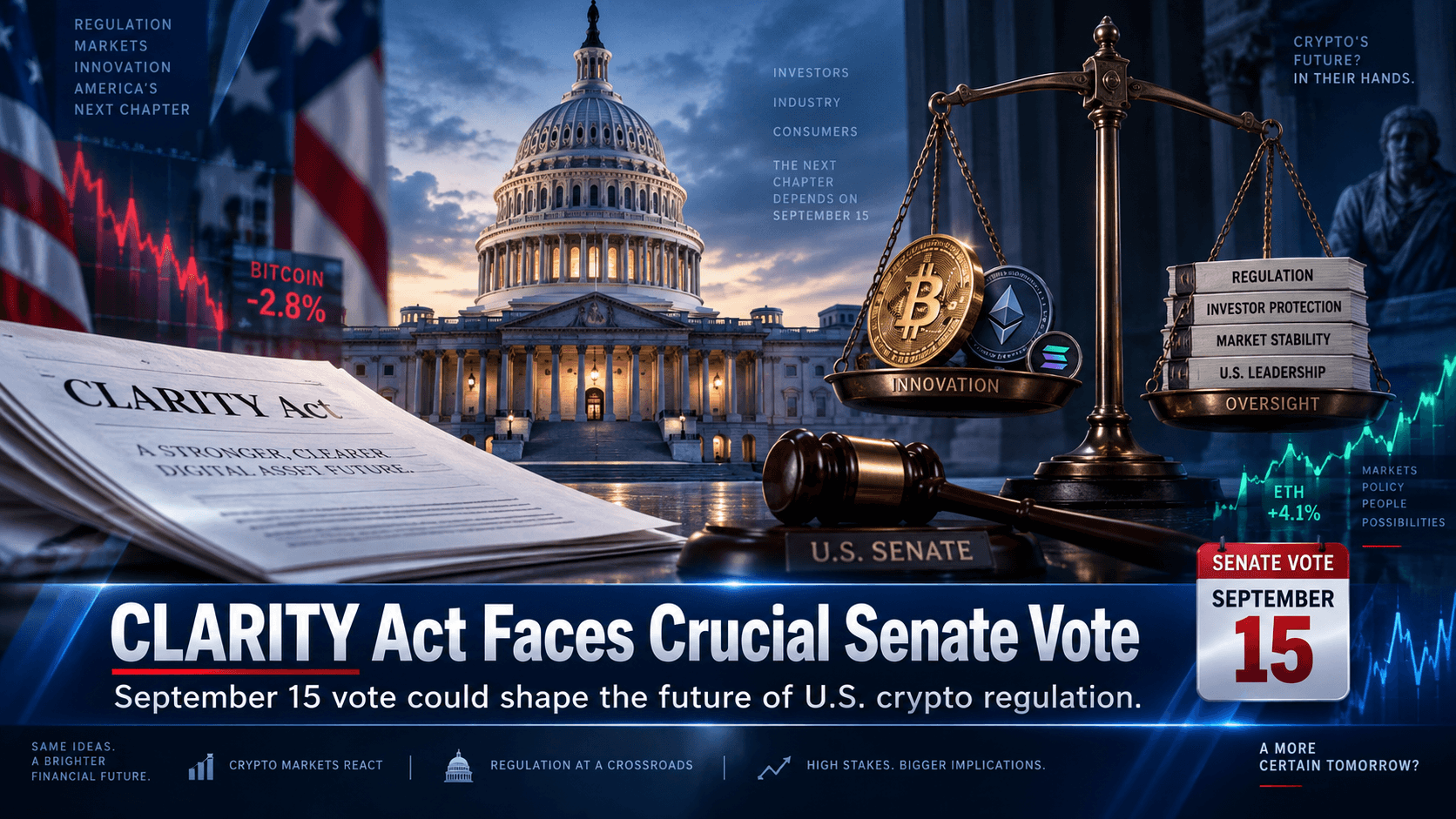
The U.S. Senate is scheduled to face a key procedural vote on the CLARITY Act on September 15, with 60 votes needed to advance consideration of the crypto market-structure legislation.
-
The bill could reshape how the SEC and CFTC divide oversight of digital assets, but disputes over government ethics, DeFi rules and stablecoin rewards are making bipartisan support difficult.
-
Bitcoin is trading near $77,000 as the vote approaches, but rising oil prices, Treasury yields and expectations for a Federal Reserve rate hike could matter more for short-term crypto prices than the regulatory vote itself.
The U.S. crypto industry is approaching one of its most important regulatory tests of 2026. On September 15, the Senate is scheduled to take a crucial procedural step involving the Digital Asset Market Clarity Act, or CLARITY Act, legislation designed to create a more durable federal framework for cryptocurrency markets.
The vote comes after more than a year of negotiations and growing pressure from both the crypto and banking industries. It also arrives at a difficult moment for markets. Bitcoin is trading near $77,200, well below its 2025 record high, while oil prices above $100 and rising Treasury yields have revived expectations that the Federal Reserve could raise interest rates this week.
For investors, the key question is therefore bigger than whether one bill advances. The September vote will test whether Congress can still build bipartisan support for comprehensive U.S. crypto regulation before the 2026 election calendar makes major legislation increasingly difficult.
Why September 15 Matters
The most important thing to understand is that September 15 is not the final vote that would make the CLARITY Act law. Senate records show that Majority Leader John Thune filed cloture on a motion to proceed to H.R. 3633. That cloture motion is scheduled to ripen at 2:15 p.m. Eastern Time on September 15. In practical terms, senators are deciding whether the chamber should overcome procedural resistance and move forward with formal consideration of the bill.
That distinction matters because the legislation would still have several steps ahead even if the motion succeeds. Senators could debate and amend the bill before holding a final passage vote, while any Senate changes would ultimately have to be reconciled with the House version. The House passed the CLARITY Act by 294 votes to 134 in July 2025, and the Senate Banking Committee advanced an updated version by 15 votes to 9 in May 2026. Those margins show that the legislation has attracted bipartisan support, but the Senate floor presents a much harder test.
The immediate hurdle is 60 votes. That is why the September 15 event is so important. A successful vote would not settle U.S. crypto regulation, but it would demonstrate that a broad enough coalition still exists to keep the bill alive. A failure would raise a different question: whether Congress has enough time to rebuild that coalition before the November midterm elections reshape the political environment.
What the CLARITY Act Would Change
The core purpose of the CLARITY Act is to address one of the most persistent problems in U.S. crypto regulation: the lack of a clear statutory boundary between assets and transactions regulated by the Securities and Exchange Commission and those overseen by the Commodity Futures Trading Commission. For years, crypto exchanges and token issuers have faced uncertainty over whether particular digital assets should be treated as securities, commodities or something that shifts between the two depending on how they are sold.
The bill seeks to establish a clearer federal market structure by creating rules for digital commodities while giving the CFTC a more defined role in supervising their spot markets. Crypto exchanges, brokers and dealers handling qualifying digital commodities would operate under a formal federal framework rather than relying heavily on enforcement cases and individual legal interpretations to understand where regulatory boundaries sit. Supporters argue that this would not mean less regulation. Instead, it would replace part of the existing uncertainty with rules on registration, customer protection, disclosures and market conduct.
That difference is particularly important for assets beyond Bitcoin. BTC has long been treated as a commodity by major U.S. regulators, meaning its basic regulatory status is less controversial. Tokens such as XRP, SOL and many other altcoins have faced more complicated questions involving securities law, secondary-market trading and token issuance. The CLARITY Act would not automatically declare every major altcoin a commodity, but it could create a clearer statutory pathway for determining when an asset or transaction falls outside traditional securities regulation.
Why the 60-Vote Test Is So Hard
The difficulty is no longer simply whether lawmakers believe crypto needs federal rules. The harder question is what those rules should say. Senator Cynthia Lummis released another updated CLARITY Act text on September 10, saying negotiators had incorporated more than 114 provisions requested by Democratic colleagues. The new version included additional language on DeFi protocols, credit unions and when certain crypto activities should fall under CFTC registration and Bank Secrecy Act requirements. Yet reporting ahead of the vote indicates that a 60-vote coalition is still not assured.
One major dispute involves government ethics. Some Democratic senators want stronger restrictions preventing senior government officials and their families from financially benefiting from crypto businesses while holding office. Another battle involves stablecoin rewards. Banks are concerned that if crypto platforms can offer attractive returns on stablecoin balances, customers could move money away from bank deposits and toward digital dollars. Crypto companies counter that excessive restrictions could undermine competition and weaken the role of dollar-backed stablecoins in global finance. Reuters reported that both banking groups and crypto advocates have intensified lobbying in senators' home states ahead of the vote.
DeFi creates another difficult boundary. The updated text would require some protocols that are not genuinely decentralized to register with the CFTC and comply with Bank Secrecy Act obligations. That raises a fundamental regulatory question: when does decentralized software become a financial intermediary? The latest language suggests lawmakers are increasingly focused not on whether a platform calls itself “DeFi,” but on whether a company, development team or identifiable group still has meaningful control over its operation. This is one reason the bill has become more complicated than a simple SEC-versus-CFTC jurisdictional fight.
What the Vote Means for Crypto Markets
A successful procedural vote would probably be interpreted as a reduction in long-term U.S. regulatory uncertainty, but its impact would not be identical across the crypto market. For Bitcoin, the main benefit would come from clearer rules surrounding exchanges, brokers, custodians and institutional access rather than from a change in BTC's own legal classification. The bill could make the U.S. market easier for large financial institutions to navigate, but there is little reason to expect one Senate vote to suddenly redefine Bitcoin itself.
The implications could be more significant for regulation-sensitive altcoins and listed crypto businesses. Assets such as XRP have spent years trading under uncertainty created by securities litigation and shifting agency positions. A statutory framework could make future classifications more predictable, potentially reducing part of the regulatory risk premium attached to those assets. The same argument applies to companies such as Coinbase and Robinhood. For them, the attraction of CLARITY is not necessarily weaker regulation; it is the possibility of knowing in advance which regulator governs a business line and what compliance framework applies.
There are also important trade-offs. Coinbase benefits from stablecoin-related activity, so tighter restrictions on rewards could limit parts of its business even if broader market-structure clarity is positive. Robinhood is increasingly exposed to crypto trading, tokenized securities and onchain infrastructure, meaning definitions around brokers, digital commodities and decentralized finance could shape several parts of its growth strategy. Traditional banks, meanwhile, worry that stablecoins could increasingly compete with deposits. The CLARITY debate has therefore evolved from a fight over crypto regulation into a broader contest over who will control the next generation of financial distribution and digital-dollar infrastructure.
Why the Fed Could Matter More for Bitcoin
The biggest challenge for investors trying to trade the CLARITY vote is that it is arriving during an unusually important macroeconomic week. Bitcoin is currently around $77,000, compared with levels above $79,000 earlier in September. At the same time, oil prices have surged amid renewed geopolitical and shipping risks. Brent crude reached roughly $107 per barrel on September 14, while the U.S. 10-year Treasury yield has been trading close to 5%.
Those moves have dramatically changed expectations for monetary policy. Goldman Sachs and JPMorgan now expect the Federal Reserve to raise rates by 25 basis points at its September meeting, while market pricing has placed the probability of a hike near 87% following stronger inflation data and higher energy prices. A rate increase would matter directly for crypto because higher yields raise the opportunity cost of holding non-yielding and high-volatility assets, while tighter financial conditions tend to reduce leverage and speculative appetite.
That creates a potentially confusing market setup. A successful CLARITY vote could lower crypto's regulatory risk premium at exactly the same time that a hawkish Fed raises its liquidity risk premium. Bitcoin could therefore fall after positive regulatory news if rates and yields move sharply higher. The opposite is also possible: a disappointing Senate result could be overshadowed by a softer Fed signal. For traders, the safest interpretation is that Congress may shape the industry's long-term legal framework, but monetary policy will probably remain the stronger force behind Bitcoin's immediate price direction.
What Happens After the Vote?
If cloture receives 60 votes, the immediate takeaway will be that comprehensive crypto market-structure legislation remains politically viable. That could improve sentiment around companies and assets with high regulatory sensitivity, but investors should avoid treating the result as final passage. Senators could still change key provisions involving ethics, DeFi, stablecoin rewards and enforcement. The Senate would eventually need to pass the legislation itself, and the House would then have to accept the same language before the bill could reach the president.
If the vote falls short, the CLARITY Act would not automatically disappear. Senate leaders could renegotiate disputed sections, seek additional bipartisan support and bring the issue back to the floor. The problem would be the calendar. With the November midterms approaching, both the crypto industry and lawmakers supporting the bill see the remaining 2026 legislative window as increasingly important. Reuters has reported that industry groups are worried a shift in congressional control could push market-structure negotiations into a less predictable 2027 environment.
The size of the vote will therefore matter almost as much as the binary result. A narrow failure could show that compromise is still close, while a much weaker tally would signal deeper political resistance. Either way, September 15 will provide one of the clearest measurements yet of whether comprehensive U.S. crypto regulation can still command a durable bipartisan majority.
🔥 Beyond the Headlines: What KuCoin 5.0 Means for You
Market news moves fast — but where you act on it matters just as much. This October, KuCoin launches KuCoin 5.0, transforming KuCoin into a rebuilt platform. Here's what actually changes for you:
-
One account for everything. Older platforms split your money across separate "spot," "margin," and "futures" accounts and expected you to understand why. KuCoin 5.0's unified account removes that entirely — deposit once, and everything is simply there.
-
Stocks, indices, and commodities. KuCoin 5.0 expands beyond crypto into global markets. When crypto chops sideways and equities rally (or the reverse), you rotate in minutes instead of opening a brokerage account and waiting days for fiat rails.
-
Real-world assets (RWA). Tokenized exposure to traditional assets like commodities, right inside your crypto account. One of the fastest-growing segments in global finance is no longer reserved for institutions — you access it from the same balance you trade with.
-
Earn while you learn. Not ready to trade? KCUSD lets your stablecoins earn daily, auto-compounding interest. The lowest-stress way to put your idle deposit to work for 4% yield.
-
An AI assistant in plain language. Ask questions, get market context, understand what you're looking at — built into the platform, no jargon required.
-
An app that doesn't overwhelm. Faster, cleaner, and consistent — intuitive from the first tap, not after a tutorial.
-
Safety you can check, not just trust. A MiCAR-licensed EU entity, Proof of Reserves you can verify yourself, and internationally certified security (SOC 2 Type II, ISO 27001:2022).
Create your account in minutes — and start on the platform built for where crypto is going, not where it's been.
Conclusion
The CLARITY Act vote comes at a critical point for both U.S. crypto policy and financial markets. Congress is trying to create clearer rules for the SEC, CFTC, exchanges, token issuers and parts of DeFi at the same time that banks and crypto firms are fighting over stablecoin economics and lawmakers remain divided over ethics and financial-crime safeguards.
For investors, the September 15 vote should therefore be viewed as a major regulatory milestone rather than a simple bullish or bearish Bitcoin catalyst. A successful procedural vote would keep the legislation moving, but it would not make the bill law. A failure would delay the process without necessarily ending it.
More importantly, the vote is taking place while Bitcoin sits near $77,000 and the Federal Reserve faces renewed pressure to raise rates. Washington may determine the legal structure of America's crypto market, but global liquidity, bond yields and monetary policy will still determine how aggressively investors are willing to price risk.
FAQs
Is the CLARITY Act the same as the GENIUS Act?
No. The GENIUS Act created a federal framework focused primarily on payment stablecoins. The CLARITY Act is broader market-structure legislation dealing with digital-asset classification, trading venues and the division of regulatory authority between agencies such as the SEC and CFTC.
Would the CLARITY Act ban self-custody crypto wallets?
The legislation is not designed as a general ban on self-custody. The more important regulatory question involves when a service or protocol becomes an identifiable financial intermediary rather than genuinely peer-to-peer software.
Does the CLARITY Act directly regulate Bitcoin mining?
Its primary focus is digital-asset markets and financial intermediaries rather than creating a general federal licensing regime for Bitcoin miners. Mining activity can still be subject to other federal, state, environmental or tax rules.
Could the CLARITY Act affect future crypto ETFs?
Potentially, but indirectly. Crypto ETFs remain subject to separate securities and exchange-listing rules. Clearer statutory treatment of underlying digital assets could, however, reduce uncertainty when issuers seek regulated products based on additional cryptocurrencies.
When could the CLARITY Act actually become law?
There is no confirmed timetable. Even after a successful procedural vote, the Senate would need to complete consideration and pass the bill, both chambers would need to agree on identical text, and the president would then need to sign it.
Disclaimer: This article is for informational purposes only and does not constitute investment advice. Crypto assets can be highly volatile, and market conditions, token liquidity and project developments may change rapidly. Readers should conduct their own research and assess their risk tolerance before making financial decisions.