

Circle Adds CCTP Upfront Fees for USDC Fast Transfers on EVM Chains
Introduction
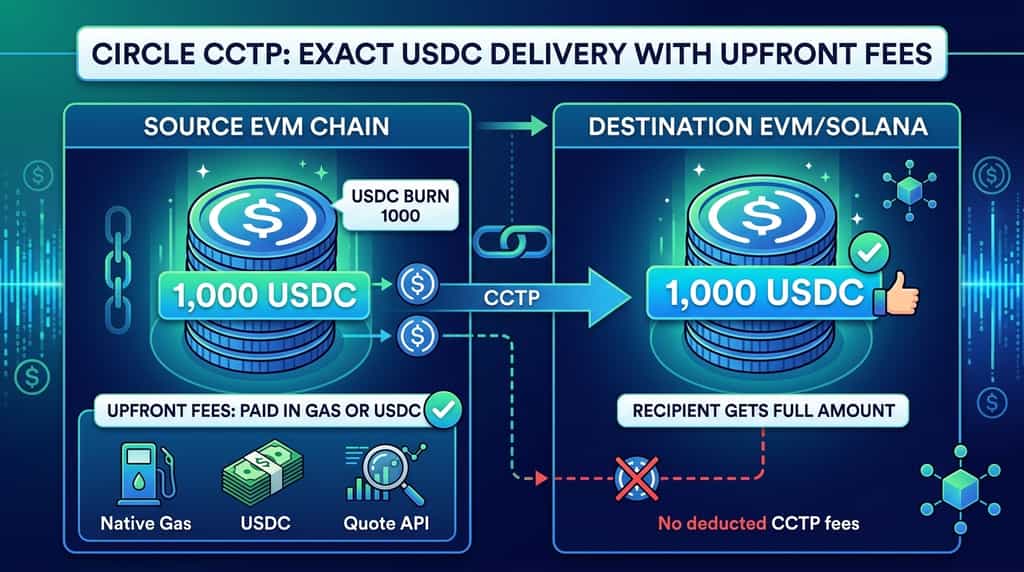
Circle now lets developers pay CCTP Fast Transfer and Forwarding Service fees on the source chain instead of deducting them from the USDC that arrives on the destination chain. According to Circle developer documentation updated in August 2026, the recipient can receive the full transfer amount when fees are collected upfront in native gas or USDC. The feature covers supported EVM sources and still allows destinations such as Solana, but it does not yet support transfers that start on Solana.
That change matters because USDC is a major dollar-pegged stablecoin. According to CoinMarketCap, USDC had a market cap of about $74.42 billion and a 24-hour volume of about $13.22 billion at the time of writing. DefiLlama data showed Circle CCTP moving hundreds of millions of dollars in a single day, which makes exact destination amounts a practical issue for wallets, exchanges, and payment apps.
What Are Circle CCTP Upfront Fees?
Circle CCTP upfront fees are protocol fees paid on the source blockchain before a USDC burn, so Fast Transfer and Forwarding Service costs are not taken from the minted amount.
CCTP moves native USDC by burning tokens on one chain and minting the same amount on another. Standard Transfer has no Circle protocol fee. Fast Transfer is faster than source-chain finality and carries a route-based fee. Circle documentation states the Fast Transfer fee range is 0–13 basis points, or about $0–$1.30 per $1,000 transferred.
By default, those fees come out of the USDC minted on the destination. Upfront fees separate the payment. You request a signed quote, pay the quoted amount in native gas or USDC, and burn only the amount the recipient should receive.
The Quote API can price Fast Transfer, Forwarding Service, or both in one signed, time-limited quote. Circle honors that quote if you submit before expiry.
How Do CCTP Upfront Fees Work on EVM Chains?
The flow starts with a quote, then a single source-chain transaction that pays the fee and burns USDC.
First, an app calls Circle’s Quote API with the transfer amount, source and destination domains, fee token, and fee types. Circle returns a signed quote with a total fee, a breakdown, issue time, and expiry.
Second, if the fee is paid in USDC, the sender approves token messenger with fees for the transfer amount plus the quoted fee. If the fee is paid in native gas, the quoted value is attached to the transaction.
Third, the sender calls deposit for burn with fees with a quote claim that includes the signed quote and a refund address. The contract verifies the quote, collects the fee, and burns the transfer amount.
Fourth, Circle attests the burn. Because the protocol fee was already paid, the destination mint is the full transferred amount.
Circle docs stress that the quote is bound to the amount, destination domain, and, for forwarding, hook data and destination caller. If those values change after the quote is issued, the on-chain call reverts.
Paying in native gas keeps the USDC balance intact. Paying in USDC is useful when an app already holds USDC and wants one-asset accounting.
Which Chains Support CCTP Upfront Fees?
Upfront fees are available on many EVM source chains that already support CCTP Fast Transfer or Forwarding Service, according to Circle’s supported-chains table updated in late August 2026.
Sources with upfront-fee support include Ethereum, Arbitrum, Base, OP Mainnet, Unichain, World Chain, Linea, Ink, Plume, Codex, Avalanche, Polygon PoS, HyperEVM, Monad, Sei, Sonic, and others listed as enabled in Circle’s matrix. Official testnets generally follow mainnet support, with Circle noting Monad Testnet as an exception for upfront fees.
Solana supports Fast Transfer as a source, but Circle documentation marks Solana as not supporting upfront fees as a source. Transfers to Solana can still use forwarding when the destination service is available.
Upfront fees apply to USDC only. Circle states they are not supported for USYC.
Apps must check both ends of a route. Fast Transfer must be available on the source. Forwarding must be available on the destination if that fee is included in the quote.
Why Did Circle Change How CCTP Fast Transfer Fees Are Paid?
Circle changed the collection path so apps can promise an exact destination amount without inflating the burn.
Deducting fees at mint forced extra math. A product that needed to deliver 1,000 USDC had to burn more than 1,000 USDC and still risk a mismatch if the live fee moved. Users saw a smaller credit than the amount they thought they sent.
Upfront collection removes that gap. Circle lists three benefits: exact delivery without extra burn math, payment in native gas or USDC, and a signed quote that locks price for a short window even if fees rise later.
That design fits wallets, payroll, treasury tools, and exchange deposits where the destination figure is part of the product contract. It also simplifies UI copy. The app can show “you send X USDC, they receive X USDC” and list the fee as a separate line.
Circle’s own USDC Bridge help pages already describe visible fees before confirmation, including protocol fees, a forwarder fee, and destination gas. Upfront CCTP fees extend that predictability to custom integrations that do not use the consumer bridge UI.
How Much Do CCTP Fast Transfer Fees Cost?
Fast Transfer fees vary by source chain and can change. According to Circle’s CCTP fees documentation updated in August 2026, examples include 1 bp on Ethereum and Solana, 1.3 bps on Base and OP Mainnet, 1.4 bps on Arbitrum, 2 bps on Ink, Unichain, and Plume, 4 bps on Morph, 12 bps on Starknet, and 13 bps on Linea.
Standard Transfer remains 0 bps on listed sources. Forwarding is a separate service fee. Circle help material for USDC Bridge lists a $0.05 forwarder fee plus destination gas that varies by network conditions.
DefiLlama reported about $160,343 in Circle CCTP fees over a recent 30-day window, with Ethereum, Hyperliquid L1, and Arbitrum among the larger contributors. That figure is protocol fee activity, not total USDC moved. DefiLlama’s CCTP bridge page also showed hundreds of millions of dollars in recent daily volume, which is why small basis-point differences add up.
Always pull live rates from Circle’s fee and quote APIs. Documentation warns that published tables can change and that overstating max fee on the older deduct-at-mint path can confuse users even when excess is refunded.
What Are the Benefits for Developers and Users?
Developers get one quote for Fast Transfer and forwarding, a fixed price window, and a destination mint that matches the burned amount.
Users get clearer receipts. The amount shown as “received” is the amount minted. Fees appear as a separate charge in gas or USDC.
Apps can keep destination accounting simple. Treasuries can fund a known invoice. Market makers can rebalance inventory without a residual dust shortfall. Consumer wallets can avoid support tickets about “missing” cents.
Paying the fee in native gas is useful on cheap L2s. Paying in USDC is useful when the sender has no spare gas token beyond the minimum needed to submit the transaction.
Predictable quotes also help compliance and operations teams. Finance can record protocol cost at initiation instead of reconciling a smaller mint later.
Beyond the Headlines: What KuCoin 5.0 Means for You
Market news moves fast — but where you act on it matters just as much. This October, KuCoin launches KuCoin 5.0, transforming KuCoin into a rebuilt platform. Here's what actually changes for you:
-
One account for everything. Older platforms split your money across separate "spot," "margin," and "futures" accounts and expected you to understand why. KuCoin 5.0's unified account removes that entirely — deposit once, and everything is simply there.
-
Stocks, indices, and commodities. KuCoin 5.0 expands beyond crypto into global markets. When crypto chops sideways and equities rally (or the reverse), you rotate in minutes instead of opening a brokerage account and waiting days for fiat rails.
-
Real-world assets (RWA). Tokenized exposure to traditional assets like commodities, right inside your crypto account. One of the fastest-growing segments in global finance is no longer reserved for institutions — you access it from the same balance you trade with.
-
Earn while you learn. Not ready to trade? KCUSD lets your stablecoins earn daily, auto-compounding interest. The lowest-stress way to put your idle deposit to work for 4% yield.
-
An AI assistant in plain language. Ask questions, get market context, understand what you're looking at — built into the platform, no jargon required.
-
An app that doesn't overwhelm. Faster, cleaner, and consistent — intuitive from the first tap, not after a tutorial.
-
Safety you can check, not just trust. A MiCAR-licensed EU entity, Proof of Reserves you can verify yourself, and internationally certified security (SOC 2 Type II, ISO 27001:2022).
Create your account in minutes — and start on the platform built for where crypto is going, not where it's been.
Conclusion
Circle’s CCTP upfront-fee path lets EVM-source apps pay Fast Transfer and Forwarding Service costs on the source chain so the destination mint can equal the intended USDC amount. Circle documentation from August 2026 describes a signed Quote API, payment in native gas or USDC, and a token messenger with fees burn that collects the fee separately from the transfer.
The feature is built for exact delivery, not for changing the underlying burn-and-mint model. Standard Transfer remains free at the protocol layer. Fast Transfer still prices by source chain in a published 0–13 bp range that can change. Solana cannot yet originate an upfront-fee transfer, and USYC is not included.
For builders, the practical work is quote handling, expiry, and matching on-chain parameters to the signed blob. For users, the practical gain is a cleaner received amount and a fee that can sit outside the USDC principal.
USDC remains a high-liquidity dollar stablecoin, with CoinMarketCap showing a market cap near $74.42 billion. Cross-chain flow through CCTP is large enough that fee design affects product quality. Check Circle’s live APIs and chain matrix before you ship a route, and treat any transfer as subject to network risk and changing protocol parameters.
FAQs
Can I pay CCTP upfront fees from Solana?
No. Circle documents upfront fees for supported EVM sources. Solana can still be a Fast Transfer source under the default deduct-at-mint model and can be a destination when forwarding is supported.
Does Standard Transfer need an upfront fee?
No. Circle states Standard Transfer has no protocol fee. Upfront quotes are for Fast Transfer and Forwarding Service.
What happens if my quote expires?
The on-chain call that relies on that signed quote will not be honored. Request a new quote and submit before the new expiry.
Can I pay part of the fee in gas and part in USDC?
The quote’s fee token selects one payment asset for the priced fees in that quote: native gas (default) or source-chain USDC.
Do upfront fees remove destination gas costs?
No. Destination gas or forwarding gas can still apply. Upfront fees cover the quoted Circle Fast Transfer and/or Forwarding Service amounts, not all network costs.
Disclaimer: This article is for informational purposes only and does not constitute financial, legal, or investment advice. Always conduct your own research before interacting with digital assets.