

Cerebras Stock Drops 20% After OpenAI Turns to Nvidia Chips: What It Means for the AI Chip Race

Cerebras Systems moved into focus after CBRS stock fell nearly 20% from late September into early October 2026. The drop followed reports that OpenAI was using Nvidia GPUs for a GPT-6.1 Sol Ultrafast workload, raising fresh questions about competition in the AI chip market. The selloff was also influenced by post-IPO share unlocks and insider-sale filings. OpenAI has not ended its Cerebras partnership, so the key issue is whether Nvidia can challenge Cerebras more directly in low-latency AI inference.
Why Did Cerebras Stock Drop Nearly 20%?
Cerebras stock came under heavy pressure at the end of September and into early October 2026, falling from $206.75 on September 25 to $166.43 on October 2. That works out to a decline of roughly 19.5%, taking CBRS below its $185 IPO price. The sharpest move came on September 30, when the stock dropped 8.87%. While reports linking OpenAI’s latest ultra-fast AI workload to Nvidia became the main technology-related catalyst, the selloff was not driven by a single event. A scheduled post-IPO share unlock and insider-sale filings arrived at roughly the same time, adding another source of selling pressure and uncertainty around the stock. The combination made it harder for investors to separate concerns about Cerebras’ competitive position from ordinary post-IPO market dynamics. That distinction matters because the roughly 20% decline reflects several overlapping pressures rather than one confirmed change in OpenAI’s strategy.
OpenAI-Nvidia Report Raised Questions About Cerebras’ Inference Role
The biggest new concern emerged after SemiAnalysis reported that OpenAI’s GPT-6.1 Sol Ultrafast workload was being served on Nvidia GPUs rather than Cerebras hardware. That mattered because Cerebras had already established a visible role in OpenAI’s high-speed inference strategy. In August, OpenAI confirmed that GPT-5.6 Sol Ultrafast was powered by Cerebras and could deliver output speeds of up to roughly 750 tokens per second. Investors therefore had reason to watch whether Cerebras would continue powering later generations of OpenAI’s fastest inference products. If Nvidia can deliver competitive performance on similar workloads, it could reduce the assumption that Cerebras has a clear advantage in every ultra-low-latency inference deployment. That possibility was enough to raise questions about how much of OpenAI’s future inference demand Cerebras could ultimately capture.
The report did not mean OpenAI had ended its relationship with Cerebras. OpenAI has long relied heavily on Nvidia GPUs, while also building a broader compute portfolio that includes Cerebras and other suppliers. More importantly, OpenAI has not announced the cancellation of its 750MW Cerebras agreement, and Sam Altman later described Cerebras as a close partner. The market reaction appears to have reflected a narrower concern: if Nvidia can compete effectively for the same low-latency workloads where Cerebras has promoted a speed advantage, Cerebras may face stronger competition for future OpenAI inference deployments than some investors had expected. That would not necessarily eliminate Cerebras from OpenAI’s infrastructure, but it could change how investors think about the company’s future share of high-value inference workloads. For a newly public AI chip company still proving the scale of its commercial opportunity, even a perceived change in customer allocation can have an outsized effect on sentiment.
Share Unlocks Added Pressure to CBRS Stock
The OpenAI-Nvidia story also arrived as a large block of Cerebras shares became eligible for sale following the company’s IPO. Around September 30, an estimated 19.4 million shares were released from lock-up restrictions, with additional tranches scheduled for October. Several insider-sale disclosures also appeared around the same period. These events do not prove that all unlocked shares were immediately sold, but they increased the potential supply of CBRS shares available to the market. For a stock that had only recently gone public, the prospect of additional tradable shares can weigh on price when investor sentiment is already weakening. Taken together, the Nvidia report, uncertainty about Cerebras’ future role in OpenAI’s fastest inference workloads, and the post-IPO share unlock provide a more complete explanation for why Cerebras stock fell nearly 20% across several trading sessions. The decline therefore looks less like a single-catalyst reaction and more like a mix of competitive concerns, supply pressure and changing expectations around Cerebras’ growth story.
OpenAI’s Nvidia Shift and What It Means for Cerebras
The bigger issue for Cerebras is not simply that Nvidia may be involved in one of OpenAI’s newest high-speed inference workloads. The more important question is whether Nvidia can now compete more effectively in the low-latency inference segment that Cerebras has used to differentiate itself from conventional GPU-based systems. Cerebras has built much of its commercial case around wafer-scale architecture, large on-chip memory bandwidth and the ability to generate tokens at very high speeds without relying on large clusters of separate GPUs. If Nvidia can narrow that performance gap while offering customers a familiar software ecosystem and much larger installed infrastructure base, Cerebras may have to prove its advantage workload by workload rather than relying on raw inference speed alone.
That does not make Cerebras irrelevant to OpenAI’s infrastructure strategy. OpenAI has increasingly adopted a multi-supplier approach to AI compute, using different hardware for training, inference and specialized workloads depending on cost, availability and performance. Cerebras can still benefit from this model if its systems remain particularly competitive for latency-sensitive inference. The strategic challenge is that OpenAI now has more options. Instead of one supplier dominating every stage of model deployment, future AI infrastructure may be divided among Nvidia GPUs, Cerebras wafer-scale systems and other specialized accelerators, with each platform winning workloads where its architecture offers the best economics or performance.
Cerebras Must Prove an Advantage Beyond Raw Inference Speed
Cerebras has attracted attention because its Wafer-Scale Engine takes a very different approach from the GPU architecture used by Nvidia. Rather than connecting large numbers of separate accelerator chips, Cerebras places an enormous number of compute cores on a single wafer-scale processor. That design can reduce communication bottlenecks and is particularly useful for workloads where latency matters. For customers running interactive AI assistants, coding models or real-time inference applications, faster token generation can directly improve the user experience.
However, AI infrastructure buyers evaluate more than tokens per second. Total cost of ownership, power efficiency, model compatibility, developer tools, deployment flexibility and access to available capacity can all influence purchasing decisions. Nvidia’s CUDA software ecosystem remains deeply embedded across the AI industry, while its Blackwell-generation systems are designed to serve both high-throughput and increasingly latency-sensitive inference workloads. Cerebras therefore needs to show that its architectural advantages translate into lower costs or meaningfully better application performance at commercial scale. That comparison will become increasingly important as AI companies move from simply training larger models to serving those models efficiently to millions of users.
OpenAI’s Multi-Chip Strategy Could Still Create Room for Cerebras
OpenAI’s infrastructure expansion suggests that the AI chip race is unlikely to become a simple winner-takes-all contest. Large AI developers require enormous amounts of compute, and relying on one hardware supplier can create capacity, pricing and supply-chain constraints. Using several chip architectures gives OpenAI more flexibility to match different models and workloads with the infrastructure that performs best for each task. That approach can also reduce dependence on any single vendor as AI inference demand continues to grow.
For Cerebras, this means the key opportunity is not necessarily replacing Nvidia across OpenAI’s entire infrastructure stack. A more realistic growth path is securing a meaningful share of specialized inference workloads where speed and low latency justify using a different architecture. Its long-term position will depend on whether it can turn those technical advantages into repeatable deployments across OpenAI and other customers. The company’s ability to diversify beyond a small number of major clients will also matter, because broader adoption would make its business less sensitive to changes in how any one AI company allocates compute between competing chip suppliers.
Cerebras vs Nvidia in the Growing AI Inference Chip Race
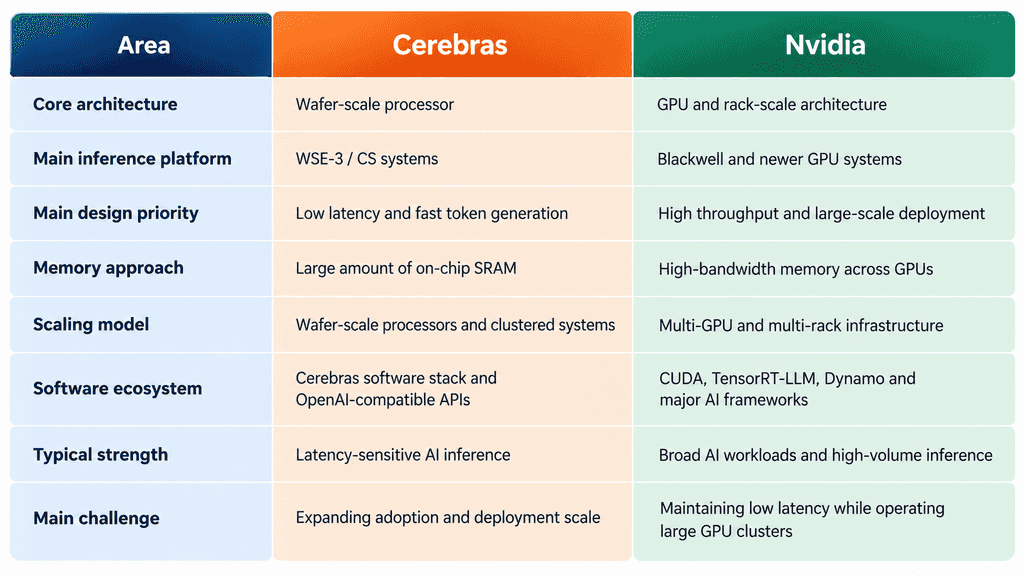
The Cerebras vs Nvidia comparison is becoming more relevant as AI companies spend more on inference, the stage where trained models generate answers, code, voice responses and agent actions for users. Cerebras and Nvidia approach this market differently: Cerebras focuses on wafer-scale processing and very low-latency token generation, while Nvidia combines powerful GPUs, high-speed networking and a mature software ecosystem to support large-scale AI workloads. That means the AI inference chip race is not simply about which processor is faster. Cost per token, throughput, latency, power efficiency, model support and ease of deployment can all influence which hardware an AI company chooses for a particular workload.
Cerebras vs Nvidia AI Inference: Key Differences
Cerebras builds its inference platform around the Wafer-Scale Engine, which places a very large number of compute cores on a single processor and is designed to reduce the communication and memory bottlenecks that can slow AI inference. Nvidia follows a more modular approach, connecting large numbers of GPUs through technologies such as NVLink and pairing them with its CUDA software ecosystem. This gives Nvidia flexibility across training, inference and data-center deployments, while Cerebras is more heavily differentiated by its focus on fast response times and specialized inference performance. Comparing the two therefore requires looking at architecture and deployment strategy rather than relying on a single tokens-per-second benchmark.
AI Inference Economics Could Matter More Than Raw Speed
As AI usage grows, infrastructure buyers are increasingly focused on how much useful inference they can deliver for every dollar and every unit of power consumed. A platform that produces extremely fast responses can be valuable for coding assistants, real-time AI agents and interactive applications, but providers handling billions of tokens may care more about throughput, utilization and cost per token. Nvidia has increasingly emphasized these metrics with its Blackwell-generation systems, arguing that newer platforms can process more inference workloads while improving energy efficiency and lowering serving costs compared with earlier Nvidia hardware.
Cerebras is approaching the same economics from a different direction. Its architecture is designed to keep more model data close to the compute cores, which can reduce memory movement and improve token-generation speed. The company has also explored disaggregated inference, where different hardware handles different stages of the inference process rather than forcing one processor type to perform every task. That model could become more common as AI companies look for the most efficient hardware combination for prefill, decoding and long-context reasoning.
The broader AI inference market may therefore become increasingly heterogeneous rather than dominated by one architecture. Nvidia has the advantage of an extensive software ecosystem, large installed base and broad support across training and inference, while Cerebras is trying to establish a stronger position in workloads where response time is especially important. As reasoning models and AI agents become more computationally demanding, the competitive edge may depend less on a single benchmark and more on which platform delivers the best balance of latency, throughput, power consumption and cost per token at commercial scale.
How the OpenAI Partnership Could Shape Cerebras Stock Ahead
For Cerebras stock, the OpenAI relationship is likely to matter less as a headline partnership and more through measurable financial results. Investors can now watch whether contracted inference capacity turns into revenue on schedule, whether Cerebras can build the infrastructure required to meet its commitments, and whether OpenAI ultimately expands its use of the platform. Those milestones could have a greater influence on the longer-term CBRS investment case than short-term changes in which chip powers an individual model or service.
OpenAI Revenue Could Become a Bigger Part of the Cerebras Growth Story
Cerebras began recognizing revenue from its OpenAI agreement in the first quarter of 2026 and recorded $56.8 million from the arrangement in the second quarter, bringing first-half revenue tied to the agreement to $74.4 million. As of June 30, Cerebras reported $25.4 billion in remaining performance obligations, with a significant portion linked to OpenAI, and said roughly 22% of that amount was expected to be recognized during the 24 months ending June 2028. For investors, the key issue is therefore revenue conversion: consistent growth from these contracted obligations would give Cerebras greater visibility into future sales, while deployment delays or slower recognition could put pressure on expectations.
Capacity Expansion Will Test Cerebras' Ability to Deliver at Scale
The size of the OpenAI agreement also creates an execution challenge. Cerebras said it had more than 600MW of data-center capacity live or under contract for delivery by the end of 2027, while manufacturing capacity was expected to increase more than tenfold during 2026. The company has also secured additional TSMC wafer supply as it prepares for higher demand. These investments are important because Cerebras must translate its technology into reliable commercial infrastructure across multiple data centers. Progress on capacity deployment, manufacturing and utilization could therefore become important operating signals for CBRS investors as more of the OpenAI commitment moves toward production.
OpenAI's Additional 1.25GW Option Represents Upside, Not Guaranteed Revenue
Beyond the committed capacity, OpenAI holds an option to purchase another 1.25GW of Cerebras inference capacity for deployment through 2030, which could increase the relationship to as much as 2GW. That option could materially expand the commercial opportunity if OpenAI chooses to exercise it, but it should not be treated as contracted revenue today. Future expansion will likely depend on performance, economics, deployment reliability and OpenAI's broader infrastructure requirements. For Cerebras stock, evidence that OpenAI is taking additional capacity could strengthen expectations for longer-term demand, while the absence of an expansion would not by itself indicate that the existing agreement has failed.
Customer Diversification Could Reduce CBRS Dependence on OpenAI
OpenAI can remain a major growth driver while Cerebras builds a broader customer base. The company has already disclosed relationships with AWS, AMD, Cognition, Lovable, CrowdStrike, Figma and other enterprise customers, while its cloud and services revenue reached $126 million in the second quarter, up 281% year over year on a GAAP basis. Expanding these deployments would give investors another way to judge whether demand for Cerebra's inference extends beyond one large customer. Over time, stronger revenue diversification could make CBRS less sensitive to changes in OpenAI's infrastructure decisions and provide clearer evidence that Cerebras can turn its wafer-scale technology into a wider commercial platform.
🔥 Beyond the Headlines: What KuCoin 5.0 Means for You
Market news moves fast — but where you act on it matters just as much. This October, KuCoin launches KuCoin 5.0, transforming KuCoin into a rebuilt platform. Here's what actually changes for you:
-
One account for everything. Older platforms split your money across separate "spot," "margin," and "futures" accounts and expected you to understand why. KuCoin 5.0's unified account removes that entirely — deposit once, and everything is simply there (only available to VIPs for now).
-
Stocks, indices, and commodities. KuCoin 5.0 expands beyond crypto into global markets. When crypto chops sideways and equities rally (or the reverse), you rotate in minutes instead of opening a brokerage account and waiting days for fiat rails.
-
Real-world assets (RWA). Tokenized exposure to traditional assets like commodities, right inside your crypto account. One of the fastest-growing segments in global finance is no longer reserved for institutions — you access it from the same balance you trade with.
-
Earn while you learn. Not ready to trade? KCUSD lets your stablecoins earn daily, auto-compounding interest. The lowest-stress way to put your idle deposit to work for 4% yield.
-
An AI assistant in plain language. Ask questions, get market context, understand what you're looking at — built into the platform, no jargon required.
-
An app that doesn't overwhelm. Faster, cleaner, and consistent — intuitive from the first tap, not after a tutorial.
-
Safety you can check, not just trust. A MiCAR-licensed EU entity, Proof of Reserves you can verify yourself, and internationally certified security (SOC 2 Type II, ISO 27001:2022).
Create your account in minutes — and start on the platform built for where crypto is going, not where it's been.
Conclusion
The nearly 20% drop in Cerebras stock reflects more than the OpenAI-Nvidia report. Share unlocks, insider-sale filings and uncertainty around future inference workloads also weighed on CBRS, while OpenAI's broader Cerebras partnership remains in place. The bigger question now is whether Cerebras can turn its wafer-scale architecture into sustained commercial growth as Nvidia pushes deeper into AI inference. Going forward, investors will likely focus on revenue growth, margins, capacity deployment, customer diversification and any expansion of the OpenAI relationship. Those factors should provide a clearer view of Cerebras' long-term position in the AI chip race than any single model or hardware decision.
FAQs
What are Cerebras Systems?
Cerebras Systems is a U.S. AI computing company best known for developing wafer-scale processors designed for artificial intelligence workloads. Its systems are used for AI training and inference, with the company placing particular emphasis on reducing the latency involved in generating responses from large AI models.
What is the Cerebras stock ticker?
Cerebras Systems trades on the Nasdaq Global Select Market under the ticker CBRS. The company went public on May 14, 2026, giving public-market investors direct exposure to one of Nvidia's emerging competitors in AI computing infrastructure.
What was the Cerebras IPO price?
Cerebras priced its initial public offering at $185 per share in May 2026. The completed offering included 34.5 million Class A shares and generated approximately $6.38 billion in gross proceeds before underwriting discounts and other offering expenses.
What makes Cerebras chips different from traditional GPUs?
Cerebras builds processors around a wafer-scale architecture rather than cutting a silicon wafer into many smaller chips. Its design places a very large amount of compute, memory and bandwidth on one processor, reducing some of the data movement between separate chips that can become a bottleneck in large AI workloads.
Why is low-latency AI inference becoming important?
Low-latency inference reduces the time between a user's request and an AI model's response. That becomes increasingly valuable for coding assistants, voice AI, autonomous agents and other applications where users need responses in near real time rather than waiting for long model outputs to finish.
Does the OpenAI-Cerebras agreement mean every OpenAI model will run on Cerebras?
No. OpenAI has described its infrastructure strategy as a portfolio of different computing systems matched to different workloads. Cerebras can therefore supply significant inference capacity without becoming the exclusive hardware provider for every OpenAI model, service or inference tier.
Disclaimer: This article is for informational purposes only and does not constitute investment advice. Crypto assets can be highly volatile, and market conditions, token liquidity and project developments may change rapidly. Readers should conduct their own research and assess their risk tolerance before making financial decisions.