

Bitmine Nears 6 Million ETH: What $334M in Staking Revenue Means for the ETH Treasury Trade
Introduction
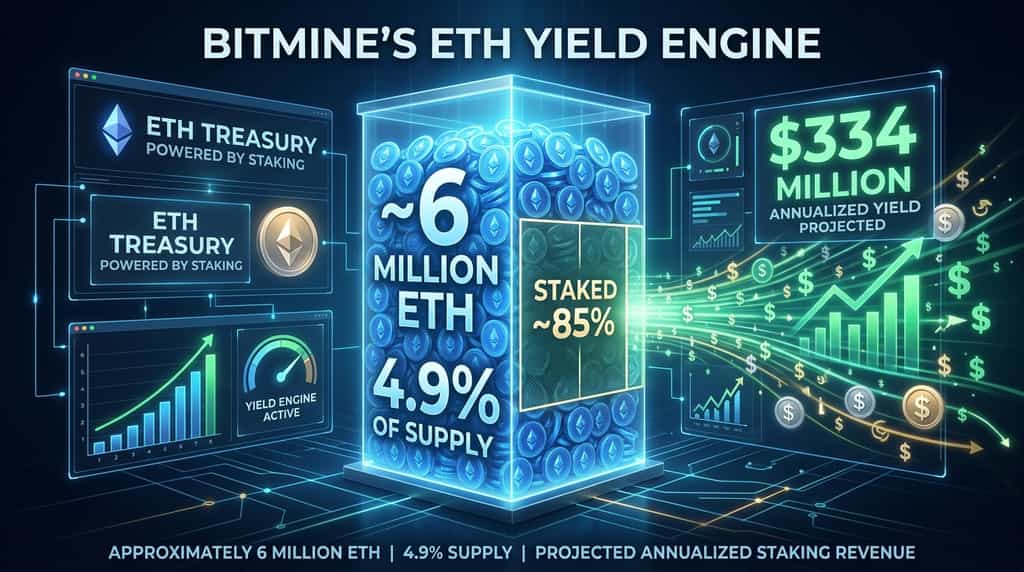
Bitmine Immersion Technologies (BMNR) now holds 5,956,378 ETH after another weekly purchase, according to the company’s September 13, 2026 holdings update. That stack is about 4.9% of Ethereum’s 122.0 million token supply and sits near a 6 million ETH milestone. More than 5.06 million of those tokens are staked, and management projects about $334 million in annualized staking revenue at a 2.62% seven-day yield. The ETH treasury play is no longer just a balance-sheet bet. It is a yield engine attached to one of the largest corporate Ether positions in the market.
How Large Is Bitmine’s ETH Treasury Right Now?
Bitmine’s ETH position is 5,956,378 tokens as of September 13, 2026, based on the company’s weekly operations update. At the firm’s stated reference price of $2,513 per ETH, that holding is worth about $15 billion. Combined with 212 BTC, a $180 million stake in Beast Industries, a $98 million stake in Eightco Holdings, and $549 million in cash and marketable securities, total reported holdings reach $15.8 billion.
The company added 27,180 ETH in the latest week. That purchase followed a 28,086 ETH buy the week before, which had lifted the stack to 5,929,198 ETH as of September 7, 2026, according to Bitmine’s earlier disclosure. Chairman Tom Lee has said Bitmine has bought ETH every week since launching its ETH treasury strategy on June 30, 2025.
The “Alchemy of 5%” target remains the headline goal. At 4.9% of a 122.0 million ETH supply, Bitmine is roughly 170,000 ETH short of a clean 5% mark, depending on how supply is measured on a given day. The weekly cadence has slowed versus earlier 2026 spikes, but it has not stopped.
Concentration risk is the other side of the same number. A single public company now controls a share of ETH large enough to matter for circulating float, staking queues, and market narrative. That is the point of the treasury model. It is also the risk.
Why Does Bitmine Stake Most of Its ETH?
Bitmine stakes ETH to convert a static treasury into recurring protocol income. As of September 7, 2026, the company reported 5,067,309 ETH staked, valued at about $12.7 billion at $2,513 per ETH. That is roughly 85% of the current ETH stack.
The firm’s own staking operations produced a 2.62% seven-day annualized yield in the latest update, according to CoinMarketCap Academy’s summary of the company figures. On that yield and the current staked balance, projected annualized staking revenue is $334 million. Management says the figure could rise to about $392 million if the full treasury is staked through MAVAN and staking partners.
That yield is not a guaranteed coupon. Ethereum staking returns move with validator participation, issuance, and network conditions. A 2.62% snapshot can compress if more ETH is staked network-wide, or expand if activity and tips rise. Bitmine’s projection is a run-rate, not a booked contract.
The structural contrast with Bitcoin treasury companies is still real. BTC does not pay native proof-of-stake rewards. ETH does. Bitmine’s model therefore has an income line that a pure BTC treasury does not have, even if both remain exposed to token price swings.
What Is MAVAN and How Does It Fit the Treasury Play?
MAVAN — the Made in America Validator Network — is Bitmine’s institutional staking and validation platform. The company uses it first for its own ETH, then as infrastructure that can serve other institutions and custodians. The September update frames MAVAN as the path to “at scale” staking, which is how management gets from $334 million in current projected revenue to $392 million if the unstaked remainder is locked.
Validator operations are not free. Bitmine recently shifted staking advisory services after ending a long-term management services agreement with Ethereum Tower LLC by mutual consent effective September 3, 2026, according to an 8-K summary of the company filing. A new arrangement with American Validator LLC, an affiliate of Ethereum Tower, sets a 1.50% fee on staking rewards. That fee is a direct haircut on gross yield and should be read into any net-revenue estimate.
Operational concentration is another issue. Staking 5.07 million ETH in one corporate program creates slashing, key-management, client-diversity, and regulatory exposure. A single operator error or policy change can affect a position large enough to move headlines. MAVAN is designed to look institutional. Size still concentrates risk.
How Does Bitmine’s ETH Treasury Compare With Other Corporate Crypto Plays?
Bitmine is the largest corporate ETH holder by reported token count in recent company coverage. Its 4.9% share of supply is the defining comparison point. Strategy-style Bitcoin treasuries still dwarf most ETH names in dollar value, but they cannot harvest native staking yield.
Grayscale’s Ethereum staking product has been cited with an 84.6% staking ratio, close to Bitmine’s roughly 85% staked share of holdings. The comparison is imperfect — an ETF wrapper is not a corporate treasury — but it shows that high staking ratios are now standard for large ETH books that want income, not just exposure.
SharpLink’s plan to stake $200 million of ETH through Lido, reported in the same CoinMarketCap Academy article, shows a second path: liquid staking tokens plus DeFi reuse. Bitmine’s path is more vertically integrated. It wants validator infrastructure and treasury ownership in the same house.
Liquidity around the equity is part of the trade. Bitmine has highlighted Russell 1000 inclusion as of June 26, 2026, and high recent trading activity. Equity liquidity does not remove mark-to-market risk on 6 million ETH. It only makes the stock easier to trade around that risk.
What Are the Main Risks in a 6 Million ETH Treasury Strategy?
Price risk is first. A multi-billion-dollar ETH book moves with ETH. Earlier in 2026, Bitmine’s SEC 10-Q for the period ended May 31 showed how mark-to-market accounting can dominate reported results when digital-asset prices fall. Staking income in the tens of millions per quarter does not offset a multi-billion-dollar unrealized swing on the stack.
Yield risk is second. The $334 million figure is annualized from a 2.62% seven-day rate and current prices. If ETH drops, dollar revenue drops even if token rewards stay similar. If network yield falls toward 2% or lower, the same 5.07 million staked ETH produces less cash.
Liquidity and unstaking risk is third. Staked ETH is not instantly spendable. Exit queues can lengthen when many validators leave at once. A company that needs cash for buybacks, taxes, or further purchases cannot treat staked ETH as a checking account.
Regulatory and custody risk is fourth. A U.S.-listed firm running a large validator set sits at the intersection of securities disclosure, banking counterparties, and evolving digital-asset rules. Fee arrangements, validator partners, and “moonshot” equity stakes add complexity that a simple spot ETH holder does not have.
Supply-share risk is fifth. Owning nearly 5% of ETH is a feature for narrative and potential influence. It is a bug if the market starts to treat one corporate wallet as a overhang. Weekly buys support the bid. They also advertise a large future seller if strategy ever reverses.
Beyond the Headlines: What KuCoin 5.0 Means for You
Market news moves fast — but where you act on it matters just as much. This October, KuCoin launches KuCoin 5.0, transforming KuCoin into a rebuilt platform. Here's what actually changes for you:
-
One account for everything. Older platforms split your money across separate "spot," "margin," and "futures" accounts and expected you to understand why. KuCoin 5.0's unified account removes that entirely — deposit once, and everything is simply there.
-
Stocks, indices, and commodities. KuCoin 5.0 expands beyond crypto into global markets. When crypto chops sideways and equities rally (or the reverse), you rotate in minutes instead of opening a brokerage account and waiting days for fiat rails.
-
Real-world assets (RWA). Tokenized exposure to traditional assets like commodities, right inside your crypto account. One of the fastest-growing segments in global finance is no longer reserved for institutions — you access it from the same balance you trade with.
-
Earn while you learn. Not ready to trade? KCUSD lets your stablecoins earn daily, auto-compounding interest. The lowest-stress way to put your idle deposit to work for 4% yield.
-
An AI assistant in plain language. Ask questions, get market context, understand what you're looking at — built into the platform, no jargon required.
-
An app that doesn't overwhelm. Faster, cleaner, and consistent — intuitive from the first tap, not after a tutorial.
-
Safety you can check, not just trust. A MiCAR-licensed EU entity, Proof of Reserves you can verify yourself, and internationally certified security (SOC 2 Type II, ISO 27001:2022).
Create your account in minutes — and start on the platform built for where crypto is going, not where it's been.
Conclusion
Bitmine’s latest update puts 5,956,378 ETH on the books, or about 4.9% of a 122.0 million token supply, with total crypto, cash, and related holdings at $15.8 billion as of September 13, 2026. The firm staked 5,067,309 ETH and projects $334 million in annualized staking revenue at a 2.62% seven-day yield, with a $392 million figure if the rest of the stack is staked through MAVAN and partners.
That is the ETH treasury play in one line: accumulate a supply-share position, stake most of it, and sell the combination as both a macro bet and a yield business. The model is distinct from Bitcoin treasuries because native staking exists. It is not risk-free, because yield, price, queues, fees, and regulation all move.
Weekly buying since June 30, 2025, has carried Bitmine to the edge of 6 million ETH. The last mile toward 5% of supply is now a modest token gap, not a multi-year dream. Whether that concentration helps Ethereum or simply concentrates corporate risk is a market question, not a slogan. Read the yield as a run-rate. Read the 4.9% as size. Trade ETH only after mapping both.
FAQs
Does Bitmine already own 6 million ETH?
No. The September 13, 2026 company update puts holdings at 5,956,378 ETH, just under 6 million.
Is the $334 million staking figure already earned this year?
No. It is an annualized projection from a 2.62% seven-day yield on the current staked balance, not a locked annual contract.
What share of Ethereum’s supply does Bitmine control?
About 4.9% of the 122.0 million ETH supply cited in the September 2026 update.
Can staking yield fall even if Bitmine keeps buying ETH?
Yes. Network-wide staking participation and protocol rewards can compress yield independent of Bitmine’s purchase pace.
Is BMNR stock the same as holding ETH?
No. The stock adds equity structure, fees, other assets, and corporate actions on top of ETH price and staking income.
Disclaimer: This article is for informational purposes only and does not constitute financial, legal, or investment advice. Always conduct your own research before interacting with digital assets.