

Cursor, Claude Code & the New Dev Stack: Why AI-Powered Coding Is Crypto's Biggest Catalyst in 2026
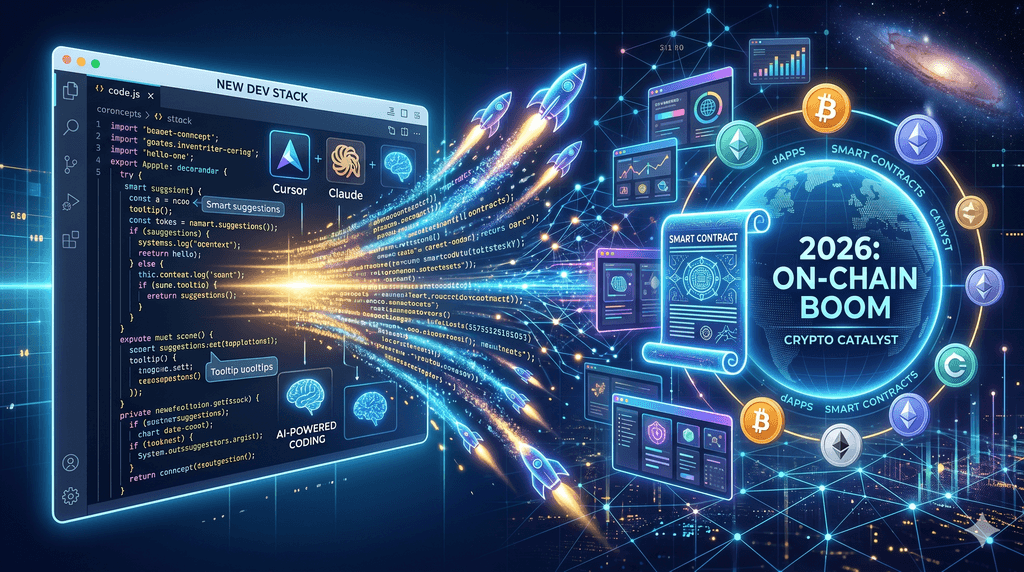
The year 2026 has officially marked the "Vibe Shift" in software engineering. If 2024 was about AI autocomplete and 2025 was about agentic assistants, April 2026 is the month the "New Dev Stack" achieved total dominance. In a world-shaking move just days ago, SpaceX secured a $60 billion option to acquire Cursor, the AI-native code editor that has become the fastest-scaling startup in history. Meanwhile, Anthropic’s Claude Code has leaked a "KAIROS" autonomous daemon blueprint, signaling a future where AI agents build entire decentralized ecosystems while their human "editors" are asleep.
For the cryptocurrency market, this isn't just a tech upgrade—it is a fundamental supply-side shock. As the cost of "producing" code drops toward zero, the value of on-chain scarcity and AI-agent economies is skyrocketing. From "Vibe Coding" smart contracts to orbital data centers, the fusion of AI coding and blockchain is the primary engine behind the 2026 bull run.
Key Takeaways: The 2026 AI-Coding Revolution
-
The $60B Acquisition: SpaceX’s move to buy Cursor (Anysphere) at a $60B valuation validates AI coding as the ultimate "vertical integration" for the Musk-led xAI/Starlink empire.
-
"Vibe Coding" Maturity: The barrier to building dApps has collapsed. Developers now provide "intent and vibes," while AI agents like Claude Code handle the Rust, Solidity, and ZK-proof logic.
-
Agentic Economics: 2026 is the year of the Autonomous Agent. AI tools are no longer just editors; they are on-chain actors that manage wallets, audit their own code, and deploy liquidity.
-
DePIN & Compute: The demand for AI coding is driving a massive rotation into DePIN (Decentralized Physical Infrastructure) tokens as developers seek censorship-resistant compute for their "KAIROS" daemons.
-
The Security Paradox: While AI-generated code is faster, new tools from alliances like the ASI (Artificial Superintelligence) are now using mathematical proofs to "vibe check" contracts before they hit the mainnet.
-
The SpaceX × Cursor Merger: Why Musk is Buying the "Printing Press"
The biggest headline of April 2026 is SpaceX's $60 billion play for Cursor. With an Annual Recurring Revenue (ARR) that jumped past $2 billion in record time, Cursor is the undisputed king of the new developer workflow. But why would a rocket company buy a code editor?
Musk’s vision is total verticality. By combining Cursor’s interface, xAI’s Colossus supercomputer (now leveraging 1 million H100 equivalents), and Starlink’s orbital bandwidth, SpaceX is building an AI-native operating system that spans from Earth to orbit.
For the crypto market, this merger means:
-
Integrated Agent Wallets: Rumors suggest the "SpaceX Cursor" will feature native crypto wallet integration, allowing AI agents to pay for API credits and compute in real-time using stablecoins.
-
High-Speed Protocol Development: The xAI-Cursor synergy allows for "Hardware-Accelerated Coding," where AI models are fine-tuned specifically for the low-latency requirements of high-performance blockchains like Solana and Monad.
-
Claude Code and the "KAIROS" Autonomous Daemon Leak
While Cursor dominates the IDE (Integrated Development Environment) space, Anthropic’s Claude Code has pushed the boundaries of agency. A recent source map leak in late March 2026 revealed "KAIROS"—an autonomous daemon mode that performs "memory consolidation" and "autoDream" nightly sessions.
In the 2026 crypto market, KAIROS represents a shift toward Self-Building Ecosystems. Instead of a team of 20 engineers, a single "Vibe Coder" can now deploy a daemon that:
-
Drafts a new DeFi protocol based on a natural language prompt.
-
Iterates on its own code to fix logic flaws identified during simulations.
-
Audits the smart contract using "Strict Write Discipline" templates.
-
Deploys the code to a Layer 2 network once specific security benchmarks are met.
This autonomous cycle is expected to lead to a 100x increase in the number of dApps deployed in 2026 compared to 2024, creating an unprecedented demand for block space and gas tokens.
-
"Vibe Coding" Smart Contracts: From Syntax to Sentiment
In 2024, coding a smart contract required deep knowledge of Solidity and EVM gas optimization. In 2026, we have entered the era of Aesthetic-Driven Development, popularized by the "Vibe Coding" movement.
The fundamental unit of work is no longer the "line of code" but the "Project Vibe." Leading developers describe a "tennis match" workflow: the human sets the intent (e.g., "Build a cross-chain lending protocol that prioritizes low-slippage for RWA tokens"), and the AI executes multi-file changes instantly.
However, this ease of use has led to "Context Entropy"—where AI agents become confused by large codebases. The solution in 2026 is Formal Verification. New tools from the ASI Alliance and Matterhorn are now being used to mathematically prove that AI-generated code is exploit-free before it touches the blockchain.
-
The DePIN Rotation: Powering the Global AI Code Engine
The massive compute requirements of Cursor, Claude Code, and their autonomous sub-agents have created a supply squeeze in the traditional cloud market. This has triggered a massive capital rotation into DePIN (Decentralized Physical Infrastructure Networks).
-
GPU Marketplaces: Tokens representing decentralized GPU clusters (like Render and Akash) have become "proxy bets" on the success of AI coding tools.
-
Orbital Data Centers: SpaceX’s plan to put data centres in orbit has sparked interest in space-based DePIN protocols. These networks provide censorship-resistant compute for AI agents that operate outside terrestrial jurisdictions.
-
ZKP Generation: As AI generates more code, the need for Zero-Knowledge Proofs (ZKPs) to verify that code's execution has led to a boom in ZK-hardware-focused crypto projects.
According to 2026 market data, the DePIN sector has outperformed traditional DeFi by 45% YTD, driven almost entirely by the demand from AI developer agents.
-
Riding the AI-Coding Bull Market on KuCoin
As the $60 billion Cursor deal and the KAIROS leak send ripples through the market, the speed of information has become the ultimate edge. In late 2026, the "Musk Trade" is no longer just about memes—it's about the Infrastructure of Intelligence.
Navigating this convergence of AI and Blockchain requires a platform that mirrors the agility of the tools being built. KuCoin has positioned itself as the premier hub for the AI-Coding narrative, offering deep liquidity and early access to the very tokens powering this revolution.
Consider how the 2026 trader interacts with the market:
-
AI Gem Discovery: Much like Cursor finds the "best vibe" for your code, KuCoin’s advanced listing criteria help traders find the "best alpha" in the AI, DePIN, and Agentic token categories before they hit the mainstream.
-
Vibe-Trading Bots: KuCoin’s 2026 trading bot suite allows you to automate your macro thesis. Whether you’re hedging against SpaceX IPO volatility or accumulating DePIN tokens during a compute squeeze, you can "vibe" your parameters and let the bots handle the execution.
-
Institutional-Grade Access: With the $18.7B institutional inflow into Bitcoin ETFs in Q1 2026, KuCoin provides the robust infrastructure needed to trade alongside the "Big Money" that is currently betting on the long-term debasement-hedge properties of AI-integrated assets.
The "New Dev Stack" is creating a world where ideas become protocols in minutes. Having an exchange that supports that velocity is not just a preference—it’s a necessity for 2026.
-
Security and the "Correct-by-Construction" Era
The dark side of AI-powered coding is what researchers call "Context Entropy"—the tendency for AI agents to become confused or hallucinatory as projects grow in complexity. This has led to a surge in specialized malware targeting developers, such as the March 2026 npm supply chain attack that coincided with the Claude Code leak.
To combat this, the 2026 crypto industry is turning to "Correct-by-Construction" development:
-
Blessed Templates: The ASI Alliance is building templates that use spatial behavioral types to mathematically prove that a contract has no race conditions or leaked funds.
-
Strict Write Discipline: AI agents are now instructed to only update their memory after a confirmed successful file write, preventing them from polluting their context with failed logic.
Conclusion: The Singularity of Code and Capital
The $60 billion valuation for Cursor and the rise of autonomous daemons like Claude Code’s KAIROS are not just software milestones. They represent the "Singularity of Capital"—the moment where the speed of innovation (AI code) finally matches the speed of value transfer (Blockchain).
In the second half of 2026, the successful crypto investor will be the one who treats these AI tools not just as helpers, but as the primary drivers of the new economy. The "New Dev Stack" is here, and it is building a decentralized future at a velocity that traditional markets can barely comprehend.
FAQs
Is "Vibe Coding" replacing actual developers in 2026?
Not replacing, but evolving. The title "Software Engineer" is shifting toward "System Architect." The AI writes the code, but humans provide the design intuition, security modeling, and "taste."
Why are DePIN tokens surging because of AI coding?
AI coding tools like Cursor and Claude Code require massive compute for training and running autonomous daemons. DePIN provides a decentralized, often cheaper, and censorship-resistant source of this compute power.
What is the $60B SpaceX Cursor deal actually for?
Vertical integration. Musk wants SpaceX to control the software "printing press" (Cursor), the hardware (Colossus), and the distribution (Starlink) to create an AI-powered aerospace and data empire.
How can I trade the "Cursor Narrative"?
A: While Cursor is a private company, traders are focusing on "Proxy Plays": xAI-related assets, DePIN compute tokens, and high-performance blockchains that benefit from an explosion of AI-generated dApps. Platforms like KuCoin offer early access to these emerging sectors.
What are the risks of AI-generated smart contracts?
A: The main risks are "Context Entropy" (AI hallucinations) and security vulnerabilities. 2026 has seen the rise of "Mathematical Proof" tools that audit AI code in real-time to ensure it is "correct-by-construction" before deployment.
Disclaimer: This article is for informational purposes only and does not constitute financial or investment advice. Cryptocurrency and AI-related investments carry significant risk.