

Japan Cuts FY2026 GDP Growth Forecast to 0.9%: What Rising Oil Prices Mean for Bitcoin and Crypto
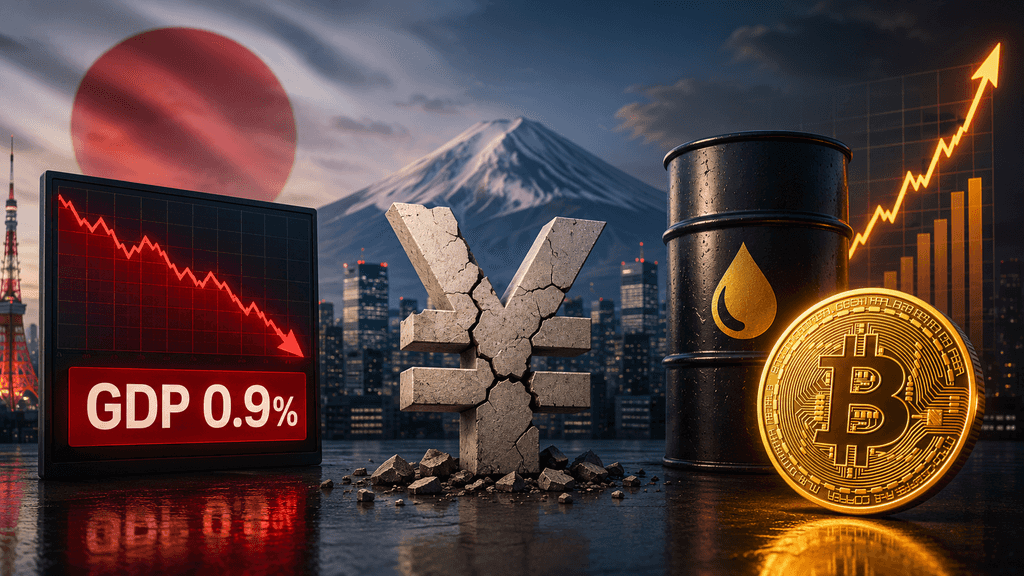
The Japanese government has officially downgraded its real GDP growth forecast for fiscal year 2026 from 1.3% to 0.9%. Driven by surging international oil prices, escalating energy import costs, a historically weak yen, and a deteriorating consumption outlook, this revision paints a complex macroeconomic picture. At the same time, inflation forecasts have been revised upward, leaving Japan caught in a difficult environment of slowing economic expansion and rising price pressures.
For cryptocurrency investors, the actual 0.9% figure is not the primary concern. The real significance lies in how this structural economic shift could influence the Bank of Japan’s (BOJ) monetary policy, disrupt the massive yen carry trade, and ultimately affect global market liquidity. Could Japan’s weaker growth outlook become another source of volatility for Bitcoin and global crypto markets? To answer this, we must first understand why Japan is uniquely vulnerable to oil price shocks and how that vulnerability transmits through foreign exchange markets directly into the global cryptocurrency ecosystem.
What Changed in Japan’s FY2026 Outlook?
To grasp the implications of this downgrade, it is necessary to establish exactly what the Japanese government is forecasting. Fiscal year 2026 in Japan runs from April 2026 through March 2027. Over this period, the expectation for real GDP growth has been meaningfully lowered to 0.9%, down from the previously optimistic 1.3%. This adjustment reflects synchronized downgrades in both private consumer spending and corporate business investment.
Simultaneously, the government has raised its inflation estimates, indicating that imported energy costs are creating new, persistent price pressures across the economy. It is important to note that the government still projects positive economic growth; this is a growth deceleration, not an official recession forecast. A downward revision in future projections does not mean that actual GDP is currently shrinking, but rather that the momentum is fading faster than previously anticipated.
| Economic Indicator | Previous Forecast | Updated Forecast | Why It Matters |
| Real GDP growth | 1.30% | 0.90% | Slower economic expansion |
| Consumer spending | Higher estimate | Lower estimate | Weaker household demand |
| Business investment | Higher estimate | Lower estimate | Rising cost uncertainty |
| Inflation | Lower estimate | Higher estimate | More pressure on the BOJ |
The core issue highlighted by these revised figures is not whether the Japanese economy can still grow, but whether that growth is sustainable under the heavy burden of elevated energy costs.
Why Rising Oil Prices Hit Japan So Hard
Japan’s economy is structurally dependent on imported energy. Lacking substantial domestic fossil fuel resources, the country relies heavily on imports of crude oil, liquefied natural gas (LNG), and coal to power its industries and cities. Consequently, any significant rise in international oil prices acts as an immediate tax on both corporate balance sheets and household budgets.
Because crude oil is universally priced in US dollars, currency fluctuations can drastically amplify the pain of rising energy costs. Even if the dollar-denominated price of oil remains flat, a weakening yen means that Japanese importers must spend more of their local currency to purchase the exact same amount of energy. This dynamic transforms a moderate global oil rally into a severe domestic cost shock for Japan.
The economic transmission chain of this shock is clear and unforgiving. Higher oil prices lead to a larger national import bill, which immediately pushes up business costs for aviation, shipping, manufacturing, and electricity generation. Companies are then faced with a stark choice: absorb the rising costs and sacrifice their profit margins, or pass the costs onto consumers through higher retail prices. Both choices ultimately lead to weaker household spending.
Ultimately, Japan’s economic risks stem not only from a slowing GDP but also from a decline in real purchasing power and real national income. For the average Japanese resident, even if nominal wages see a slight bump, as long as energy and food prices rise at a faster pace, their actual capacity to consume—and invest—will continue to deteriorate.
The Weak Yen Makes the Oil Shock Worse
The relationship between the Japanese yen and global energy prices creates a compounding problem for the nation's economy. When the US dollar appreciates against the yen, Japanese utility companies and manufacturers require vastly more yen to settle their dollar-denominated crude oil contracts. While a weak yen historically benefited Japan’s massive export sector by boosting the repatriated value of overseas earnings, the sheer scale of modern energy import costs has shifted this balance.
Today, the benefits enjoyed by major exporters and the financial strain placed on everyday households can occur simultaneously. If the yen remains persistently weak, it threatens to unmoor inflation expectations and severely damage consumer confidence. As domestic purchasing power declines, Japanese traders and investors may increasingly look to alternative assets to preserve wealth, often by tracking BTC/JPY price movements to assess how Bitcoin performs against a depreciating local currency.
Market participants are intensely focused on how the Japanese government and central bank will respond. Persistent currency weakness inevitably sparks discussions about direct government intervention in the foreign exchange market, as well as debates over whether the BOJ needs to adopt a more aggressive, hawkish stance to defend the currency.
Japan is facing a difficult combination of imported inflation and slowing domestic demand. This is not a typical demand-pull inflation caused by an overheating economy. Cost-push inflation, driven by external oil prices and foreign exchange rates, cannot be easily solved by simply raising interest rates, as aggressive rate hikes could simultaneously crush whatever domestic economic growth remains.
The Bank of Japan Faces a Policy Trap
The current macroeconomic landscape places the Bank of Japan in a precarious policy trap, torn between the need to curb inflation and the necessity of supporting a fragile economy. On one hand, the BOJ faces intense hawkish pressure. The combination of rising oil prices and a weak yen is relentlessly pushing up import prices, causing inflation to hover above the central bank's target for a sustained period. As companies pass these costs onto consumers, a prolonged weak yen threatens to erode the BOJ's institutional credibility, leading markets to price in an accelerated schedule of interest rate hikes.
On the other hand, the BOJ is severely constrained in its ability to tighten monetary policy. The downgrade of the FY2026 GDP growth forecast to 0.9% highlights the underlying fragility of the economy. Household consumption remains sluggish, and small-to-medium enterprises are already buckling under the combined weight of high energy bills, rising wages, and borrowing costs. Furthermore, given the massive scale of Japan’s government debt, higher interest rates would significantly increase the state's fiscal burden.
This dynamic creates a lose-lose scenario for policymakers. If the BOJ hikes rates too slowly, the yen may continue to depreciate, exacerbating imported inflation and crushing household purchasing power. Conversely, if they hike rates too quickly to defend the currency, economic growth could stall completely, placing immense stress on domestic financial markets.
For crypto investors, the key issue is not simply whether the BOJ raises rates, but whether its policy shift changes the cost and availability of global liquidity. The resolution of this policy trap will have ripple effects far beyond Japan's borders, impacting risk assets worldwide.
Why Japan Matters to Bitcoin Liquidity
To understand why a downgrade in Japan’s GDP forecast matters to the global crypto market, one must look at the mechanics of global liquidity. For decades, Japan’s ultra-low interest rates have made the yen a premier funding currency for global investors. Institutional players borrow yen at near-zero costs, convert it into other currencies, and invest in higher-yielding risk assets—including foreign stocks, bonds, and cryptocurrencies.
This mechanism is widely known as the yen carry trade. When Japanese interest rates begin to rise, or when the yen suddenly appreciates, the mathematics of this trade break down. Investors face higher borrowing costs and currency losses, forcing them to unwind their positions. To repay their yen-denominated debt, they must rapidly liquidate their risk assets.
Because Bitcoin trades 24/7 and possesses deep global liquidity, it is often one of the first assets sold off during periods of sudden macro deleveraging. An abrupt unwinding of the carry trade can cause sharp, correlated drops across global markets, heavily impacting the Bitcoin price as institutional funds rush to raise cash. The crypto market is highly forward-looking; it will not wait for Japan’s GDP to officially contract before reacting to shifting policy expectations and currency volatility.
It is crucial to note that the yen carry trade is only one part of global liquidity, but sudden changes in Japanese rates and currency markets can amplify volatility across leveraged assets. While not every Bitcoin dollar is funded by Japanese debt, the marginal liquidity provided by these trades plays a massive role in crypto market stability.
What Higher Oil Prices Mean for Bitcoin
The direct connection between oil prices and Bitcoin is multifaceted, and investors should avoid the simplistic conclusion that rising oil is automatically bearish for crypto. The relationship plays out across three distinct economic channels. First, through the inflation channel, surging crude prices elevate global inflation expectations. Sticky inflation makes it difficult for major central banks, like the US Federal Reserve, to cut interest rates quickly. A prolonged "higher-for-longer" interest rate environment traditionally suppresses the valuation of high-beta, volatile assets like Bitcoin.
Second, through the growth channel, higher energy costs drag down consumer spending and corporate profit margins in energy-importing nations worldwide. When global growth expectations deteriorate, institutional investors typically reduce their overall risk exposure. Despite its long-term narrative, Bitcoin is still frequently traded as a risk-on asset in the short term, meaning it is susceptible to broad economic slowdowns.
Third, through the currency debasement channel, a weak yen and declining fiat purchasing power strengthen Bitcoin’s core narrative as a decentralized, non-sovereign store of value. However, there is a practical limitation: as household real incomes fall due to energy and food inflation, retail investors have less disposable income available to allocate toward cryptocurrency purchases.
Rising oil prices may be negative for Bitcoin through liquidity and risk appetite in the short term, while supporting the long-term monetary hedge narrative under persistent currency weakness. The ultimate direction of the market will depend on which of these macro forces exerts the strongest gravitational pull on capital.
Bitcoin, Ether and Altcoins May React Differently
A macro shock originating from Japan will not impact all digital assets equally. Investors must differentiate between the unique market structures and liquidity profiles of Bitcoin, Ether, and the broader altcoin market.
Bitcoin boasts the deepest liquidity in the digital asset space. During a macro risk-off event, it is typically the first asset impacted by institutional capital flows. However, because Bitcoin straddles the line between a risk asset and a hedge against fiat debasement, it often finds a price floor faster than smaller tokens as safe-haven narratives take hold.
Ether is highly sensitive to global liquidity conditions and broad risk appetite. In addition to macroeconomic factors, ETH's valuation is driven by on-chain activity, staking yields, and ecosystem upgrades. In a deleveraging environment triggered by rising Japanese rates, Ether may experience higher volatility than Bitcoin due to its heavier reliance on decentralized finance (DeFi) leverage.
Altcoins possess significantly lower market depth and rely heavily on speculative retail capital. When the US dollar strengthens, bond yields rise, or carry trades unwind, altcoins generally face the steepest downside risks. While Japanese economic data does not directly alter the fundamental technology of a specific altcoin, it can drastically shrink the overall risk budget of global investors.
| Market Scenario | Bitcoin | Ether | Altcoins |
| Oil rises, yen weakens | Volatile, macro-sensitive | Higher beta pressure | Greatest downside risk |
| BOJ turns hawkish | Carry-trade concerns | Liquidity pressure | Broad deleveraging |
| Oil prices ease | Risk sentiment improves | May outperform BTC | Stronger speculative rebound |
| Yen stabilizes | Reduced macro stress | Neutral to positive | Selective recovery |
Three Scenarios Crypto Investors Should Consider
To navigate this complex macroeconomic backdrop, crypto investors should structure their analysis around actionable market scenarios based on how oil, the yen, and BOJ policy interact.
Scenario One: Oil Prices Stay High
If international oil prices remain elevated, Japan’s economic growth will continue to face intense pressure while inflation remains sticky. The BOJ may therefore be forced to confront hawkish policy pressures sooner rather than later. Under this scenario, Bitcoin and altcoins would likely experience greater macro-driven volatility as liquidity conditions tighten. Defensive capital within the crypto market could rotate away from highly speculative small-cap tokens and toward cash equivalents, stablecoins, or yield-generating options for idle crypto assets, with investors prioritizing liquidity and capital preservation over aggressive growth.
Scenario Two: Oil Prices Fall Back
A retreat in global oil prices would immediately alleviate Japan’s import cost pressures, brightening the outlook for corporate profits and domestic consumption. Crucially, this would relieve the BOJ from the urgent need to aggressively tighten monetary policy. As the threat of an imminent liquidity shock fades, global risk sentiment would likely improve. In this risk-on environment, Ether and high-quality altcoins could demonstrate stronger elasticity and upside performance compared to Bitcoin, driven by a resurgence in speculative capital.
Scenario Three: The Yen Rebounds Sharply
If the yen appreciates rapidly—whether due to direct BOJ intervention, an unexpected rate hike, or a weakening US dollar—the global market could face a severe carry-trade unwind. Even if oil prices are falling simultaneously, markets may first experience a sharp liquidity shock as leveraged yen-funded positions are forcibly closed. Bitcoin could suffer a sudden drop in the initial panic. However, a stabilized yen ultimately lowers long-term macro stress, meaning that once the short-term deleveraging clears, the crypto market could stage a healthy, more fundamentally driven recovery.
Key Signals Crypto Traders Should Watch
Navigating Japan’s macro influence on crypto requires monitoring a specific set of cross-asset indicators. Traders should track the following data points to gauge the evolving risk environment:
-
Brent and WTI Crude Prices: The primary driver of Japan’s import costs.
-
USD/JPY Exchange Rate: The benchmark for yen weakness and carry trade profitability.
-
Japan Core Inflation & Wage Growth: Key metrics dictating BOJ policy timing.
-
BOJ Meetings and Policy Guidance: Forward-looking statements on interest rate trajectories.
-
Japanese Government Bond (JGB) Yields: Indicators of domestic borrowing costs and policy shifts.
-
US Treasury Yields and DXY: The other side of the currency pair, dictating global dollar strength.
-
Bitcoin Perpetual Funding Rates: To monitor the level of leverage within the crypto market itself.
-
Stablecoin Supply and Exchange Net Flows: Indicators of dry powder ready to buy dips or capital fleeing the ecosystem.
Understanding how these indicators interact is vital. For example, rising oil prices combined with a falling yen and surging JGB yields signal maximum macro pressure for risk assets. Conversely, stabilizing exchange rates and improving real wages suggest the risks of a sudden BOJ shock are fading. If the yen appreciates rapidly while crypto open interest is at record highs, traders must remain on high alert for cascading liquidations.
Is Japan’s GDP Cut a Major Crypto Warning?
Viewed in isolation, a 0.9% GDP growth forecast is not a catastrophic bearish signal for Bitcoin. Mature economies frequently experience minor growth revisions without triggering global financial meltdowns. The true warning light flashing for the crypto industry is the synchronized occurrence of a growth downgrade alongside rising inflation expectations.
The convergence of soaring oil prices, a historically weak yen, and a paralyzed central bank creates a powerful vortex that can dramatically alter global liquidity conditions. Bitcoin, trading as a highly sensitive barometer of global fiat liquidity, faces immediate risk-asset-style volatility in the short term. Yet, looking further out, prolonged fiat depreciation only hardens the fundamental thesis for holding non-sovereign digital scarcity.
For the broader altcoin market, the calculus is much simpler: shrinking global liquidity generally means less capital available for speculative bets. While Japan is certainly not the only macroeconomic variable influencing digital assets, its unique position in global finance means it acts as a massive amplifier.
Japan’s growth downgrade is not a standalone crypto crisis, but it could become an important volatility catalyst if oil prices, yen weakness and tighter monetary policy occur at the same time.
|
KuCoin is celebrating its 9th anniversary with a special platform campaign filled with exclusive rewards, trading activities, and limited-time offers. Don’t miss the chance to participate and enjoy the benefits as the exchange marks nine years of growth and innovation. Visit the official campaign page now:
|

Conclusion
Japan’s decision to lower its FY2026 real GDP growth forecast to 0.9% highlights the severe toll that rising energy import costs and sluggish domestic demand are taking on the world's fourth-largest economy. As oil prices remain elevated, the resulting cost-push inflation and currency depreciation have trapped the Bank of Japan between the need to contain prices and the necessity of supporting fragile economic growth.
For the cryptocurrency market, the direct transmission mechanism lies in the potential disruption of global liquidity. The fate of the yen carry trade, shifts in global risk appetite, and fluctuating interest rate expectations will dictate how capital flows in and out of digital assets. Bitcoin will not rise or fall solely based on Japanese economic data, but sudden adjustments in BOJ policy or violent currency swings can trigger swift market reactions. Crypto investors should treat Japan’s revised outlook as part of a broader global liquidity story rather than as an isolated national economic headline.
Frequently Asked Questions
What does FY2026 mean in Japan?
Japan’s FY2026 begins on April 1, 2026, and ends on March 31, 2027. It is different from calendar-year 2026, which runs from January through December. Economic forecasts for Japan may therefore appear different depending on whether an institution reports by fiscal year or calendar year.
Is Japan officially forecasting a recession?
No. A real GDP growth forecast of 0.9% still means the government expects the economy to expand. A forecast downgrade indicates slower expected growth, while a recession would normally involve an actual contraction in economic activity rather than a reduction in a positive forecast.
Does the Japanese government hold Bitcoin as a national reserve?
Japan’s foreign reserves traditionally consist of assets such as foreign currencies, government securities and gold. Debate about Bitcoin as a reserve asset should not be confused with private cryptocurrency ownership or regulated crypto trading within Japan. A change in Japan’s GDP forecast does not indicate that the government plans to add Bitcoin to its reserves.
Can residents of Japan legally buy cryptocurrency?
Yes. Japanese residents can legally buy and sell cryptocurrencies through registered service providers. Japan applies licensing, custody, anti-money-laundering and consumer-protection requirements to domestic crypto businesses, which makes its market more regulated than many offshore trading environments.
Which trading pairs are most sensitive to yen volatility?
BTC/JPY and other yen-denominated crypto pairs show the exchange-rate effect most directly. However, global Bitcoin price discovery remains heavily influenced by dollar and stablecoin markets. A large BTC/JPY move may therefore reflect changes in Bitcoin, the yen or both.
Would weaker growth automatically make the BOJ cut rates?
Not necessarily. The central bank must consider inflation, wages, exchange rates, financial stability and economic growth together. If growth weakens while imported inflation remains elevated, the BOJ may have reasons both to ease and to tighten, which is exactly why the current policy environment is so complicated.
Disclaimer: This content is for informational purposes only and does not constitute investment advice. Cryptocurrency investments carry risk. Please do your own research (DYOR).