

Is KuCoin Trustworthy? Why Compliance Became Crypto's Core Competitive Advantage
Introduction
For most of crypto's history, exchanges competed on three things: listings, liquidity, and fees. In 2026, the industry is competing on something else entirely — trust. After a cycle of high-profile failures, tightening global regulation, and a wave of institutional capital demanding bank-grade safeguards, the question users ask is no longer "what can I trade?" but "can I trust who I'm trading with?" This piece examines how compliance turned from a cost center into crypto's defining competitive advantage — and how KuCoin 5.0 is built for exactly this era.
TL;DR
-
Exchange competition has shifted from traffic and features to trust and compliance.
-
Coinbase's trajectory shows the market rewards compliance-first positioning with durable, long-term value.
-
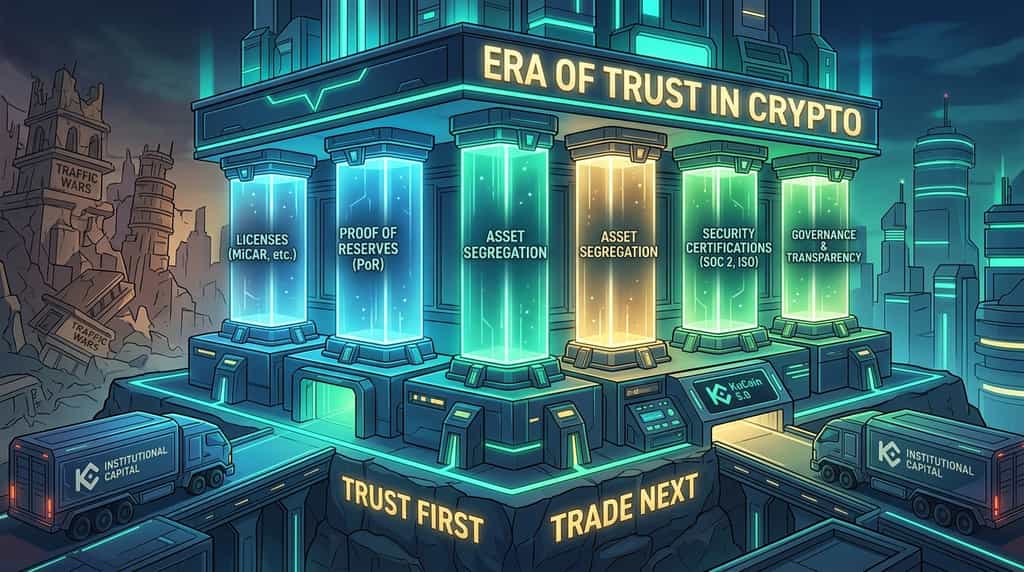
Five metrics now define a trustworthy exchange: licenses, proof of reserves, asset segregation, security certifications, and governance.
-
KuCoin 5.0 treats compliance not as a supporting function but as core infrastructure for global growth.
-
Trust is no longer the price of entry — it is the product.
After the Traffic Wars, What Do Exchanges Compete On?
Every era of exchange competition had its axis. First came the listing wars — whoever listed the most tokens won the most users. Then came the liquidity and derivatives wars — deeper order books, higher leverage, lower fees. Both eras assumed the same thing: that users choose platforms for opportunity.
That assumption broke. Each major platform failure taught users that opportunity without protection is just risk in disguise. Regulators responded with comprehensive frameworks — the EU's MiCAR chief among them — and institutional capital arrived with compliance requirements that no amount of marketing could substitute for. The result: trust has become the scarcest asset in the industry, and the exchanges that can prove it are pulling away.
The Reference Case: How Compliance-First Positioning Builds Lasting Value
For a public-market illustration of this shift, look at Coinbase. As the first major crypto exchange to go public — listing on Nasdaq in 2021 — Coinbase submitted itself to a different order of accountability: audited financial statements, quarterly SEC reporting, and continuous disclosure obligations that most private crypto companies never face. Its corporate strategy has consistently treated regulation not as friction but as the moat: engaging policymakers, pursuing licenses market by market, and marketing transparency as a feature.
The lesson isn't about any single company. It's about what the market rewards. A compliance-first platform earns durable advantages that fee discounts can't replicate: access to institutional capital, banking relationships, regulatory goodwill in new markets, and — most importantly — users who stay through market cycles because their trust was earned structurally, not promotionally. Compliance, done right, compounds.
Five Metrics That Define a Trustworthy Exchange in 2026
If trust is the new competition, it needs a scorecard. These five metrics separate platforms that claim trustworthiness from those that demonstrate it:
-
Licenses and registrations. Not just the count, but the caliber — a license under a comprehensive framework like MiCAR requires deep examination of capital, governance, and consumer protection.
-
Proof of Reserves (PoR). Regular, cryptographic, user-verifiable evidence that customer assets are fully backed — with third-party assessment of the methodology.
-
Asset segregation. Structural separation of customer assets from operating funds, so user money cannot be repurposed.
-
Security certifications. Independent, time-tested audits such as SOC 2 Type II and ISO 27001:2022 — verifying that controls work consistently, not just on inspection day.
-
Governance and transparency. Clear corporate structure, accountable leadership, and a track record of engaging regulators constructively rather than evading them.
Note what these have in common: none can be bought with a marketing budget, and all of them can be independently checked by users themselves.
KuCoin 5.0's Answer: Compliance as Core Infrastructure
KuCoin's own trajectory mirrors the industry's shift. In 2025, the platform launched a US$2 billion Trust Project, completed four international-grade security certifications, and secured core regulatory approvals including a KuCoin's MiCAR license in Austria and registration in Australia. But KuCoin 5.0 — launching this October under the philosophy of Trust First and Trade Next. — goes further: it rebuilds the platform's architecture so that compliance is not a supporting function bolted onto the product, but the core infrastructure on which the product runs.
In practice, that means protection engineered into every step of the user journey — identity verification, asset custody, fund transfers, trade execution, and risk handling — and designed to be visible and verifiable rather than assumed. Against the five-metric scorecard:
-
Licenses: a MiCAR-licensed EU entity, Australian registration, and participation in the Central Bank of Nigeria's supervisory pilot as the only global exchange in the first cohort.
-
Proof of Reserves: recognized by CryptoQuant as a PoR transparency leader with a score of 96.7 (A+) — with user-level self-verification built in.
-
Asset segregation: user assets held separately under frameworks shaped by regulated-market requirements.
-
Certifications: SOC 2 Type II and ISO 27001:2022, among four international-grade security credentials; KuCoin also holds the top global security ranking on CER.live.
-
Governance: a CEO who previously served as Chief Legal Officer — a leadership profile that itself signals where the platform's priorities sit.
On that trust foundation, 5.0 layers the growth engine: a unified account connecting every product, global multi-asset access spanning crypto, stocks, indices, and commodities, and AI that assists users from insight to execution. The sequencing is the strategy — trust first, then trade next.
Looking Ahead: Trust as the Industry's Operating System
The trust competition will not be won in a single release cycle. Regulatory frameworks will keep tightening, institutional due diligence will keep deepening, and users will keep getting better at verifying rather than believing. The platforms that thrive will be those that treat every license, every audit, and every reserve snapshot not as a cost of doing business, but as the business itself.
For users, this is unambiguously good news: an industry competing on trust is an industry competing to protect you. And the five-metric scorecard above is yours to use — on KuCoin, or on any platform you trust with your assets.
FAQs
Why is compliance important for crypto exchanges?
Compliance determines whether an exchange is supervised, accountable, and structurally required to protect users. Licensed platforms face ongoing regulatory examination of their capital, governance, and asset protection — protections that unlicensed platforms simply don't provide.
What are the signs of a trustworthy crypto exchange?
Five verifiable metrics: high-caliber licenses (such as MiCAR), regular user-verifiable Proof of Reserves, asset segregation, independent security certifications (SOC 2 Type II, ISO 27001:2022), and transparent, accountable governance.
How is KuCoin 5.0 different from previous versions?
KuCoin 5.0 rebuilds the platform with compliance as core infrastructure rather than a supporting function — pairing that trust foundation with a unified account, global multi-asset access, a fully rebuilt app experience, and AI-assisted trading.
Disclaimer: This article is for informational and educational purposes only and does not constitute financial advice. Cryptocurrency investments carry risk, including platform and counterparty risk. APR rates, subscription caps, and redemption terms are subject to change based on KuCoin's platform policy. Past performance does not guarantee future results. Always conduct your own research (DYOR).