

Is Google Stock Undervalued in 2026? GOOGL Valuation, AI Growth, and Upside Potential
Introduction
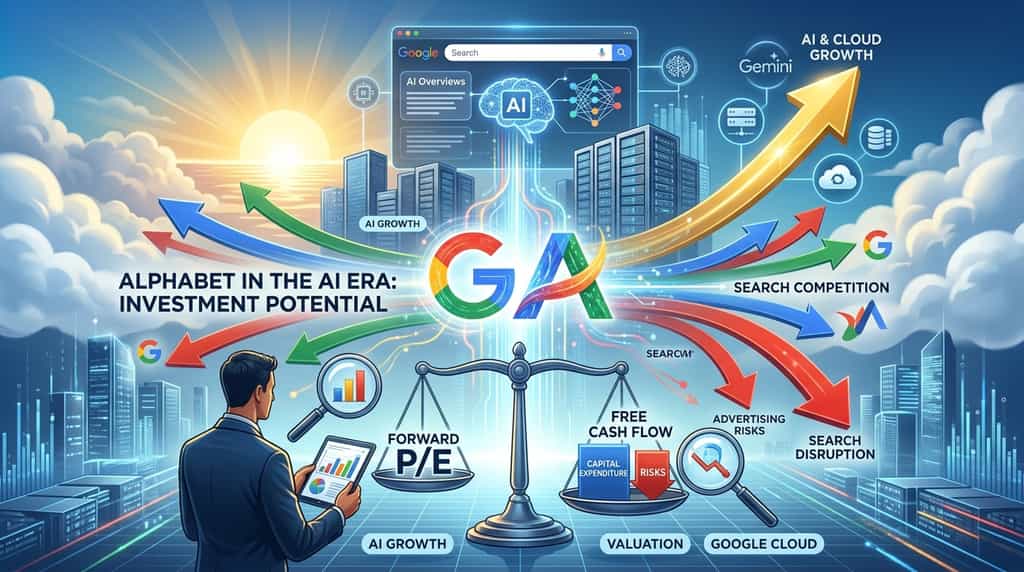
Can Alphabet's artificial intelligence (AI) growth create an attractive investment opportunity even as competition reshapes the search industry? Google parent Alphabet (NASDAQ: GOOGL) combines a dominant digital advertising business, a rapidly expanding cloud platform, and substantial AI capabilities. Whether its stock is undervalued in 2026 depends on how much future growth investors are already paying for and whether AI can strengthen its earnings power faster than it increases costs and competitive risks.
Alphabet's second-quarter 2026 results provide a strong fundamental starting point. According to its official earnings release filed with the SEC, revenue increased 24% year over year to $119.8 billion, while Google Cloud revenue surged 82% to $24.8 billion. These results demonstrate that Alphabet's growth extends beyond traditional search advertising.
However, strong operating performance does not automatically make GOOGL undervalued. Investors must assess its valuation, AI monetization potential, capital expenditure requirements, and regulatory exposure to determine whether the stock offers asymmetric upside - the possibility of gains that outweigh plausible downside risks.
Is GOOGL Stock Undervalued in 2026?
Alphabet's investment case rests on the possibility that its earnings growth, AI monetization, and cloud expansion can justify or exceed the expectations embedded in its share price. The stock's valuation must therefore be assessed against both its existing cash-generating businesses and its future growth opportunities.
As of October 13, 2026, Alphabet's Class A shares closed at approximately $353.78, giving the company a market capitalization of about $4.33 trillion. The same source reported a trailing price-to-earnings (P/E) ratio of approximately 17.7 and a forward P/E ratio of about 26.2. These figures reflect different earnings periods and should not be interpreted interchangeably.
The apparent gap between historical and forward valuation illustrates an important consideration: investors are paying for anticipated earnings, not simply the profits Alphabet has already generated. Whether the stock is cheap depends on the reliability of those expectations, the durability of its competitive advantages, and the amount of capital required to sustain growth.
What Does Alphabet's P/E Ratio Tell Investors?
The P/E ratio measures how much investors pay for each dollar of a company's earnings. A lower ratio can indicate an attractive valuation, but it can also reflect concerns about slowing growth, regulatory pressure, or declining profitability. A higher ratio may be justified when earnings are expected to grow rapidly and consistently.
Alphabet's forward P/E is particularly relevant because the investment thesis depends on future AI and cloud earnings. If these businesses expand while advertising remains resilient, earnings could grow enough to make today's valuation more reasonable over time. If growth disappoints or expenses rise faster than revenue, the stock could underperform even if Alphabet remains highly profitable.
Investors should also distinguish between earnings-based valuation and cash-flow valuation. AI infrastructure requires significant investment in data centers, servers, networking, and specialized computing hardware. Consequently, accounting earnings can improve while free cash flow remains under pressure from capital expenditure.
A complete valuation assessment should compare P/E, forward earnings growth, free cash flow, and capital intensity rather than relying on one ratio.
What Does Asymmetric Upside Mean for GOOGL?
Asymmetric upside means that the potential return from a favorable outcome may be substantially greater than the loss associated with a plausible unfavorable outcome. For Alphabet, this thesis would require its existing businesses to remain resilient while AI and cloud create additional sources of growth that the market has not fully priced in.
The upside scenario could involve AI-powered search preserving advertising relevance, Google Cloud continuing to gain enterprise customers, and new AI products creating additional revenue streams. Under those conditions, earnings growth could support both a higher share price and a more favorable valuation multiple.
The downside scenario is different. AI could weaken the economics of traditional search, infrastructure spending could constrain free cash flow, and regulatory remedies could limit distribution advantages or increase operating costs. If these risks materialize together, the market could reduce the earnings multiple it is willing to pay for Alphabet.
Therefore, asymmetric upside is an investment hypothesis, not a measurable guarantee. Investors need to estimate plausible earnings outcomes, valuation multiples, and downside scenarios before concluding that GOOGL offers an attractive risk-reward profile.
How Could AI Create Additional Upside for Alphabet Stock?
AI could create additional upside for Alphabet by improving the economics of Google Search, expanding enterprise cloud revenue, and creating new monetization opportunities across its product ecosystem. The key question is whether these opportunities generate incremental profits that justify the substantial investment required to develop and operate AI systems.
According to Alphabet's July 22, 2026, second-quarter earnings release, Google Search and other revenue grew 17% year over year, YouTube advertising revenue increased 13%, and Google Cloud revenue rose 82%. Alphabet also reported that Gemini had reached 950 million monthly active users and that its models were processing 22 billion API tokens per minute. These company-reported figures demonstrate significant product adoption, although usage growth does not automatically translate into equivalent revenue growth.
Can AI Search Protect Google's Advertising Business?
AI-powered Search could protect Alphabet's advertising business if it helps users find relevant information while preserving valuable opportunities for advertisers. Google has integrated AI features into Search, including AI Overviews and AI Mode, as part of its broader strategy to adapt to changing search behavior.
The opportunity is substantial because Search remains a major revenue generator. AI can potentially handle more complex queries, improve the relevance of recommendations, and help users move from discovering information to evaluating products and services. More useful search experiences could support continued engagement and create new commercial opportunities.
However, AI search also introduces a potential economic trade-off. Generating detailed answers may require more computing resources than traditional search results, while fewer conventional website visits or advertising placements could affect monetization. Users may also shift some queries to competing AI assistants.
For GOOGL investors, the most important indicators are sustained Search revenue growth, advertising performance, user engagement, and the cost of delivering AI-powered experiences. If AI improves user experience without materially weakening advertising economics, it could reinforce Alphabet's competitive position. If it increases costs while reducing monetizable search activity, the investment case becomes less compelling.
Why Is Google Cloud an Important Growth Driver?
Google Cloud is important because it gives Alphabet a second major growth engine beyond digital advertising. Its business serves enterprises that need cloud infrastructure, data analytics, AI models, and tools for deploying AI applications.
The 82% year-over-year increase in Google Cloud revenue to $24.8 billion in Q2 2026, reported by Alphabet, indicates strong demand for its infrastructure and AI-related services. Alphabet also reported that nearly 90% of Fortune 100 companies were using Gemini Enterprise, illustrating the breadth of enterprise adoption, although this figure does not establish the amount of revenue generated by those customers.
Cloud growth can improve Alphabet's revenue diversification and potentially increase the value of its AI infrastructure investments. As businesses develop and deploy AI applications, they may require more computing capacity, storage, and managed services. Alphabet can monetize these needs through its cloud platform and related products.
Investors should nevertheless examine cloud operating margins, capital requirements, and customer spending patterns. Rapid revenue growth is valuable only if the business can convert a meaningful share of that growth into sustainable profits and cash flow.
Can Gemini and Other AI Products Become Material Revenue Sources?
Gemini and related AI products could contribute to Alphabet's long-term upside through subscriptions, enterprise services, API usage, and integration into existing products. Their financial importance will depend on paying customer adoption, pricing, retention, and the costs of serving users.
A large user base creates potential distribution advantages because Alphabet can introduce AI capabilities through products that already reach consumers and businesses. Its existing infrastructure, software ecosystem, and cloud platform may also help it distribute new services without building every customer relationship from scratch.
Yet adoption metrics should not be mistaken for profitability metrics. Free users can generate significant computing costs without producing equivalent direct revenue. Enterprise customers may also negotiate different pricing arrangements, and competitors can pressure margins by offering alternative models or services.
The strongest evidence of AI-driven upside would be sustained growth in paid usage, improving product economics, and measurable contributions to operating income or free cash flow. Investors should look for financial results rather than assuming that every increase in AI usage creates proportional shareholder value.
What Are the Biggest Risks to GOOGL's Asymmetric Upside Thesis?
Alphabet's biggest risks are disruption to search advertising, rising AI infrastructure costs, regulatory intervention, and a valuation that already assumes substantial future growth. Any of these factors could reduce returns even if the company continues to expand.
Could AI Disrupt Google's Core Search Business?
AI assistants could weaken Google's traditional search model if users increasingly obtain answers directly from conversational interfaces rather than clicking through conventional search results. This shift could alter advertising placement, reduce traffic to publishers and commercial websites, or change how advertisers allocate budgets.
Google has advantages in distribution, data, infrastructure, and product integration. Nevertheless, competitors are developing their own AI assistants, search products, and enterprise platforms. Alphabet must continue innovating while preserving the economic value of its established services.
The critical question is not whether AI will change search, but whether Alphabet can monetize the new user experience as effectively as, or more effectively than, its existing model.
Will AI Capital Expenditure Reduce Free Cash Flow?
AI infrastructure spending is a material risk because data centers, computing hardware, networking equipment, and power infrastructure require substantial upfront capital. Alphabet must invest ahead of demand while ensuring that future revenue and operating profits justify those expenditures.
According to Alphabet's Form 10-Q for the quarter ended June 30, 2026, capital expenditure reached $44.9 billion in Q2. The filing also reported $80.6 billion in capital expenditure during the first six months of 2026, compared with $39.6 billion in the same period of 2025.
This increase highlights the scale of Alphabet's infrastructure commitments. Spending can support future growth, but it can also pressure free cash flow, increase depreciation expenses, and create the risk of underutilized capacity if demand disappoints.
Investors should therefore monitor capital expenditure relative to revenue, operating cash flow, depreciation, and the profitability of Google Cloud and AI services. Strong revenue growth alone does not guarantee attractive returns on invested capital.
Beyond the Headlines: What KuCoin 5.0 Means for You
Market news moves fast — but where you act on it matters just as much. This October, KuCoin launches KuCoin 5.0, transforming KuCoin into a rebuilt platform. Here's what actually changes for you:
-
One account for everything. Older platforms split your money across separate "spot," "margin," and "futures" accounts and expected you to understand why. KuCoin 5.0's unified account removes that entirely — deposit once, and everything is simply there (only available to VIPs for now).
-
Stocks, indices, and commodities. KuCoin 5.0 expands beyond crypto into global markets. When crypto chops sideways and equities rally (or the reverse), you rotate in minutes instead of opening a brokerage account and waiting days for fiat rails.
-
Real-world assets (RWA). Tokenized exposure to traditional assets like commodities, right inside your crypto account. One of the fastest-growing segments in global finance is no longer reserved for institutions — you access it from the same balance you trade with.
-
Earn while you learn. Not ready to trade? KCUSD lets your stablecoins earn daily, auto-compounding interest. The lowest-stress way to put your idle deposit to work for 4% yield.
-
An AI assistant in plain language. Ask questions, get market context, understand what you're looking at — built into the platform, no jargon required.
-
An app that doesn't overwhelm. Faster, cleaner, and consistent — intuitive from the first tap, not after a tutorial.
-
Safety you can check, not just trust. A MiCAR-licensed EU entity, Proof of Reserves you can verify yourself, and internationally certified security (SOC 2 Type II, ISO 27001:2022).
Create your account in minutes — and start on the platform built for where crypto is going, not where it's been.
Conclusion
Alphabet's investment case in 2026 combines a large, established advertising business with rapid growth in cloud computing and expanding AI capabilities. Its second-quarter results, including 24% consolidated revenue growth and 82% Google Cloud revenue growth, provide evidence that the company is generating momentum beyond traditional search advertising. Gemini adoption and AI-powered Search also create opportunities to develop new revenue streams and strengthen existing products.
However, whether GOOGL is undervalued depends on the relationship between its share price, future earnings, and the capital required to sustain growth. AI infrastructure spending can pressure free cash flow, while competition and antitrust proceedings introduce uncertainty around long-term profitability. Strong business performance alone does not guarantee attractive investment returns.
The asymmetric-upside thesis is strongest if Alphabet can preserve Search monetization, convert enterprise AI demand into profitable Cloud growth, and generate sufficient returns on its infrastructure investments. It weakens if AI disrupts advertising economics or spending rises faster than the resulting revenue and cash flow.
Investors should therefore compare bullish, base-case, and bearish scenarios, using current valuation metrics and official financial disclosures to test their assumptions. GOOGL may offer an attractive opportunity if future earnings growth exceeds what its price already reflects, but a disciplined assessment of valuation and downside risk remains essential.
FAQs
1. How can investors calculate GOOGL's intrinsic value?
Investors can estimate intrinsic value using discounted cash flow analysis, which projects future free cash flow and discounts it to present value. The result depends heavily on assumptions about revenue growth, operating margins, capital expenditure, discount rates, and terminal growth.
2. How do interest rates affect Alphabet stock?
Higher interest rates can reduce the present value of future cash flows and make lower-risk assets more competitive with equities. They can also affect corporate borrowing costs and advertising demand. The actual impact depends on market expectations and Alphabet's operating performance.
3. Is Alphabet stock suitable for long-term investors?
Alphabet may suit investors seeking exposure to digital advertising, cloud computing, and AI, but suitability depends on individual objectives, risk tolerance, diversification, and valuation. Even established technology companies face competitive, regulatory, and execution risks.
Disclaimer
This article is for informational purposes only and does not constitute financial, legal, or investment advice. Stock prices can fluctuate, and investors may lose some or all of their invested capital. Always conduct your own research before making investment decisions.