

Why IonQ Stock Jumped 15% After Its NVIDIA Deal and Real-Time Quantum Error Correction Breakthrough
IonQ’s Quantum Breakthroughs Strengthen Its Case for Scalable Quantum Computing
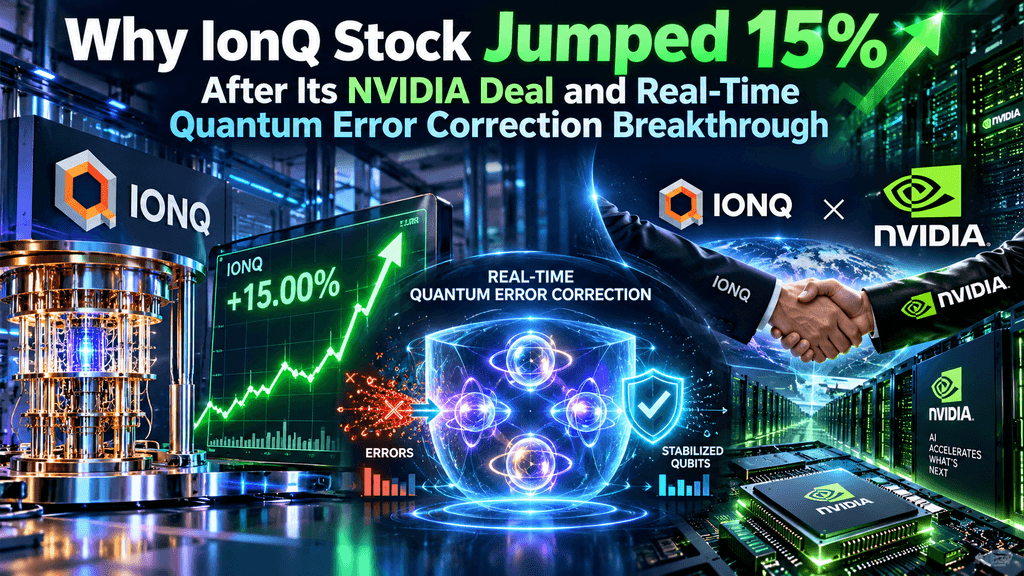
IonQ shares experienced a notable increase in late September 2026, following two closely timed announcements that effectively addressed long-standing technical and commercial questions surrounding the field of quantum computing. On September 22, the company provided an in-depth overview of an innovative end-to-end real-time quantum error correction decoder, which impressively operates on a single off-the-shelf CPU, showcasing the potential for more accessible quantum technology. The very next day, IonQ confirmed that its Superion 256 system is set to become the first on-premises quantum processing unit installed at NVIDIA’s Accelerated Quantum Research Center. This significant installation is scheduled for 2027 and will be directly linked to a GB200 NVL72 platform through the advanced NVQLink and CUDA-Q technologies.
As a result of these announcements, the stock opened more than 12 percent higher on September 23, reaching an impressive intraday high near $46, and ultimately closed up 4.42 percent at $42.54 after trading volume exceeded a remarkable 72 million shares. Subsequent trading sessions further extended this multi-day advance, reflecting strong investor confidence. These pivotal developments significantly reduce the perceived execution risk associated with IonQ’s fault-tolerance roadmap and strategically position its hardware within NVIDIA’s hybrid research environment. This alignment provides investors with a clearer and more promising near-term validation path for scalable quantum-GPU systems, particularly in critical application areas such as finance, materials science, and chemistry.
Superion 256 Installation Marks First On-Premise QPU at NVIDIA Research Facility
IonQ announced on September 23 that its Superion 256 quantum computer will be the first quantum processor deployed on-premises at NVIDIA’s Accelerated Quantum Research Center. Scheduled for 2027, the system will connect directly to NVIDIA’s GB200 NVL72 through NVQLink, with workloads managed by CUDA-Q. The collaboration will focus on hybrid software development, large-scale system prototyping, and quantum-GPU co-design, targeting portfolio optimization, risk modeling, materials science, and drug discovery. IonQ CEO Niccolo de Masi described the placement as a step toward hybrid quantum-classical computing, while NVIDIA’s Timothy Costa said it would help integrate quantum processors with advanced GPU infrastructure. The deployment provides a practical environment to test IonQ’s trapped-ion hardware alongside NVIDIA’s computing systems, potentially accelerating development of commercially relevant quantum applications across several industries.
The timing follows IonQ’s September 8 introduction of the Superion product line. Superion 256 is the company’s sixth-generation platform and the first fully integrated 256-qubit quantum processing unit fabricated at its SkyWater foundry subsidiary. Early chips completed multiple tape-outs in the first half of 2026, design cycles shortened from nine months to two, and the first ions were trapped in prototype systems under construction at multiple U.S. sites. The architecture relies on electronic qubit control technology, which places control electronics on the chip rather than relying solely on laser systems, and fits a standard data center rack footprint. Orders are open, with customer deliveries expected in 2027. Placing the first production-oriented Superion system inside NVIDIA’s research center supplies an independent, high-visibility testbed for hybrid workloads that investors can monitor as the 2027 installation approaches.
Real-Time Decoder Runs End-to-End on a Single Commodity CPU
On September 22, IonQ reported successful testing of what it called the industry’s first end-to-end real-time quantum error correction decoder operating on a single standard off-the-shelf CPU. Researchers evaluated a dual-decoder architecture across simulated benchmark circuits that reached 408 logical qubits distributed across 88 memory blocks and magic-state factories. Those circuits executed more than 31.5 million quantum operations at the MegaQuOp scale. Under standard operational noise, the decoder introduced as little as 0.02 percent stretch time, meaning the classical decoding overhead added virtually no delay to the quantum computation. Stretch remained below 0.3 percent at a physical two-qubit gate error rate of 10^{-4} and stayed manageable even at higher noise levels. Quantum research lead Nicolas Delfosse noted that validating real-time decoding across hundreds of logical qubits and millions of operations on a single CPU opens a practical path to commercial-scale fault-tolerant systems.
Error correction remains essential because physical qubits are sensitive to environmental noise. Traditional decoding approaches can create classical bottlenecks that force the quantum processor to pause. IonQ’s dual-decoder design uses concurrent sliding-window components, one continuous error decoder that tracks Pauli frames and a low-latency outcome decoder that resolves measurements, so the system can keep pace with trapped-ion syndrome extraction cycles measured in milliseconds. The result demonstrates that classical overhead need not scale exponentially with logical qubit count or circuit depth. This validation supports IonQ’s Walking Cat architecture, which aims to move beyond 256 physical qubits toward platforms controlling thousands of qubits while keeping time-to-solution, cost, and energy efficiency as primary metrics.
Market Reaction Reflected Immediate Recognition of Dual Catalysts
Shares of IonQ opened at $45.84 on September 23, a gain of roughly 12.5 percent from the prior close of $40.74, and touched an intraday high of $46.05 before settling at $42.54, up 4.42 percent on volume of more than 72 million shares. The multi-session advance from mid-September levels approached 15 percent in some calculations that incorporate the preceding research momentum. Peer quantum names, including Rigetti Computing and D-Wave Quantum, also rose, though the largest percentage move belonged to IonQ. Trading activity remained elevated the following day as the stock closed higher again. Market participants treated the combination of a concrete NVIDIA placement and a practical decoding milestone as simultaneous reductions in technical and commercial uncertainty.
The reaction occurred against a backdrop in which IonQ stock had been essentially flat to slightly down year-to-date before the announcements. Earlier 2026 sessions had seen volatility tied to broader technology sentiment and the company’s own execution updates. The September 23 volume spike and the ability of the stock to hold a multi-day gain indicated that the news altered the near-term risk-reward assessment for a meaningful set of investors. Subsequent sessions through September 25 continued to reflect residual interest as the stock traded above both its 20-day and 50-day moving averages while remaining below longer-term resistance levels near recent highs.
Hybrid Quantum-GPU Integration Targets Practical Workloads
The NVIDIA research center deployment is structured so that quantum-specific tasks route to the Superion 256, while the GB200 NVL72 cluster handles classical and AI-heavy portions of the workload. CUDA-Q orchestrates the combined system, creating a shared software layer that both companies can refine. This arrangement moves hybrid computing from theoretical discussion into a physical facility designed for accelerated quantum supercomputing research. Applications shown by the partners, financial portfolio optimization, risk modeling, materials discovery, and computational chemistry, align with domains where quantum algorithms have shown early promise on smaller systems.
The open nature of the planned research outputs is intended to guide broader ecosystem development of quantum-GPU co-design practices. Earlier collaborative work between IonQ, NVIDIA, Oak Ridge National Laboratory, and the University of Tennessee had already demonstrated generative AI methods that produce quantum optimization circuits directly, holding generation time nearly constant as problem size increased. That study ran on CUDA-Q and NVIDIA H200 GPUs. Placing a full Superion 256 system inside the research center extends those software experiments into a production-oriented hardware environment. Investors gain a visible timeline: installation in 2027 followed by published hybrid results that can be compared against classical baselines. The structure therefore supplies both technical validation and a potential commercial reference architecture for future enterprise deployments.
Walking Cat Architecture Gains Empirical Support from Decoder Results
IonQ’s Walking Cat architecture outlines a path to fault-tolerant operation that relies on efficient classical decoding and high physical-qubit fidelity. The September 22 decoder demonstration supplies the first full-stack measurement of that classical component at the MegaQuOp scale. By showing that a commodity CPU can keep pace with syndrome extraction without meaningful stretch, the company removes one frequently cited barrier to scaling. Prior work had established two-qubit gate fidelities of 99.99 percent using the same electronic qubit control technology that underpins Superion. Combining high physical fidelity with lightweight classical decoding reduces the number of physical qubits required per logical qubit and lowers overall system cost and energy demand.
The architecture also incorporates quantum multiplexed input/output and plans for integrated cryogenic CMOS in later generations. Superion 256 serves as the first production platform on which these elements can be exercised at 256 physical qubits. Successful real-time decoding on standard hardware supports the claim that classical resources can remain modest even as logical qubit counts rise into the hundreds and eventually thousands. This combination of hardware fidelity and classical efficiency forms a coherent technical narrative that the NVIDIA research placement will test under realistic hybrid workloads.
SkyWater Foundry Accelerates Manufacturing Cadence
IonQ completed its acquisition of SkyWater Technology in 2026, gaining domestic semiconductor fabrication capacity. Superion 256 chips were the first fully integrated 256-qubit processors produced at the foundry. Design cycle time compressed from nine months to two months, and wafer-lot output rose twelvefold over six months relative to prior arrangements. Six tape-outs occurred in the first half of 2026. The foundry relationship also supports IonQ’s longer-term cost-per-qubit reduction targets through semiconductor-style process control rather than purely laboratory fabrication methods.
Vertical integration shortens iteration loops between design, fabrication, and system assembly. Prototype Superion systems are already under construction at multiple U.S. facilities, and the first ions have been trapped. The ability to manufacture control electronics and trap structures on standard semiconductor lines lowers the barrier to producing systems in volume rather than one-off laboratory instruments. For investors, the foundry capability converts the Superion roadmap from a research schedule into a manufacturable product plan whose first commercial deliveries are scheduled for 2027.
On the day of the announcements, other publicly traded quantum computing companies recorded gains. Rigetti Computing, D-Wave Quantum, and additional names in the group advanced several percentage points in sympathy. The sector-wide move reflected recognition that progress on real-time error correction and hybrid integration benefits the broader industry narrative even when the specific hardware and software advances originate at one company. IonQ’s trapped-ion approach differs from superconducting and other modalities, yet the demonstration that classical decoding can run efficiently on commodity hardware addresses a challenge common across architectures.
Investors appear to interpret the NVIDIA research center placement as an external endorsement of hybrid quantum-GPU architectures rather than an exclusive partnership. Multiple quantum companies already participate in NVIDIA’s CUDA-Q ecosystem and related research programs. The concrete installation of a full-scale system inside the Accelerated Quantum Research Center simply provides the most visible near-term example. Sector performance therefore moved in tandem while IonQ captured the largest absolute and percentage gains, consistent with company-specific catalysts.
Financial Context Shows Elevated Valuation Against Growing Revenue Base
IonQ’s market capitalization stood near $16–18 billion around the time of the announcements, depending on the precise closing price used. The company had raised full-year 2026 revenue guidance earlier in September after the SkyWater acquisition closed, projecting a range that incorporated the foundry contribution. Organic quantum computing revenue continued to grow from system deployments, cloud usage, and commercial contracts. Gross margins remain negative as the company invests in manufacturing scale and research, a pattern typical of early-stage hardware platforms.
Analyst price targets compiled around the period clustered in the $60–70 range, implying meaningful upside from the mid-$40 levels reached after the news. The valuation debate centers on the speed at which technical milestones convert into recurring, higher-margin revenue. The Superion 256 order book and the NVIDIA research placement supply tangible milestones against which progress can be measured in 2027. Investors weighing the stock therefore focus less on near-term profitability and more on whether the company can demonstrate hybrid workload performance and manufacturing repeatability at the scale required for commercial systems.
Historical Context of NVIDIA–IonQ Interaction
In early 2025, NVIDIA CEO Jensen Huang had publicly estimated that very useful quantum computers would remain 15 to 30 years away, a remark that weighed on quantum stocks at the time. Less than two years later, NVIDIA’s research organization is preparing to host IonQ hardware inside its own facility. The shift illustrates how rapidly the practical conversation has moved from distant timelines toward concrete integration experiments. IonQ’s Superion roadmap now targets commercially manufacturable fault-tolerant systems later in the decade, with Superion 256 as the near-term vehicle.
The research center arrangement does not constitute a large commercial purchase order, yet it places IonQ’s technology inside the environment where NVIDIA evaluates next-generation accelerated computing architectures. That visibility matters for both technical feedback and potential future commercial relationships. The sequence of events, from Huang’s earlier skepticism to the 2027 installation plan, supplies a clear narrative of improving industry confidence in hybrid approaches.
Risk Factors Remain Centered on Execution and Timeline
Despite the positive technical and partnership news, IonQ still faces the classic challenges of an early-stage quantum hardware company. Delivery of Superion 256 systems begins only in 2027, and full performance metrics from customer or research deployments will lag installation. The decoder results, while impressive, were obtained on simulated circuits rather than a running 256-qubit machine. Scaling from hundreds of physical qubits to the thousands required for broad commercial advantage will demand continued advances in both hardware fidelity and software tooling. Cash burn remains elevated as the company funds foundry operations, system production, and research.
Market participants will watch the 2027 installation and subsequent hybrid results closely. Any delay in deployment or underwhelming performance relative to classical baselines could reverse the sentiment gains of September 2026. Conversely, published results that demonstrate clear hybrid advantage would strengthen the commercial case. The announcements therefore reduce but do not eliminate the execution risk that has long characterized the sector.
Rival Approaches Reveal Key Market Differences
IonQ’s trapped-ion architecture with all-to-all connectivity and electronic qubit control differs from the superconducting approaches pursued by several competitors and from photonic or neutral-atom platforms. The ability to run high-fidelity operations without continuous laser arrays and to decode errors on commodity CPUs forms part of IonQ’s differentiation thesis. NVIDIA’s research center, however, is modality-agnostic and is expected to host or evaluate multiple technologies over time. Success will ultimately be measured by useful computational output rather than architectural purity.
The September announcements reinforce IonQ’s claim that its combination of physical performance and classical efficiency can reach practical fault tolerance with lower overhead than some alternative roadmaps. Whether that claim holds will be tested inside the same NVIDIA facility that will also explore other integration paths. Investors therefore evaluate IonQ both on its absolute technical progress and on its relative position within a still-fragmented competitive field.
Near-Term Catalysts Focus on 2027 Deployment and Hybrid Results
The most immediate observable milestones are the physical installation of Superion 256 at the Accelerated Quantum Research Center in 2027 and the subsequent release of hybrid workload results. Parallel commercial deliveries of Superion systems to other customers will supply additional data points on manufacturing yield, system reliability, and early application performance. Continued progress on the Walking Cat architecture and further decoder refinements will also be monitored. Revenue growth from both quantum systems and the SkyWater foundry business will provide the financial counterpart to the technical narrative.
These catalysts are spaced over the next 12–18 months, giving the market a series of checkpoints rather than a single binary event. The September 2026 announcements effectively front-loaded recognition of the technical path while leaving the empirical validation for 2027 and beyond. That sequencing explains both the sharp initial price reaction and the residual volatility that typically accompanies multi-year technology roadmaps.
🔥 Beyond the Headlines: What KuCoin 5.0 Means for You
Market news moves fast — but where you act on it matters just as much. This October, KuCoin launches KuCoin 5.0, transforming KuCoin into a rebuilt platform. Here's what actually changes for you:
-
One account for everything. Older platforms split your money across separate "spot," "margin," and "futures" accounts and expected you to understand why. KuCoin 5.0's unified account removes that entirely — deposit once, and everything is simply there (only available to VIPs for now).
-
Stocks, indices, and commodities. KuCoin 5.0 expands beyond crypto into global markets. When crypto chops sideways and equities rally (or the reverse), you rotate in minutes instead of opening a brokerage account and waiting days for fiat rails.
-
Real-world assets (RWA). Tokenized exposure to traditional assets like commodities, right inside your crypto account. One of the fastest-growing segments in global finance is no longer reserved for institutions — you access it from the same balance you trade with.
-
Earn while you learn. Not ready to trade? KCUSD lets your stablecoins earn daily, auto-compounding interest. The lowest-stress way to put your idle deposit to work for 4% yield.
-
An AI assistant in plain language. Ask questions, get market context, understand what you're looking at — built into the platform, no jargon required.
-
An app that doesn't overwhelm. Faster, cleaner, and consistent — intuitive from the first tap, not after a tutorial.
-
Safety you can check, not just trust. A MiCAR-licensed EU entity, Proof of Reserves you can verify yourself, and internationally certified security (SOC 2 Type II, ISO 27001:2022).
Create your account in minutes — and start on the platform built for where crypto is going, not where it's been.
FAQs
What exactly did IonQ announce regarding the NVIDIA research center?
IonQ will install a Superion 256 system as the first on-premises quantum processor at NVIDIA’s Accelerated Quantum Research Center in 2027. The system will connect to a GB200 NVL72 platform via NVQLink and use CUDA-Q for workload orchestration, with joint research focused on hybrid software, system prototyping, and applications in finance, materials, and chemistry.
How significant is the real-time error-correction decoder achievement?
The decoder is the first reported end-to-end real-time quantum error correction system running on a single commodity CPU. It handled simulated circuits with up to 408 logical qubits and more than 31.5 million operations while adding as little as 0.02 percent stretch time under standard noise conditions, removing a major classical bottleneck on the path to fault-tolerant machines.
Did the stock fully retain its initial gains?
Shares opened more than 12 percent higher and reached approximately $46 before closing up 4.42 percent at $42.54 on elevated volume. Subsequent sessions extended the multi-day advance, producing a cumulative move near 15 percent from recent lows depending on the precise measurement window.
What is Superion 256, and when will customers receive it?
Superion 256 is IonQ’s sixth-generation 256-qubit trapped-ion platform, the first fully integrated QPU fabricated at the SkyWater foundry. Orders are open now, and customer deliveries are expected to begin in 2027. The system fits a standard data center rack and uses on-chip electronic qubit control.
How does the decoder support IonQ’s longer-term roadmap?
By demonstrating that classical decoding can keep pace with high-fidelity trapped-ion hardware on ordinary CPUs, the result validates a core assumption of the Walking Cat architecture. That architecture aims to scale beyond 256 physical qubits toward systems with thousands of qubits while controlling classical overhead, cost, and energy consumption.
Are there immediate commercial revenue implications from the NVIDIA deal?
The research-center placement itself is not a large product sale. Its value lies in technical validation, hybrid software development, and potential future commercial reference architectures. Revenue impact will depend on subsequent system sales and any broader adoption of the resulting hybrid approaches.
Disclaimer: This content is for informational purposes only and does not constitute investment advice. Investments carry risk. Please do your own research (DYOR).