

Zcash Covered Calls Could Yield 70%: How the Strategy Works and Why the Risk Is So High
Zcash Volatility Creates Higher Option Income Potential
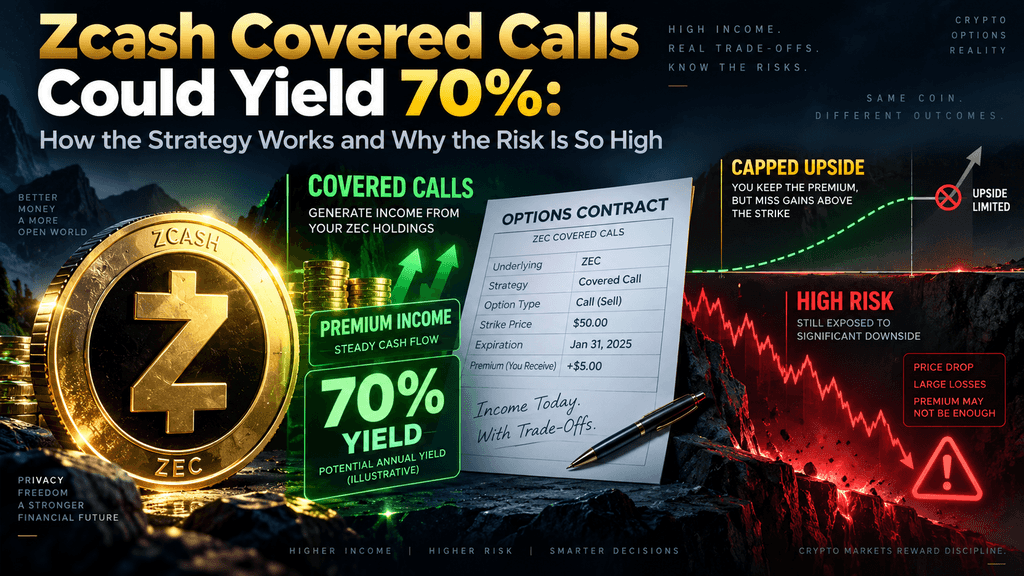
Zcash has drawn fresh attention from institutional observers after its spot ETF gained quick traction and options markets expanded. In early September 2026, Grayscale Head of Research Zach Pandl showed that the privacy-focused cryptocurrency’s elevated price swings create unusually large option premiums. A hypothetical covered-call approach on Zcash currently points to roughly 70 percent annualized income from those premiums, compared with about 30 percent for an equivalent Bitcoin strategy. The difference stems directly from volatility levels: Zcash has averaged around 140 percent over the past year, while Bitcoin has settled near 40 percent, closer to the range of large-cap technology stocks.
Zcash’s market capitalization remains only about 1 percent of Bitcoin’s, reinforcing the higher risk profile that accompanies the richer premiums. Covered calls on Zcash can generate substantial premium income because of sustained high volatility, yet the same volatility exposes holders to a significant downside that premiums may not fully offset, making the strategy suitable only for investors who fully understand the capital-risk trade-off.
Grayscale Research Highlights Zcash Volatility Edge Over Bitcoin
Grayscale’s comprehensive analysis, which was published in early September 2026, places Zcash’s realized annualized volatility at an approximate level of 140 percent for the trailing twelve-month period. In stark contrast, Bitcoin has experienced a significant compression in its volatility, which has now settled at roughly 40 percent over the same timeframe, following earlier levels that were near 125 percent during its formative years. The firm highlights that this notable compression has effectively brought Bitcoin closer to the realized volatility of the so-called Magnificent Seven technology stocks, which are known for their substantial market influence. Zcash’s considerably smaller market size, which is roughly equivalent to only 1 percent of Bitcoin’s overall capitalization, helps to explain the persistence of larger price swings that are characteristic of this cryptocurrency.
In this context, Pandl’s insightful note frames options as a highly practical tool for both income generation and effective risk management, precisely because of that elevated volatility associated with Zcash. The hypothetical covered-call calculation assumes the sale of three-month at-the-money call options that are priced with an implied volatility of 100 percent for Zcash, in comparison to 40 percent for Bitcoin. This results in a compelling implied yield comparison of 70 percent versus 30 percent. It is important to note that these figures are presented as illustrative examples rather than guarantees of future results, and they rest on current market conditions that can change rapidly and unpredictably.
How a Covered Call Strategy Generates Income on Zcash Holdings
A covered call begins with ownership of the underlying asset, in this case ZEC tokens or an equivalent exchange-traded product such as the recently launched ZCSH fund. The holder then sells a call option against that position, collecting an upfront premium. If the option expires worthless because the spot price stays below the strike, the seller keeps both the premium and the underlying asset. If the price rises above the strike, the asset is called away at the strike price, and the seller retains the premium plus any appreciation up to that level. The strategy therefore trades potential upside beyond the strike for immediate income.
On a high-volatility asset such as Zcash, the premium received tends to be larger relative to the asset’s value, which is why the annualized figure can reach the 70 percent range under the assumptions used by Grayscale. Liquidity in the underlying and in the options market itself determines how efficiently the strategy can be implemented and rolled forward. Recent expansion of options trading linked to the Zcash ETF has improved accessibility for investors who prefer regulated vehicles.
Why Zcash Volatility Remains Elevated Compared with Mature Assets
Zcash has consistently demonstrated larger percentage movements compared to Bitcoin, primarily due to its relatively smaller market capitalization, the thinner liquidity present in certain trading venues, and its heightened sensitivity to shifts in narratives surrounding privacy technology. Over the past year, the average realized volatility for Zcash has remained elevated, hovering around an impressive 140 percent, which is more than three times the recent volatility level of Bitcoin, which stands at approximately 40 percent. Various events, including protocol upgrades, security disclosures, or sudden inflows of institutional capital, have the potential to significantly amplify daily price ranges for Zcash.
The introduction of the first U.S. spot Zcash ETF on August 25, 2026, along with the subsequent initiation of options trading on this product, has created new avenues for both demand and hedging activities. However, it is important to note that the underlying asset, Zcash, is still considerably less mature compared to Bitcoin. The smaller absolute market size of Zcash implies that equivalent dollar flows can lead to larger percentage price changes. This inherent structural characteristic not only supports richer option premiums but also simultaneously heightens the probability of experiencing sharp adverse price movements that could potentially erase premium income and more.
Implied Yield Calculation and the Assumptions Behind the 70 Percent Figure
Grayscale’s 70 percent implied annualized yield is based on a specific and detailed set of parameters: the sale of three-month at-the-money call options, where the implied volatility input is set at a substantial 100 percent for Zcash. When applying the same analytical framework to Bitcoin, with a more conservative 40 percent implied-volatility assumption, the resulting figure is notably lower at 30 percent. It is important to clarify that these figures do not represent observed market yields derived from continuous rolling strategies; rather, they serve as hypothetical illustrations grounded in the current volatility levels observed in the market. The actual premiums that are available in the market can vary significantly and depend on several factors, including the precise strike price, the expiration date of the options, and the prevailing implied-volatility surface at the exact moment of sale.
Moreover, transaction costs, bid-ask spreads, and the ability to roll positions without incurring significant slippage can further influence and affect the realized results of these strategies. Given that Zcash options liquidity is still in the process of developing relative to Bitcoin, the gap between the theoretical yields and what can actually be achieved in practice can be quite material. Therefore, investors must approach the 70 percent figure with caution, treating it as a directional indicator of relative opportunity in the market rather than as a definitive forecast of net returns after accounting for costs and potential adverse price movements that may occur.
Principal Risk When Spot Price Declines Beyond Collected Premium
The primary risk associated with any covered-call strategy lies in the potential for the underlying asset to decline in value by an amount greater than the premium that has been received. In such a situation, the net position will still incur a capital loss, even though the option may expire worthless and the premium is retained by the investor. Given Zcash’s average volatility of 140 percent, the likelihood of experiencing significant drawdowns is considerably higher compared to assets that exhibit lower volatility levels. A swift decline of 30 or 40 percent in the price of ZEC, which has been observed multiple times throughout the asset’s historical performance, can easily surpass the premium that is typically collected on a short-dated or medium-dated call option.
As a result, this strategy offers only a limited degree of downside protection for investors. Pandl explicitly points out that covered calls will incur capital losses whenever the decline in the spot price exceeds the premium that was collected. He further suggests that investors who are looking for more precisely defined risk-reward outcomes might find it more advantageous to consider outright long calls or puts instead. Consequently, the decisions regarding position sizing and the selection of the strike price in relation to the current market price become critical components of effective risk-control measures that investors must carefully evaluate.
Role of the New Zcash ETF and Expanding Options Markets
The Grayscale Zcash ETF (ZCSH) began trading on NYSE Arca on August 25, 2026, and quickly surpassed $500 million in assets under management. The product has attracted more than $70 million in reported inflows in addition to a sizable seed investment, and it now holds more than 550,000 ZEC. Options on the ETF itself began trading shortly afterward, giving investors a regulated pathway both to hold the asset and to write calls against it.
This infrastructure reduces some of the operational frictions that previously limited covered-call strategies to direct token holders or offshore platforms. Greater accessibility can increase both the supply of and demand for options, potentially influencing premium levels over time. At the same time, the concentration of holdings in a single ETF product introduces its own set of liquidity and tracking considerations that strategy designers must monitor.
Mechanics of Selecting Strike and Expiration for Zcash Calls
Strike selection balances income against the probability of assignment. At-the-money or slightly out-of-the-money strikes typically deliver higher premiums but also higher assignment risk if Zcash continues its recent upward direction. Longer-dated options capture more time value yet expose the seller to greater cumulative volatility risk. Shorter-dated contracts allow more frequent rolling and adjustment but require continuous monitoring and generate higher transaction costs.
Because Zcash can move several percent in a single session, delta and gamma risk are elevated compared with lower-volatility underlyings. Traders often examine the implied-volatility term structure and skew to identify relatively rich points on the surface. Collateral requirements, margin treatment, and any early-exercise features of the specific option contract further shape the practical implementation.
Market Reaction of Recent Zcash Price Action and Institutional Interest
Zcash has experienced a powerful rally in recent months, with prices moving from lower ranges into the $1,100–$1,300 area in early September 2026 and recording substantial year-over-year percentage gains. The ETF launch and subsequent options availability have coincided with increased institutional and on-chain accumulation. Open interest in derivatives has risen sharply at times, and short liquidations have amplified upward moves.
These conditions raise the absolute size of premiums available to call sellers but also elevate the opportunity cost of capping upside. An investor writing calls during a strong uptrend may forgo significant additional gains if the asset continues higher. Conversely, the same high realized volatility that supports large premiums can reverse quickly, converting an income strategy into a capital-loss event.
Comparison of Risk-Reward Profiles Between Zcash and Bitcoin Covered Calls
Bitcoin’s lower realized volatility results in smaller absolute premiums, which consequently leads to lower implied yields when assessed under the same modeling assumptions. This situation presents a trade-off, as it also results in a reduced probability of experiencing extreme drawdowns in relation to the premium that has been collected. In stark contrast, Zcash provides an opposite profile: it offers the potential for larger income, but this comes with the accompanying risk of larger potential capital impairment.
The significant market-capitalization differential, with Zcash consistently remaining at approximately 1 percent of Bitcoin’s market cap, serves as a fundamental underpinning for this difference and is unlikely to diminish quickly in the near future. When investors are evaluating both strategies, they must carefully weigh their tolerance for absolute percentage losses against their desire for higher current income. Portfolio-level considerations, which include overall cryptocurrency allocation and the correlation with other existing holdings, further influence whether the higher-yield, higher-risk approach associated with Zcash aligns well with an individual’s specific risk budget and investment strategy.
Liquidity Considerations and Execution Challenges in Zcash Options
Although the arrival of ETF options has improved the landscape, Zcash options markets remain thinner than those for Bitcoin or major equity indexes. Wider bid-ask spreads, lower open interest at certain strikes, and occasional gaps in the volatility surface can erode theoretical yields. Rolling positions from one expiration to the next may incur meaningful slippage, particularly during periods of elevated realized volatility.
Market makers may demand additional compensation for inventory risk in a less liquid name, which can compress the net premium available to sellers. Careful monitoring of volume, open interest, and the depth of the order book is therefore essential before committing meaningful size to a covered-call overlay.
Alternative Options Structures for Investors Seeking Defined Outcomes
Investors who find the open-ended downside of covered calls unattractive can consider long call or long put positions that define maximum loss at the outset. A long call provides leveraged upside participation with limited capital at risk equal to the premium paid. A long put offers downside protection or speculative short exposure with a known maximum cost.
These structures sacrifice the income component of covered calls in exchange for clearer risk boundaries. Combinations such as collars and buying a put while selling a call, can further tailor the risk-reward profile, though they introduce additional complexity and costs. The choice among these approaches depends on the investor’s view of direction, volatility, and the relative pricing of the options surface at the time of implementation.
Future Impact for Privacy-Asset Options Markets
As institutional vehicles for Zcash expand and options liquidity deepens, the gap between theoretical and realizable covered-call yields may narrow. Greater participation can also stabilize or alter the volatility regime itself. If Zcash’s realized volatility compresses toward levels seen in more mature assets, the premium advantage currently observed would diminish.
Conversely, continued narrative strength around privacy technology or further regulatory clarity could sustain elevated volatility and support ongoing income opportunities. Market participants will need to reassess the strategy periodically as both the underlying asset and the options infrastructure evolve. Continuous attention to changing volatility, liquidity, and product availability remains necessary for any sustained implementation.
🔥 Beyond the Headlines: What KuCoin 5.0 Means for You
Market news moves fast — but where you act on it matters just as much. This October, KuCoin launches KuCoin 5.0, transforming KuCoin into a rebuilt platform. Here's what actually changes for you:
-
One account for everything. Older platforms split your money across separate "spot," "margin," and "futures" accounts and expected you to understand why. KuCoin 5.0's unified account removes that entirely — deposit once, and everything is simply there.
-
Stocks, indices, and commodities. KuCoin 5.0 expands beyond crypto into global markets. When crypto chops sideways and equities rally (or the reverse), you rotate in minutes instead of opening a brokerage account and waiting days for fiat rails.
-
Real-world assets (RWA). Tokenized exposure to traditional assets like commodities, right inside your crypto account. One of the fastest-growing segments in global finance is no longer reserved for institutions — you access it from the same balance you trade with.
-
Earn while you learn. Not ready to trade? KCUSD lets your stablecoins earn daily, auto-compounding interest. The lowest-stress way to put your idle deposit to work for 4% yield.
-
An AI assistant in plain language. Ask questions, get market context, understand what you're looking at — built into the platform, no jargon required.
-
An app that doesn't overwhelm. Faster, cleaner, and consistent — intuitive from the first tap, not after a tutorial.
-
Safety you can check, not just trust. A MiCAR-licensed EU entity, Proof of Reserves you can verify yourself, and internationally certified security (SOC 2 Type II, ISO 27001:2022).
Create your account in minutes — and start on the platform built for where crypto is going, not where it's been.
FAQs
What exactly is a covered call strategy applied to Zcash?
A covered call involves holding ZEC or an equivalent product such as the ZCSH ETF and simultaneously selling a call option against that holding. The seller collects a premium upfront. If the option expires out of the money, the premium is retained and the underlying remains owned. If the price rises above the strike, the underlying may be sold at the strike while the premium is still kept. The strategy converts potential upside beyond the strike into immediate income and is commonly used on assets that exhibit meaningful volatility.
Why does Grayscale estimate a 70 percent implied yield for Zcash covered calls?
The estimate is based on the sale of three-month at-the-money calls assuming an implied volatility of 100 percent for Zcash, which produces premium income that annualizes to roughly 70 percent under those inputs. The comparable calculation for Bitcoin using 40 percent implied volatility yields about 30 percent. These numbers illustrate the relative opportunity created by Zcash’s higher volatility rather than guarantee future performance.
How does Zcash’s volatility compare with Bitcoin’s in recent data?
Over the past year, Zcash has averaged approximately 140 percent realized annualized volatility, while Bitcoin has averaged about 40 percent. Bitcoin’s earlier history showed levels near 125 percent that have since compressed. The difference is closely linked to Zcash’s smaller market capitalization, which is roughly 1 percent of Bitcoin’s.
Can the premium from a covered call fully protect against losses?
No. If the underlying asset declines by more than the amount of premium collected, the net position still experiences a capital loss. With Zcash’s elevated volatility, such declines are more probable than with lower-volatility assets, so the premium provides only partial cushioning.
What role does the new Zcash ETF play in this strategy?
The ZCSH ETF, launched on August 25, 2026, and now exceeding $500 million in assets, offers a regulated vehicle for holding ZEC exposure. Options on the ETF itself have begun trading, which can simplify the process of writing covered calls for investors who prefer exchange-traded products over direct token custody.
Disclaimer: This content is for informational purposes only and does not constitute investment advice. Cryptocurrency investments carry risk. Please do your own research (DYOR).