

USDD and B.AI Strategic Partnership: Powering the AI Autonomous Economy with On-Chain Payments
2026/05/31 13:06:00
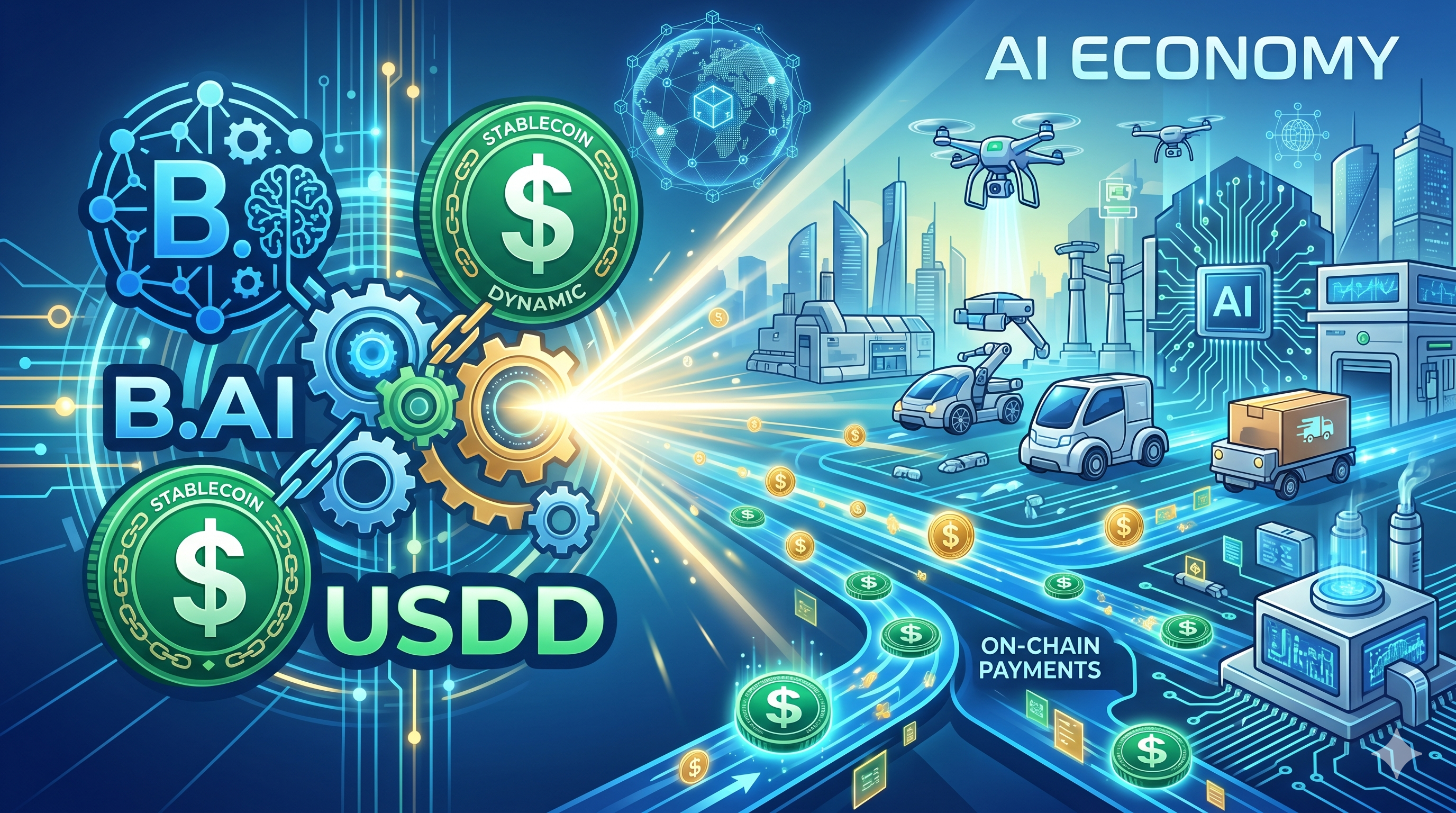
The strategic partnership announced on May 25, 2026, between USDD, the decentralized stablecoin managed by the TRON DAO Reserve, and B.AI, an intelligent economic infrastructure platform, marks a significant advancement in merging decentralized finance with artificial intelligence systems. This collaboration designates USDD as the core payment network for B.AI, enabling AI agents to perform autonomous transactions, value settlements, and economic exchanges entirely on-chain. B.AI, which launched on the TRON network in mid-April 2026, specifically targets challenges faced by AI agents such as model access, payments, settlements, identity management, and multi-agent coordination.
By leveraging USDD’s peg stability and TRON’s high-performance blockchain with B.AI’s specialized tools for agent identity, access control, and economic coordination, this partnership establishes functional infrastructure for AI agents to act as independent economic entities, overcoming traditional barriers in AI commercialization while utilizing proven blockchain capabilities for efficient, scalable operations in emerging autonomous economies.
💡 Tips: New to crypto? KuCoin's Knowledge Base has everything you need to get started.
How the USDD-B.AI Partnership Enables Agentic On-Chain Settlements
The partnership solidifies USDD’s position as the primary settlement mechanism within B.AI’s ecosystem, granting AI agents reliable access to programmable payment infrastructure capable of supporting instantaneous, trust-minimized value transfers across various use cases. Launched on TRON in April 2026, B.AI directly confronts operational hurdles for AI agents by providing integrated solutions for model consumption, payment processing, final settlements, on-chain identity establishment, and seamless coordination between multiple autonomous systems. USDD contributes through its over-collateralized reserve structure, which has historically maintained strong collateralization ratios supported by diversified assets, including TRX and Bitcoin holdings, offering a dependable unit of account amid broader market volatility.
This integration capitalizes on TRON’s proven capacity to manage thousands of transactions per second with consistently low fees, creating an environment suitable for the high-frequency, machine-initiated interactions that characterize agentic workflows. AI agents can authenticate using emerging on-chain identity standards, interface with premium AI models through consolidated API gateways, and execute payments via innovative protocols such as x402, which extends HTTP standards to facilitate direct machine-to-machine value exchange. Compared to conventional systems reliant on credit cards or centralized billing, this approach eliminates many geographic restrictions, recurring authorization requirements, and elevated processing costs that often impede global AI deployment.
Practical applications become evident when considering agents specialized in data processing or automated content production, which can independently secure computational resources, compensate for API utilization, and receive remuneration for delivered outputs without requiring continuous human supervision. The framework supports efficient cross-chain operations, extending USDD’s utility beyond TRON while preserving settlement integrity. Industry analysts show TRON’s dominant position in stablecoin liquidity pools, particularly with USDD and USDT, as a critical enabler for sustaining the volume and velocity anticipated in machine-driven economic activities.
As AI systems evolve toward greater autonomy, such payment infrastructures may eventually surpass traditional retail networks in transaction throughput, with the added advantage of immutable, publicly verifiable records that enhance accountability across participants. The initiative aligns closely with TRON DAO’s substantial commitments to AI development, including the expansion of its dedicated AI fund to $1 billion, which prioritizes agentic technologies and supporting financial primitives.
B.AI Platform Architecture and Its Reliance on TRON Infrastructure
B.AI functions as a comprehensive financial operating system tailored for AI agents, merging blockchain-native identity frameworks with optimized payment and coordination protocols designed explicitly for non-human participants. Constructed on the TRON blockchain, the platform exploits the network’s exceptionally low transaction costs and robust throughput capabilities to sustain persistent agent activities that would quickly become economically unfeasible on higher-fee alternatives. Agents operating within B.AI receive dedicated on-chain wallets paired with verifiable identity credentials, facilitating secure economic engagements while enabling standardized coordination mechanisms for collaborative tasks.
Core architectural components encompass subsidized access to leading AI models, where participants or agents replenish balances using TRON-native assets, including TRX, USDT, USDD, and USD1. This arrangement establishes efficient circular economies wherein expenditures on model inference translate directly into service revenues through automated settlement flows. TRON’s established leadership in global stablecoin transaction volumes supplies the necessary liquidity depth to support these machine-orchestrated exchanges without significant friction. The incorporation of USDD as the designated payment standard introduces advanced programmability, permitting smart contract enforcement of recurring obligations, performance-based releases, or proportional revenue distributions among collaborating agents.
Within the current AI development landscape, momentum is building around shifting from primarily conversational interfaces toward fully autonomous entities capable of managing intricate, multi-step processes independently. B.AI mitigates adoption challenges by streamlining agent provisioning processes and minimizing traditional compliance burdens while still generating on-chain behavioral histories that can inform credit-like assessments. Real-world implementations might involve agents participating in decentralized content ecosystems, where they produce material, manage distribution channels, and automatically process micro-compensations from end users or platforms.
Application developers can leverage B.AI’s exposed interfaces to construct specialized marketplaces that match users with domain-specific agents for functions ranging from intelligent contract verification to dynamic market intelligence gathering. The platform’s foundational emphasis on horizontal scalability positions it to accommodate anticipated exponential increases in agent populations and their associated interaction densities. TRON’s ongoing enhancements in areas such as oracle integrations and advanced DeFi tooling further bolster B.AI’s operational resilience.
USDD’s Role as a Stable Payment Rail for Autonomous AI Transactions
USDD serves as the foundational stability mechanism within the B.AI environment, delivering a consistent medium for value transfer that effectively neutralizes price fluctuation risks commonly associated with agent-driven commercial activities. Operating as a decentralized, over-collateralized stablecoin primarily on TRON with extensions to additional chains, USDD upholds its parity through meticulously managed and transparently reported reserves comprising TRX, BTC, and supplementary assets, all verifiable directly on the blockchain. Recent reserve management activities, including strategic acquisitions to bolster backing, have reinforced confidence in its suitability for mission-critical applications.
For autonomous agents, this predictability proves indispensable when modeling operational expenses, establishing service pricing, or managing multi-party financial arrangements. Consider an agent overseeing logistics optimization: it can project expenditures with greater precision when conducting procurements or invoice clearances denominated in USDD as opposed to more volatile cryptocurrencies. The partnership unlocks sophisticated programmable capabilities, including automated escrow arrangements contingent on verified deliverables or mechanisms allowing idle balances to accrue yields through connected DeFi venues. TRON’s distinctive resource model, utilizing Energy and Bandwidth, substantially diminishes expenses related to repetitive, granular transactions characteristic of agent ecosystems.
In the context of the expanding stablecoin sector, USDD distinguishes itself through its emphasis on practical DeFi applications and progressive transparency measures, such as those associated with version upgrades. Embedding within B.AI broadens its relevance to specialized AI scenarios involving frequent cross-jurisdictional or high-quantity micropayments that bypass conventional banking channels. Deployments could feature creative agents aggregating payments from diverse sources before autonomously allocating shares to computational suppliers or specialized subcontractors. Such dynamics promote enhanced capital productivity, as agents maintain operational continuity while directing earnings toward liquidity provision or lending opportunities within the broader TRON DeFi ecosystem.
The collaboration complements TRON DAO’s established focus on strengthening stablecoin frameworks, demonstrated through yield optimization programs and reserve diversification strategies. By anchoring settlements, USDD effectively connects conventional AI engineering practices with decentralized economic models, cultivating settings where machine cognition translates into quantifiable, verifiable contributions to overall system value. This integration also supports compliance-oriented use cases by providing immutable audit trails for all agent-initiated flows, addressing growing demands for accountability in automated systems.
Overcoming Traditional Payment Barriers in AI Agent Commercialization
Conventional financial infrastructures present multiple constraints for AI agents, ranging from extended clearing periods and disproportionate fees on low-value transfers to regional access limitations and dependence on centrally controlled accounts requiring human oversight. The USDD-B.AI initiative systematically addresses these limitations by deploying native blockchain payment channels that facilitate near-instantaneous, rule-driven transfers at negligible costs. B.AI incorporates protocols like x402 to enable agents to initiate and process payments through familiar web standards, thereby simplifying integration with external services and peer agents.
This transition substantially expands commercialization potential by permitting agents to maintain uninterrupted operation cycles free from payment-induced interruptions. An analytical agent, for instance, could autonomously subscribe to specialized datasets, remunerate for processing capacity, and commercialize derived insights within a unified technical stack. On-chain identity features within B.AI generate trustworthy credentials based on historical activity, fostering confidence in decentralized marketplaces without relying on centralized authorities. TRON’s architectural attributes ensure these processes scale effectively as agent deployments potentially reach millions, consistent with forward-looking ecosystem projections.
Sector-wide examinations reveal surging capital allocation toward agentic architectures, as organizations pursue methods to implement self-governing operational sequences. The partnership supplies the critical transactional component previously absent, decreasing reliance on outdated financial mechanisms that restrict worldwide reach and introduce unnecessary intermediaries. Builders now possess resources to develop comprehensive applications where agents oversee complete value chains encompassing sourcing, execution, and compensation phases. USDD’s consistent valuation supports uniform pricing models irrespective of operational geographies, complemented by transparent ledger entries that streamline regulatory adherence and operational auditing.
Consequently, this infrastructure may activate previously underserved segments, including peer-to-peer AI service exchanges where agents engage competitively or cooperatively according to performance data logged immutably. TRON DAO’s targeted funding initiatives for payment-related and oracle technologies further validate the commitment to maturing these capabilities. The cumulative effect creates a more equitable ecosystem, enabling smaller innovators and users to engage meaningfully in AI value generation processes historically concentrated among major technology conglomerates.
Integration of DeFi and AI Through Programmable USDD Settlements
This collaboration fuses decentralized finance instruments with AI functionalities by directing agent activities through USDD-powered smart contracts deployed on TRON. Agents thereby gain direct entry to liquidity sources, automated yield optimization routines, and participatory governance structures concurrent with performing primary assignments. The synthesis produces composite applications wherein financial rules augment AI reasoning processes, for example, by enabling agents to dynamically adjust resource distributions according to live market indicators or risk parameters.
Advanced programmability supports intricate sequences, such as payments conditionally unlocked following oracle-confirmed task validations or multi-stage revenue allocations. B.AI’s system connects agent profiles directly to financial primitives, guaranteeing that operations remain traceable and contractually binding on the ledger. Observable cases encompass trading specialists that finalize positions in USDD before reallocating gains per encoded strategies or utility agents that secure funds in escrow pending successful outcome verification. TRON’s substantial stablecoin liquidity reservoirs minimize execution risks during these cycles.
Across the industry, the fusion of DeFi mechanics with AI capabilities is increasingly recognized as a driver for more efficient capital deployment toward productive applications. USDD’s collateral transparency and reserve reporting build assurance for institutional-scale involvement. The partnership progresses this vision by granting agents seamless incorporation of financial tools into their native operational contexts, thereby reducing external integration overheads. With expanding agent populations, these connections are positioned to generate meaningful increases in on-chain activity levels, enhancing overall network utility.
TRON Network’s Technical Advantages for High-Frequency AI Payments
TRON’s core engineering emphasizes rapid execution and economic efficiency, rendering it particularly appropriate for the frequent, modest-value exchanges projected to dominate agent-based economies. Its sustained ability to deliver elevated transaction processing rates, combined with minimal fees, creates suitable conditions for scenarios involving agents conducting numerous micro-interactions throughout operational periods. B.AI harnesses these attributes, which are established by TRON as its principal settlement foundation, thereby preventing payment processes from constraining overall system performance.
Distinguishing elements such as resource management innovations and stablecoin-specific enhancements further simplify agent implementations. USDD’s inclusion introduces valuation constancy, permitting agents to preserve capital without perpetual risk management activities. Empirical performance metrics from TRON’s stablecoin operations illustrate its competence in reliably accommodating substantial throughputs. This foundation sustains elaborate coordination frameworks, including automated distributions in multi-agent projects where compensation reflects predefined contribution metrics.
Comparative evaluations consistently position TRON among frontrunners in stablecoin handling capacity, delivering the liquidity reservoirs vital for AI-mediated marketplaces. The partnership channels these strengths into nascent agent applications, where operational dependability often outweighs theoretical maximums. Implementation reports from builders indicate simplified incorporation of payment functionalities relative to competing networks.
As agent frameworks advance, TRON’s attributes are likely to draw additional initiatives seeking dependable scaling foundations. Continuous protocol advancements encompassing bridging solutions and expanded DeFi primitives complement B.AI’s offerings. This technical harmony constructs a resilient base for piloting and operationalizing sophisticated AI economic platforms capable of sustained real-world utility. Network statistics reflecting consistent uptime and growing adoption metrics reinforce its suitability for always-on autonomous systems.
Identity and Coordination Mechanisms for AI Agents on B.AI
B.AI deploys blockchain-based identity protocols enabling AI agents to maintain durable, cryptographically attested profiles that accumulate reputation scores and interaction histories over time. These mechanisms cultivate reliability in open environments, allowing agents to enter into agreements or joint ventures grounded in documented performance records. Coordination utilities support collective endeavors, with compensation frameworks encoded to distribute value proportionally according to smart contract logic.
USDD integrates as the transactional medium within these structures, guaranteeing accurate fulfillment of negotiated parameters. Agents thereby achieve genuine economic independence, progressing beyond reactive query handling to proactive marketplace involvement. Illustrations include collaborative research groups wherein agents aggregate capabilities, exchange outputs, and apportion USDD earnings according to contribution algorithms. The architecture notably decreases overheads associated with organizing distributed intelligence systems on centralized alternatives.
These advancements correspond with industry progression toward increasingly independent AI configurations, where operational autonomy necessitates robust identification and transactional foundations. The partnership delivers mature tooling addressing these prerequisites, drawing upon TRON’s security model and distributed consensus. Practical consequences extend into domains necessitating perpetual functionality, such as infrastructure oversight or adaptive service delivery networks. Evolving interoperability standards promise to broaden application scopes across heterogeneous platforms. TRON DAO’s resource allocations toward identity and coordination primitives ensure ongoing development and resilience. This creates opportunities for reputation economies where high-performing agents command premium compensation through transparent track records.
Developer Opportunities in Building on the USDD-B.AI Stack
Developers obtain comprehensive APIs and development kits that conceal underlying complexities associated with agent financial operations, identification management, and model connectivity. This significantly reduces onboarding thresholds for crafting niche agents or complete marketplace platforms. USDD’s scripting features permit tailored economic rulesets, while TRON’s tooling manages reliable execution layers. Ecosystem programs, including hackathons and grant allocations from TRON DAO stimulate exploration in domains such as autonomous DeFi managers or generative content platforms. Builders can experiment with hybrid models combining AI decision engines and on-chain execution, accelerating time-to-market for innovative services. Community resources and documentation further support rapid prototyping and iteration.
The availability of these tools creates substantial opportunities for developers seeking to participate in the growing intersection of AI and blockchain. With B.AI providing unified access to leading AI models through subsidized credits topped up via TRON assets like TRX, USDT, USDD, and USD1, developers can focus on building specialized agent logic rather than infrastructure basics. For instance, a developer creating a content generation agent can integrate USDD for automated micropayments from users while the agent pays for compute resources or data feeds independently. TRON’s low-fee environment and high throughput ensure these interactions remain cost-effective even at scale.
TRON DAO’s $1 billion AI fund further incentivizes development by offering grants and support for projects that advance agentic infrastructure. Hackathons hosted around the ecosystem often feature challenges centered on B.AI integrations, rewarding solutions that demonstrate practical use cases such as AI-powered supply chain optimizers or decentralized research collaborators. Documentation includes detailed guides on implementing x402 payment protocols alongside USDD smart contracts, allowing for conditional payments released only upon oracle-verified task completion.
This setup lowers barriers for independent developers and small teams who previously faced challenges integrating payments into AI systems. Marketplaces built on the stack could enable agents to advertise services, negotiate terms via smart contracts, and settle in USDD, creating new revenue streams. Early participants report faster iteration cycles due to the abstracted layers handling identity via on-chain standards and coordination for multi-agent tasks. As the ecosystem matures, developers can leverage TRON’s stablecoin liquidity to build applications with real economic depth, such as yield-generating agents that manage USDD holdings while performing services.
Case Studies of Early AI Agent Deployments Using On-Chain Payments
Initial rollouts showcase agents managing functions including algorithmic trading executions, automated content oversight with integrated compensation, and systematic data annotation processes settled via USDD. These trial implementations confirm the stack’s dependability for extended autonomous functioning. Participant input emphasizes lowered management burdens relative to legacy combinations. Early integrations with gaming and analytics platforms demonstrate cross-sector applicability. One notable early deployment involves trading agents on TRON that utilize USDD for stable settlements in DeFi protocols. These agents monitor market conditions, execute trades based on predefined strategies, and automatically handle settlements without human intervention, leveraging B.AI’s identity and payment layers for seamless operations.
Feedback from testers indicates significant reductions in operational overhead, as agents manage escrow and payouts through programmable contracts. Another case features content moderation agents in decentralized platforms, where they review user-generated material, flag issues, and receive USDD compensation distributed proportionally via smart contracts. In data annotation projects, agents label datasets for machine learning models, with payments processed instantly upon completion verification. Integrations with gaming environments allow agents to handle in-game economies, purchasing virtual assets or services using USDD while earning from player interactions. These examples highlight how B.AI addresses previous limitations in AI commercialization by providing on-chain rails that support continuous activity.
Analytics platforms have incorporated agents for real-time market intelligence, where USDD facilitates payments for data access and distributes insights as paid services. Developers involved report that the transparency of TRON’s ledger aids in auditing agent performance and building reputation systems. Cross-sector applicability is evident as similar frameworks adapt to logistics, where agents coordinate shipments and settle supplier invoices autonomously. The low costs and high speed of TRON enable high-frequency interactions that would be impractical on other networks.
Risk Management and Stability Features in Agentic Payment Systems
USDD’s over-collateralization approach, combined with diversified holdings and public reserve disclosures, bolsters systemic resilience. B.AI incorporates behavioral constraints and transaction monitoring to moderate potential agent anomalies. Participants benefit from dashboard tools for exposure oversight amid fluctuating AI adoption rates. Multi-signature and oracle redundancies add protective layers. USDD maintains its stability through a robust over-collateralization model, with reserves including TRX, BTC, and other assets reaching ratios around 146% as reported in April 2026 transparency updates when supply approached 1.5 billion.
Real-time on-chain verification allows agents and users to monitor backing continuously, reducing counterparty risks in autonomous transactions. B.AI adds layers by implementing spending limits and anomaly detection for agent behaviors, preventing runaway executions or unauthorized transfers. Dashboard interfaces provide real-time visibility into portfolio exposures, helping participants adjust strategies based on market conditions or AI model performance. Oracle redundancies ensure data feeds for conditional payments remain accurate and tamper-resistant, while multi-signature requirements for larger settlements add security against single-point failures. These features collectively create a safer environment for high-volume, machine-driven activities.
In practice, agents operating in volatile sectors like trading benefit from USDD’s peg stability to avoid liquidation risks common with native tokens. B.AI’s monitoring tools flag unusual patterns, such as excessive API calls, triggering pauses or alerts. Ecosystem participants, including developers and enterprises, utilize these safeguards to manage systemic risks as AI adoption accelerates. TRON’s established security track record, with consistent uptime and battle-tested consensus, further supports confidence in the payment rails.
Ecosystem Growth Metrics Following the Partnership Announcement
Activity indicators post-May 25 announcement include heightened developer engagement and discussions surrounding agent implementation resources. USDD performance parameters demonstrate continued steadiness, with anticipated positive contributions from deepened AI connectivity. Community metrics reflect growing interest in related tooling. Following the announcement, TRON ecosystem forums and social channels saw increased discussions on B.AI integrations, with developer queries focusing on USDD settlement implementations. USDD supply metrics remained stable, supported by transparent reserves and ongoing vault campaigns offering yields.
On-chain activity in TRON stablecoins showed resilience, with potential uplift from AI-driven use cases. Community metrics, including GitHub contributions to related repositories and participation in ecosystem events, indicate rising momentum. Hackathon registrations targeting agent technologies surged, reflecting interest in building on the stack. USDD’s collateral ratio and treasury reports continue to build confidence, with April 2026 figures highlighting strong backing.
Analytics platforms tracking TRON activity noted spikes in wallet creations and contract deployments aligned with AI themes. The partnership announcement amplified visibility, drawing attention from AI-focused projects seeking blockchain payment solutions. Long-term growth may manifest in higher daily transactions and TVL as agents proliferate. These indicators suggest the collaboration catalyzes broader ecosystem expansion, with USDD benefiting from increased utility in autonomous systems. Monitoring tools show sustained engagement, positioning the network for further advancements in the agent economy.
FAQs
How does the USDD-B.AI partnership specifically benefit AI developers looking to monetize autonomous agents?
The partnership equips developers with integrated infrastructure supporting native handling of payments, identities, and settlements on TRON via USDD. This substantially cuts time and expenses involved in constructing bespoke financial components, enabling concentration on core agent intelligence and vertical applications while utilizing stable, economical rails that improve commercial prospects and operational reliability.
What technical standards enable AI agents to transact autonomously within the B.AI platform?
B.AI employs standards including x402 payment extensions and identity protocols alongside USDD-driven smart contract capabilities. These facilitate direct machine interactions for service requests, outcome verification, and value transfers, removing the need for human mediation in economic loops.
In what ways does USDD’s collateral structure support its use in high-volume AI transactions?
USDD upholds robust over-collateralization backed by transparently reported reserves across multiple assets, delivering the consistency required for agents conducting frequent exchanges. Regular updates and risk management practices help sustain performance during varying market conditions.
How might businesses integrate B.AI-powered agents into existing operations?
Enterprises can utilize available APIs to introduce agents for procurement automation, analytical processing, or client engagement tasks, with USDD managing associated settlements efficiently. This delivers measurable productivity improvements and detailed activity logs for oversight purposes.
What role does TRON’s network performance play in supporting agent coordination at scale?
TRON’s combination of high processing capacity and economical operations accommodates extensive concurrent agent activities and transfers, avoiding constraints that might disrupt sophisticated collaborative or high-frequency economic patterns.
Are there resources for developers to start building with the USDD-B.AI integration?
Comprehensive guides, B.AI APIs, TRON development suites, and ecosystem funding opportunities offer accessible entry points, augmented by practical demonstrations from pioneering agent economy projects.
Disclaimer: This content is for informational purposes only and does not constitute investment advice. Cryptocurrency investments carry risk. Please do your own research (DYOR).