

U.S. Treasury Secretary Scott Bessent Views Crypto Infrastructure as the Ultimate Anchor for Dollar Dominance
Introduction
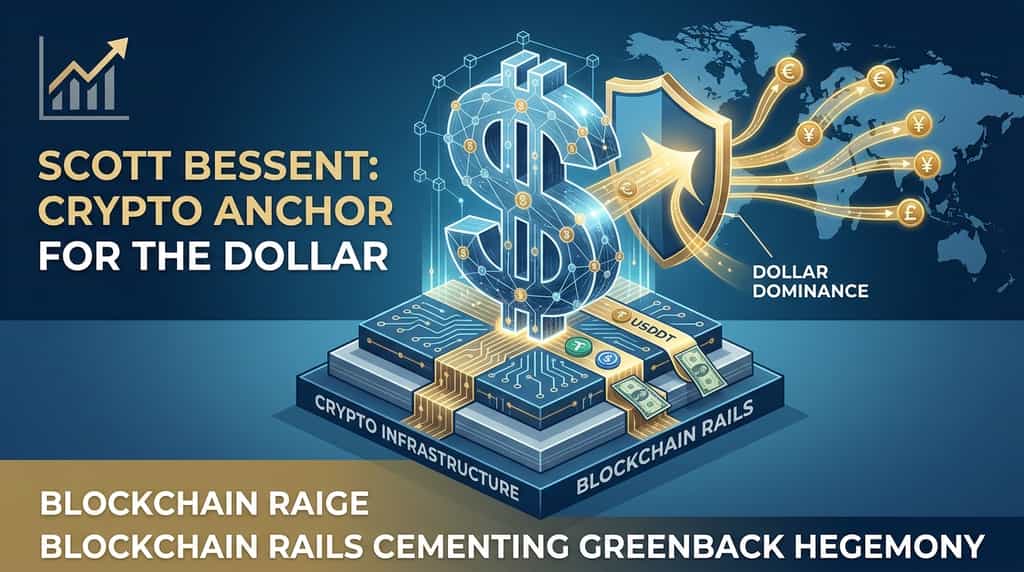
As global financial competition enters a digital-first era, United States leadership is shifting focus from traditional geopolitical levers to blockchain architecture. According to the U.S. Department of the Treasury data released in October 2026, over 90% of all stablecoins currently in global circulation are pegged directly to the greenback. Speaking at Ripple’s Swell conference, U.S. Treasury Secretary Scott Bessent outlined a transformative vision where decentralized technology and digital asset rails serve as the primary defensive wall for greenback hegemony. Rather than viewing tokenized networks as a threat to fiat supremacy, the Treasury is embracing crypto infrastructure as a powerful mechanism to expand sovereign reach, absorb federal debt, and secure long-term macroeconomic dominance.
How Stablecoins Fortify Federal Financing and Debt Absorption
Tokenized dollar instruments directly expand domestic borrowing capacity by establishing an organic, continuous buyer base for U.S. government debt. According to official U.S. Treasury Department briefings from October 2026, issuers of dollar-pegged digital assets are required to hold substantial reserves in short-term sovereign securities and cash equivalents to maintain their fixed pegs.
Every newly minted token backed by short-term government paper translates into direct, incremental institutional demand for federal debt instruments. This mechanism provides the Treasury Department with an alternative funding pipeline that operates independently of traditional foreign central bank buying patterns. By embedding sovereign liabilities into the operational reserves of decentralized networks, the United States effectively turns digital tokenization into an engine for domestic fiscal stability.
Expanding Greenback Reach Into Emerging Global Markets
Digital tokenization breaks down traditional banking friction, allowing greenback-denominated assets to penetrate high-inflation economies faster than legacy correspondent banking networks. According to macro-financial analyses published by the U.S. Department of the Treasury in October 2026, decentralized digital tokens provide citizens in developing nations with instant access to stable purchasing power without requiring local bank accounts.
This organic market expansion prevents dollar erosion by capturing retail and institutional demand in regions plagued by severe local currency devaluation. Instead of competing with the sovereign currency, tokenized rails export greenback liquidity directly to foreign digital wallets, cementing the United States monetary unit as the default unit of account across borderless digital economies.
| Feature | Legacy Banking Networks | Tokenized Digital Rails |
| Settlement Speed | 2 to 5 business days | Instantaneous (Sub-second to seconds) |
| Accessibility | Restricted by local correspondent banks | Permissionless smartphone-based wallets |
| Reserve Backing | Fractional commercial bank deposits | Direct short-term U.S. Treasury securities |
Technological Competitiveness as the New Geopolitical Shield
Technological leadership in distributed ledgers is replacing military might as the foundational pillar of global reserve currency status. According to statements delivered by Treasury Secretary Scott Bessent in October 2026, the United States must out-innovate international competitors in the digital assets arena to ensure that the infrastructure of global commerce remains anchored in Western financial standards.
Allowing adversarial financial networks to build alternative settlement layers would gradually fragment global liquidity and erode the enforcement power of sovereign monetary policy. By fostering an innovation-friendly domestic regulatory ecosystem—supported by frameworks like the GENIUS Act—the Treasury aims to ensure that the foundational rails of next-generation global trade run exclusively on U.S. dollar standards.
Regulatory Alignment and Institutional Integration
Unified federal oversight between the Securities and Exchange Commission, the Commodity Futures Trading Commission, and the Treasury Department is essential to mainstreaming institutional digital asset adoption. According to official regulatory policy updates from October 2026, federal financial regulators are actively working to eliminate legacy banking hurdles and safeguard market participants against arbitrary debanking.
Clear statutory guidelines eliminate compliance ambiguity, encouraging major financial institutions, payment processors, and custody providers to integrate blockchain rails into core commercial operations. This regulatory harmonization bridges traditional finance with decentralized networks, establishing deep institutional liquidity pools that reinforce the structural integrity of the entire digital asset ecosystem.
Empowering the Future of Global Digital Finance
The integration of blockchain architecture into sovereign fiscal strategy marks a historic turning point for international monetary policy. As tokenized finance scales to support trillions of dollars in daily cross-border settlement, understanding the underlying dynamics of sovereign debt integration, regulatory compliance, and market liquidity becomes critical for every active digital asset participant. Whether you are managing institutional treasury reserves or trading retail digital assets, staying informed on macroeconomic shifts driven by the U.S. Department of the Treasury ensures you remain ahead of structural market transformations. Position your portfolio strategically by leveraging professional analytics tools and secure custody solutions available on KuCoin.
Conclusion
The endorsement of crypto infrastructure by U.S. Treasury Secretary Scott Bessent signals a permanent evolution in how sovereign states view blockchain technology. By recognizing that over 90% of stablecoins act as synthetic demand engines for federal debt, the United States has positioned digital asset rails as a vital instrument for preserving greenback hegemony. This paradigm shift proves that decentralized networks and sovereign fiat are not mutually exclusive adversaries, but rather interdependent components of the next-generation global financial architecture. As institutional adoption deepens and regulatory frameworks mature, tokenized settlement layers will continue to redefine cross-border commerce, federal financing, and macroeconomic power dynamics for decades to come.
Frequently Asked Questions
What specific legislative framework governs stablecoin reserves in the United States?
The GENIUS Act establishes the federal regulatory structure requiring digital token issuers to maintain full backing in liquid assets, specifically including short-term U.S. Treasury securities.
How do stablecoin issuers directly impact federal debt management?
Issuers purchase and hold short-term U.S. government debt as reserve backing to maintain their currency pegs, creating a consistent, automated buyer base for Treasury issuances.
Why does the U.S. Treasury view tokenized networks as a defense for dollar dominance?
Because over 90% of all stablecoins are denominated in U.S. dollars, expanding token adoption globally increases foreign demand for greenback-backed liquidity rather than competing sovereign currencies.
What role do federal regulatory agencies play in this digital asset strategy?
Agencies like the SEC and CFTC collaborate with the Treasury Department to establish clear compliance guidelines, eliminate debanking practices, and integrate institutional banking with blockchain networks.
How do tokenized assets reach users in high-inflation emerging markets?
Tokenized assets operate on permissionless public networks, allowing individuals in developing economies to access stable greenback value directly via mobile digital wallets without traditional banking access.
Disclaimer
This general market information, possibly from third-party, commercial, or sponsored sources, is provided for reference and educational purposes only and does not constitute financial or investment advice, an offer, solicitation, or guarantee. We disclaim liability for its accuracy, completeness, reliability, and any resulting losses. Investments/trading are risky; past performance doesn’t guarantee future results. Users should research, judge prudently, and take full responsibility. For further details, please consult KuCoin’s Terms of Use and Risk Disclosure.