

Tesla Bitcoin Holdings Near $1 Billion After $122M Unrealized Gain — Without Buying a Single Coin
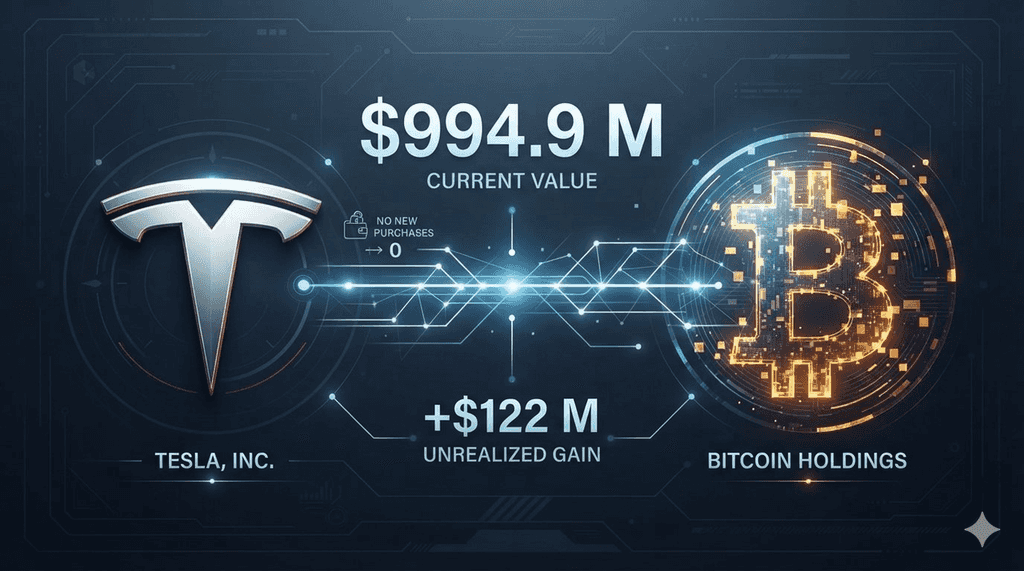
As of late September 2026, Tesla officially holds 11,509 Bitcoin (BTC) as part of its corporate treasury, a position that has recently approached a total market valuation of $1 billion. Without initiating any new purchase orders or executing any sales since 2022, recent macroeconomic shifts and cryptocurrency market rallies have lifted the value of this portfolio substantially. In a single week, a 14% upward movement in the spot price of Bitcoin generated approximately $122.6 million in unrealized market value gains for the company.
This development highlights the structural mechanics of modern corporate treasury management involving digital assets. Tesla’s current position provides an observable, public case study on the long-term retention of cryptocurrency on a corporate balance sheet. While the initial phases of Tesla's involvement with Bitcoin were marked by high-profile acquisitions and strategic liquidations optimized for fiat liquidity, the company's strategy has decisively transitioned into a phase of passive retention. For institutional investors and market analysts, Tesla represents a paradigm wherein digital assets are utilized not as a core operational focus, but as a supplementary instrument for financial diversification.
Key Takeaways
-
Driven by a robust cryptocurrency market rally in late September 2026, the total market valuation of Tesla's Bitcoin holdings advanced to approximately $995 million to $997.8 million, placing the portfolio within a narrow margin of the $1 billion threshold.
-
The electric vehicle manufacturer recorded an estimated $122.6 million increase in the market value of its holdings over a single week due to asset appreciation, illustrating the balance sheet impact of a corporate digital asset treasury.
-
Blockchain analytics confirm that Tesla has not executed any purchases or sales since its last major liquidity event in the second quarter of 2022. The 11,509 BTC held by the company remain securely retained across multiple on-chain addresses.
-
Under updated Financial Accounting Standards Board (FASB) reporting rules, upward price fluctuations directly bolster the asset side of Tesla's balance sheet at fair market value, allowing the company to recognize wealth increases without generating operational cash flow.
-
Tesla’s strictly passive holding strategy presents a distinct contrast to enterprise entities like MicroStrategy, highlighting the divergent methodologies institutional entities utilize to manage digital scarcity.
On-Chain Data: An Objective Look at Tesla’s 11,509 BTC Portfolio
In the current landscape of corporate finance, companies holding public blockchain assets can be independently audited through transparent on-chain analysis. This operational transparency allows market participants, shareholders, and institutional analysts to verify treasury reserves without waiting for standardized quarterly earnings disclosures. The blockchain functions as a continuous, immutable ledger, providing real-time visibility into the exact status, movement, and security of corporate digital asset holdings.
According to comprehensive blockchain tracking by the intelligence platform Arkham, the Tesla Bitcoin portfolio currently consists of 11,509 BTC. This precise figure matches the digital asset balance consistently reported in the company's regulatory filings with the U.S. Securities and Exchange Commission (SEC) since late 2022. Distributing these assets across multiple distinct on-chain wallet addresses is a foundational institutional security protocol. This architectural fragmentation is designed to mitigate the risks associated with centralized points of failure, ensuring that the potential compromise of a single private key or custodial vector cannot jeopardize the entirety of the corporate reserve.
The defining characteristic of these addresses over the past several years has been their strict operational stability. Since the significant liquidation event executed in the second quarter of 2022, there has been no recorded outgoing transaction volume associated with selling activities. Blockchain ledgers confirm that no coins have been routed to centralized exchange hot wallets for liquidation, no over-the-counter (OTC) transfers have been initiated, and no new institutional purchases have been added to this specific storage allocation.
During the broader cryptocurrency market rally in late September 2026, Bitcoin's spot price experienced a sharp upward trajectory, climbing above the $86,700 mark and temporarily exceeding $87,000 before encountering mild resistance. At these elevated price levels, the 11,509 BTC held by Tesla reached a gross market valuation of approximately $997.8 million. To contextualize the scale of this rapid appreciation, Tesla's financial disclosures at the end of June 2026 listed the fair market value of their digital assets at roughly $674 million. The late September surge effectively increased the market value of the company's treasury by hundreds of millions of dollars over a single quarter. Specifically, the 14% positive price swing in Bitcoin over a single week directly translated into a $122.6 million unrealized gain for Tesla, pushing the portfolio to within roughly $5.1 million of the psychological $1 billion barrier.
The Historical Context of Tesla's Cryptocurrency Strategy
In the first quarter of 2021, Tesla made a prominent entry into the digital asset space by allocating $1.5 billion of its corporate cash reserves into Bitcoin. This strategic acquisition was initially framed by corporate leadership as an effort to diversify the company's treasury holdings and maximize returns on available cash. Occurring during a macroeconomic environment characterized by expansive quantitative easing and historically low interest rates, this allocation positioned Tesla at the forefront of the corporate digital asset adoption narrative.
Later in that same quarter, Tesla executed a highly publicized sale of 10% of its holdings, generating approximately $272 million in fiat currency. Executive leadership explicitly noted that this partial liquidation was not indicative of a lack of faith in the asset's long-term viability. Rather, it was intended to serve as an empirical "stress test" to prove the deep liquidity of the Bitcoin market. The successful execution of this sale demonstrated that a major multinational corporation could efficiently convert a quarter of a billion dollars of digital assets back into traditional fiat currency without causing detrimental market disruptions or incurring prohibitive slippage.
The most substantial structural adjustment to Tesla's portfolio occurred in the second quarter of 2022. Amid severe global supply chain constraints, inflationary pressures, and extended factory lockdowns in key manufacturing hubs like Shanghai, Tesla's executive board prioritized the immediate availability of fiat liquidity. Consequently, the company converted approximately 75% of its remaining Bitcoin reserves into conventional currency, adding $936 million in cash to its balance sheet. Management clarified that this maneuver was strictly a defensive, tactical measure designed to maximize the company's cash position during a period of intense operational constraint and macroeconomic uncertainty.
Following the Q2 2022 liquidation, Tesla retained the core position of 11,509 BTC it holds today. Since that period, the corporate strategy has been characterized by strictly passive retention. Throughout subsequent market cycles—including the broader industry downturns of 2023 and the subsequent institutional recoveries extending into 2026—Tesla's holdings have remained fundamentally untouched. With operational cash flows stabilizing and manufacturing output recovering, the necessity for emergency fiat conversions was entirely negated. The remaining Bitcoin now functions as a long-term, non-correlated diversification asset on the balance sheet, held securely without active trading or ongoing accumulation.
Financial Mechanics: Fair Value Accounting and Unrealized Gains
When financial reports indicate a $122.6 million weekly gain in Tesla's Bitcoin portfolio, it is highly essential for investors and market analysts to distinguish between unrealized market value increases and operational cash flow. This distinction is fundamentally tied to the structural mechanics of how corporate accounting standards treat digital assets.
An unrealized gain signifies that the prevailing market price of an asset has increased, but the corporate entity has not executed a sale to realize that profit in fiat currency. While the sale of electric vehicles or energy storage systems generates direct operational cash flow that can be immediately deployed for capital expenditures, facility expansion, or research and development, an unrealized gain in a treasury asset does not yield immediately deployable capital. Tesla cannot utilize the $122.6 million increase to purchase raw materials or fund robotics development unless the underlying Bitcoin is actively sold on a cryptographic exchange.
However, the absence of immediate operational cash flow does not diminish the financial and structural relevance of these treasury gains. This is largely due to sweeping modernization in corporate accounting regulations. Historically, under the Generally Accepted Accounting Principles (GAAP) in the United States, digital assets like Bitcoin were strictly classified as indefinite-lived intangible assets. This outdated classification created a highly asymmetric and punitive reporting environment. If the market price of Bitcoin dropped below the company's initial purchase price, the firm was legally required to record an impairment charge, which negatively impacted their reported quarterly earnings. Conversely, if the price subsequently recovered or surged to new all-time highs, the company was prohibited from revising the asset's value upward on their balance sheet until the asset was physically sold. This framework actively discouraged broad corporate adoption by introducing significant earnings volatility without allowing companies to reflect the true market appreciation of their holdings.
This environment fundamentally shifted following targeted interventions by the Financial Accounting Standards Board (FASB). Responding to extensive feedback from corporate stakeholders, the FASB issued an Accounting Standards Update (ASU) that officially permitted corporations to measure qualifying crypto assets at fair market value. Under this modernized fair value accounting model, companies like Tesla are required to evaluate their Bitcoin reserves based on quoted prices in active markets at the end of each reporting period. Any fluctuations in value—encompassing both downward corrections and upward price appreciation—are now recognized directly in net earnings.
Consequently, the estimated $122.6 million market gain experienced in late September 2026 is highly consequential from an accounting perspective. When Tesla files its impending quarterly SEC regulatory disclosures, this asset appreciation will be officially captured on the asset side of the consolidated balance sheet. Recognizing this unrealized gain mathematically bolsters the company’s core financial ratios. A robust, appreciating asset base can optimize the overall cost of capital, improve credit ratings from major financial institutions, and project immense balance sheet health to equity investors, proving that a passive holding strategy can deliver tangible corporate reporting benefits.
Corporate Treasury Strategies: Passive Retention vs. Active Accumulation
The contemporary landscape of corporate Bitcoin treasuries is generally dominated by two fundamentally distinct strategic methodologies. A comparative analysis between Tesla’s approach and that of companies like MicroStrategy illustrates the diverse utilization of digital assets within corporate finance, highlighting how risk tolerance and core business objectives dictate treasury management.
MicroStrategy, under its executive leadership, views Bitcoin not merely as a supplementary reserve asset, but as the central, defining component of its overarching corporate strategy. The firm actively leverages traditional financial instruments and credit markets to accumulate additional cryptocurrency at an aggressive pace. MicroStrategy regularly issues convertible senior notes (corporate debt) and strategically dilutes shareholder equity to raise billions of dollars in fiat capital, which is subsequently deployed to execute large-scale market purchases of Bitcoin. The primary operational objective of this accumulation is to maximize the company's total digital asset holdings relative to its outstanding shares, essentially transitioning the enterprise into a leveraged proxy vehicle for Bitcoin exposure within traditional equity markets.
In stark contrast, Tesla employs a highly disciplined, passive retention strategy. Fundamentally, Tesla remains a hardware, energy infrastructure, and artificial intelligence company focused entirely on the manufacturing of electric vehicles, stationary energy storage solutions, and advanced robotics. Bitcoin does not represent Tesla's core operational business model; rather, it serves strictly as an auxiliary instrument for balance sheet diversification. Tesla does not issue corporate debt to finance cryptocurrency purchases, nor do they dilute shareholder equity to expand their digital asset portfolio. The 11,509 BTC are maintained in the exact same conceptual manner as traditional treasury instruments—such as short-term government securities, money market funds, or physical commodities—acting as a passive, non-correlated hedge against fiat devaluation and macroeconomic instability.
| Strategic Element | Tesla (TSLA) | MicroStrategy (MSTR) |
| Primary Business Focus | Automotive Manufacturing, AI, Energy Storage | Business Intelligence Software, Digital Asset Accumulation |
| Role of Bitcoin | Auxiliary treasury asset; passive reserve hedge | Core corporate strategy; primary balance sheet focus |
| Purchasing Behavior | No acquisitions executed since early 2021 | Continuous, leveraged open-market accumulation |
| Funding Mechanism | Excess historical operational cash flow | Convertible debt issuance and strategic equity dilution |
| Current Market Stance | Passive Retention (Holding 11,509 BTC) | Aggressive Accumulator (Holding over 200,000 BTC) |
Both methodologies reflect entirely different corporate risk tolerances and structural objectives. Tesla’s strategy firmly indicates that a major multinational corporation can benefit from the long-term appreciation and fair value accounting advantages of a digital asset portfolio without fundamentally altering its core business operations or assuming the systemic risks associated with leveraged accumulation tactics.
Conclusion
Tesla’s corporate Bitcoin portfolio, comprising precisely 11,509 BTC, recently approached a $1 billion market valuation following an estimated $122.6 million weekly unrealized gain in late September 2026. By opting not to acquire or liquidate any digital assets since the second quarter of 2022, Tesla continues to demonstrate the strict viability of a passive retention strategy. Aided by the FASB's updated fair value accounting standards, these upward market fluctuations actively and positively influence the company’s reported financial health without requiring asset liquidation. Unlike entities that utilize heavy financial leverage to continuously expand their cryptocurrency holdings, Tesla utilizes its stationary reserves strictly as a supplementary diversification tool, reflecting a highly conservative yet financially impactful approach to modern corporate treasury management.
🔥 Beyond the Headlines: What KuCoin 5.0 Means for You
Market news moves fast — but where you act on it matters just as much. This October, KuCoin launches KuCoin 5.0, transforming KuCoin into a rebuilt platform. Here's what actually changes for you:
-
One account for everything. Older platforms split your money across separate "spot," "margin," and "futures" accounts and expected you to understand why. KuCoin 5.0's unified account removes that entirely — deposit once, and everything is simply there (only available to VIPs for now).
-
Stocks, indices, and commodities. KuCoin 5.0 expands beyond crypto into global markets. When crypto chops sideways and equities rally (or the reverse), you rotate in minutes instead of opening a brokerage account and waiting days for fiat rails.
-
Real-world assets (RWA). Tokenized exposure to traditional assets like commodities, right inside your crypto account. One of the fastest-growing segments in global finance is no longer reserved for institutions — you access it from the same balance you trade with.
-
Earn while you learn. Not ready to trade? KCUSD lets your stablecoins earn daily, auto-compounding interest. The lowest-stress way to put your idle deposit to work for 4% yield.
-
An AI assistant in plain language. Ask questions, get market context, understand what you're looking at — built into the platform, no jargon required.
-
An app that doesn't overwhelm. Faster, cleaner, and consistent — intuitive from the first tap, not after a tutorial.
-
Safety you can check, not just trust. A MiCAR-licensed EU entity, Proof of Reserves you can verify yourself, and internationally certified security (SOC 2 Type II, ISO 27001:2022).
Create your account in minutes — and start on the platform built for where crypto is going, not where it's been.
FAQs
How much Bitcoin does Tesla currently hold?
Tesla holds exactly 11,509 BTC across multiple on-chain addresses. This figure has remained constant since the company’s last major liquidation event in the second quarter of 2022, reflecting a passive long-term retention strategy.
Did Tesla purchase new Bitcoin to reach the near-$1 billion valuation?
No, the increase in valuation was driven entirely by favorable market conditions. A 14% rise in Bitcoin’s price in late September 2026 added approximately $122.6 million to the portfolio's value without any new purchases.
Why did Tesla sell 75% of its Bitcoin in 2022?
During Q2 2022, Tesla faced severe global supply chain disruptions and extended factory lockdowns. The company sold approximately 75% of its Bitcoin to maximize immediate fiat cash flow and fortify its operational liquidity.
Where does Tesla historically store its 11,509 BTC?
According to blockchain intelligence data, Tesla’s Bitcoin is distributed across hundreds of distinct, dormant on-chain wallet addresses. This structural fragmentation minimizes security risks by ensuring no single point of failure compromises the reserve.
How does Tesla’s crypto strategy differ from MicroStrategy’s?
Tesla uses Bitcoin purely as a passive treasury diversification tool. Conversely, MicroStrategy actively issues corporate debt and dilutes equity to continuously purchase more Bitcoin, making digital asset accumulation its primary corporate business strategy.
Disclaimer
The information provided on this page may originate from third-party sources and does not necessarily represent the views or opinions of KuCoin. This content is intended solely for general informational purposes and should not be considered financial, investment, or professional advice. KuCoin does not guarantee the accuracy, completeness, or reliability of the information, and is not responsible for any errors, omissions, or outcomes resulting from its use. Investing in digital assets carries inherent risks. Please carefully evaluate your risk tolerance and financial situation before making any investment decisions. For further details, please consult KuCoin’s Terms of Use and Risk Disclosure.