

South Korea’s KOSPI Surges 5.9% as AI Chip Rally Boosts Global Risk Appetite and Crypto Sentiment
2026/08/21 15:01:00
Key Takeaways
-
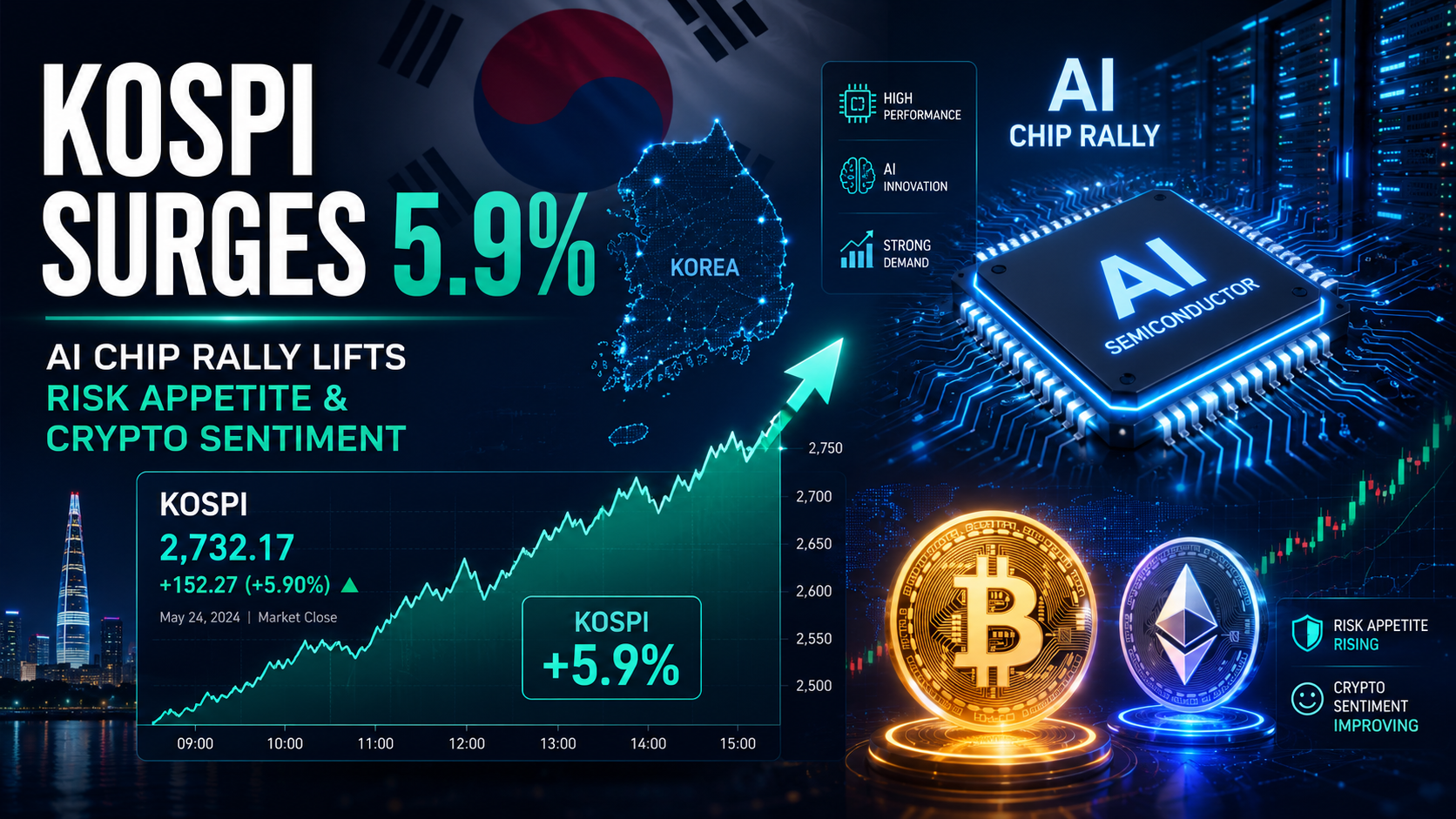
South Korea’s KOSPI surged 5.9% as semiconductor stocks fueled a powerful market rebound, highlighting renewed confidence in the AI-driven technology cycle.
-
Major chipmakers such as Samsung Electronics and SK Hynix benefited from strong investor interest in artificial intelligence infrastructure demand.
-
The rally reflects improving risk appetite across Asian markets, which may influence sentiment toward other growth-oriented assets, including cryptocurrencies.
-
While stock market performance does not directly determine Bitcoin or Ethereum prices, both traditional markets and crypto assets are influenced by broader liquidity and investor confidence trends.
South Korea’s KOSPI index recently delivered one of its strongest single-day performances, surging 5.9% as artificial intelligence-related semiconductor stocks led a broad market recovery. The move placed South Korea’s technology sector back in focus and highlighted the continued influence of the AI investment cycle on global financial markets.
The rally was driven by renewed optimism surrounding semiconductor demand, particularly for advanced memory chips used in AI infrastructure. Beyond South Korea’s equity market, the move also raised questions about whether improving risk appetite across traditional markets could influence cryptocurrency sentiment.
For crypto market participants, the significance of the KOSPI rally is not simply that stocks moved higher. Instead, it reflects a broader market trend: investors are once again showing stronger interest in technology, innovation, and growth-oriented assets. This article explores why South Korea’s market surged, how AI is reshaping global investment trends, and what the rally could mean for Bitcoin, Ethereum, and the broader crypto ecosystem.
What Happened to South Korea’s KOSPI Market?
South Korea’s benchmark KOSPI index experienced a sharp rebound as investors returned to technology and semiconductor stocks. The nearly 6% surge marked a significant improvement in market sentiment and reflected growing confidence in companies connected to the artificial intelligence supply chain.
The rally was primarily supported by major semiconductor companies, especially Samsung Electronics and SK Hynix. These companies play a crucial role in global memory chip production, including high-bandwidth memory (HBM), which has become increasingly important for AI servers and high-performance computing systems.
| Company | Role in AI Supply Chain | Market Significance |
| Samsung Electronics | Semiconductor manufacturing and memory chips | One of the world’s largest technology companies |
| SK Hynix | High-bandwidth memory (HBM) supplier | Key beneficiary of AI data center demand |
South Korea’s stock market has a unique relationship with the semiconductor industry because technology companies represent a significant portion of its economic and market structure. Unlike some markets that are more diversified across industries, KOSPI performance is highly sensitive to global demand for electronics, memory chips, and advanced manufacturing.
The latest rally therefore reflects both company-specific optimism and a broader reassessment of the AI technology cycle. Investors are increasingly focused on whether AI-related spending will continue expanding and whether semiconductor companies can sustain earnings growth as demand for computing infrastructure increases.
Why Did AI Chip Stocks Drive the Rally?
The Growing Demand for AI Infrastructure
The biggest factor behind the semiconductor rally is the rapid expansion of artificial intelligence infrastructure. As companies around the world invest heavily in AI models, cloud computing, and data centers, demand for advanced computing hardware has increased significantly.
AI development requires enormous computing power. Large-scale AI systems depend on powerful processors, advanced memory solutions, and extensive data center infrastructure. This has created a new investment cycle centered around companies that provide the hardware foundation for artificial intelligence.
The relationship can be summarized as:
→ AI model development
→ Higher computing demand
→ More data center investment
→ Greater demand for advanced chips
→ Stronger semiconductor industry outlook
South Korean companies are positioned at the center of this trend because they dominate important segments of the global memory chip market. High-bandwidth memory has become especially important as AI systems require faster data processing capabilities. As demand for AI computing grows, investors have increasingly viewed Korean semiconductor companies as strategic beneficiaries of the technology transition.
The market reaction also shows that investors are looking beyond short-term chip demand. The AI theme has become a broader investment narrative about future productivity growth, technological competition, and digital infrastructure expansion. As a result, companies connected to AI supply chains have attracted significant capital from investors seeking exposure to long-term innovation trends.
South Korea’s Semiconductor Advantage
South Korea’s importance in the global technology industry comes from decades of investment in semiconductor manufacturing. Companies such as Samsung Electronics and SK Hynix have built extensive expertise in memory technology, making the country a critical part of the global electronics supply chain.
The AI boom has strengthened this position because memory chips are essential components of modern AI systems. While much attention has focused on advanced processors, AI applications also require large amounts of fast, efficient memory to process increasingly complex workloads.
This creates a favorable environment for Korean semiconductor companies. As global technology firms continue expanding AI infrastructure, demand for memory solutions could remain an important growth driver.
However, the semiconductor industry remains cyclical. Strong demand expectations can support stock valuations, but investors must also consider factors such as production capacity, pricing conditions, and global economic trends. The current rally reflects optimism about the future, but continued performance will depend on whether AI investment translates into sustainable business growth.
How AI Optimism Is Changing Global Risk Appetite
The KOSPI rally is part of a broader market trend in which investors are showing renewed confidence in technology-driven growth assets. AI has become one of the most influential investment themes across global markets, affecting not only semiconductor companies but also software firms, cloud providers, and digital infrastructure businesses.
Risk appetite refers to investors’ willingness to allocate capital toward assets with higher potential returns but greater uncertainty. When confidence improves, investors often move away from defensive positions and increase exposure to growth-oriented assets.
The current AI-driven market environment demonstrates how a single technology trend can influence multiple sectors. Strong performance in semiconductor stocks can improve confidence across the broader technology sector, while positive sentiment can spread to other markets, including emerging markets and digital assets.
For example, when investors believe that innovation-driven growth opportunities are expanding, they may become more willing to allocate capital toward assets associated with technological transformation. This does not mean every growth asset will rise together, but it creates a more supportive environment for markets that depend heavily on investor confidence and liquidity conditions.
The connection between AI stocks and crypto markets is based on this shared market psychology. Both sectors are often viewed as part of the broader innovation economy, where investors seek exposure to emerging technologies and future financial infrastructure.
Why Does South Korea’s Rally Matter for Crypto Markets?
Although the KOSPI rally is a traditional financial market event, it has attracted attention from crypto participants because both stock markets and digital assets are influenced by similar macro factors, including liquidity conditions, investor confidence, and global risk appetite. When investors become more comfortable with higher-risk opportunities, capital often moves toward growth-oriented assets across different markets.
However, it is important to understand that a stronger Korean stock market does not directly cause Bitcoin or Ethereum prices to rise. Crypto markets have their own unique drivers, including network activity, regulatory developments, institutional flows, and digital asset-specific demand. The relationship between traditional markets and crypto is therefore more about shared market conditions rather than direct price correlation.
One of the most important connections is liquidity. During periods when investors are optimistic about economic growth and financial conditions, risk assets across markets can benefit. Technology stocks, emerging markets, and cryptocurrencies may all experience stronger demand because investors are more willing to seek opportunities beyond traditional defensive assets.
Liquidity has become one of the most important factors influencing both traditional markets and cryptocurrencies. When financial conditions become more supportive, investors often increase exposure to assets with higher growth potential.
For equity markets, this can lead to stronger demand for technology companies and emerging industries. For crypto markets, improving liquidity conditions can support demand for major assets such as Bitcoin and Ethereum.
Several factors influence this environment, including expectations around monetary policy, interest rates, currency movements, and institutional capital allocation. Although stocks and cryptocurrencies respond differently to these factors, they often react to changes in broader investor sentiment.
The KOSPI rally provides an example of how market psychology can shift. Strong performance in AI-related companies suggests that investors are becoming more comfortable with innovation-focused investments. This does not guarantee a crypto market rally, but it indicates that risk appetite across global markets may be improving.
South Korea’s Role in the Global Crypto Market
South Korea is particularly relevant to cryptocurrency discussions because it has one of the world’s most active digital asset markets. Korean retail investors have historically shown strong interest in cryptocurrencies, and local exchanges play an important role in regional trading activity.
The country’s technology-focused economy also creates an interesting connection between traditional innovation industries and digital assets. South Korea has strong positions in areas such as semiconductors, electronics, and digital infrastructure, while also maintaining significant participation in blockchain and cryptocurrency markets.
Therefore, changes in Korean investor sentiment can provide useful insight into broader Asian market behavior. When technology stocks perform strongly and risk appetite improves, it may influence how investors view other emerging technology-related assets, including cryptocurrencies.
The Connection Between AI, Crypto, and Digital Infrastructure
The relationship between artificial intelligence and cryptocurrencies has become increasingly important as both industries expand around digital infrastructure. While AI and blockchain serve different purposes, they share a common foundation: the demand for advanced computing, decentralized systems, and new forms of digital economic activity.
AI growth has increased demand for computing power, cloud infrastructure, and energy resources. At the same time, the cryptocurrency industry has continued developing around blockchain networks, decentralized applications, and digital financial services.
These trends increasingly overlap. For example, some cryptocurrency mining companies have begun exploring AI and high-performance computing services, using existing infrastructure and energy resources to support data-intensive applications. Meanwhile, blockchain projects are exploring ways to integrate AI capabilities into decentralized applications and digital services.
However, the connection between AI and crypto should not be overstated. AI-related stock rallies are driven primarily by corporate earnings expectations, hardware demand, and technology adoption, while cryptocurrency markets depend on additional factors such as network usage, regulation, and investor behavior.
The broader takeaway is that both sectors represent different parts of a larger digital transformation trend. Capital flowing into innovative technologies can influence market sentiment across multiple industries, even when individual assets have different underlying fundamentals.
Could Improving Risk Appetite Support Bitcoin and Ethereum?
The improvement in global risk sentiment following events such as the KOSPI rally may create a more supportive environment for major cryptocurrencies. Bitcoin and Ethereum are often considered high-growth digital assets, meaning they can benefit when investors become more willing to allocate capital toward emerging technologies.
Bitcoin is particularly sensitive to macroeconomic conditions because many institutional investors view it as part of a broader alternative asset allocation strategy. Factors such as liquidity conditions, interest rate expectations, and institutional demand can significantly influence Bitcoin market behavior.
Ethereum may respond to improving sentiment through a different mechanism. As the largest smart contract platform, Ethereum’s value is closely connected to blockchain adoption, decentralized applications, and ecosystem activity. Stronger confidence in digital infrastructure may support interest in Ethereum’s long-term role within the blockchain economy.
| Asset | Key Drivers | Relationship With Risk Appetite |
| Bitcoin | Institutional demand, liquidity, macro conditions | Often benefits when investors seek alternative assets |
| Ethereum | Network activity, DeFi, applications, ecosystem growth | May benefit from increased blockchain adoption |
| Technology Stocks | Earnings growth, AI investment, innovation | Directly linked to economic growth expectations |
Despite these connections, investors should avoid assuming that stock market gains automatically lead to cryptocurrency appreciation. Traditional markets and crypto markets can move differently depending on specific conditions.
For example, a technology stock rally may continue even if crypto markets weaken due to regulatory concerns or declining blockchain activity. Similarly, cryptocurrencies can experience strong rallies during periods when traditional markets remain uncertain.
The most accurate interpretation is that improving risk appetite creates a favorable background, but crypto assets still require their own market catalysts.
What Risks Could Challenge the Current Market Optimism?
While the AI-driven market recovery has created significant enthusiasm, several risks could challenge the current optimism. The first concern is whether AI-related valuations have moved too quickly relative to actual business performance. The rapid rise of AI-focused companies has led investors to assign high expectations to future growth. If corporate earnings or AI infrastructure demand fail to meet expectations, technology stocks could experience periods of adjustment. The semiconductor industry is also cyclical. Although AI demand remains a major growth factor, chip companies still face traditional industry challenges, including supply-demand fluctuations, production costs, and geopolitical risks.
Another important factor is the global macroeconomic environment. Changes in interest rates, bond yields, or currency markets can significantly influence investor behavior. Higher interest rates or tighter financial conditions may reduce demand for risk assets, including technology stocks and cryptocurrencies. Crypto markets face additional risks. High leverage, regulatory uncertainty, and sudden changes in investor sentiment can create sharp price movements. Even when broader risk appetite improves, digital assets remain highly sensitive to market expectations.
Therefore, the current environment should be viewed as a period of improving optimism rather than a guarantee of continued market gains.
What Investors Should Watch Next
The next stage of the market cycle will likely depend on whether current optimism develops into sustainable growth. For AI-related markets, investors will closely monitor whether semiconductor demand continues expanding and whether companies can convert AI investment into long-term earnings growth. Macroeconomic conditions will also remain important. Expectations around monetary policy, inflation trends, and global liquidity will continue influencing how investors allocate capital across asset classes.
For crypto markets, attention will likely remain on Bitcoin and Ethereum performance, institutional investment trends, and overall market liquidity. Stablecoin activity, exchange flows, and blockchain network usage can provide additional insight into whether crypto demand is strengthening. The relationship between traditional markets and cryptocurrencies is becoming increasingly complex. Rather than moving independently, many markets now respond to shared forces such as technology adoption, financial conditions, and global investor sentiment.
The KOSPI rally demonstrates how developments in one region and one industry can influence broader market narratives. Whether this translates into stronger crypto performance will depend on how these wider trends evolve.
Conclusion
South Korea’s 5.9% KOSPI surge highlights the growing influence of artificial intelligence and semiconductor demand on global financial markets. Driven by strong performance from major chip companies such as Samsung Electronics and SK Hynix, the rally reflects renewed confidence in the AI investment cycle and improving investor sentiment.
For cryptocurrency markets, the importance of this event lies not in a direct price impact but in what it reveals about broader risk appetite. When investors become more optimistic about technology-driven growth, assets across different markets may benefit from improved liquidity and stronger confidence.
However, stock market rallies and crypto movements are shaped by different factors. Bitcoin and Ethereum will continue to depend on their own fundamentals, including institutional demand, network development, regulation, and market structure.
As AI continues reshaping global technology investment, the relationship between traditional markets and digital assets will likely become increasingly important. The KOSPI rally is another example of how innovation trends can influence investor behavior across the global financial landscape.
FAQs
What is the KOSPI index?
The KOSPI (Korea Composite Stock Price Index) is South Korea’s primary stock market benchmark. It tracks the performance of companies listed on the Korea Exchange and is widely used to measure the overall health of South Korea’s equity market.
Why are South Korean semiconductor companies important globally?
South Korean semiconductor companies play a major role in the global technology supply chain, particularly in memory chips and advanced semiconductor manufacturing. Companies such as Samsung Electronics and SK Hynix supply components used in smartphones, data centers, and AI computing systems.
Does a stock market rally always mean cryptocurrency prices will rise?
No. Stock market gains do not guarantee cryptocurrency price increases. However, both markets can be influenced by similar factors, such as liquidity conditions, investor confidence, and risk appetite.
How does AI growth affect the cryptocurrency industry?
AI growth can influence crypto through several channels, including increased demand for computing infrastructure, new blockchain applications, and greater interest in technology-driven investments. However, AI and crypto remain separate markets with different fundamentals.
What factors influence Bitcoin and Ethereum besides stock markets?
Bitcoin and Ethereum prices are influenced by many factors, including monetary policy, institutional investment, regulatory developments, network activity, market liquidity, and investor sentiment. Stock market performance is only one part of the broader picture.
🔥 KuCoin Offers A More Stable Option in A Volatile Market
If you worry about the frequent ups and downs in the market, and pursue a more stable option to earn money passively, KuCoin is the right place to come:
Simple Earn: Deposit and withdraw tokens anytime, earning stable returns.
Kucoin Earn: Earn stable profits with professional asset management.
Hold to Earn: Earn rewards by holding assets in Funding, Trading, Margin, Futures, Mining, and Unified Accounts.
Staking: Unlock the earning potential of on-chain assets.
Advanced Investments: Advanced Investments offer a variety of structured products to help your money grow in any market.
Shark Fin: Principal Protection and Guaranteed Gains
Dual Investment: Buy low and sell high with transparent return calculations.
Snowball: High yields, with price protection.
Discount Buy: Buy crypto at discount prices.
KCS Loyalty: Level up to enjoy exclusive perks by staking ≥ 1 KCS.
KuCoin Wealth: Discover future value and begin your smart investing journey.
KCS Benefits: Hold and stake KCS to access benefits across the platform.
KCS Staking 2.0: Participate in KCS on-chain governance to earn yield.
Disclaimer: This content is for informational purposes only and does not constitute investment advice. Cryptocurrency investments carry risk. Please do your own research (DYOR).