

Solana Tokenized Stocks Hit $4.4B in September: What the Record Volume Means
Introduction
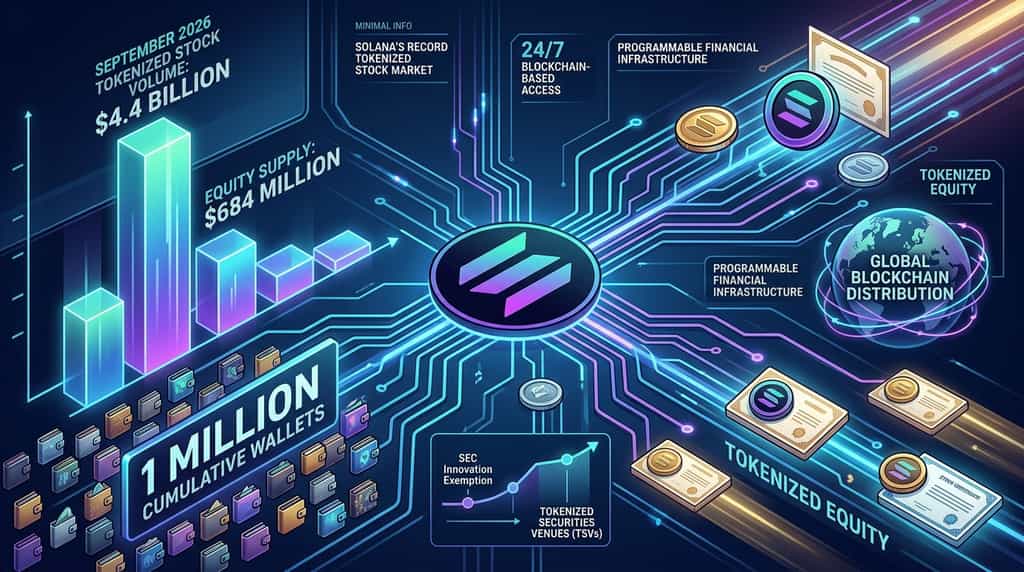
Can stocks really trade like crypto assets on a blockchain? In September 2026, Solana's tokenized-stock market processed roughly $4.4 billion in trading volume, setting a new monthly record, according to the Solana Foundation's October 6, 2026 ecosystem report. Tokenized-equity supply also reached $684 million, up 47% over three weeks, while cumulative tokenized-stock holder wallets reached 1 million.
The numbers point to more than a short-term trading spike. They show that tokenized equities are becoming a meaningful use case for Solana, combining traditional financial assets with blockchain-based settlement and trading infrastructure.
This article explains what drove the surge, how tokenized stocks work on Solana, why the September record matters, what regulatory developments changed the market, and what investors should understand before trading tokenized equities.
What Happened to Solana Tokenized Stocks in September 2026?
Solana tokenized stocks reached approximately $4.4 billion in September trading volume, making it the network's strongest month for tokenized-stock activity to date, according to the Solana Foundation's October 6, 2026 ecosystem report.
The $4.4 billion figure represents trading activity rather than the total value of tokenized stocks outstanding. This distinction is important because trading volume measures the cumulative value of transactions during a period, while tokenized-equity supply measures the value of the assets represented onchain.
The Solana Foundation reported that tokenized-equity supply reached $684 million in September, rising 47% over a three-week period. At the same time, the number of cumulative wallets holding tokenized stocks reached 1 million. These figures describe two different aspects of market growth. The $4.4 billion volume indicates strong secondary-market activity, while the $684 million supply indicates the value of tokenized equities available on the network. The 1 million wallet milestone indicates that ownership or holding activity has spread across a large number of blockchain addresses.
The scale of September activity is particularly notable because tokenized stocks remain a relatively young segment of onchain finance. Instead of merely representing another cryptocurrency use case, tokenized equities connect blockchain infrastructure with traditional securities markets.
Why Did Tokenized Stock Trading Grow So Quickly on Solana?
The September surge reflects the combination of deeper onchain infrastructure, broader tokenized-equity availability, and a regulatory environment that is becoming more accommodating to blockchain-based securities trading.
Solana provides a blockchain environment in which tokenized assets can be transferred and traded using the same underlying infrastructure that supports other digital assets. Decentralized exchanges can provide liquidity, while wallets and smart contracts enable users to interact with tokenized assets directly.
This structure is particularly relevant for tokenized stocks because traditional equity markets operate through highly structured market infrastructure with defined trading sessions, intermediaries, clearing processes, and settlement systems. Blockchain-based markets can potentially make parts of that process more programmable and interoperable.
The Solana Foundation reported that the network processed $78.33 billion in decentralized exchange volume in September, up 20% from $65.29 billion in August. Tokenized stocks therefore developed within an already active decentralized trading ecosystem rather than operating in isolation.
Another important factor is the growing availability of tokenized representations of traditional financial assets. As more equities and exchange-traded products become available in tokenized form, users have more opportunities to trade assets that previously existed primarily within conventional financial infrastructure. The result is a market structure in which blockchain liquidity, crypto-native trading interfaces, and traditional financial assets increasingly overlap.
What Are Tokenized Stocks and How Do They Work?
Tokenized stocks are blockchain-based representations of equity securities or related claims that are designed to provide exposure to an underlying stock through a digital token.
The key point is that tokenized stocks are not automatically identical to ordinary shares held through a conventional brokerage account. Their legal structure, ownership rights, redemption mechanisms, custody arrangements, and regulatory status depend on the issuer and product design.
Some tokenization models are designed to represent underlying securities held with a custodian. Others can have different legal structures. Investors therefore need to examine the specific token rather than assuming that every asset labeled as a tokenized stock provides identical rights.
The distinction has become increasingly important as regulators establish frameworks for onchain securities markets. On September 17, 2026, the U.S. Securities and Exchange Commission issued a temporary conditional exemption for certain Tokenized Securities Venues, or TSVs, allowing qualifying venues to trade tokenized National Market System stocks under specified conditions.
The SEC's framework requires qualifying tokenized NMS stocks to provide holders with the same rights and privileges as the equivalent traditional stock. The order also includes requirements covering transparency, smart-contract auditability, trading limits, and coordination with trading halts in the underlying stock. This means tokenization is not simply a matter of putting a stock ticker on a blockchain. The legal and financial relationship between the token and the underlying security remains fundamental.
Why Is Solana Important for Tokenized Equities?
Solana has become an important blockchain for tokenized equities because it combines a large decentralized trading ecosystem with infrastructure capable of supporting frequent onchain transactions. According to the Solana Foundation's October 6 report, Solana hosted more than half of all tokenized-equity volume in 2026.
That share matters because tokenized equities compete across multiple blockchain networks. A network's relevance is determined not only by the amount of tokenized assets issued but also by whether those assets have active markets, usable liquidity, and enough participants to support trading.
Solana's existing decentralized exchange ecosystem provides a natural distribution layer for tokenized assets. Users who already hold blockchain wallets and interact with decentralized applications can potentially access tokenized equities through familiar onchain interfaces, subject to the product's geographic, regulatory, and eligibility restrictions.
The network's broader activity also provides supporting infrastructure. Solana recorded 3.18 billion completed non-vote transactions in September, up 8.3% from August, according to the Solana Foundation. The third quarter reached 8.78 billion completed non-vote transactions, up 23.3% from the second quarter.
These network-wide figures do not directly prove that tokenized stocks caused Solana's overall growth. They do, however, demonstrate that tokenized equities are developing inside a blockchain ecosystem with substantial transaction activity.
What Role Did Regulation Play in the Tokenized Stock Market?
The September 17 SEC Innovation Exemption was a major regulatory development because it created a temporary framework for certain forms of onchain trading of tokenized NMS stocks.
The SEC said its order grants temporary, conditional relief from the definition of an exchange for qualifying Tokenized Securities Venues. The exemption is designed to allow certain permissioned onchain trading environments to operate while the Commission evaluates longer-term regulatory approaches.
The framework is subject to several conditions. For example, tokenized NMS stocks traded through a qualifying TSV must meet requirements concerning investor rights, issuer notice, smart-contract auditability, transaction transparency, and trading limits.
The SEC also stated that the exemption is scheduled to expire five years after publication of the order. The Commission requested public comment as it considers potential modifications and future regulatory action. This development does not mean that all tokenized stocks on Solana are automatically approved by the SEC or that every blockchain-based stock product falls under the same framework. Instead, it establishes a specific regulatory pathway for qualifying venues and assets.
That distinction is essential for investors. Regulatory progress can improve market infrastructure and clarity without eliminating product-specific risks or compliance requirements.
What Are the Main Benefits of Tokenized Stocks on Solana?
The biggest potential advantage is that tokenized equities can combine traditional financial exposure with blockchain-native infrastructure.
24/7 Blockchain-Based Market Access
Blockchain markets can operate outside the traditional trading calendar, although the exact availability of a tokenized stock depends on its issuer, venue, and regulatory structure.
This creates the possibility of trading financial assets through blockchain infrastructure beyond conventional stock-market sessions. The SEC's September order, for example, specifically establishes conditions for onchain trading environments rather than simply reproducing the traditional exchange model.
Programmable Financial Infrastructure
Tokenized stocks can also interact with smart contracts and other blockchain applications.
In principle, a tokenized equity can become part of a broader onchain financial environment, where ownership, transfers, liquidity, and settlement can be represented through programmable infrastructure. This could support new forms of collateralization, settlement, portfolio management, and financial applications.
However, programmability does not remove legal or financial constraints. A tokenized security remains subject to the rules and contractual arrangements governing the underlying asset and its issuer.
Global Blockchain Distribution
Tokenization can make traditional financial assets accessible through digital-asset infrastructure in jurisdictions and environments where the relevant products are legally available. This does not mean tokenized stocks are universally available worldwide. Geographic restrictions, KYC requirements, investor eligibility rules, and local securities regulations can still apply.
The practical advantage is therefore better described as expanded digital distribution rather than unrestricted global access.
What Are the Risks of Tokenized Stocks on Solana?
Tokenized stocks introduce blockchain-specific risks in addition to the risks associated with conventional equities.
The first risk is structural. Investors need to determine exactly what a token represents and what rights the holder receives. The legal relationship between the token, the underlying security, the issuer, and the custodian can differ across products.
The second risk is liquidity. A tokenized stock can theoretically trade continuously, but continuous blockchain availability does not guarantee deep liquidity at every moment. Thin liquidity can increase slippage and make large orders more expensive to execute.
The third risk is smart-contract and infrastructure risk. Tokenized assets depend on blockchain networks, smart contracts, wallets, bridges or other infrastructure, depending on the product design. Technical failures can create risks that do not exist in exactly the same form in traditional brokerage accounts.
The fourth risk is regulatory uncertainty. The SEC's September 2026 exemption is temporary and conditional rather than a permanent blanket authorization for tokenized securities.
Finally, tokenized stocks retain the market risk of the underlying equity. If a token represents exposure to a company whose share price declines, blockchain technology does not protect the investor from that loss.
Beyond the Headlines: What KuCoin 5.0 Means for You
Market news moves fast — but where you act on it matters just as much. This October, KuCoin launches KuCoin 5.0, transforming KuCoin into a rebuilt platform. Here's what actually changes for you:
-
One account for everything. Older platforms split your money across separate "spot," "margin," and "futures" accounts and expected you to understand why. KuCoin 5.0's unified account removes that entirely — deposit once, and everything is simply there (only available to VIPs for now).
-
Stocks, indices, and commodities. KuCoin 5.0 expands beyond crypto into global markets. When crypto chops sideways and equities rally (or the reverse), you rotate in minutes instead of opening a brokerage account and waiting days for fiat rails.
-
Real-world assets (RWA). Tokenized exposure to traditional assets like commodities, right inside your crypto account. One of the fastest-growing segments in global finance is no longer reserved for institutions — you access it from the same balance you trade with.
-
Earn while you learn. Not ready to trade? KCUSD lets your stablecoins earn daily, auto-compounding interest. The lowest-stress way to put your idle deposit to work for 4% yield.
-
An AI assistant in plain language. Ask questions, get market context, understand what you're looking at — built into the platform, no jargon required.
-
An app that doesn't overwhelm. Faster, cleaner, and consistent — intuitive from the first tap, not after a tutorial.
-
Safety you can check, not just trust. A MiCAR-licensed EU entity, Proof of Reserves you can verify yourself, and internationally certified security (SOC 2 Type II, ISO 27001:2022).
Create your account in minutes — and start on the platform built for where crypto is going, not where it's been.
Conclusion
Solana's tokenized-stock market reached a major milestone in September 2026, processing approximately $4.4 billion in trading volume, according to the Solana Foundation's October 6 ecosystem report. Tokenized-equity supply reached $684 million, up 47% over three weeks, while cumulative tokenized-stock holder wallets reached 1 million.
The significance of the record extends beyond the headline number. The data shows that tokenized equities are developing into an active blockchain market with substantial trading turnover and a growing user base. Solana's broader decentralized exchange infrastructure has helped provide an environment where tokenized financial assets can be issued, held, and traded through blockchain-based applications.
Regulation is also becoming an important part of the story. On September 17, 2026, the SEC introduced temporary conditional exemptions for certain tokenized-stock trading venues, creating a defined framework for qualifying onchain securities markets.
Still, $4.4 billion in volume does not mean $4.4 billion of new investment entered the market. Tokenized stocks also carry liquidity, regulatory, smart-contract, custody, and underlying-equity risks. For Solana, September's record is best viewed as evidence that tokenized equities have moved from an experimental concept toward a significant real-world asset use case.
FAQs
Are tokenized stocks the same as regular stocks?
Not necessarily. The rights and legal structure depend on the specific token, issuer, custody arrangement, and regulatory framework. Investors should review the terms of each product before trading.
Can tokenized stocks be traded 24/7?
Some blockchain-based tokenized stock markets can operate beyond traditional stock-market hours, but availability depends on the issuer, venue, regulatory restrictions, and product design.
Does buying a tokenized stock give me voting rights?
Not automatically. Voting rights depend on the legal structure of the specific token. The SEC's September 2026 framework requires qualifying tokenized NMS stocks traded through covered Tokenized Securities Venues to provide holders with the same rights and privileges as equivalent traditional stocks.
Are tokenized stocks available to investors worldwide?
No. Availability depends on jurisdiction, investor eligibility, KYC requirements, local securities laws, and the policies of the issuer or trading platform.
Does Solana's $4.4 billion volume represent the market capitalization of tokenized stocks?
No. The $4.4 billion figure represents trading volume during September. The Solana Foundation separately reported approximately $684 million in tokenized-equity supply during the month.
Disclaimer: This article is for informational purposes only and does not constitute financial, legal, or investment advice. Always conduct your own research before interacting with digital assets.