

Solana Stablecoins: Adoption Surges as Supply Tops $15 Billion
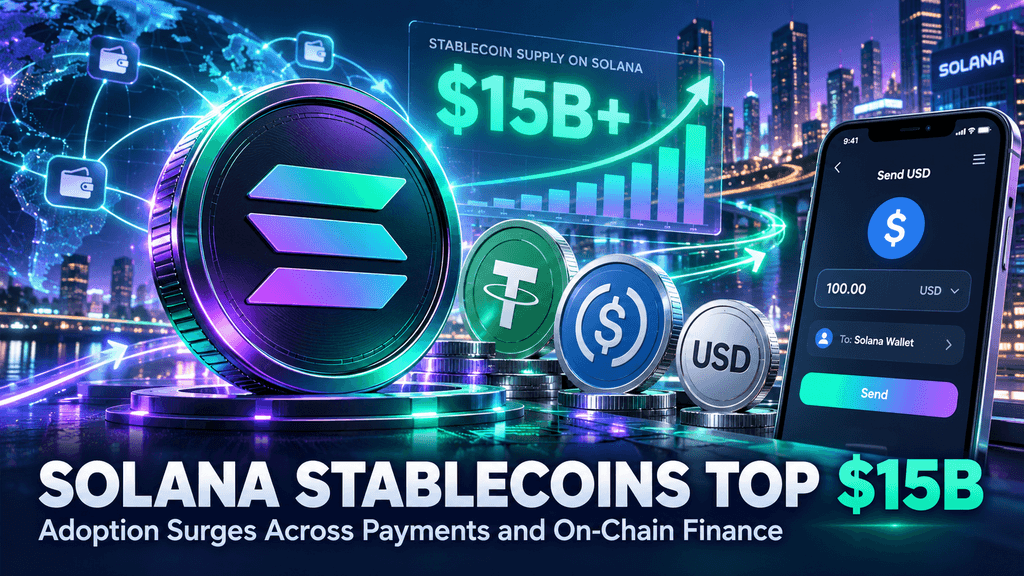
Solana stablecoins are entering a new phase of adoption as the blockchain's stablecoin supply remains above $15 billion and the number of stablecoin-holding addresses reaches a record 14.02 million. The expansion comes alongside growing institutional interest, new payment integrations, and rising demand for blockchain-based dollar transfers. With more than $5.25 trillion in stablecoin transfer volume processed on Solana during 2026, the network is increasingly positioning itself as infrastructure for digital payments rather than solely a platform for cryptocurrency trading.
Recent developments highlight this transition. Samsung has announced plans to integrate Solana-based USDC transfers into Samsung Wallet, while new stablecoin products and institutional settlement tools are expanding the network's financial applications. However, rising supply does not automatically translate into mainstream adoption or higher SOL prices. The central question is whether Solana can convert its expanding stablecoin ecosystem into sustainable payment activity, institutional usage, and long-term economic value.
How Big Is Solana's Stablecoin Market in 2026?
Stablecoin Supply Surpasses $15 Billion
Solana's stablecoin market has expanded significantly as more issuers, decentralized applications, and payment providers adopt the network. The ecosystem surpassed the $15 billion supply milestone earlier in 2026, demonstrating growing demand for dollar-denominated digital assets. According to the Solana Foundation's September ecosystem report, stablecoin supply reached a reported high of $17.51 billion during September, while other daily trackers recorded values closer to $15 billion toward the end of the month.
These figures require careful interpretation because stablecoin supply changes continuously through issuance, redemption, and transfers between blockchains. Different analytics providers may also use different methodologies when counting bridged assets, individual tokens, or eligible contracts. Nevertheless, the sustained presence of more than $15 billion in stablecoins indicates that Solana has developed a substantial pool of dollar-denominated liquidity.
This liquidity supports several financial activities, including cryptocurrency trading, decentralized lending, cross-border transfers, and institutional settlement. Unlike SOL, whose price fluctuates with market conditions, dollar-pegged stablecoins aim to maintain a relatively stable value. Their presence allows users and businesses to move funds through blockchain applications without necessarily taking direct exposure to cryptocurrency price volatility.
Stablecoin-Holding Addresses Reach a New Record
A separate milestone emerged on October 7, when the number of addresses holding stablecoins on Solana exceeded 14.02 million. According to Crypto Briefing, this represented an all-time high and an increase of more than 4 million addresses since the beginning of 2026. At the end of 2024, fewer than 4 million addresses held stablecoins on the network.
The rapid increase suggests that stablecoin ownership is expanding beyond the network's earlier user base. However, a blockchain address is not equivalent to an individual person. A single user may control several wallets, while exchanges, custodians, and automated systems can manage numerous addresses.
For this reason, holding-address growth should be evaluated alongside transaction frequency, active payment wallets, transfer patterns, and actual commercial usage. The strongest evidence of adoption would be a sustained increase in people and businesses using stablecoins for recurring financial activities rather than simply holding tokens.
| Solana Stablecoin Indicator | Recent Milestone | Why It Matters |
| Stablecoin supply | Above $15 billion | Indicates substantial on-chain dollar liquidity |
| September reported supply high | $17.51 billion | Highlights the ecosystem's recent scale |
| Stablecoin-holding addresses | More than 14.02 million | Suggests wider wallet-level distribution |
| 2026 stablecoin transfer volume | Above $5.25 trillion | Reflects extensive on-chain activity |
| Cumulative stablecoin card volume | Above $1 billion | Indicates growth in payment-linked usage |
Why Is Stablecoin Adoption Growing on Solana?
Low Fees Make Smaller Payments More Practical
One of Solana's main advantages is its relatively low transaction cost. Traditional international transfers can involve intermediary banks, foreign exchange charges, and settlement delays. Blockchain-based stablecoin transfers offer an alternative infrastructure in which users can move digital dollars directly between supported wallets and financial service providers.
According to Solana Foundation materials, the network's median transaction fee has been approximately $0.0013. Such low network-level costs can make small transfers, merchant settlements, and frequent payment operations more practical. For example, a business processing numerous small payouts may benefit from a network where transaction fees represent only a tiny proportion of each payment.
However, blockchain transaction fees are not the same as total payment costs. Users may still pay for currency conversion, custody, compliance services, or access to banking infrastructure. Real-world competitiveness therefore depends on the complete payment experience, not simply the fee charged by the blockchain.
Fast Settlement Supports Financial Applications
Solana's architecture is designed to process transactions quickly, which can reduce the delay between payment initiation and on-chain confirmation. For businesses, faster settlement may help improve treasury management, reduce the time funds remain in transit, and support financial activities requiring frequent transfers.
These characteristics are relevant for international remittances, digital commerce, exchange settlements, and automated payments. Rather than waiting for traditional banking operating hours, businesses can use supported blockchain infrastructure continuously, subject to the availability of their service providers and any applicable compliance requirements.
The resulting network effect can be significant. More payment providers create additional places where stablecoins can be used, while broader stablecoin availability encourages developers to build financial applications. Whether this cycle produces lasting adoption depends on transaction reliability, regulatory compatibility, accessible fiat conversion, and meaningful user demand.
Which Stablecoins Are Driving Solana's Growth?
USDC and USDT Remain Important Liquidity Providers
USDC and USDT continue to play important roles in Solana's stablecoin ecosystem. USDC, issued by Circle, is widely used across cryptocurrency exchanges, decentralized finance applications, and payment services. Its integration with financial technology companies makes it relevant to businesses seeking digital dollar settlement.
USDT, issued by Tether, remains an important source of liquidity throughout the broader Cryptocurrency market. Its extensive presence across trading venues and blockchain networks supports trading activity and international transfers. On Solana, both USDC and USDT provide users with dollar-denominated assets that can interact with supported wallets and financial applications.
The coexistence of these stablecoins offers users flexibility, but it also creates different issuer, redemption, compliance, and reserve-related considerations. Stablecoins should not be treated as interchangeable merely because they target the same dollar value. Their legal structures, reserve arrangements, and supported redemption channels may differ.
New Stablecoins Expand the Ecosystem Beyond Trading
Solana's stablecoin economy is becoming increasingly diversified. Products such as USDG, USD1, and PayPal USD, or PYUSD, serve different market segments, from digital asset liquidity to payment-related applications. This diversification could reduce reliance on a small number of tokens while attracting issuers with specialized financial use cases.
One notable development occurred on September 30, when Open USD, or OUSD, launched natively on Solana. The stablecoin is issued by Bridge and allows eligible businesses to mint and redeem tokens at a one-to-one dollar ratio without issuer-level minting or redemption fees. According to the Solana Foundation, Coinbase, Mastercard, Shopify, Stripe, and Visa participated as founding partners, with more than $1 billion committed to establishing OUSD liquidity.
Importantly, a liquidity commitment is not equivalent to circulating token supply or completed payment volume. The success of OUSD will ultimately depend on actual issuance, redemption activity, counterparty participation, and business adoption. Its launch nevertheless illustrates how stablecoin development is moving toward treasury management, merchant payments, and financial settlement rather than remaining concentrated in cryptocurrency trading.
| Stablecoin | Main Ecosystem Role | Potential Adoption Driver |
| USDC | Payments, trading, and DeFi | Financial technology integrations |
| USDT | Trading and cross-border liquidity | Global cryptocurrency market demand |
| USDG | Digital dollar payment infrastructure | Institutional and payment partnerships |
| USD1 | Dollar liquidity and DeFi applications | Ecosystem integrations |
| PYUSD | Payment-oriented dollar stablecoin | PayPal-linked financial services |
| OUSD | Enterprise payments and treasury operations | Institutional settlement partnerships |
How Are Samsung and Payment Giants Using Solana?
Samsung Wallet Could Expand Stablecoin Access
On October 7, the Solana Foundation announced a partnership with Samsung to integrate stablecoin functionality directly into Samsung Wallet. Beginning in the final week of October 2026, eligible users in the United States are expected to gain access to cross-border USDC transfers using Solana infrastructure.
The announcement identified approximately 82 million US Galaxy devices as the potential distribution footprint. The planned functionality would combine blockchain transfers with integrated fiat on-ramps and off-ramps, allowing users to move between digital dollars and supported local currencies through a familiar mobile wallet interface.
This development could be important because mainstream consumers may be more willing to use blockchain payments when they do not need to navigate unfamiliar cryptocurrency exchanges or specialized wallet interfaces. However, the planned device coverage should not be confused with active user adoption. Transaction counts, supported corridors, conversion costs, and actual customer usage after launch will determine whether the integration becomes commercially meaningful.
Visa, Western Union, and MoneyGram Expand Payment Infrastructure
Samsung's announcement follows broader efforts by established financial companies to integrate Solana-based payments. Visa has explored stablecoin settlement infrastructure, while Western Union and MoneyGram have pursued services connecting digital dollar transfers with existing financial distribution networks.
In August 2026, the Solana Foundation reported that Western Union had launched a Visa card backed by USDPT, a stablecoin issued through Anchorage Digital, across 37 markets. MoneyGram also introduced MoneyGram Ramps, connecting Solana applications to a retail cash network spanning numerous countries.
These developments indicate that blockchain payments are increasingly being connected to traditional financial services rather than operating entirely separately from them. Nevertheless, commercial partnerships, product launches, and customer adoption are distinct milestones. Sustainable growth requires regular payment activity, competitive total transaction costs, regulatory compliance, and reliable access to local banking systems.
Can Solana DvP Bring Institutions Onchain?
Atomic Settlement Could Reduce Financial Transaction Risk
On October 6, the Solana Foundation announced Solana DvP, an open-source delivery-versus-payment settlement program designed for financial institutions. The system aims to support atomic settlement, allowing tokenized assets and their corresponding payments to be exchanged within a coordinated transaction.
In traditional financial markets, settlement risk can arise when one party delivers an asset before receiving payment. Delivery-versus-payment mechanisms are designed to reduce this exposure by connecting the transfer of securities or other assets with the corresponding payment obligation. On Solana, stablecoins can potentially serve as the payment instrument for eligible tokenized assets.
The foundation stated that J.P. Morgan had provided input regarding institutional settlement practices and requirements. This contribution should not be interpreted as confirmation that the bank has deployed Solana DvP for live production settlement. The next important development will be whether financial institutions adopt the infrastructure for actual transactions.
Stablecoins Could Support Tokenized Assets and RWA Markets
Institutional settlement infrastructure becomes more relevant as tokenized real-world assets gain traction. Solana's September ecosystem report identified approximately $4.6 billion in real-world asset value, alongside substantial activity in tokenized equities and decentralized financial applications.
Stablecoins can function as settlement assets within these markets. For example, an institution purchasing tokenized securities may need a digital dollar instrument to complete transactions efficiently. A deeper pool of stablecoin liquidity could therefore make it easier for tokenized financial products to trade and settle on-chain.
However, this relationship is not automatic. Institutions must also evaluate custody arrangements, settlement finality, legal enforceability, counterparty exposure, and regulatory requirements. Stablecoin supply creates potential financial capacity, but meaningful institutional adoption requires working infrastructure and compliant commercial demand.
Does Stablecoin Growth Support SOL Price?
More Stablecoins Do Not Automatically Mean More SOL Buying
The growth of Solana's stablecoin supply may strengthen the network's long-term economic prospects, but it does not automatically translate into higher SOL prices. USDC, USDT, and other stablecoins are separate digital assets. A user holding additional dollar stablecoins does not necessarily purchase or hold more SOL.
Nevertheless, greater stablecoin activity can increase demand for network transactions. Solana uses SOL for transaction fees, and applications may create additional demand for blockchain resources through transfers, decentralized trading, lending, and financial settlement. If activity becomes more frequent and economically meaningful, it could support the network's broader utility.
The magnitude of this effect depends on fee structures, transaction composition, network economics, and whether users maintain direct SOL exposure or rely on service providers. Because Solana transaction fees are relatively low, even substantial growth in stablecoin transfers may not generate proportional growth in network revenue.
Institutional Adoption Could Strengthen Solana's Investment Narrative
Institutional partnerships may also influence perceptions of Solana's long-term competitive position. If payment providers and financial institutions increasingly choose Solana for settlement, investors may view its infrastructure as more commercially relevant.
Such expectations could support sentiment toward SOL, particularly when broader cryptocurrency conditions are favorable. However, token prices also depend on market liquidity, macroeconomic policy, speculative positioning, competition, and overall investor risk appetite.
Consequently, analysts following the Crypto market should distinguish between stablecoin supply growth and measurable value capture by the Solana network. Transaction fees, active paying users, decentralized application revenues, and sustained demand for SOL provide additional context.
What Risks Could Slow Solana Stablecoin Adoption?
Regulation and Issuer Risk Remain Important
Stablecoins face legal and regulatory requirements concerning reserves, redemption rights, anti-money laundering controls, consumer protection, and financial supervision. These requirements vary across jurisdictions and can influence whether issuers or payment businesses launch products in particular markets.
Stablecoin users also face issuer and counterparty risks. A token designed to maintain a one-dollar value may still be affected by reserve problems, redemption restrictions, operational failures, or temporary secondary-market price deviations. Increasing the number of supported stablecoins expands consumer choice but also makes understanding their underlying structures more important.
For businesses, reliable fiat conversion and compliant access to financial institutions may ultimately matter more than blockchain transaction speed alone. Regulatory clarity could support adoption, while inconsistent international requirements may complicate cross-border deployment.
Network Competition and Data Quality Could Challenge Growth
Solana competes with established stablecoin networks such as Ethereum and Tron, as well as newer scaling ecosystems including Base and Arbitrum. Ethereum benefits from substantial institutional decentralized finance infrastructure, while Tron has established a significant position in dollar-denominated transfers. Solana's competitive position depends on whether low costs, fast settlement, and growing payment partnerships translate into durable usage.
Market statistics also require careful interpretation. A blockchain can process extremely large stablecoin transfer volumes because exchanges, market makers, and automated systems repeatedly move funds. Likewise, holding addresses may increase without a comparable rise in independent users or consumer spending.
These limitations do not invalidate Solana's growth, but they suggest that analysts should examine adjusted transfer volume, active payment participants, stablecoin transaction frequency, and identifiable commercial settlement activity. Strong adoption requires more than impressive headline metrics.
What's Next for Solana Stablecoins?
The most immediate development to monitor is Samsung Wallet's planned rollout in the final week of October. If the integration launches as announced, subsequent transaction activity and consumer usage could provide important evidence about whether stablecoins can reach mainstream mobile payment audiences.
Investors should also monitor OUSD's actual circulating supply, the adoption of Solana DvP by financial institutions, and the continued growth of tokenized asset settlements. These developments could demonstrate whether Solana's existing dollar liquidity is being converted into recurring economic activity.
For on-chain analysis, useful indicators include stablecoin supply by issuer, active holding addresses, adjusted transaction volume, payment-linked transfers, network fees, and DeFi liquidity. Platforms such as DeFiLlama and official Solana ecosystem reports can provide complementary perspectives. The decisive question is whether real financial usage continues increasing after the initial excitement surrounding new product launches fades.
🔥 Beyond the Headlines: What KuCoin 5.0 Means for You
Market news moves fast — but where you act on it matters just as much. This October, KuCoin launches KuCoin 5.0, transforming KuCoin into a rebuilt platform. Here's what actually changes for you:
-
One account for everything. Older platforms split your money across separate "spot," "margin," and "futures" accounts and expected you to understand why. KuCoin 5.0's unified account removes that entirely — deposit once, and everything is simply there (only available to VIPs for now).
-
Stocks, indices, and commodities. KuCoin 5.0 expands beyond crypto into global markets. When crypto chops sideways and equities rally (or the reverse), you rotate in minutes instead of opening a brokerage account and waiting days for fiat rails.
-
Real-world assets (RWA). Tokenized exposure to traditional assets like commodities, right inside your crypto account. One of the fastest-growing segments in global finance is no longer reserved for institutions — you access it from the same balance you trade with.
-
Earn while you learn. Not ready to trade? KCUSD lets your stablecoins earn daily, auto-compounding interest. The lowest-stress way to put your idle deposit to work for 4% yield.
-
An AI assistant in plain language. Ask questions, get market context, understand what you're looking at — built into the platform, no jargon required.
-
An app that doesn't overwhelm. Faster, cleaner, and consistent — intuitive from the first tap, not after a tutorial.
-
Safety you can check, not just trust. A MiCAR-licensed EU entity, Proof of Reserves you can verify yourself, and internationally certified security (SOC 2 Type II, ISO 27001:2022).
Create your account in minutes — and start on the platform built for where crypto is going, not where it's been.
Conclusion
Solana's stablecoin ecosystem has developed into a substantial digital dollar network, with supply above $15 billion, more than 14 million holding addresses, and trillions of dollars in annual on-chain transfers. Recent announcements involving Samsung Wallet, Open USD, and Solana DvP demonstrate growing interest from payment providers and financial institutions.
However, the next stage of growth will depend on converting network activity into measurable adoption. Stablecoin supply and transaction volume provide evidence of scale, but active payments, recurring institutional settlement, and reliable financial services will determine Solana's longer-term relevance. For SOL investors, the opportunity lies in expanding network utility rather than assuming that stablecoin growth alone guarantees token price appreciation.
FAQs
What Is the Difference Between Stablecoin Supply and Stablecoin Transfer Volume?
Stablecoin supply represents the total outstanding value of eligible tokens on a blockchain at a given time. Transfer volume measures the value moved during a period. The same tokens can be transferred repeatedly, so transfer volume can greatly exceed outstanding supply.
Do Users Need SOL to Transfer USDC on Solana?
Solana transactions generally require fees denominated in SOL. However, some wallet and payment providers can sponsor transaction fees, meaning the end user may not need to manage a separate SOL balance directly.
Are Solana Stablecoins FDIC-Insured?
Stablecoins are not automatically FDIC-insured simply because they are pegged to the US dollar. Legal protections depend on the issuer, reserve structure, custody arrangements, and applicable regulatory framework.
Can Stablecoins on Solana Be Redeemed Directly for US Dollars?
Redemption rights depend on the stablecoin issuer and the user's eligibility. Some issuers allow approved customers to redeem directly, while other users may need exchanges or payment providers to convert stablecoins into bank deposits.
Can Solana Stablecoins Be Used Without a Traditional Bank Account?
Some supported wallets allow users to receive and transfer stablecoins without directly connecting a bank account. However, converting stablecoins into local currency or accessing regulated financial services may require identity verification and a supported payment provider.
Disclaimer: This content is for informational purposes only and does not constitute investment advice. Investments carry risk. Please do your own research (DYOR).