

Should You Sell AI Stocks Now? A 2026 Investor's Guide to Valuation, Market Risks, and Smarter Capital Rotation
2026/06/24 17:48:00
Introduction
AI stocks have created one of the fastest wealth-building cycles in modern market history - but rapid gains also raise an uncomfortable question: should investors sell now?
The short answer is: not necessarily. Selling AI stocks purely because prices have risen is usually a weak strategy. A better approach is to evaluate whether valuation, earnings growth, AI spending trends, and portfolio concentration still justify holding. In 2026, the AI trade has become more selective than speculative. Some AI leaders continue to compound earnings, while others appear increasingly dependent on future expectations.
For crypto investors, this question matters even more. Capital frequently rotates across themes. Money moving out of AI equities does not automatically exit risk assets - it may rotate into AI infrastructure, digital assets, and emerging blockchain sectors instead.
This guide explains when selling AI stocks makes sense, when it does not, and how investors can think about AI exposure across both equities and crypto.
What Has Changed in the AI Stock Market in 2026?
The AI stock market has shifted from hype-driven buying toward earnings-driven selection.
During the earlier AI expansion phase, investors rewarded nearly every company connected to artificial intelligence. In 2026, markets increasingly differentiate between companies that generate AI revenue and companies that simply discuss AI.
Based on June 2026 market data, AI-related public companies collectively represent more than $53 trillion in market capitalization globally, with large-cap technology companies continuing to dominate market value. According to recent market rankings, NVIDIA alone exceeds $5 trillion in market capitalization.
At the same time, valuation multiples remain elevated. According to June 2026 public market valuation analysis, leading AI and hyperscaler companies trade around a median of 11.1x forward revenue, while several infrastructure layers trade above 10x revenue multiples.
That does not automatically mean a bubble exists. It means expectations are extremely high.
The market now rewards execution, not narratives
The strongest AI stocks continue producing measurable outputs:
-
Revenue growth
-
Margin expansion
-
AI product monetization
-
Cloud adoption
-
Enterprise deployment
Companies unable to demonstrate these metrics increasingly face sharp corrections. Recent market volatility shows that investors have become less tolerant of expensive growth stories.
Should You Sell AI Stocks Now?
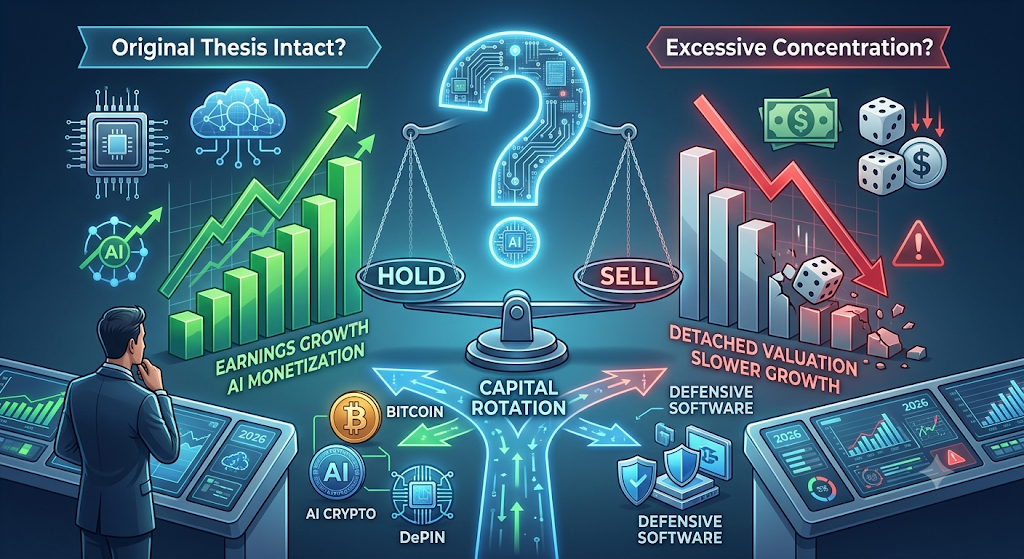
Most investors should not sell AI stocks solely because they appear expensive. The decision should depend on whether the original investment thesis remains intact. Selling becomes more reasonable under three conditions:
-
Valuation has detached from business performance
Price appreciation alone is not a sell signal. If earnings growth slows while valuation continues expanding, expected future returns decline.
Community discussions across investing forums increasingly reflect this concern - investors are questioning whether future earnings assumptions remain realistic for leading AI names.
-
AI exposure dominates your portfolio
Portfolio concentration creates hidden risk. An investor with 70% exposure to semiconductors may think they are diversified because they own multiple stocks, but the portfolio remains dependent on the same AI spending cycle. Reducing concentration differs from abandoning the sector.
-
You no longer understand the investment thesis
If you originally bought because everyone else was buying, that is not a durable investment framework. Markets eventually force investors to justify ownership using business fundamentals.
Are AI Stocks in a Bubble or Still Early?
AI likely remains early - but not every AI stock deserves premium pricing. This distinction matters. Many investors compare today's environment with the dot-com period.
Recent commentary following AI-led market volatility noted increasing concern around concentration risk and infrastructure spending intensity. However, today's environment differs in one important way: Current AI leaders already generate enormous cash flows.
Compare two environments:
| Metric | Dot-Com Era | AI Cycle 2026 |
| Revenue | Often minimal | Massive |
| Profitability | Frequently negative | Generally strong |
| Infrastructure | Limited | Global |
| Enterprise adoption | Early | Active |
This does not eliminate the downside. It means investors should focus less on "bubble versus no bubble" and more on whether growth can continue matching valuation.
Which Signals Suggest It May Be Time to Take Profits?
Profit-taking is often healthier than full liquidation. Investors commonly make two mistakes:
-
Selling everything after fear appears
-
Refusing to sell anything because momentum worked before
Instead, monitor measurable signals.
Earnings growth slows while multiples rise
If revenue growth decelerates but valuation expands, future returns compress.
Capex spending becomes unsustainable
AI infrastructure requires enormous investment. Recent commentary around AI expansion increasingly highlights concerns over financing intensity and infrastructure debt accumulation.
Narrative shifts from outcomes to possibilities
When investor conversations become dominated by phrases like:
-
"This could become"
-
"This might disrupt"
-
"This may replace"
rather than:
-
Revenue
-
Margins
-
Retention
-
Cash flow
Where Could Capital Rotate if Investors Sell AI Stocks?
Selling AI stocks does not necessarily mean becoming bearish. Capital rotation is becoming more important than market timing.
Historically, when one growth narrative matures, capital often migrates toward adjacent sectors. Possible destinations include:
Defensive technology
Investors may rotate into software platforms, enterprise providers, and infrastructure suppliers.
Some institutional investors increasingly favor "pick-and-shovel" exposure rather than direct AI winners. Recent hedge fund commentary emphasized semiconductor equipment providers as a lower-dependency approach to AI growth.
AI infrastructure
Rather than application companies, investors may focus on compute, networking, storage, and energy.
Crypto and digital assets
This is increasingly relevant for KuCoin audiences. Crypto investors are already familiar with thematic capital cycles.
Recent years showed transitions from: Bitcoin -> Layer 1 -> AI -> DePIN -> infrastructure narratives.
AI-related crypto sectors may attract investors seeking higher upside but also accepting higher volatility. That does not make crypto a replacement for AI equities. It makes it an alternative expression of the same technological theme.
Should You Trade AI Stocks on KuCoin?
If you believe AI remains a long-term theme but want exposure beyond public equities, digital assets can provide additional diversification opportunities.
Traditional AI stocks offer exposure to profitable companies building chips, cloud platforms, and enterprise
software.
Crypto markets may offer exposure to earlier-stage narratives including decentralized compute, AI infrastructure, tokenized data, and emerging application layers.
For investors already taking profits from AI equities, diversification may become more valuable than complete risk reduction. KuCoin provides access to multiple market narratives across spot and broader digital asset categories, allowing investors to participate in emerging sectors while maintaining flexibility.
Now users can also participate in KuCoin's Campaign of Trading US Stock Perps:
-
After complete simple trading missions, users may unlock 100,000 USDT prize pool rewards in TSLA, AAPL, or GOOGL.
Conclusion
Selling AI stocks now is not automatically the correct move - and continuing to hold without evaluation is not automatically correct either.
The AI investment cycle in 2026 has matured beyond simple momentum. Markets increasingly reward companies with measurable earnings, durable competitive advantages, and realistic capital deployment. Investors should stop asking whether AI itself is over and start asking whether individual positions still justify their valuation.
For most investors, the stronger approach is selective management rather than full exits. Rebalance if concentration becomes excessive. Trim positions if expectations outrun fundamentals. Continue holding if business execution supports long-term growth.
For crypto-oriented investors, this transition may also create opportunities. Capital rarely disappears completely; it rotates. Understanding where capital moves next may matter more than guessing exactly when AI stocks peak.
FAQs
-
Is selling AI stocks after large gains considered market timing?
Not necessarily. Selling to rebalance exposure differs from trying to predict the exact market top.
-
What percentage of a portfolio should be allocated to AI?
There is no universal number, but concentration risk increases significantly once a single theme dominates total exposure.
-
What is the biggest mistake investors make with AI stocks?
Confusing a strong technological trend with guaranteed investment returns. A great industry does not automatically create great investments.