

Sei Network Completes Major v6.6 Upgrade: Ares & Eidos Launches Kick Off Giga Plan
2026/08/07 11:06:00
Key Takeaways
-
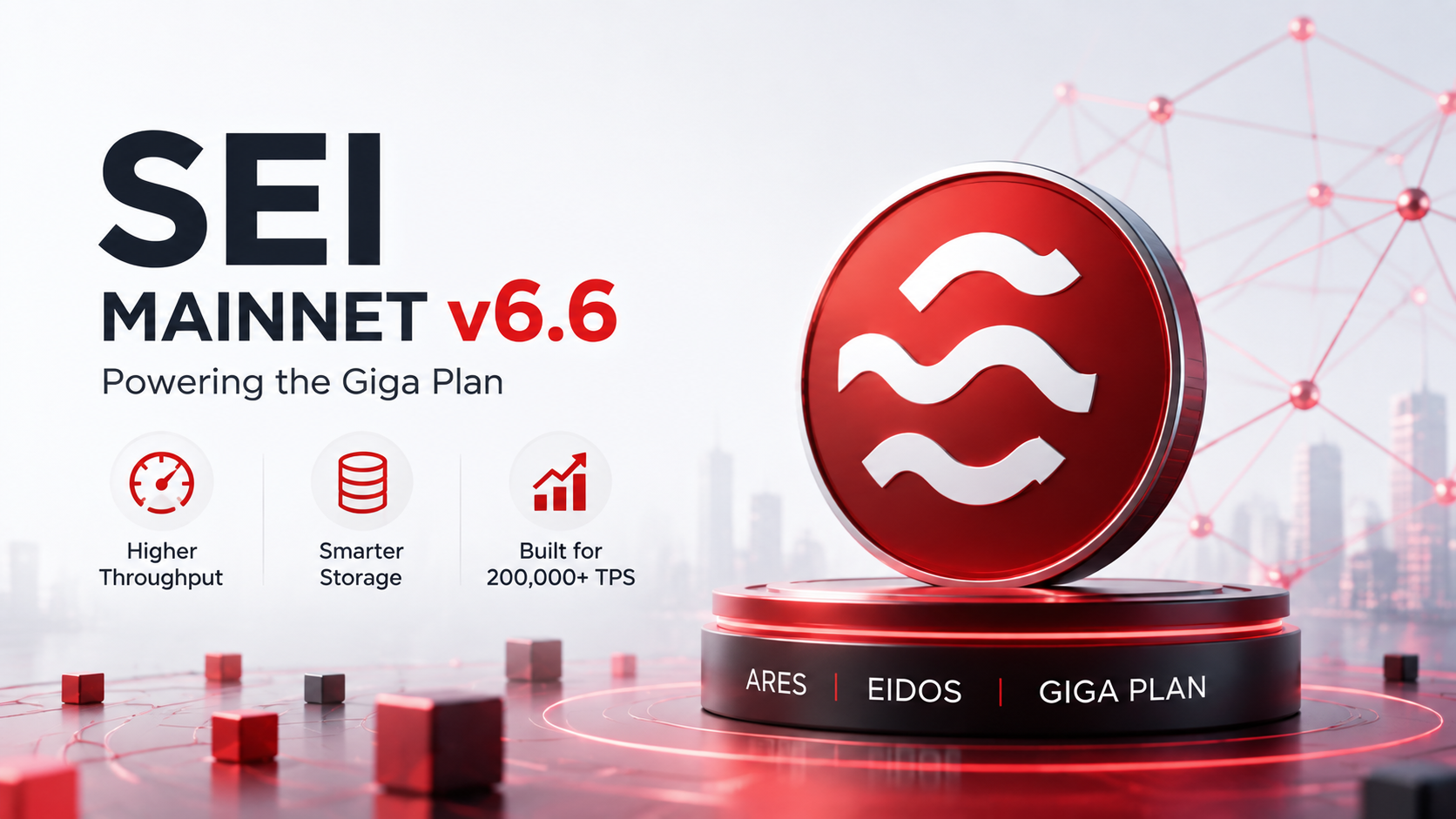
Historic Milestone Delivered: The Sei Mainnet v6.6 upgrade represents the network’s largest architectural update since introducing EVM support, officially deploying the first two core components of the ambitious Giga Plan.
-
Ares Execution Engine: Replaces the legacy Go-native executor with an EVMC-backed framework (
evmone), introducing an automated fallback mechanism to optimize smart contract processing and throughput. -
Eidos Storage Separation: Decouples two years of EVM historical state from the Cosmos SDK state into an independent database, eliminating disk I/O bottlenecks for real-time transactions.
-
Targeting 200,000 TPS: Lays the technical groundwork for the multi-phase Giga Plan, which targets sub-250ms block finality and industrial-grade throughput for decentralized finance.
-
Network & Developer Optimizations: Includes over 30 targeted bug fixes, optimized node synchronization protocols, refined data pruning, and enhanced JSON-RPC call tracing.
Sei Network has completed its mainnet v6.6 upgrade, marking its largest technical transition since adding Ethereum Virtual Machine (EVM) compatibility. According to official disclosures from Sei Labs in August 2026, the v6.6 upgrade officially deploys the first two architectural pillars of the Giga Plan: the Ares execution engine and the Eidos storage engine. By separating historical EVM data from Cosmos state and replacing legacy Go-native execution with an EVMC-backed framework, v6.6 creates the core infrastructure necessary to scale transaction throughput toward 200,000 transactions per second (TPS). According to real-time market tracking on KuCoin, SEI traded around $0.0417 in early August 2026 following the upgrade proposal execution.
What Is the Sei Network v6.6 Upgrade?
The Sei Network v6.6 upgrade is a fundamental architectural overhaul designed to transition Sei from a general-purpose Layer-1 network into a specialized, ultra-high-throughput execution layer for decentralized trading. Executed via governance proposal in early August 2026, v6.6 introduces mainnet deployments of two foundational components of the broader Sei Giga Plan: the Ares execution engine and the Eidos storage engine.
According to technical release notes published by the Sei core development team in August 2026, the primary goal of the v6.6 update is to dismantle key scaling bottlenecks in transaction execution and database storage. Before this release, EVM state history and Cosmos native state shared a single database, forcing historical data reads to compete directly with live real-time transactions. Simultaneously, transaction execution relied on a Go-native engine that reached physical processing limits during high network demand.
The v6.6 release fundamentally restructures this architecture. By deploying Eidos, Sei migrates two years of accumulated EVM historical state into a dedicated, isolated database built specifically for scaled reads. By deploying Ares, the network replaces its legacy Go-native executor with an EVMC-backed client (evmone), dramatically improving smart contract execution predictability and speed. Furthermore, v6.6 packages over 30 protocol-level bug fixes, consensus parameter tuning, and developer-facing enhancements into a single release.
How Does the Ares Upgrade Boost Execution Performance?
The Ares upgrade boosts execution performance by establishing a high-throughput, EVMC-backed client (
evmone) as the default transaction execution engine across all active Sei mainnet nodes. Based on developer documentation released by Sei Labs in August 2026, Ares shifts execution away from the legacy Go-native v2 engine to eliminate internal execution bottlenecks and reduce contract processing times.Under the new v6.6 framework, every upgraded validator node runs Ares by default. The legacy v2 engine is not immediately discarded; instead, it enters a structured phase-out process where it serves two crucial roles during the transition:
-
Per-Transaction Fallback Mechanism: If the new Ares engine encounters an unhandled edge case or an unverified execution state, the specific transaction is immediately re-run through the legacy v2 engine. This prevents transaction drops, avoids state corruption, and ensures seamless execution continuity.
-
Live Reference Verification: A dedicated v2 node runs continuously on the network to mirror mainnet blocks. It compares transaction outputs against Ares block by block, automatically alerting core engineers if any execution discrepancy occurs between the legacy and new clients.
By implementing
evmone along with an optimized state and caching stack, Ares delivers consistent execution speed for complex decentralized finance (DeFi) logic, high-frequency trading engines, and automated liquidations. This technical baseline is essential for handling the extreme transaction density targeted by subsequent releases in the Giga roadmap.How Does the Eidos Upgrade Solve Blockchain Storage Bottlenecks?
The Eidos upgrade solves blockchain storage bottlenecks by decoupling EVM historical data from active consensus state, moving historical storage into a dedicated database designed specifically for deep reads. Based on performance reports from the core development team in August 2026, Eidos resolves the disk I/O contention that previously degraded node performance when high volumes of historical queries coincided with peak trading activity.
In standard blockchain architectures, historical transactions, contract logs, and state history reside in the same database engine as active account balances and pending state changes. On Sei, EVM history historically coexisted alongside Cosmos SDK module states. This created two major operational inefficiencies:
-
Database Contention: Analytical tools, block explorers, and RPC nodes requesting historical EVM transaction data forced disk reads that directly competed with live transaction processing, causing latency spikes.
-
Unnecessary Disk Write Costs: Non-EVM modules pay overhead costs when updating state due to the heavy write amplification caused by shared EVM history storage.
Eidos systematically eliminates these friction points by extracting two years of EVM state history and placing it inside an independent, storage-optimized database framework. Active transactions no longer suffer disk read competition from historical telemetry, and non-EVM system modules are freed from carrying the write amplification costs of legacy EVM data. This structural database separation ensures that node storage scales smoothly alongside transaction volume growth.
What Is the Sei Giga Plan and How Does It Target 200,000 TPS?
The Sei Giga Plan is a multi-phase architectural roadmap designed to redesign the Sei blockchain from first principles into a high-throughput, low-latency execution layer capable of reaching 200,000 transactions per second (TPS) and sub-250 millisecond block finality. According to the Sei Giga Whitepaper V2 released in July 2026, the plan breaks down the blockchain lifecycle into three distinct, specialized technical layers.
To achieve industrial scale for decentralized exchanges, real-world asset (RWA) tokenization, and AI-agent micro-transactions, the Giga Plan segregates consensus, execution, and storage into isolated subsystems:
The Three Pillars of the Sei Giga Architecture
| Technical Layer | Component Name | Primary Function | Mainnet Status (v6.6) |
| Storage Layer | Eidos | Isolates EVM historical state into a dedicated storage layer, eliminating disk contention. | Live on Mainnet v6.6 |
| Execution Layer | Ares | Employs an EVMC-backed framework (evmone) with custom caching for parallel execution. | Live on Mainnet v6.6 |
| Consensus Layer | Autobahn | Advanced consensus layer utilizing asynchronous execution to achieve sub-250ms finality. | Scheduled for Future Phase |
By deploying both Ares and Eidos in the v6.6 release, Sei has operationalized two-thirds of the Giga framework on mainnet. The remaining piece—the Autobahn consensus upgrade—will introduce advanced consensus optimization, enabling transaction validation to run asynchronously alongside block production. Together, these three layers aim to lower transaction costs while delivering Web2-like responsiveness for on-chain financial applications.
What Network Optimizations and Bug Fixes Were Delivered in v6.6?
The v6.6 upgrade delivered over 30 targeted core bug fixes, consensus parameter adjustments, node synchronization enhancements, and developer tooling updates alongside the headline Ares and Eidos releases. Based on the official release documentation published on the Sei governance forum in August 2026, these protocol optimizations resolve critical operational edge cases and improve system reliability for node operators and application builders.
Key core optimizations delivered in v6.6 include:
-
Node Synchronization Efficiency: Optimized peer-to-peer block sync protocols to reduce sync times for newly joined validator and RPC nodes.
-
Consensus Timeout Tuning: Refined consensus timeout parameters to minimize block production stalls during localized network latency spikes.
-
Data Pruning Enhancements: Improved automated state pruning mechanisms, enabling validator nodes to manage local storage growth efficiently.
-
JSON-RPC Handling: Rebuilt receipt generation routines and error-handling paths to prevent RPC call drops during high request volumes.
-
Developer Tracing Capability: Upgraded historical call-tracing features, giving smart contract developers accurate debugging visibility into past execution states.
These infrastructure refinements eliminate friction for decentralized application (dApp) developers, providing a stable platform for high-density trading products, liquidity hubs, and cross-chain bridges building within the Sei ecosystem.
How Does the v6.6 Upgrade Impact SEI Token Price and Market Performance?
The v6.6 upgrade strengthens SEI’s fundamental value proposition as a specialized Layer-1 blockchain for high-frequency trading, though token price action continues to reflect broader market dynamics and supply mechanics. According to market data from KuCoin and CoinMarketCap in early August 2026, SEI traded around $0.0417, reflecting stabilization following a period of market-wide altcoin consolidation.
To evaluate SEI’s market status following the v6.6 rollout, key network and token metrics provide essential context:
SEI Market & Protocol Metrics Overview (August 2026)
| Metric | Current Value | Market Context & Significance |
| Token Price | ~$0.0417 | Trades in a consolidation band following broader crypto market trends. |
| Market Capitalization | ~$280M – $450M | Ranks among top specialized Layer-1 execution platforms. |
| Staking Ratio | ~59.5% | Highlights strong network security and token lockup commitment from holders. |
| Target Throughput | 200,000 TPS | Unlocked incrementally through the ongoing Giga Plan rollout. |
| Primary Trading Venues | KuCoin, Binance, Coinbase | Deep liquidity across major centralized exchanges. |
While the v6.6 upgrade significantly upgrades network capacity, token price performance remains influenced by ongoing supply unlocks extending into 2030, alongside competition from alternative high-performance networks like Solana, Sui, and Aptos. However, the operational deployment of Ares and Eidos positions Sei favorably to capture institutional DeFi volume, RWA settlement traffic, and automated trading flows as adoption grows.
How Does Sei v6.6 Compare to Other High-Performance Layer-1 Blockchains?
Sei v6.6 distinguishes itself from competing high-performance Layer-1 networks through its hybrid architecture that combines parallelized EVM execution with specialized state database separation. According to architectural benchmarks published across Layer-1 developer forums in mid-2026, Sei’s dedicated focus on trading infrastructure allows it to deliver superior state management compared to general-purpose blockchains.
Architectural Comparison: Sei v6.6 vs. Leading Layer-1 Networks
| Feature / Metric | Sei Network (v6.6 / Giga) | Solana | Sui | Monad (Devnet/Testnet) |
| Execution Engine | EVMC / evmone (Ares Engine) | Sealevel (SVM) | Move VM | Custom Parallel EVM |
| EVM Compatibility | Native Parallel EVM | Non-EVM | Non-EVM | Native Parallel EVM |
| State Storage Model | Eidos (Separated EVM/Cosmos) | Accounts DB | Object-centric Store | MonadDB |
| Target Throughput | 200,000 TPS | 65,000 TPS | 297,000 TPS | 100,000 TPS |
| Primary Focus | On-Chain Trading & Order Books | General DeFi & Consumer | Gaming & Digital Assets | High-Throughput EVM |
Unlike networks that require developers to rewrite smart contracts in Rust or Move, Sei v6.6 offers full EVM compatibility while achieving high throughput. The separation of historical state via Eidos addresses long-term storage bloat—a persistent challenge for high-throughput networks like Solana—making Sei an attractive environment for developers seeking both EVM tooling familiarities and high transaction throughput.
How to Trade SEI on KuCoin and Join the 9th Anniversary Competition?
Trading SEI on KuCoin gives crypto investors access to deep liquidity, advanced order types, and competitive fee structures across both spot and futures markets. According to trading volume metrics on KuCoin in August 2026, the SEI/USDT pair remains one of the most active trading pairs within the Layer-1 ecosystem section.
To mark this operational milestone alongside KuCoin’s official celebrations, traders can also participate in the KuCoin 9th Anniversary Trading Competition featuring a substantial multi-track prize pool.
To start trading SEI and join the promotional event on KuCoin, follow these simple steps:
-
Create and Verify Your Account: Register a free account on the official KuCoin website or mobile app. Complete standard identity verification (KYC) to unlock full trading privileges and deposit options.
-
Deposit Funds: Deposit cryptocurrency (such as USDT, BTC, or ETH) directly into your KuCoin Funding Account, or purchase crypto using credit/debit card options or P2P trading.
-
Register for the Competition: Visit the official KuCoin 9th Anniversary Trading Competition Page to sign up and participate across Spot, Futures, or VIP trading tracks.
-
Transfer to Trading Account: Transfer your deposited USDT or crypto assets from your Funding Account to your Spot or Futures Trading Account with zero internal fees.
-
Locate the SEI Market: Navigate to the KuCoin Trade section, select Spot Trading or Futures Trading, and search for the SEI/USDT trading pair.
-
Place Your Order: Choose your preferred order type:
-
Limit Order: Specify the exact price at which you wish to buy or sell SEI.
-
Market Order: Execute your transaction instantly at the best available market price.
-
Stop-Limit / OCO: Set automated risk management triggers to protect your trading positions.
-
-
Manage and Secure Your Assets: Once executed, monitor your SEI holdings in your KuCoin account or transfer them to a secure non-custodial Web3 wallet for on-chain staking.
Conclusion
The completion of the v6.6 mainnet upgrade represents a major technical milestone for the Sei Network, officially transitioning the ambitious Giga Plan from technical blueprint to active mainnet execution. By deploying the Ares execution engine and the Eidos storage framework simultaneously, Sei successfully addresses the core throughput and storage bottlenecks that historically constrained smart contract blockchains.
Through Eidos, the network isolates EVM history into a dedicated database, eliminating storage contention between active transactions and historical reads. Through Ares, the network deploys an EVMC-backed framework that delivers deterministic execution and higher contract speeds, backed by safety fallback mechanisms. Accompanied by over 30 network optimizations, v6.6 establishes a solid foundation as Sei targets its ultimate goal of 200,000 TPS and sub-250ms finality. For crypto traders, developers, and institutional investors, the successful execution of v6.6 reinforces Sei’s position as a premier, purpose-built Layer-1 platform for high-frequency trading and high-throughput DeFi applications.
Frequently Asked Questions (FAQs)
What is the primary purpose of the Sei v6.6 upgrade?
The primary purpose of the Sei v6.6 upgrade is to launch the first two architectural components of the Giga Plan—Ares and Eidos—improving contract execution speed, separating on-chain storage layers, and resolving over 30 protocol-level stability issues.
How does the Ares upgrade handle smart contract execution errors?
The Ares upgrade handles execution errors through an automated per-transaction fallback mechanism that reruns any problematic transaction through the legacy v2 Go-engine, preventing transaction drops and maintaining state accuracy without interrupting block production.
Why is the Eidos storage separation important for node operators?
The Eidos storage separation is important because it moves two years of EVM historical state into an independent database, preventing deep historical reads from competing for disk I/O against live, real-time transaction processing.
Does the v6.6 upgrade break compatibility for existing EVM smart contracts on Sei?
No, the v6.6 upgrade does not break smart contract compatibility. Existing EVM contracts continue to function seamlessly on the new Ares engine, benefiting from faster execution speeds and improved historical call-tracing features.
Where can users stake SEI tokens after the v6.6 upgrade?
Users can stake SEI tokens directly through supported non-custodial Web3 wallets connected to the Sei staking portal or participate in flexible exchange staking programs supported on platforms like KuCoin.、