

Do Robinhood Stock Tokens Have Voting Rights? 1:1 Share Redemption Plan Explained
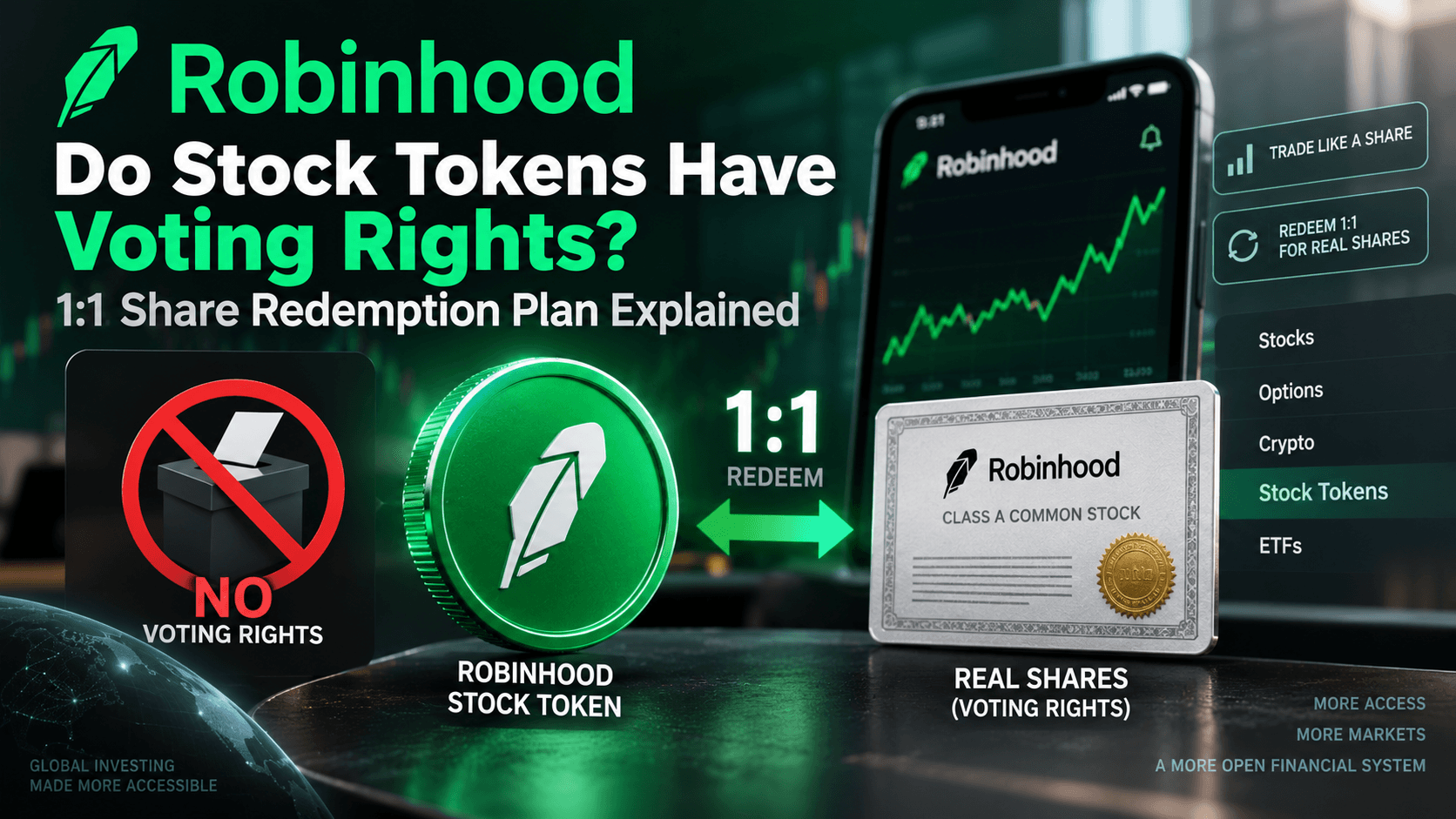
Robinhood Stock Tokens are moving closer to traditional shares — but they are not there yet. As of September 2026, holders of Robinhood’s new Stock Tokens do not receive direct ownership or voting rights in the companies whose shares the tokens track. The products are legally structured as tokenized debt securities issued by Robinhood Assets (Jersey) Limited, or RHJ, and are designed to provide economic exposure to U.S. stocks and ETFs rather than conventional shareholder status.
That distinction could become less clear-cut in the future. On September 14, Robinhood executives said the company is actively working on 1:1 in-kind share redemption and has voting for eligible Stock Token holders on its roadmap. CEO Vlad Tenev summarized the plan by saying that “in-kind redemption and voting are coming” to Robinhood Stock Tokens. The announcement arrived amid an intensifying debate over tokenized equities, including a public dispute with AMC Entertainment and a broader race among Robinhood, Kraken, Nasdaq and traditional exchanges to bring stocks onchain.
What Are Robinhood Stock Tokens?
Robinhood launched its new generation of Stock Tokens in July 2026 through Robinhood Assets (Jersey) Limited. Unlike ordinary shares held in a brokerage account, these products are tokenized debt securities linked to an underlying U.S. stock or ETF. Robinhood says every Stock Token in circulation is backed 1:1 by the corresponding underlying equity, with the shares held by a licensed U.S. custodian. The tokens themselves are standard ERC-20 assets on Robinhood Chain, meaning they can be held in compatible self-custody wallets, transferred onchain and integrated into decentralized applications.
The critical distinction is that buying a Stock Token does not make the investor a shareholder of the referenced company. Robinhood’s own SEC filing says the products provide economic exposure but do not grant investors legal or beneficial rights against the issuer of the underlying security. In practical terms, an Apple Stock Token may track the economics of Apple stock, but the token holder is not placed on Apple’s shareholder register simply by owning that token.
Robinhood has also continued to offer an older product called Classic Stock Tokens in Europe. Those are derivative contracts with different transfer and trading characteristics and should not be confused with the newer ERC-20 Stock Tokens launched on Robinhood Chain. Robinhood’s European documentation says Classic Stock Tokens cannot currently be sent to external wallets, whereas the new RHJ-issued Stock Tokens are explicitly designed to be transferable and composable onchain.
Do Robinhood Stock Tokens Have Voting Rights Today?
No. Under the current structure, Robinhood Stock Token holders do not have the voting rights normally associated with owning the underlying company’s shares. They are not registered shareholders, do not receive direct ownership of the underlying security and do not automatically participate in shareholder votes simply because they hold a token linked to that stock.
That makes the difference between economic exposure and shareholder ownership central to understanding the product. Economic exposure can reproduce much of what investors care about financially — price movements, corporate-action adjustments and the economic equivalent of dividends — while legal ownership carries additional governance and issuer-related rights.
| Feature | Robinhood Stock Tokens Today | Planned Model | Traditional Shares |
| Exposure to stock price | Yes | Yes | Yes |
| Backed by underlying shares | Robinhood says 1:1 | Expected to remain 1:1 | Not applicable |
| Direct shareholder ownership | No | Not announced | Yes |
| Voting rights | No | Planned for eligible holders | Generally yes |
| Redeem token for actual shares | No | Planned 1:1 | Not applicable |
| Dividend economics | Yes, via multiplier | Yes | Direct dividend where applicable |
| Onchain transferability | Yes | Yes | Usually no |
This is why saying Robinhood plans to “give Stock Tokens shareholder rights" would currently go too far. The company has announced voting functionality, not that the legal nature of the token will become identical to an ordinary share.
The biggest planned change is in-kind redemption. Robinhood already uses the term “redemption” in its existing Stock Token framework, but the current mechanism should not be confused with receiving the underlying stock. Under the product’s present legal structure, redemption is settled in cash rather than through physical delivery of the referenced shares.
Robinhood now wants to change that. Johann Kerbrat, the company’s head of crypto and international, said on September 14 that Robinhood is “actively working on redemptions for shares 1:1.” If implemented as described, an eligible investor could potentially convert a Stock Token into the corresponding amount of actual brokerage-held stock rather than simply receiving cash value.
That would create a much stronger bridge between blockchain markets and traditional securities infrastructure. A user could theoretically hold or trade stock exposure onchain and later convert that exposure into conventional shares. However, Robinhood has not announced a launch date or full operational rules. Important questions remain around eligibility, brokerage-account requirements, fractional positions, geographic restrictions, settlement timing and possible redemption fees.
How Could Voting Work for Stock Token Holders?
Robinhood has been careful to describe voting as a feature for eligible Stock Token holders, rather than saying every token will automatically carry a conventional corporate vote. Kerbrat also pointed to Say by Robinhood, the company’s existing shareholder-engagement platform, while discussing how Robinhood could support voting.
One possible model would involve the custodian or another legal holder retaining the actual shares while eligible token holders send voting instructions that are ultimately exercised against those underlying positions. That would resemble a pass-through or proxy-voting structure rather than directly converting the token holder into the registered shareholder. Robinhood has not yet published the final architecture.
This distinction matters because the ability to influence a vote is not necessarily the same as legal ownership of the share carrying that vote. Bringing proxy voting into a 24/7 transferable token market could also complicate record dates, settled ownership and stock-lending rules.
Why Is Robinhood Making This Change Now?
The AMC Dispute Put Shareholder Rights in the Spotlight
Robinhood’s announcement came shortly after a highly public dispute with AMC Entertainment CEO Adam Aron. In early September, Aron criticized Robinhood for offering tokenized exposure to AMC stock without AMC’s participation or approval. His criticism focused partly on the fact that investors could encounter a product carrying AMC’s ticker and economic exposure without receiving conventional AMC shareholder rights.
Vlad Tenev Defended the Tokenization Model
Robinhood CEO Vlad Tenev pushed back against the idea that listed companies should automatically have veto power over every financial product referencing their shares. His position is that an issuer controls the shares it issues and the rights attached to those shares, but not necessarily every independent financial instrument created around their market value.
Redemption and Voting Address the Biggest Product Gap
Just days later, Robinhood revealed that both share redemption and voting were on the roadmap. It would be inaccurate to say AMC forced Robinhood to make these changes; no such causal link has been established. But the timing highlights a broader issue facing tokenized equities: investors increasingly want to know whether these products can reproduce not only stock prices, but also the ownership functions attached to real shares.
How Is the Market Reacting to Robinhood’s Tokenization Push?
Robinhood enters this debate from a position of substantial growth. Its August 2026 operating data showed 28.6 million funded customers and $384 billion in total platform assets, while equity notional trading volume reached roughly $335 billion for the month. Crypto notional volume also jumped 61% from July to $17.5 billion. Separately, Robinhood reported that international funded customers had already passed one million during the second quarter.
Robinhood shares also remain closely watched as investors evaluate whether products such as Stock Tokens, Robinhood Chain, crypto trading and prediction markets can expand the company beyond its original U.S. brokerage model. HOOD closed at about $114.35 on September 14, up 1.58% on the session, even as the broader market faced macroeconomic pressure. The move should not be treated as a direct market verdict on the voting-rights announcement because Robinhood shares have been volatile throughout September.
The tokenized-equity market itself remains small relative to traditional stock exchanges. Reuters estimated the category at roughly $3 billion in value, with monthly volume below $30 billion. Robinhood’s Kerbrat said Stock Tokens had exceeded $170 million in TVL and were associated with nearly $50 billion of DEX volume on Robinhood Chain, showing both rapid experimentation and how early the sector still is.
Tokenized Stocks Are Becoming a Wall Street Race
Robinhood is far from the only company trying to bring equities onto blockchain infrastructure. On September 10, Nasdaq announced an agreement for Nasdaq Ventures to invest $100 million in Payward, the parent company of Kraken, while deepening work on the Nasdaq Equity Token framework.
That contrast is important. Robinhood’s model has shown that a platform can create tokenized economic exposure without requiring direct participation from every underlying company. Nasdaq, by comparison, has emphasized an “issuer-centric” framework. Deutsche Börse, the London Stock Exchange and other established financial institutions are also exploring digital securities.
The next stage of competition may therefore move beyond the question of who can put stocks onchain toward a harder question: which tokenization model can preserve the most useful elements of real stock ownership while still delivering 24/7 blockchain functionality?
If Robinhood successfully adds 1:1 share redemption and voting, its Stock Tokens could become significantly closer to ordinary shares in practical use. Investors would already have stock-price exposure, economic treatment of dividends and corporate actions, blockchain transferability and composability. Adding a path back to the underlying share plus participation in voting would eliminate two of the largest functional gaps in the current product.
| Key Question | If Robinhood’s Plan Succeeds | Planned Model | Traditional Shares |
| Can investors track stock performance? | Already available | Yes | Yes |
| Can tokens reflect dividends and splits? | Already supported | Expected to remain 1:1 | Not applicable |
| Can investors move tokens onchain? | Already available | Not announced | Yes |
| Can tokens become real brokerage shares? | Planned | Planned for eligible holders | Generally yes |
| Can token holders participate in voting? | Planned for eligible holders | Planned 1:1 | Not applicable |
| Does the token itself become the legal share? | Still unclear | Yes | Direct dividend where applicable |
| Onchain transferability | Yes | Yes | Usually no |
Even then, functional similarity would not necessarily mean legal equivalence. A token could offer price exposure, dividend economics, redemption and voting instructions while still remaining a separate security issued by RHJ. Unless Robinhood restructures the instrument so that token ownership itself represents direct legal or beneficial ownership of the underlying equity, the distinction between “tokenized stock exposure” and “the stock itself” will remain important.
What Risks Are Still Unanswered?
The first unanswered issue is voting eligibility. Robinhood has not explained which holders will qualify, how voting power will be calculated when tokens move between wallets around a shareholder record date, or how fractional token balances will be handled. These questions become especially complex in a market where tokens can transfer around the clock.
A second issue is the path from token to actual share. In-kind redemption would likely require interaction with regulated brokerage and custody infrastructure, meaning KYC, jurisdiction restrictions and settlement rules cannot simply disappear because the starting asset exists on a blockchain.
Finally, Robinhood’s legal documentation will need to align with whatever product ultimately launches. Today’s framework says Stock Tokens do not give holders shareholder rights and that redemption does not provide physical delivery of the underlying shares. Turning the roadmap into a live service will therefore require changes across custody, proxy processing, investor eligibility and offering documents.
What Happens Next for Robinhood Stock Tokens?
The most important development to watch is the publication of formal product terms explaining how in-kind redemption and voting will actually work. Investors should look for updated RHJ documentation, eligibility requirements, record-date rules and details on how a token converts into a conventional brokerage position. Until those appear, the September announcement remains a roadmap rather than a completed product change.
Still, Robinhood’s plan marks an important shift in the tokenized-equity debate. The first generation of stock tokens mainly asked whether blockchain markets could reproduce a stock’s price. The emerging generation is being judged by a higher standard: whether the ownership experience itself can move onchain.
🔥 Beyond the Headlines: What KuCoin 5.0 Means for You
Market news moves fast — but where you act on it matters just as much. This October, KuCoin launches KuCoin 5.0, transforming KuCoin into a rebuilt platform. Here's what actually changes for you:
-
One account for everything. Older platforms split your money across separate "spot," "margin," and "futures" accounts and expected you to understand why. KuCoin 5.0's unified account removes that entirely — deposit once, and everything is simply there.
-
Stocks, indices, and commodities. KuCoin 5.0 expands beyond crypto into global markets. When crypto chops sideways and equities rally (or the reverse), you rotate in minutes instead of opening a brokerage account and waiting days for fiat rails.
-
Real-world assets (RWA). Tokenized exposure to traditional assets like commodities, right inside your crypto account. One of the fastest-growing segments in global finance is no longer reserved for institutions — you access it from the same balance you trade with.
-
Earn while you learn. Not ready to trade? KCUSD lets your stablecoins earn daily, auto-compounding interest. The lowest-stress way to put your idle deposit to work for 4% yield.
-
An AI assistant in plain language. Ask questions, get market context, understand what you're looking at — built into the platform, no jargon required.
-
An app that doesn't overwhelm. Faster, cleaner, and consistent — intuitive from the first tap, not after a tutorial.
-
Safety you can check, not just trust. A MiCAR-licensed EU entity, Proof of Reserves you can verify yourself, and internationally certified security (SOC 2 Type II, ISO 27001:2022).
Create your account in minutes — and start on the platform built for where crypto is going, not where it's been.
FAQs
Can U.S. Investors Buy Robinhood Stock Tokens?
No. The new RHJ-issued Stock Tokens are currently unavailable to U.S. persons and are also restricted in several other jurisdictions.
Can Robinhood Stock Tokens Be Sent to a Crypto Wallet?
Yes. The new ERC-20 Stock Tokens can be transferred to compatible wallets where supported. This differs from Robinhood’s older Classic Stock Tokens.
What Happens During a Stock Split?
Robinhood adjusts an onchain multiplier so the token continues to reflect the economics of the underlying stock after splits and other corporate actions.
Can Robinhood Stock Tokens Be Used in DeFi?
Potentially yes. Their ERC-20 structure allows integration with compatible trading, lending and collateral applications, subject to platform and jurisdiction rules.
Can Stock Tokens Trade When U.S. Markets Are Closed?
Yes. Stock Tokens can trade onchain outside regular U.S. market hours, though liquidity may be thinner and prices can temporarily diverge from the underlying stock.
Does 1:1 Backing Remove All Risk?
No. Investors still face issuer, custody, liquidity, regulatory and smart-contract risks, and 1:1 backing does not currently make the token holder the legal owner of the underlying share.
Disclaimer: This article is for informational purposes only and does not constitute investment advice. Crypto assets can be highly volatile, and market conditions, token liquidity and project developments may change rapidly. Readers should conduct their own research and assess their risk tolerance before making financial decisions.