

Robinhood Chain Gets Leveraged ETF-Style pTokens: How Arcus Tokenizes Perpetual Positions
2026/08/31 15:13:00
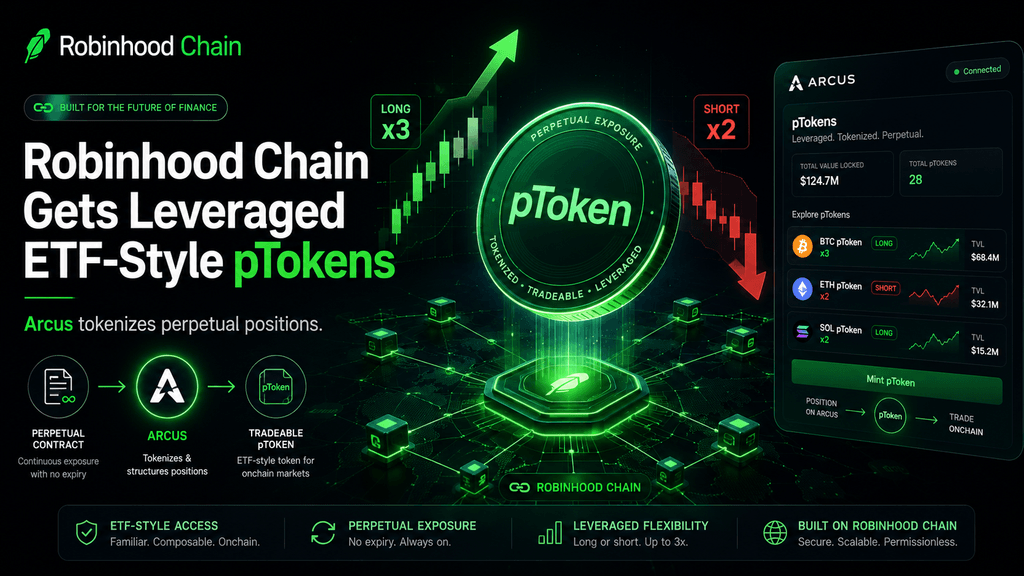
Robinhood Chain is expanding beyond Stock Tokens and conventional decentralized trading. On August 25, 2026, Arcus launched pTokens, a new protocol designed to package managed perpetual futures positions into transferable ERC-20 assets. The initial lineup includes products offering fixed target exposure to markets such as Bitcoin and other crypto assets, including leveraged long and short strategies. Arcus describes each pToken as a proportional interest in an underlying perpetual account configured around a specific market and leverage target.
The concept resembles leveraged exchange-traded funds in one important respect: users can obtain packaged leveraged exposure without manually managing an individual derivatives position. But pTokens are not ETFs. They are blockchain-native assets built on perpetual futures infrastructure, with different funding, liquidity, technical and regulatory risks. More importantly, turning a perpetual position into an ERC-20 token could allow leverage itself to become transferable and potentially composable across decentralized finance. That makes the Arcus launch more than another leveraged crypto product—it is an experiment in tokenizing financial positions rather than simply tokenizing underlying assets.
What Are Arcus pTokens?
A conventional perpetual futures trade normally lives inside a derivatives account. A trader deposits collateral, selects a market, chooses a direction and leverage level, and then manages the resulting position. The trader may need to monitor margin requirements, funding payments, liquidation thresholds and changing collateral values. Even if the position becomes profitable, the position itself generally cannot be moved into another wallet or used directly inside an unrelated DeFi application.
Arcus pTokens change the wrapper around that exposure. Instead of requiring every holder to open and maintain an individual perpetual position, Arcus manages an underlying perpetual account and issues ERC-20 tokens representing proportional economic interests in that account. A product such as pBTC3x, for example, is designed to provide approximately three-times long Bitcoin exposure through a managed perpetual position. Arcus has introduced structures covering assets including Bitcoin, Solana and HYPE, with 1x and 3x long or short configurations.
The distinction matters. A pBTC3x holder is not buying three Bitcoin, and the product is not a Bitcoin ETF. Instead, the holder owns a token whose economic value depends on an underlying leveraged perpetual strategy. By wrapping that strategy into an ERC-20 asset, Arcus aims to make leveraged exposure feel more like owning a token than maintaining an active derivatives account.
How Do pTokens Turn Perpetual Positions Into ERC-20 Assets?
The basic structure can be understood as two layers. At the bottom sits the managed Arcus perpetual account, which holds collateral and the relevant derivatives position. Above it sits the pToken, which represents a proportional stake in the economics of that account. Instead of interacting continuously with the perpetual market, a user can acquire the token representing the strategy and hold or transfer it like another blockchain asset. Arcus says the design allows the resulting ERC-20s to move into lending markets and other onchain protocols.
This changes an important characteristic of derivatives. Traditionally, leverage is account-bound: the exposure remains inside the platform where the position was created. Tokenization potentially makes that exposure portable. If ecosystem integrations develop, a leveraged position could theoretically be traded through an automated market maker, held in self-custody, transferred between wallets or incorporated into another DeFi strategy. This is the broader idea behind what might be called composable leverage.
However, the token wrapper does not remove the financial mechanics underneath it. The value of a pToken still depends on the performance of the underlying market, the leverage target, perpetual funding, position adjustments and trading costs. Packaging those components into one ERC-20 can simplify access, but it does not simplify the underlying risk.
How Are pTokens Different From Leveraged ETFs?
Arcus has compared the accessibility of pTokens with the role leveraged ETFs have played in traditional finance. Leveraged ETFs package derivatives and rebalancing strategies into securities that investors can buy through ordinary brokerage accounts. Arcus CEO Eddie Zhang said traditional markets have spent decades making sophisticated strategies easier to access through products such as leveraged ETFs and argued that similar strategies could become native to blockchain infrastructure.
The comparison is useful, but the products are structurally very different.
| Feature | Leveraged ETF | Arcus pToken |
| Product structure | Regulated fund/security | ERC-20 onchain asset |
| Main exposure | Swaps, futures and securities | Managed perpetual positions |
| Trading venue | Traditional securities exchange | Blockchain and DeFi markets |
| Typical custody | Brokerage account | Compatible crypto wallet |
| Trading availability | Exchange-dependent | Potentially 24/7 onchain |
| Perpetual funding | No direct perp funding | Exposed to perpetual funding economics |
| Composability | Limited | Potential DeFi integration |
| Key risks | Leverage, tracking and decay | Leverage, funding, liquidity and smart contracts |
A three-times leverage target should also not be confused with a guarantee of three-times the underlying asset's long-term return. If Bitcoin rises 20% over several months, that does not automatically mean a 3x pToken must return exactly 60%. The path Bitcoin takes, changes in leverage, funding costs and position-management expenses can all affect the result. This is similar to the reason long-term returns from leveraged ETFs can diverge significantly from a simple multiple of the underlying asset's cumulative return.
Why Is Robinhood Chain a Natural Home for pTokens?
Robinhood Chain is a permissionless, EVM-compatible Layer 2 built using Arbitrum infrastructure and designed around onchain financial markets, crypto and tokenized real-world assets. The network uses ETH as its native gas asset and supports standard Ethereum development tools. Robinhood specifically highlights Stock Tokens as a flagship real-world asset category for the network.
Robinhood Stock Tokens are standard ERC-20 tokens issued by Robinhood Assets (Jersey) Limited. They provide economic exposure to underlying securities such as U.S. shares and ETFs, but they do not give holders direct legal or beneficial ownership rights in the companies behind those securities. Their ERC-20 structure allows them to be held, transferred and incorporated into blockchain applications, including trading and potentially lending markets.
That infrastructure makes Arcus strategically interesting. Robinhood Chain can support the asset layer through Stock Tokens, the collateral layer through stablecoins and other assets, the derivatives layer through perpetual markets, and now the packaged strategy layer through pTokens. Instead of merely moving traditional assets onto a blockchain, the ecosystem is beginning to build new financial products on top of those assets.
Why Tokenized Perpetual Positions Could Matter for DeFi
The simplest benefit is accessibility. Leveraged perpetual trading normally requires users to understand margin management, funding rates and liquidation mechanics before actively maintaining a position. A pToken compresses much of that operational complexity into one asset. Someone seeking a specific type of leveraged exposure could acquire the relevant token rather than repeatedly adjusting a derivatives account. That does not make the investment safer, but it can make the interface to leverage considerably simpler.
The bigger innovation is portability. An ordinary perpetual position is usually trapped inside the exchange or protocol where it was created. An ERC-20 representation can, at least in principle, move between applications. Arcus specifically designed pTokens so that they can potentially circulate through lending markets and other onchain protocols. If sufficient liquidity and risk infrastructure emerge, leveraged strategies could themselves become building blocks for other DeFi applications.
This represents another stage in the evolution of tokenization. Stablecoins tokenized money. Liquid staking tokens helped tokenize yield-bearing staking positions. RWA platforms are bringing government bonds, private credit and other traditional assets onchain. Robinhood Chain is extending that model through Stock Tokens. pTokens go one step further: the thing being tokenized is no longer simply Bitcoin, a stock or another underlying asset. It can be a financial strategy built around that asset.
Stock Tokens as Collateral Could Be the Bigger Story
Arcus is also developing the ability to use eligible Stock Tokens as collateral for leveraged positions. This may ultimately prove just as important as the pToken wrapper itself because it connects tokenized traditional-market exposure with crypto-native derivatives. Rather than treating a Stock Token as an asset that can only be bought and sold, DeFi infrastructure can potentially turn it into productive collateral.
Consider the traditional capital-allocation problem. An investor holding an equity position who needs liquidity may have to sell some of that position or borrow through a conventional securities-backed lending arrangement. Onchain, the emerging model could allow an eligible Stock Token to remain in a wallet while supporting another position. The investor could retain economic exposure to the original asset while using its collateral value to enter a different market.
That improved capital efficiency comes with additional leverage. If an asset already carrying market risk becomes collateral for a leveraged derivatives position, losses can propagate across layers. The more interconnected Stock Tokens, stablecoins, perpetuals and tokenized strategies become, the more important collateral haircuts, oracle design, liquidation mechanisms and liquidity conditions will be.
What Are the Biggest Risks of pTokens?
Leverage remains the most obvious risk. A strategy targeting three-times exposure magnifies unfavorable price moves as well as favorable ones. Perpetual funding can also create a meaningful drag on returns when traders on one side of the market are paying consistently high funding rates. Position adjustments and trading costs introduce another source of performance divergence, particularly during volatile periods. A holder therefore cannot judge a pToken solely by predicting whether the underlying asset will rise or fall.
Tokenization creates additional layers of risk that a simple spot asset does not have. The pToken needs sufficient secondary-market liquidity, and weak liquidity can produce wider spreads, higher slippage and potentially meaningful differences between an implied underlying value and the price at which the token can actually be traded. Smart-contract vulnerabilities, oracle failures and blockchain infrastructure problems can also affect the product even when the underlying market behaves normally.
| Risk | Why It Matters |
| Leverage risk | Gains and losses can be amplified rapidly |
| Funding risk | Perpetual funding can reduce returns over time |
| Path dependence | Long-term performance may diverge from a simple leverage multiple |
| Liquidity risk | Thin markets can increase spreads and slippage |
| Smart-contract risk | Contract or infrastructure failures can create losses |
| Layered collateral risk | Stock Tokens, perpetuals and pTokens can introduce multiple dependencies |
The layered structure becomes especially important when real-world-asset exposure is involved. A position could ultimately depend on an underlying security, a Stock Token referencing that security, collateral and oracle infrastructure, an Arcus perpetual position and finally the pToken representing the strategy. Every additional layer can improve programmability, but it can also create another dependency that users need to understand.
Are pTokens Available to Everyone?
A permissionless blockchain should not be confused with universally available financial products. Robinhood Chain itself is open and EVM-compatible, meaning users and developers can interact with the network and deploy applications. Robinhood also makes clear that the blockchain operates independently from customers' ordinary Robinhood brokerage and crypto accounts. Using Robinhood Chain is therefore not the same thing as trading a security inside the standard Robinhood brokerage application.
Product availability is also subject to jurisdictional restrictions. Robinhood's documentation says Stock Tokens are not registered under U.S. securities laws and cannot be offered, sold or delivered in the United States or to U.S. persons, with restrictions also applying in several other jurisdictions. Arcus has separately said its Stock Token products are unavailable in the United States, United Kingdom, Canada and other restricted markets.
This distinction will matter increasingly as DeFi combines tokenized traditional assets with derivatives and leverage. A blockchain can be globally accessible while the legal availability of specific financial instruments remains highly fragmented. The technical permissionlessness of an ERC-20 token does not override securities, derivatives or consumer-protection rules.
Can pTokens Become a New DeFi Primitive?
The bullish case for pTokens is not primarily that traders need another way to obtain leveraged Bitcoin exposure. Crypto markets already offer abundant leverage. The more interesting possibility is that standardized token representations of leveraged strategies become widely usable across DeFi. A pToken with deep liquidity could potentially sit inside an automated market maker, lending market, structured vault or portfolio-management protocol, allowing applications to interact with a financial position without recreating the underlying strategy themselves.
The challenge is whether the ecosystem actually needs this primitive. Composability is only valuable when other protocols are willing to integrate an asset, liquidity is deep enough to support meaningful trading, oracle infrastructure is reliable and users understand the product. Lending protocols may also be cautious about accepting highly leveraged tokens as collateral because their volatility can create difficult liquidation dynamics. The presence of an ERC-20 interface alone does not guarantee broad integration.
For that reason, the real experiment is not whether Arcus can create a 3x token. It clearly can. The more important question is whether a leveraged financial position can become a liquid, interoperable blockchain asset that other applications consider useful enough to build around.
What Could Come Next for Arcus and Robinhood Chain?
The next stage will be determined by adoption rather than product design. Arcus said at launch that it had processed more than $2 billion in trading volume on Robinhood Chain and averaged more than $100 million in daily trading volume across its platform. Those figures show that the broader trading venue already has activity, but pTokens will need to develop their own liquidity and demonstrate sustained demand rather than relying on the novelty of the launch.
DeFi integrations will be an equally important signal. The core promise of pTokens becomes much more compelling if they begin to appear in lending markets, automated market makers, portfolio vaults or structured products. Investors should also watch whether Arcus expands the range of markets and leverage structures, whether Stock Tokens gain broader use as collateral, and whether developers create entirely new financial products on top of tokenized positions.
Regulation is the other major variable. Combining tokenized real-world assets, derivatives, leverage and open blockchain infrastructure brings several regulatory categories together in one product stack. Even if the technology succeeds, the long-term market for pTokens could depend heavily on where the products can legally be distributed and how regulators ultimately classify onchain representations of managed derivatives strategies.
Conclusion: pTokens Are More Than Another Leveraged Crypto Product
Arcus pTokens take a familiar financial idea—packaged leveraged exposure—and rebuild it using blockchain-native infrastructure. Instead of requiring every trader to maintain a perpetual futures account, Arcus turns managed positions into transferable ERC-20 assets. That produces an experience reminiscent of leveraged ETFs while relying on fundamentally different mechanics, including perpetual funding, onchain liquidity and smart contracts.
The larger significance is composability. Robinhood Chain is already designed around programmable financial assets such as Stock Tokens, and pTokens extend that concept from tokenizing assets to tokenizing financial positions. A leveraged strategy can potentially become something that is held, transferred and eventually incorporated into other applications.
Whether this becomes a major DeFi category remains uncertain. Liquidity, funding costs, risk management, protocol integrations, regulatory restrictions and actual user demand will matter more than the novelty of the architecture. But the launch illustrates an important direction for onchain finance: the next phase of tokenization may not simply put more assets on blockchains. It may put entire investment strategies onchain as programmable assets.
FAQs
Do You Need a Robinhood Brokerage Account to Use Robinhood Chain?
No. Robinhood Chain is a separate permissionless blockchain and is not connected to a user's ordinary Robinhood brokerage or crypto account. Users interact with it through compatible blockchain wallets and applications rather than through their brokerage portfolio. Robinhood Wallet supports the network directly, while other EVM-compatible wallets can also connect.
What Token Is Used to Pay Gas on Robinhood Chain?
Robinhood Chain uses ETH as its native gas token. The network is an Arbitrum-based Ethereum Layer 2 with Chain ID 4663, so users need ETH on Robinhood Chain to pay transaction fees when interacting directly with supported applications.
Does Robinhood Chain Have a Native Network Token?
Robinhood Chain currently uses ETH for transaction fees rather than a separate blockchain-native gas token. Users should therefore distinguish the network itself from similarly named financial assets, community tokens or securities associated with Robinhood.
Can pTokens Be Stored in a Normal Crypto Wallet?
Because pTokens are designed as ERC-20 assets, their token structure is compatible with standard Ethereum-style wallet infrastructure. Actual access to a particular pToken, however, can still depend on application support, liquidity and jurisdictional restrictions. Wallet compatibility should not be interpreted as confirmation that a financial product is legally available to every user.
Could Other DeFi Protocols Build Products on Top of pTokens?
Potentially. ERC-20 compatibility gives pTokens a standardized interface that other applications can integrate, creating possibilities for trading pools, lending markets, portfolio vaults or structured strategies. Whether those integrations emerge in practice will depend on liquidity, oracle reliability, collateral policies and each protocol's assessment of the risks associated with leveraged tokenized positions.
🔥 KuCoin Offers A More Stable Option in A Volatile Market
If you worry about the frequent ups and downs in the market, and pursue a more stable option to earn money passively, KuCoin is the right place to come:
Simple Earn: Deposit and withdraw tokens anytime, earning stable returns.
Kucoin Earn: Earn stable profits with professional asset management.
Hold to Earn: Earn rewards by holding assets in Funding, Trading, Margin, Futures, Mining, and Unified Accounts.
Staking: Unlock the earning potential of on-chain assets.
Advanced Investments: Advanced Investments offer a variety of structured products to help your money grow in any market.
Shark Fin: Principal Protection and Guaranteed Gains
Dual Investment: Buy low and sell high with transparent return calculations.
Snowball: High yields, with price protection.
Discount Buy: Buy crypto at discount prices.
KCS Loyalty: Level up to enjoy exclusive perks by staking ≥ 1 KCS.
KuCoin Wealth: Discover future value and begin your smart investing journey.
KCS Benefits: Hold and stake KCS to access benefits across the platform.
KCS Staking 2.0: Participate in KCS on-chain governance to earn yield.
Disclaimer: This content is for informational purposes only and does not constitute investment advice. Cryptocurrency investments carry risk. Please do your own research (DYOR).