

Oil Prices Surge as Treasury Yields Hit 2002 Highs: What It Means for Bitcoin and Crypto
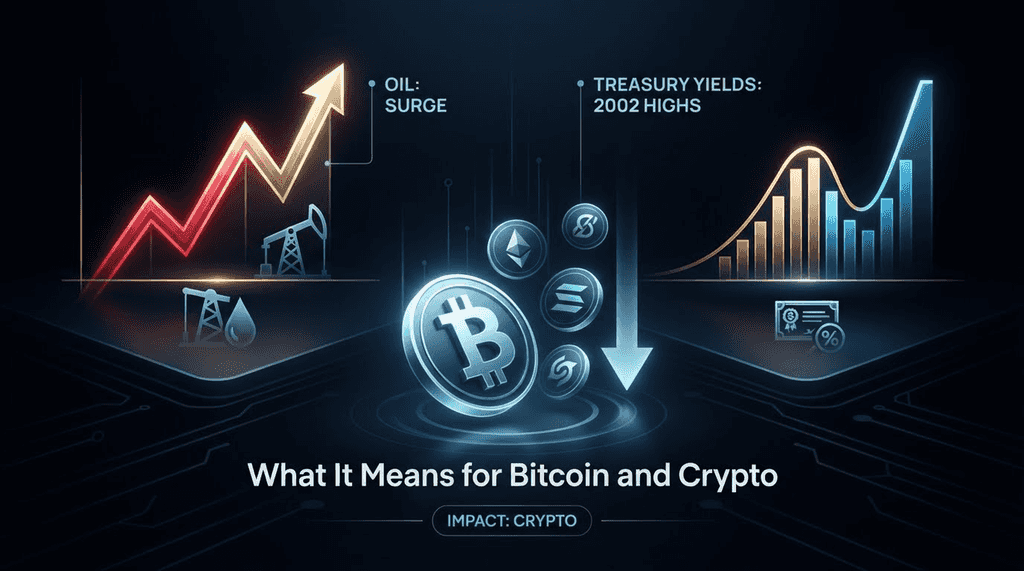
Global financial markets are confronting a renewed period of macroeconomic adjustment. Energy prices have experienced a notable upward repricing, with Brent crude moving past the $100 per barrel mark due to escalating geopolitical tensions and supply chain frictions in the Middle East. Concurrently, sovereign bond markets have reacted with significant selling pressure, pushing United States sovereign debt yields to multi-decade peaks. Recently, the 10-year US Treasury yield climbed to 5.36%, its highest level since April 2002, while the 30-year yield advanced to 5.73%.
This dual surge in energy commodities and sovereign debt yields has created immediate headwind conditions for risk assets globally. As observed across real-time crypto market data, the sector reacted swiftly to this macro shift, with Bitcoin (BTC) experiencing a technical pullback from the $83,000 threshold to trade near the $82,600 level, while Ethereum (ETH) retraced toward $2,560. While this nominal percentage drop was relatively minor for spot markets, it was sufficient to trigger the clearing of approximately $550 million in over-leveraged long positions in the derivatives market. This was accompanied by a single-day net outflow of $213.4 million from spot Bitcoin exchange-traded funds (ETFs).
Understanding the impact of Treasury yields on the cryptocurrency market requires examining how macroeconomic tightening transmits across asset classes. When energy prices raise inflation expectations and sovereign yields establish elevated benchmarks for capital, institutional portfolio managers systematically alter how they price liquidity, leverage, and alternative assets.
Energy Shocks and the "Higher-for-Longer" Reality
To analyze how macroeconomic factors are operating in this current cycle, it is necessary to examine the interaction between crude oil and sovereign debt. The recent escalation in Brent crude above $100 per barrel acts as an immediate input cost shock across global supply chains. Crude oil is a foundational economic input that directly affects industrial manufacturing, agricultural fertilizers, plastics, freight logistics, and consumer goods distribution.
When oil prices sustain elevated levels, headline consumer price index (CPI) measurements face direct upward revisions. While central banks primarily focus on core inflation—which strips out volatile food and energy components—sustained energy price increases inevitably filter into core services and non-energy goods through transport and operational overhead. This transition has complicated the monetary outlook for the Federal Reserve.
Market participants had previously priced in a progressive easing cycle characterized by steady rate cuts. However, elevated energy prices combined with resilient economic data have forced a reassessment of Federal Open Market Committee (FOMC) policy projections. Recent communications indicate that committee members remain alert to secondary inflation risks, acknowledging that restrictive policy may need to be maintained longer than the market previously anticipated.
In response, the fixed-income market repriced terminal policy rate expectations. As bond investors demanded higher term premiums to offset prolonged inflation risks, bond prices declined, driving the 10-year Treasury yield to levels unseen in over twenty-four years.
Why Rising Treasury Yields Impact Crypto
The relationship between sovereign debt yields and digital assets is governed by standard financial mechanics rather than pure market sentiment. For institutional allocators, rising bond yields alter three core variables: the baseline risk-free hurdle rate, the cost of portfolio leverage, and mechanical ETF liquidity flows.
-
The Risk-Free Rate vs. Opportunity Cost
The most direct pressure on digital assets stems from the fundamental concept of the risk-free rate of return. United States Treasuries are treated by global institutions as risk-free instruments in nominal dollar terms, backed by the taxing and currency-issuing authority of the US federal government.
When the 10-year yield sits at historically low levels, the opportunity cost of holding non-yielding assets—such as physical gold, commodities, or Bitcoin—remains relatively low. In that environment, institutional investors are more willing to deploy capital into higher-volatility assets to capture capital appreciation.
However, when the 10-year yield reaches 5.36% and the 30-year yield reaches 5.73%, asset managers can secure predictable, cash-flow-generative returns with zero credit risk. Bitcoin does not pay an organic nominal yield or dividend; its financial return is driven purely by capital appreciation and network adoption. Consequently, as the risk-free benchmark rises, the mathematical hurdle rate required to justify holding high-beta, non-yielding digital assets shifts higher. This prompts a standard capital rotation, where institutional allocators shift a portion of funds from speculative markets into short- and intermediate-term government debt.
-
Financing Costs and Open Interest Clearing
The modern cryptocurrency market is heavily financialized, relying on centralized exchange perpetual contracts and institutional prime brokerage lending desks. The interest rates governing these credit facilities reflect broader commercial funding benchmarks, including the Secured Overnight Financing Rate (SOFR).
As rising bond yields increase borrowing costs across the broader economy, the cost of maintaining leveraged long exposure in crypto derivatives climbs. When a macro shock triggers even a mild spot market drawdown—such as the 0.5% move from $83,000 to $82,600—it can easily breach the maintenance margins of highly leveraged retail and quantitative trading accounts.
The recent $550 million liquidation event was not a systemic market failure, but rather a routine clearing of excessive open interest. These automated liquidations force market orders into the order book, creating temporary downward price momentum that is independent of Bitcoin's core fundamentals.
-
Mechanical Portfolio Rebalancing and ETF Outflows
The integration of spot Bitcoin ETFs established a direct, regulated conduit between Wall Street wealth management platforms and on-chain liquidity. While this structural bridge provides significant capital inflows during expansionary phases, it operates symmetrically during periods of macro contraction.
Institutional multi-asset portfolios, such as Commodity Trading Advisors (CTAs) and risk-parity funds, follow rigid, algorithmically driven allocation rules. When market volatility indices (such as the VIX) climb and bond market volatility (the MOVE index) expands alongside oil price spikes, portfolio managers are mandated to reduce overall portfolio Value at Risk (VaR). Because Bitcoin exhibits higher annualized volatility than equities or sovereign debt, it is mechanically trimmed to restore portfolio risk balance.
Clarifying the Inflation Hedge Narrative
To evaluate the long-term implications of these macro shifts, it is useful to review how Bitcoin has historically reacted during different inflationary regimes. Digital asset proponents frequently refer to Bitcoin generally as an "inflation hedge," but empirical market data reveals an important distinction between different types of inflation.
Market data demonstrates that Bitcoin functions most effectively as a hedge against monetary debasement—the intentional expansion of central bank balance sheets and the rapid growth of the broad money supply (M2). When the monetary base expands rapidly, Bitcoin's hard mathematical supply cap of 21 million units provides structural scarcity, attracting capital seeking to preserve purchasing power.
However, Bitcoin does not reliably serve as a short-term hedge against supply-driven cost-push inflation, such as an energy shock caused by oil production bottlenecks. When crude prices surge, central banks do not expand liquidity; they contract it by raising rates or keeping borrowing conditions restrictive. This monetary tightening drains system liquidity, which weighs on all risk assets simultaneously, including equities and digital assets. During the initial phase of an energy-driven inflationary pulse, Bitcoin's correlation with oil prices is frequently negative, as the immediate consequence of higher oil is liquidity withdrawal.
The Medium-Term Fiscal Outlook and Portfolio Diversification
While the immediate market impact of rising yields is contractionary, the medium- to long-term implications present a different structural dynamic for institutional portfolio construction. The current surge in Treasury yields creates notable challenges for sovereign balance sheets, a factor that macro funds are increasingly pricing into their long-term models.
The United States gross national debt exceeds $36 trillion, with the federal budget deficit projected at approximately $1.9 trillion for fiscal year 2026. As older sovereign debt issued during the low-interest-rate era matures, the US Treasury must refinance these obligations at prevailing market rates. With 10-year yields at 5.36%, the annual net interest expense on the federal debt has become one of the largest categories of government spending.
For institutional allocators, this presents a long-term portfolio risk. If interest obligations consume an increasingly large share of federal tax receipts, markets anticipate that central banks may eventually need to intervene—either through targeted liquidity mechanisms or yield curve interventions—to maintain debt market stability.
It is this specific fiscal dynamic that drives institutional interest in Bitcoin as an alternative duration asset. On-chain data indicates that despite the recent ETF outflows, institutional accumulation addresses established significant bid depth in the $81,000 to $82,000 range. These entities are not buying Bitcoin out of an ideological stance against fiat currencies; rather, they are pragmatically diversifying their portfolios. They view Bitcoin as a non-correlated, non-sovereign asset that provides a hedge against the persistent challenges of sovereign debt management and potential future expansions of the monetary base.
Support Levels and Open Interest Resets
Beyond macroeconomic theory, short-term crypto price discovery is governed by market liquidity and technical positioning.
-
Critical Spot Support Zones: The $81,000 to $82,000 price band represents a notable volume cluster on order-book depth charts across tier-1 exchanges. This range aligns with the realized price of several large accumulation tranches acquired following prior consolidation phases. A daily close below $81,000 would expose secondary support near the $78,500 level, a zone that has historically attracted institutional volume.
-
On-Chain Absorption: Despite broader market VaR derisking, on-chain entity-adjusted metrics show that wallets holding between 100 and 1,000 BTC increased net absorption during the recent pullback. This divergence indicates that long-term balance sheet allocators are stepping in to absorb the supply offloaded by retail derivative traders and short-term ETF participants.
-
Funding Rate Normalization: The liquidation of $550 million in long contracts returned perpetual funding rates from highly elevated, over-leveraged positive levels back to neutral. This reset clears speculative excess from the market, creating a healthier technical structure and reducing the probability of further cascading liquidations in the near term.
🔥 Beyond the Headlines: What KuCoin 5.0 Means for You
Market news moves fast — but where you act on it matters just as much. This October, KuCoin launches KuCoin 5.0, transforming KuCoin into a rebuilt platform. Here's what actually changes for you:
-
One account for everything. Older platforms split your money across separate "spot," "margin," and "futures" accounts and expected you to understand why. KuCoin 5.0's unified account removes that entirely — deposit once, and everything is simply there (only available to VIPs for now).
-
Stocks, indices, and commodities. KuCoin 5.0 expands beyond crypto into global markets. When crypto chops sideways and equities rally (or the reverse), you rotate in minutes instead of opening a brokerage account and waiting days for fiat rails.
-
Real-world assets (RWA). Tokenized exposure to traditional assets like commodities, right inside your crypto account. One of the fastest-growing segments in global finance is no longer reserved for institutions — you access it from the same balance you trade with.
-
Earn while you learn. Not ready to trade? KCUSD lets your stablecoins earn daily, auto-compounding interest. The lowest-stress way to put your idle deposit to work for 4% yield.
-
An AI assistant in plain language. Ask questions, get market context, understand what you're looking at — built into the platform, no jargon required.
-
An app that doesn't overwhelm. Faster, cleaner, and consistent — intuitive from the first tap, not after a tutorial.
-
Safety you can check, not just trust. A MiCAR-licensed EU entity, Proof of Reserves you can verify yourself, and internationally certified security (SOC 2 Type II, ISO 27001:2022).
Create your account in minutes — and start on the platform built for where crypto is going, not where it's been.
Conclusion
The simultaneous surge in crude oil past $100 and Treasury yields to multi-decade highs highlights how tightly modern digital asset markets are integrated with macroeconomic policy. While elevated risk-free yields and systematic VaR derisking exert measurable short-term downward pressure on crypto valuations, the resulting escalation in sovereign debt servicing costs reinforces the need for portfolio diversification. Consequently, institutional participants continue to evaluate Bitcoin through a dual lens: managing short-term cyclical liquidity contractions while maintaining strategic, long-term allocations as a hedge against persistent sovereign debt expansion.
FAQs
Why does a rising Treasury yield pressure Bitcoin in the short term?
A rising Treasury yield increases the risk-free rate of return available on US government bonds. Because Bitcoin is a non-yielding asset that pays no regular dividend or interest, institutional investors face a higher opportunity cost when holding it. In response, capital often rotates out of volatile risk assets and into predictable government paper, while higher borrowing costs mechanically trigger systematic portfolio derisking.
How do high oil prices affect crypto prices?
High crude oil prices (such as Brent crude surpassing $100 per barrel) increase transport and production costs, which raises headline inflation. This disrupts market expectations for interest rate cuts, forcing central banks to maintain restrictive monetary policies for longer. This prolonged monetary tightening withdraws global fiat liquidity, placing downward pressure on all risk asset valuations, including cryptocurrencies.
Is Bitcoin still considered an inflation hedge when yields are rising?
Bitcoin functions primarily as a long-term hedge against monetary inflation (the expansion of the M2 money supply). It does not reliably hedge against short-term supply-shock inflation, such as energy spikes. In supply-shock scenarios, central banks tighten liquidity to cool demand, which typically triggers short-term price pullbacks across speculative risk assets.
What triggered the recent $550 million crypto liquidation event?
The liquidation event was caused by a routine clearing of excessive leverage in the derivatives market, rather than a failure of Bitcoin's core network. As spot prices experienced a minor macro-driven drawdown from $85,000 toward $83,000, it breached the strict maintenance margins of highly leveraged perpetual long contracts. This automated triggering forced systemic market sell orders into the order book, creating a temporary, cascading downward price momentum.
How do spot Bitcoin ETFs impact market behavior during macro contractions?
Spot Bitcoin ETFs serve as a direct, regulated conduit between traditional Wall Street capital and on-chain crypto liquidity, meaning they transmit volatility symmetrically in both directions. When macro shocks compress global liquidity, institutional allocators running multi-asset risk-parity models are algorithmically mandated to reduce their portfolio Value at Risk (VaR). Because Bitcoin has high annualized volatility, these funds mechanically trim their ETF shares to rebalance risk, generating temporary capital outflows that reflect systematic derisking rather than a loss of long-term asset confidence.
Disclaimer
The information provided on this page may originate from third-party sources and does not necessarily represent the views or opinions of KuCoin. This content is intended solely for general informational purposes and should not be considered financial, investment, or professional advice. KuCoin does not guarantee the accuracy, completeness, or reliability of the information, and is not responsible for any errors, omissions, or outcomes resulting from its use. Investing in digital assets carries inherent risks. Please carefully evaluate your risk tolerance and financial situation before making any investment decisions. For further details, please consult KuCoin’s Terms of Use and Risk Disclosure.