

Nvidia Raises AI Server Prices by 15% as Memory Crunch Hits Blackwell Demand
2026/08/25 15:10:00
Key Takeaways
-
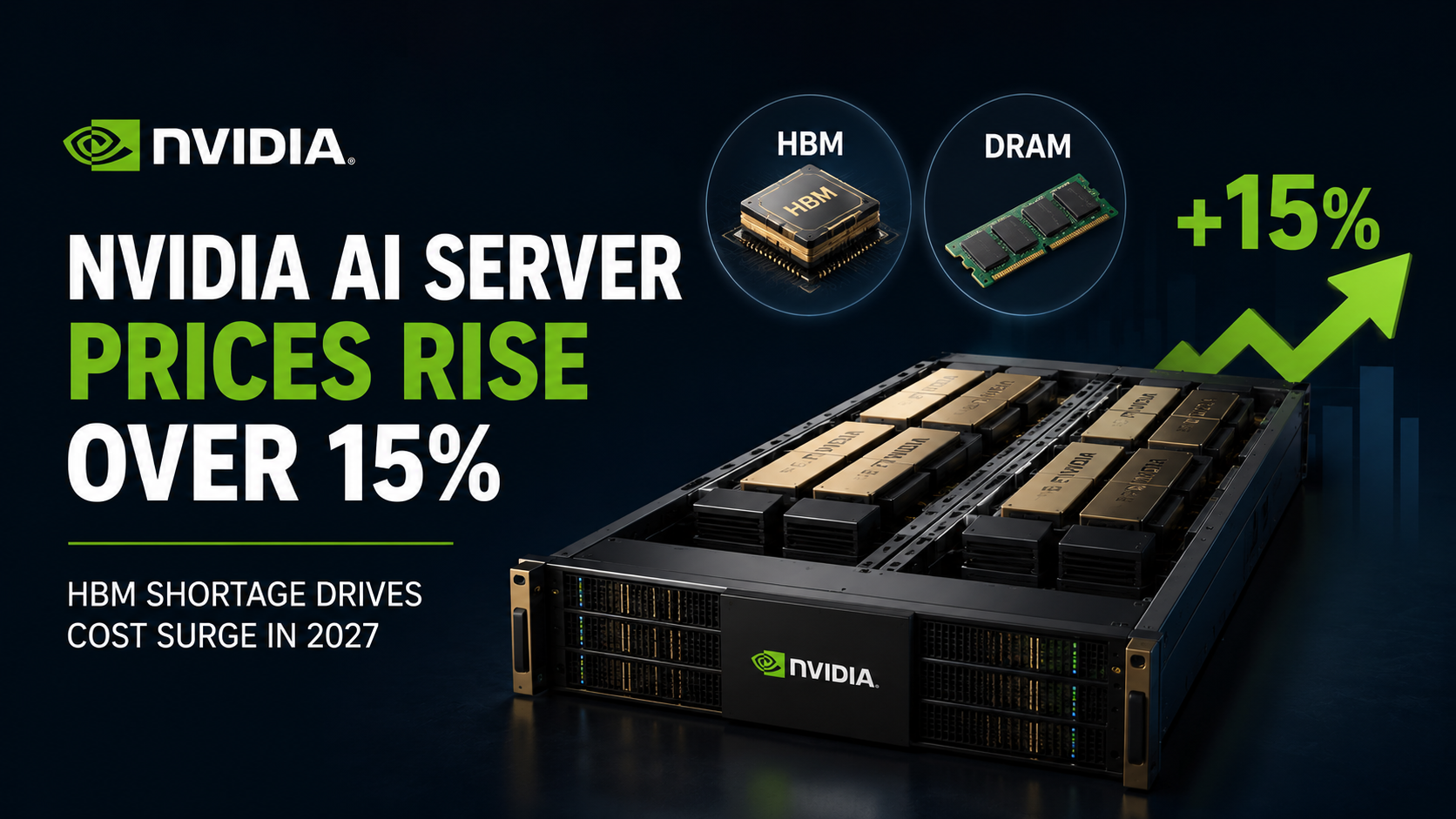
Price Surge: Nvidia is increasing AI server system prices by over 15% for shipments starting in early 2027.
-
Root Cause: A severe bottleneck and skyrocketing costs in high-bandwidth memory (HBM) and server DRAM from top producers like Samsung, SK Hynix, and Micron.
-
Affected Hardware: Flagship enterprise systems powered by Grace Blackwell and next-generation Vera Rubin architectures.
-
Market Impact: Hyperscalers and major data center builders face billions in added capital expenditures, potentially accelerating the push for in-house custom silicon.
Nvidia has notified major enterprise customers and cloud computing giants—including Microsoft, Google, and Oracle—that it is raising the prices of its flagship AI server systems by over 15%. Driven by an unprecedented crunch in high-bandwidth memory (HBM) and server DRAM, this impending price adjustment is set to reshape capital expenditure models across the technology sector. Below is an in-depth analysis of why these hardware costs are surging and how the market is reacting.
Introduction
Nvidia’s move to increase AI server prices by more than 15% for shipments starting in early 2027 marks a critical turning point for the artificial intelligence hardware market. According to reports citing industry communications, surging memory costs are forcing the world's leading chip designer to pass component inflation down to major hyperscalers. As global demand for high-performance computing infrastructure outpaces semiconductor manufacturing capacity, data center expansion costs are climbing to unprecedented heights, putting pressure on corporate budgets worldwide.
Why Are Nvidia AI Server Prices Increasing?
The price hike is directly tied to a severe supply chain bottleneck centered around high-bandwidth memory and traditional server DRAM. According to market assessments from Counterpoint Research and Bloomberg, memory manufacturers have struggled to keep pace with the massive quantities of silicon required for modern AI infrastructure.
-
Exploding Memory Costs: Counterpoint Research reported an 80% to 90% quarter-over-quarter increase across DRAM, NAND, and HBM during early 2026, significantly inflating the base bill of materials.
-
Intense Hardware Loadouts: Modern AI accelerators carry massive memory footprints. For example, upcoming architectures like the Vera Rubin platform require dense quantities of HBM4 per package, transforming memory into one of the most expensive components in a server rack.
-
Supplier Concentration: Major memory producers—including Samsung, SK Hynix, and Micron—have redirected substantial manufacturing lines toward HBM production, leaving commodity markets constrained and driving up contract pricing universally.
Which Hardware Systems Are Affected?
The price adjustments target Nvidia’s most advanced and compute-dense enterprise ecosystems. Based on reports from Bloomberg and industry trackers, the structural increases apply broadly across top-tier computing tiers.
-
Grace Blackwell Architectures: Systems integrating Nvidia’s combined Grace CPUs and Blackwell GPUs, which power massive foundational model training runs for global cloud providers, will see direct adjustments.
-
Vera Rubin Platforms: Next-generation rack configurations utilizing the Vera Rubin architecture are slated to absorb these higher baseline manufacturing costs upon their commercial rollout.
-
Variable Scale Hikes: Contract manufacturers building these systems have noted that the exact percentage increase varies depending on the specific chip generation and the custom memory configuration demanded by the client.
How Will This Impact Hyperscalers and Data Center Budgets?
Major cloud service providers face immediate financial recalibrations as hardware inflation compounds existing data center expansion challenges. According to infrastructure analysts, the fiscal impact extends far beyond simple component markups.
-
Amplified Infrastructure Expenditures: Financial analysts project that for massive 1-gigawatt (1GW) data center projects, a 15% hardware surge translates to billions of dollars in added capital expenses.
-
Compounding Power and Real Estate Bottlenecks: Data center operators are already fighting constraints related to municipal power grid caps and cooling limitations; adding multi-billion dollar hardware inflations complicates deployment timelines further.
-
Strategic Re-evaluations: Tech giants may become more selective regarding cluster deployment sizes, prioritizing mission-critical frontier model training while delaying secondary deployments or lower-priority enterprise nodes.
Will the Price Hike Accelerate Custom Silicon Development?
The rising cost of off-the-shelf Nvidia hardware provides an even stronger incentive for major cloud providers to rely on proprietary solutions. Industry observers note that high market prices traditionally encourage ecosystem diversification.
-
In-House ASIC Expansion: Hyperscalers like Google, Amazon, and Meta already design custom application-specific integrated circuits (ASICs) like TPUs and Trainium to handle specific internal workloads.
-
Reducing Margin Exposure: By migrating routine inference tasks and predictable model-serving pipelines onto internal silicon, tech giants can mitigate their reliance on high-margin merchant hardware.
-
Maintaining Competitive Leverage: Developing internal alternatives ensures that cloud operators retain negotiating leverage against acute component shortages and sudden price shifts from external suppliers.
How to Trade Semiconductor and AI Infrastructure Trends on KuCoin
While physical server components are procured through enterprise supply chains, broader macroeconomic momentum surrounding the artificial intelligence sector heavily influences global equity and tokenized technology assets. Traders looking to capitalize on semiconductor market shifts can monitor related developments on KuCoin.
KuCoin provides robust spot and derivatives markets for tracking high-tech sector performance, allowing users to execute diversified trading strategies securely. By utilizing advanced order types and real-time market analytics, participants can position themselves effectively ahead of major institutional earnings reports, memory supply updates, and enterprise infrastructure announcements. Always ensure proper risk management and conduct thorough technical research before entering positions in fast-moving technology sectors.
Conclusion
Nvidia's decision to raise AI server prices by over 15% underscores the intense physical and economic limits currently facing the global artificial intelligence expansion. Driven primarily by a chronic scarcity of advanced high-bandwidth memory and server DRAM, this pricing shift demonstrates how upstream component constraints eventually cascade down to the industry's largest buyers.
As systems built around Grace Blackwell and Vera Rubin head toward commercial release, hyperscalers will need to balance aggressive innovation timelines against steepened capital expenditure requirements. Whether this dynamic slows down mass deployments or simply accelerates the industry-wide shift toward custom internal silicon remains one of the most critical questions facing the technology sector. Ultimately, the memory crunch proves that even the most dominant players in artificial intelligence are ultimately bound by the limits of physical semiconductor manufacturing.
FAQs
When will Nvidia's 15% AI server price hike take effect?
The price increases apply to server systems scheduled for shipment starting in early 2027. Contract manufacturers began notifying major enterprise customers and cloud providers of the adjustments ahead of time.
Which specific memory technologies are causing the shortage?
The bottlenecks are driven by extreme demand for high-bandwidth memory (HBM), specifically HBM3E and HBM4 iterations, alongside tight supplies of standard server-grade DRAM.
Are consumer-grade graphics cards affected by this price increase?
While consumer GeForce GPUs have experienced separate pricing adjustments due to broader retail and component pressures, the specific 15% enterprise hike directly targets rack-scale AI server systems utilized by data center operators.
Which companies are primarily supplying the memory for these servers?
The vast majority of global high-performance DRAM and HBM manufacturing is concentrated among three primary producers: Samsung, SK Hynix, and Micron.
How do high-end memory requirements scale in modern AI racks?
Modern configurations, such as large-scale rack systems combining dozens of advanced GPUs, require massive loadouts scaling into tens of terabytes of HBM per deployment, making memory a dominant factor in total hardware costs.
🔥 KuCoin Offers A More Stable Option in A Volatile Market
If you worry about the frequent ups and downs in the market, and pursue a more stable option to earn money passively, KuCoin is the right place to come:
Simple Earn: Deposit and withdraw tokens anytime, earning stable returns.
Kucoin Earn: Earn stable profits with professional asset management.
Hold to Earn: Earn rewards by holding assets in Funding, Trading, Margin, Futures, Mining, and Unified Accounts.
Staking: Unlock the earning potential of on-chain assets.
Advanced Investments: Advanced Investments offer a variety of structured products to help your money grow in any market.
Shark Fin: Principal Protection and Guaranteed Gains
Dual Investment: Buy low and sell high with transparent return calculations.
Snowball: High yields, with price protection.
Discount Buy: Buy crypto at discount prices.
KCS Loyalty: Level up to enjoy exclusive perks by staking ≥ 1 KCS.
KuCoin Wealth: Discover future value and begin your smart investing journey.
KCS Benefits: Hold and stake KCS to access benefits across the platform.
KCS Staking 2.0: Participate in KCS on-chain governance to earn yield.
Disclaimer: This content is for informational purposes only and does not constitute investment advice. Cryptocurrency investments carry risk. Please do your own research (DYOR).