

Mastercard Offers Open USD Access Through BVNK for Fiat and Stablecoin Conversion
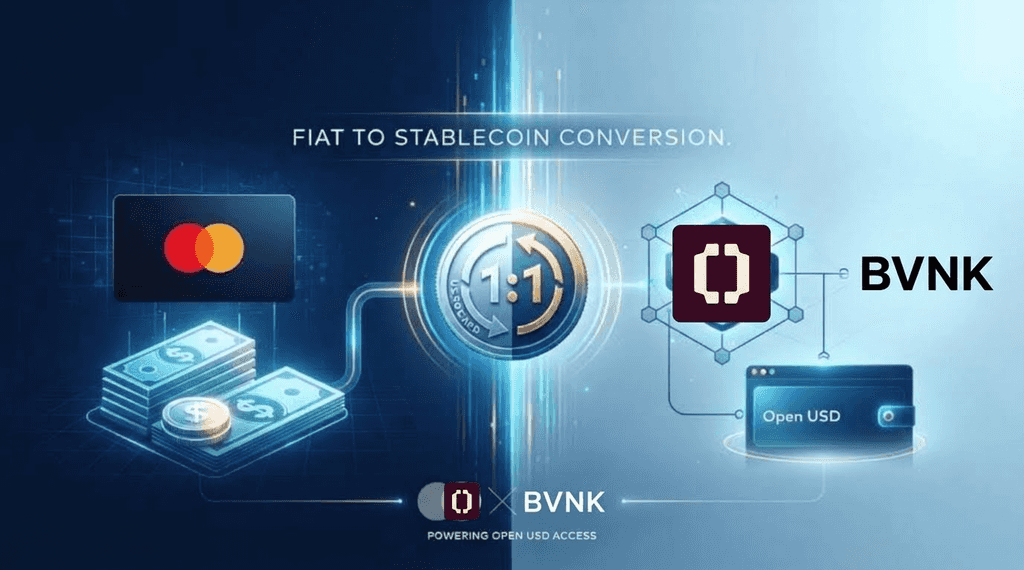
The integration of digital assets into global financial networks has reached a notable stage of infrastructure development. In October 2026, Mastercard, utilizing the infrastructure of its recently acquired subsidiary BVNK, officially enabled access to the Open USD (OUSD) stablecoin. This development provides a structured, regulated pathway for fiat and stablecoin conversion, specifically tailored for enterprise clients and B2B stablecoin settlement. For financial institutions, multinational merchants, and cross-border businesses, the Mastercard BVNK integration offers a streamlined bridge between traditional fiat banking systems and decentralized blockchain networks.
This article provides a comprehensive technical and strategic analysis of the Mastercard BVNK Open USD integration. We will explore the infrastructure underlying this initiative, the specific mechanics of the Open USD stablecoin, and how this alliance impacts the broader landscape of traditional finance (TradFi) and institutional cross-border settlement, while also examining the persistent structural challenges it faces.
The Infrastructure: Mastercard's Acquisition of BVNK
To understand the mechanics of this integration, it is necessary to examine the structural foundation of the partnership. In March 2026, Mastercard announced a definitive agreement to acquire BVNK, a London-based stablecoin infrastructure provider, for up to $1.8 billion. The acquisition was officially completed in August 2026, marking a deliberate strategic move by the payment network to internalize digital asset clearing capabilities rather than relying entirely on external partners.
BVNK processes significant transaction volumes for enterprises globally, providing compliance frameworks, technical intellectual property, and regulatory licensing necessary for digital asset settlements. Prior to the acquisition, enterprise clients utilized BVNK to address the fragmentation of cross-border money movement by using stablecoins as a base layer for value transfer.
By combining BVNK’s crypto-native infrastructure with Mastercard's global network, the unified platform aims to facilitate secure fiat and stablecoin conversion. This integration allows banks, fintechs, and corporate treasuries to test new use cases with stablecoins and tokenized assets without needing to construct proprietary blockchain architecture from scratch. However, while Mastercard effectively bridges digital wallets and corporate banking rails, the efficiency of this system is still heavily dependent on the processing speeds of local banking partners in various jurisdictions.
What is Open USD (OUSD)?
For enterprises looking to adopt digital currencies, a common question arises regarding how Open USD differs from existing market offerings. Launched on October 1, 2026, by the Open Standard alliance, OUSD is a stablecoin designed with a distribution model built around institutional partners rather than direct-to-consumer retail marketing.
The alliance behind OUSD represents a consortium of major entities in payments and commerce, including Coinbase, Mastercard, Shopify, Stripe, and Visa. Together, these founding members committed over $1 billion to seed the initial liquidity of the token, ensuring deep market depth at launch.
Unlike algorithmic tokens or yield-bearing retail assets, the Open USD stablecoin functions strictly as institutional-grade collateralized digital cash. The token is issued by Bridge, the specialized stablecoin infrastructure firm that Stripe acquired for $1.1 billion in 2024. To maintain price stability, the fiat reserves backing OUSD are held in custody at highly regulated entities, including BlackRock, Lead Bank, and BNY, with Bridge committing to publish monthly reserve attestations.
A core differentiator of OUSD is its economic distribution model. In traditional stablecoin models, the central issuer typically retains the overwhelming majority of the yield generated by the underlying fiat reserves. Open Standard reverses this approach by distributing rewards and corporate equity to its partners in proportion to the circulating supply and transaction activity they drive. This structure incentivizes networks like Mastercard to facilitate B2B stablecoin settlement, as their institutional stake grows alongside the token's adoption.
How Mastercard BVNK Integration Works for B2B Settlement
The core mechanical advantage of the Mastercard BVNK integration centers on reducing the friction and latency traditionally associated with the intermediary stages of cross-border payments. Through the BVNK portal, businesses can execute zero-fee stablecoin conversion, minting and redeeming OUSD at a strict 1:1 ratio against the US dollar.
The operational workflow for enterprises relies on several integrated components:
Streamlined On/Off Ramp Utility
Corporate entities can receive international B2B payments in OUSD and settle those digital assets into local fiat currencies within their traditional bank accounts. Conversely, a business holding USD can instantly convert those funds into OUSD to pay international suppliers. While the minting and redemption process through BVNK carries no transaction fee for USD, it is important to note that businesses operating in other fiat currencies (like the Euro or emerging market currencies) will still face traditional foreign exchange (FX) spreads and local banking fees when converting their local currency into the USD required to mint OUSD.
Multi-Chain Interoperability
The OUSD token does not rely on a single blockchain ecosystem. At launch, it operates natively across four distinct blockchains: Base, Ethereum, Solana, and Tempo. BVNK's backend infrastructure abstracts the complexities of network routing, gas fee management, and cryptographic wallet provisioning. Corporate treasurers interact with a standard financial interface to view balances and execute transfers, while the system handles the underlying chain mechanics.
Mitigation of Middle-Stage Latency
Traditional correspondent banking and SWIFT transfers often require days to clear and settle, particularly for emerging market corridors. By utilizing OUSD for B2B stablecoin settlement, the intermediary clearing time is compressed to the block-time of the underlying network (often a matter of seconds). However, the "last-mile" settlement—moving the converted fiat from BVNK into a local corporate bank account—is still subject to the operating hours, settlement delays, and legacy infrastructure of local commercial banks.
Expanding Merchant Acquiring
Beyond direct B2B transfers, this integration allows acquiring banks and payment service providers (PSPs) to offer crypto payouts to their downstream merchants. A merchant processing traditional credit card transactions can opt to receive their settlement in OUSD rather than local fiat, providing an alternative treasury management strategy in markets with high local currency volatility.
Open USD vs. USDC vs. USDT: An Institutional Comparison
With the introduction of OUSD, the digital asset market is becoming increasingly segmented. While Tether (USDT) and Circle (USDC) have historically dominated the market—accounting for over 85% of the roughly $308 billion stablecoin supply as of August 2026—OUSD is specifically positioned to capture institutional settlement volume.
| Feature / Metric | Open USD (OUSD) | Circle USD (USDC) | Tether (USDT) |
| Primary Target Audience | Institutional clearing, B2B stablecoin settlement, payment networks. | Broad DeFi ecosystem, retail trading, enterprise integrations. | Retail trading, offshore liquidity, emerging market remittance. |
| Minting / Redemption Fees | Zero-fee stablecoin conversion for USD through founding partners (Mastercard, Visa, Stripe). | Low fees, but exact costs depend on the institutional partner and volume tiers. | Variable fees for minting/redeeming fiat (often 0.1% or specific minimums). |
| Reserve Custodians | BlackRock, Lead Bank, BNY. | BNY Mellon, BlackRock, and specific global banking partners. | Cantor Fitzgerald, Britannia Bank & Trust, among others. |
| Issuer Structure | Open Standard alliance; issued by Bridge (a Stripe company). | Circle Internet Financial. | Tether Limited. |
| Economic Incentive Model | Yield and equity distributed to network partners based on utility driven. | Centralized revenue model with specific revenue-sharing agreements. | Centralized revenue model retained by Tether. |
While OUSD enters a concentrated market, its explicit backing by major payment processors provides an immediate distribution channel. Executives at Mastercard, Visa, and Coinbase have publicly maintained that their platforms will continue to support multiple stablecoins, including USDC, ensuring that OUSD will need to compete directly on the merits of its fee architecture and liquidity depth.
Industry Impact: The Future of TradFi Web3 Integration
The Mastercard BVNK Open USD initiative represents a significant developmental phase in TradFi and Web3 convergence. Traditional financial institutions are increasingly testing decentralized ledgers as alternative technical rails for value transmission, though broad adoption remains contingent on overcoming regulatory hurdles.
Testing the Premise of Blockchain Cash
By processing fiat and stablecoin conversion natively, Mastercard is testing the premise that stablecoins can serve as efficient vehicles for cross-border settlement. When a firm of Mastercard's scale integrates stablecoin liquidity, it provides a structured case study for commercial banks. However, widespread adoption by the broader banking sector is not guaranteed; many banks remain risk-averse, severely constrained by anti-money laundering (AML) pressures and the strict capital requirements for digital assets outlined under the Basel III framework.
Pressure on Foreign Exchange Margins
The introduction of zero-fee USD-to-OUSD conversion highlights an ongoing trend toward commoditizing the basic act of moving US dollars internationally. Traditional payment processors have historically relied on foreign exchange spreads and cross-border interchange fees as significant revenue centers. As alternative B2B stablecoin settlements gain traction, financial institutions may increasingly need to compete on value-added software services—such as programmable escrow, automated tax withholding, and supply chain financing—rather than basic money transmission.
Enterprise Adoption and Compliance
For businesses operating in diverse regulatory environments, holding USD-pegged assets is a complex operational undertaking. Through compliant gateways like the Mastercard BVNK network, enterprises can maintain stable, dollar-denominated balances via OUSD while adhering to regional Know Your Customer (KYC) and AML requirements. Yet, this does not bypass local capital controls, and multinational corporations still must navigate the regulatory nuances of every jurisdiction in which they convert OUSD back into local fiat.
Conclusion
The Mastercard and BVNK integration of Open USD offers a regulated, zero-fee pathway for cross-border B2B settlements. While this partner-driven stablecoin model challenges legacy foreign exchange revenues and accelerates corporate adoption, its ultimate success remains heavily dependent on overcoming persistent structural hurdles, including local banking latency, complex multi-jurisdictional regulations, and the historically risk-averse nature of the broader commercial banking sector.
🔥 Beyond the Headlines: What KuCoin 5.0 Means for You
Market news moves fast — but where you act on it matters just as much. This October, KuCoin launches KuCoin 5.0, transforming KuCoin into a rebuilt platform. Here's what actually changes for you:
-
One account for everything. Older platforms split your money across separate "spot," "margin," and "futures" accounts and expected you to understand why. KuCoin 5.0's unified account removes that entirely — deposit once, and everything is simply there (only available to VIPs for now).
-
Stocks, indices, and commodities. KuCoin 5.0 expands beyond crypto into global markets. When crypto chops sideways and equities rally (or the reverse), you rotate in minutes instead of opening a brokerage account and waiting days for fiat rails.
-
Real-world assets (RWA). Tokenized exposure to traditional assets like commodities, right inside your crypto account. One of the fastest-growing segments in global finance is no longer reserved for institutions — you access it from the same balance you trade with.
-
Earn while you learn. Not ready to trade? KCUSD lets your stablecoins earn daily, auto-compounding interest. The lowest-stress way to put your idle deposit to work for 4% yield.
-
An AI assistant in plain language. Ask questions, get market context, understand what you're looking at — built into the platform, no jargon required.
-
An app that doesn't overwhelm. Faster, cleaner, and consistent — intuitive from the first tap, not after a tutorial.
-
Safety you can check, not just trust. A MiCAR-licensed EU entity, Proof of Reserves you can verify yourself, and internationally certified security (SOC 2 Type II, ISO 27001:2022).
Create your account in minutes — and start on the platform built for where crypto is going, not where it's been.
FAQs
What is Open USD (OUSD)?
Open USD (OUSD) is a stablecoin launched in October 2026 by the Open Standard alliance, which includes Mastercard, Visa, Stripe, Shopify, and Coinbase. Issued by the infrastructure firm Bridge, it serves as institutional digital cash backed 1:1 by fiat reserves held at BNY, BlackRock, and Lead Bank, designed primarily to facilitate global B2B payments.
How does the Mastercard BVNK integration work for businesses?
Mastercard acquired BVNK to connect traditional fiat operations with blockchain networks. Businesses connected to the platform can receive stablecoin payments and settle them into fiat, or convert USD into OUSD to execute high-speed, cross-border payments without relying directly on retail crypto exchanges.
Is there a cost for fiat and stablecoin conversion with OUSD?
For direct USD to OUSD conversions, the ecosystem employs a zero-fee model across its founding partners' platforms (such as Mastercard and Stripe). However, businesses utilizing other fiat currencies will still incur standard foreign exchange fees and potential banking spreads when converting their local currency into the required USD base.
In the debate of Open USD vs USDC, what is the main difference?
While both are highly regulated, USD-pegged stablecoins, OUSD utilizes a partner-driven economic model where yield is distributed to the partners driving token adoption. Furthermore, OUSD guarantees zero-fee minting and redemption for USD across its founders' platforms, specifically targeting B2B corporate settlement, whereas USDC maintains a strong foothold in the broader retail and decentralized finance (DeFi) ecosystems.
Disclaimer
The information provided on this page may originate from third-party sources and does not necessarily represent the views or opinions of KuCoin. This content is intended solely for general informational purposes and should not be considered financial, investment, or professional advice. KuCoin does not guarantee the accuracy, completeness, or reliability of the information, and is not responsible for any errors, omissions, or outcomes resulting from its use. Investing in digital assets carries inherent risks. Please carefully evaluate your risk tolerance and financial situation before making any investment decisions. For further details, please consult KuCoin’s Terms of Use and Risk Disclosure.