

Lido Proposes $1.5M LDO and $480K USDC Market-Making Budget to Cut CEX Delisting Risk
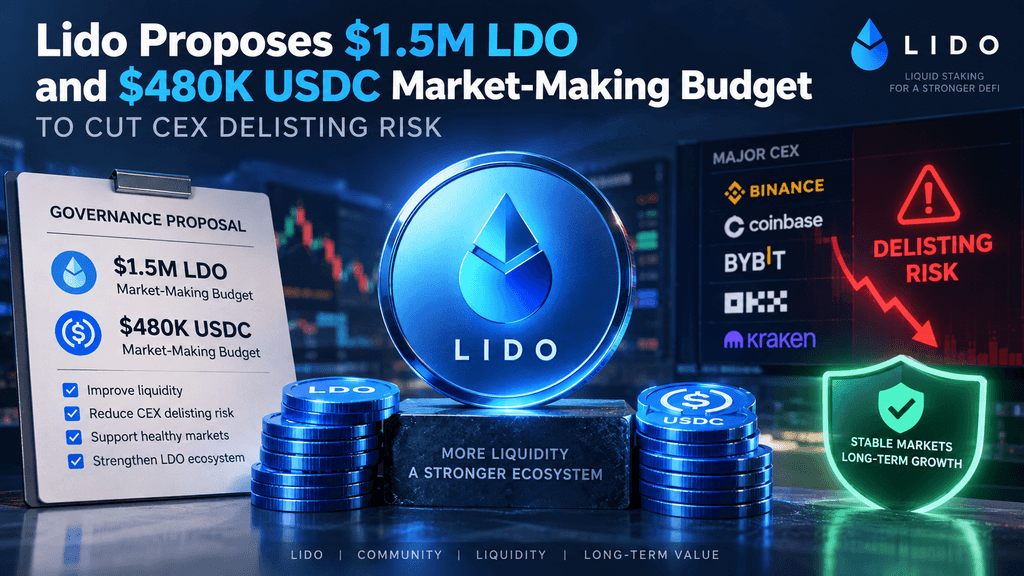
Lido Seeks $1.5 Million Treasury Buffer as LDO CEX Liquidity Thins
Lido’s governance forum has advanced a proposal seeking pre-authorization for a conditional centralized-exchange liquidity program. The initiative would draw up to $1.5 million in recallable LDO inventory, capped at 7.5 million tokens, from the DAO treasury, along with up to 480,000 USDC earmarked for fixed service fees and related costs over up to 12 months. Activation would occur only if the Lido Growth Committee determines that CEX liquidity for LDO has become insufficient or is likely to become insufficient. The authorization itself would expire after two years if unused. Data released with the proposal show LDO’s average daily trading volume over the most recent 90 days at approximately $34 million.
That figure stands below the $43.8 million recorded in the prior 90-day window and well below the roughly $95.4 million average seen in the corresponding period of 2025. The proposal states that the funds are intended solely to maintain bilateral liquidity and continued listing of trading pairs; they are not designed to support price. No market makers or specific exchanges have been designated at this stage. Faced with measurable contraction in LDO trading volume and the structural risk that thinner order books pose to CEX listings, Lido is seeking flexible, pre-approved treasury capacity that can be deployed rapidly by its Growth Committee when liquidity metrics deteriorate, thereby protecting accessibility for traders without committing capital until conditions require it.
Declining LDO Daily Volumes Signal Structural Pressure on Exchange Depth
LDO’s 90-day average daily volume of about $34 million represents a clear step-down from both the preceding period and the prior-year benchmark. At current price levels near $0.33, the token’s market capitalization sits in the mid-$270 million range, so the volume-to-market-cap ratio remains material yet has compressed. Lower absolute turnover typically translates into shallower order books, wider spreads, and higher slippage for larger tickets. Centralized exchanges routinely monitor these metrics when conducting periodic listing reviews; sustained underperformance can trigger warnings or outright delisting of pairs.
The proposal therefore frames the market-making budget as a preemptive tool rather than a reactive rescue. By placing recallable LDO inventory and a limited USDC fee pool under the Growth Committee’s conditional authority, the DAO creates an operational buffer that can be activated without a fresh governance cycle each time liquidity metrics slip. This design acknowledges that volume declines of the magnitude observed between 2025 and 2026 are unlikely to reverse spontaneously and that exchange listing status is a public-goods function for the token’s broader utility.
Conditional Trigger Mechanism Centers on Growth Committee Assessment
The authority to activate the program is vested solely in the Lido Growth Committee, which holds the exclusive responsibility for making this critical decision. The committee is tasked with assessing whether the liquidity available on centralized exchanges (CEX) is currently inadequate or is at a significant risk of becoming insufficient in the near future. Upon reaching this determination, the pre-authorized caps that have been established will become accessible for a maximum execution period of 12 months. Should the committee fail to arrive at such a finding within a two-year timeframe, the entire authorization will lapse, and the treasury capacity will revert to the standard governance control mechanisms that are typically in place.
This carefully designed structure effectively balances the need for speed with the necessity of accountability. It is important to note that full DAO votes can take several days or even weeks to complete; however, liquidity crises on exchanges can escalate at a much faster pace. By delegating the decision-making authority to a standing committee that is already charged with overseeing growth and liquidity functions, the proposal significantly shortens the response time. Nevertheless, it still mandates an explicit and documented assessment before any tokens are allowed to leave the treasury. The recallable nature of the LDO inventory serves to further limit any permanent capital commitment: the market-making inventory can be returned to the treasury once market conditions stabilize, ensuring that the DAO retains flexibility and control over its assets.
Recallable LDO Inventory Caps Exposure at 7.5 Million Tokens
The LDO component has been strategically sized at a maximum notional value of $1.5 million, while it is also hard-capped at a total of 7.5 million tokens. Given the prevailing market prices, which are currently hovering around $0.33, it is evident that the token cap serves as the binding constraint in this context. Due to the recallable nature of the inventory, the DAO maintains the crucial ability to reclaim the tokens once the market-making engagement concludes or if the program is terminated prematurely for any reason. This thoughtful design significantly reduces the risk that treasury LDO becomes permanently locked within the accounts of external market-makers, thereby safeguarding the DAO's assets.
The feature of recallability also plays a vital role in aligning incentives effectively. Market makers are provided with inventory that can be withdrawn, which encourages them to operate strictly within the agreed parameters rather than treating the tokens as if they were free capital. The proposal does not delve into the specific custody or settlement arrangements that would govern the management of the inventory. Instead, it leaves those important details to be determined in subsequent operational agreements once the Growth Committee decides to activate the mandate. Until such activation occurs, the tokens will remain securely housed within the DAO treasury and will continue to be subject to the ordinary governance processes that are in place.
Fixed USDC Allocation Covers Service Fees Without Open-Ended Cost Risk
The proposal, in conjunction with the LDO inventory, authorizes a substantial allocation of up to 480,000 USDC specifically designated for fixed service fees and costs that are directly related to the services provided. This particular tranche of USDC is intentionally time-limited, with a maximum duration of 12 months from the moment of activation. The use of fixed-fee structures is a common practice in professional market-making contracts, as these arrangements provide both parties with predictable economic outcomes and effectively limit the DAO’s potential downside to a known and fixed dollar amount. By strategically separating the inventory of LDO from the compensation provided in USDC, the proposal successfully avoids the necessity for market makers to accept payment in a governance token that is subject to volatility.
The establishment of a hard ceiling on the USDC allocation serves to prevent any potential fee creep that could arise. Should there be any costs that exceed the authorized amount of 480,000 USDC, it would necessitate the initiation of a new governance process to address those additional expenses. This thoughtful separation of capital and expense is a deliberate design choice made by the proposal's authors, ensuring that the financial footprint of the program remains both transparent and bounded, thereby fostering trust and clarity among stakeholders involved in the initiative.
Bilateral Liquidity Mandate Explicitly Excludes Price Support
The proposal language is unambiguous: the program exists to maintain bilateral liquidity and the continued listing of trading pairs. It is not intended to support or influence the price of LDO. Market makers operating under the mandate would be expected to quote both sides of the book within agreed spread and size parameters, thereby reducing the probability that order-book depth falls below exchange minimum thresholds.
This distinction matters for governance optics and regulatory perception. Price-support programs can attract scrutiny and create moral-hazard expectations among token holders. A pure liquidity mandate, by contrast, can be defended as infrastructure maintenance. The absence of any price target or directional trading language in the current proposal reinforces that the objective is accessibility and listing continuity rather than valuation management.
No Market Makers or Exchanges Designated at Proposal Stage
At the time of the forum post, no specific market-making firms or centralized exchanges have been named. The proposal seeks only the pre-authorization of capital capacity. Counterparty selection, exchange prioritization, and contractual terms would be determined later by the Growth Committee if and when the program is activated.
Leaving these operational choices open preserves flexibility. Liquidity conditions and exchange policies change; locking in counterparties years in advance could prove suboptimal. The two-year sunset on the authorization itself further ensures that any future activation reflects then-current market realities rather than assumptions made in September 2026.
Volume Contraction Relative to 2025 Benchmark Underscores Urgency
The comparison with the same period in 2025 is stark: average daily volume has fallen from roughly $95.4 million to $34 million. Even the sequential decline from the prior 90-day window ($43.8 million) is material. In absolute terms, LDO still records tens of millions of dollars in daily turnover, yet the direction is downward. Thinning volume raises the probability that spreads widen and that certain trading pairs fall below the internal liquidity thresholds used by major exchanges for continued listing.
The proposal therefore arrives at a moment when the data already show deterioration. Pre-authorizing capacity now allows the Growth Committee to act if the trend continues, rather than waiting for a full governance cycle after a delisting warning has already been issued. The timing reflects a pragmatic recognition that liquidity is a lagging but critical indicator of token health on centralized venues.
Growth Committee’s Existing Mandate Makes It the Logical Activation Body
The Lido Growth Committee already oversees liquidity-related and incentive programs. Combining prior Liquidity Observation Lab and Rewards Share functions into a single Growth Committee created an operational body with both mandate and institutional knowledge of market-structure issues. Vesting the activation decision in this committee therefore leverages existing expertise rather than creating a new ad-hoc process.
Committee members operate under documented policies and multi-signature controls. Any activation decision would be visible on-chain and subject to community scrutiny after the fact. This combination of pre-existing authority and post-hoc transparency is intended to satisfy both the need for speed and the DAO’s preference for accountable execution.
Treasury Impact Remains Limited by Caps and Recall Features
At current valuations, the maximum LDO commitment of 7.5 million tokens represents a modest fraction of the circulating supply and an even smaller fraction of total treasury holdings when measured against broader Lido assets. The USDC outlay is similarly bounded. Because the LDO is recallable, the net permanent transfer of value is limited to the USDC fees actually paid and any inventory that cannot be returned for operational reasons.
This limited footprint is consistent with Lido’s broader financial discipline. Recent treasury reports have emphasized careful capital allocation amid declining ETH prices and shifting staking market share. A market-making program sized at under $2 million notional fits within that cautious framework while still providing meaningful order-book support if activated.
Listing Continuity Protects Broader Token Utility and Accessibility
CEX listings remain the primary access point for many retail and institutional participants. Loss of major pairs would reduce discoverability, complicate fiat on-ramps, and potentially impair secondary liquidity on decentralized venues that rely on CEX price discovery. Maintaining bilateral depth therefore functions as a public good for the entire LDO ecosystem.
The proposal does not claim that market-making alone can reverse volume trends driven by macro conditions or competitive dynamics in liquid staking. It does claim that professional inventory provision can keep order books within the parameters exchanges require for continued listing. That narrower objective is both achievable and measurable.
Governance Process Still Requires Formal Approval Before Capital Moves
The forum post is a proposal, not an executed decision. Any allocation remains subject to the ordinary Lido governance process, including Snapshot voting and, where required, on-chain ratification. Token holders retain the ability to reject or modify the terms before any treasury assets are placed under the Growth Committee’s conditional control.
This sequencing preserves the DAO’s ultimate authority. Pre-authorization, once granted, merely removes the need for a second full vote at the moment of activation. The initial governance step therefore remains the critical gate.
Potential Interaction with Broader Lido Tokenomics and Buyback Activity
Lido has previously executed opportunistic LDO accumulation programs funded by stETH sales and has developed automated mechanisms linking protocol revenue to token purchases. A market-making inventory program is conceptually distinct: it temporarily places tokens with external parties rather than permanently removing them from circulation. Nonetheless, both activities affect the visible free float and order-book dynamics.
Coordination between any future market-making deployment and ongoing buyback or revenue-share mechanisms would be a practical matter for the Growth Committee and treasury managers. The current proposal does not address that interaction explicitly, leaving room for operational alignment if both programs are active simultaneously.
Two-Year Sunset Creates Natural Review Point for the Mandate
If the Growth Committee does not activate the program within two years, the authorization expires. This built-in sunset forces a fresh governance conversation should liquidity conditions still warrant support after 2028. It also prevents an open-ended contingent liability from lingering on the DAO’s books indefinitely.
The sunset therefore serves dual purposes: it limits the temporal scope of the pre-authorization and guarantees that any future renewal would reflect updated volume data, exchange policies, and treasury priorities. In a fast-moving market, such automatic review points are a form of risk management.
🔥 Beyond the Headlines: What KuCoin 5.0 Means for You
Market news moves fast — but where you act on it matters just as much. This October, KuCoin launches KuCoin 5.0, transforming KuCoin into a rebuilt platform. Here's what actually changes for you:
-
One account for everything. Older platforms split your money across separate "spot," "margin," and "futures" accounts and expected you to understand why. KuCoin 5.0's unified account removes that entirely — deposit once, and everything is simply there.
-
Stocks, indices, and commodities. KuCoin 5.0 expands beyond crypto into global markets. When crypto chops sideways and equities rally (or the reverse), you rotate in minutes instead of opening a brokerage account and waiting days for fiat rails.
-
Real-world assets (RWA). Tokenized exposure to traditional assets like commodities, right inside your crypto account. One of the fastest-growing segments in global finance is no longer reserved for institutions — you access it from the same balance you trade with.
-
Earn while you learn. Not ready to trade? KCUSD lets your stablecoins earn daily, auto-compounding interest. The lowest-stress way to put your idle deposit to work for 4% yield.
-
An AI assistant in plain language. Ask questions, get market context, understand what you're looking at — built into the platform, no jargon required.
-
An app that doesn't overwhelm. Faster, cleaner, and consistent — intuitive from the first tap, not after a tutorial.
-
Safety you can check, not just trust. A MiCAR-licensed EU entity, Proof of Reserves you can verify yourself, and internationally certified security (SOC 2 Type II, ISO 27001:2022).
Create your account in minutes — and start on the platform built for where crypto is going, not where it's been.
FAQs
What exact capital limits does the Lido proposal set for the market-making program?
The proposal authorizes up to $1.5 million in recallable LDO inventory, subject to a hard cap of 7.5 million LDO tokens, drawn from the DAO treasury. Separately, it authorizes a maximum of 480,000 USDC for fixed service fees and related costs over a period not exceeding 12 months from activation. These are ceilings; actual deployment could be lower depending on the terms ultimately negotiated and the duration of any engagement.
Who decides whether and when the market-making budget is activated?
Activation authority rests solely with the Lido Growth Committee. The committee must make an affirmative determination that CEX liquidity for LDO is insufficient or is likely to become insufficient. Only after that finding can the pre-authorized capital be deployed. The determination itself is expected to be documented and visible to the community.
Is the LDO inventory permanent capital transferred to market makers?
No. The LDO component is explicitly described as recallable inventory. Once the market-making engagement ends or the program is terminated, the tokens can be returned to the DAO treasury. This feature limits permanent dilution of treasury holdings and aligns incentives for the market makers who temporarily hold the inventory.
Does the proposal aim to support or stabilize the price of LDO?
The proposal states the opposite. Its stated purpose is to maintain bilateral liquidity and the continued listing of trading pairs on centralized exchanges. It is not designed for price support, directional trading, or any form of market intervention intended to influence valuation. The distinction is deliberate and repeated in the forum language.
How does recent trading-volume data factor into the proposal’s rationale?
Forum disclosures show LDO’s average daily volume over the past 90 days at approximately $34 million, down from $43.8 million in the preceding 90-day period and from about $95.4 million in the same period of 2025. The contraction supplies the empirical basis for concern that order-book depth could fall below exchange listing thresholds if the trend persists.
What happens if the Growth Committee never activates the program?
The authorization carries a two-year sunset. If it is not activated within that window, the pre-authorization expires, and the associated treasury capacity reverts to ordinary governance control. No capital is committed, and no fees are paid unless the committee makes the required liquidity determination.
Disclaimer: This content is for informational purposes only and does not constitute investment advice. Cryptocurrency investments carry risk. Please do your own research (DYOR).