

Hunter Biden Says He Made Nothing From $LAPTOP After Launch Crash, Calls Price “Stabilized
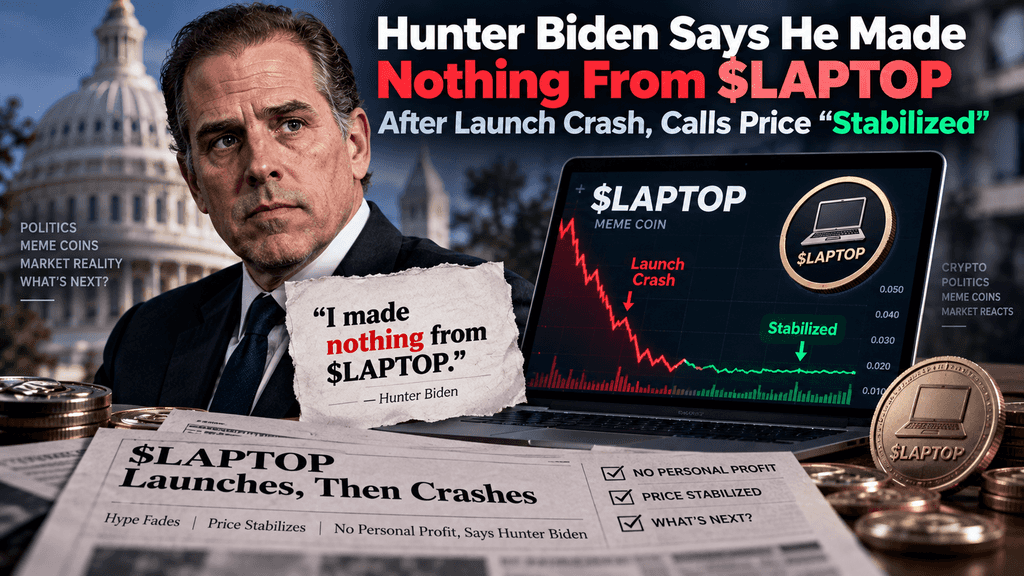
Hunter Biden’s LAPTOP memecoin has become one of the most closely watched political crypto launches of 2026 after its price surged within minutes and then collapsed roughly 99% from its early peak. The Base-based token attracted intense trading activity, sniper bots and speculation before shallow liquidity contributed to extreme price swings and heavy losses for many traders. Biden later said he had “not made a single dollar” from LAPTOP, maintained that the founders had not sold their locked allocations and described the token’s price as having “stabilized to healthy levels.” However, subsequent market data showed $LAPTOP continuing to trade far below its launch-day highs, raising questions about what caused the crash, who benefited from the volatility and what price stabilization actually means for the Hunter Biden memecoin. The episode has also drawn attention to the wider risks surrounding political memecoins, where viral interest, limited market depth and automated trading can produce dramatic price movements within a very short period.
Why Did Hunter Biden’s $LAPTOP Crash Nearly 99% After Launch?
Hunter Biden’s LAPTOP memecoin crashed roughly 99% from its early launch peak after extreme buying pressure collided with very limited liquidity. The Base-based token launched on September 9, 2026, and its price surged within minutes as traders and automated bots rushed into the market. Because only a relatively small amount of liquidity was available to support trading, even modest transactions were capable of producing unusually large price movements and briefly pushing LAPTOP to an enormous theoretical fully diluted valuation. Once the initial buying frenzy faded and selling increased, the same shallow liquidity that helped drive the price higher accelerated its collapse. Market trackers recorded slightly different highs, but the broader picture was consistent: $LAPTOP lost about 98–99% of its early peak value shortly after launch, making the token’s debut one of the most volatile political memecoin launches of the year.
How Thin Liquidity and Sniper Bots Amplified the $LAPTOP Price Crash
The $LAPTOP team attributed much of the volatility to thin launch liquidity, technical issues and sniper bots—automated trading programs designed to buy newly launched tokens almost immediately. These bots can enter before many ordinary traders and rapidly push prices higher when a liquidity pool is small. The project's explanation was that demand overwhelmed the available liquidity, creating an unsustainable price spike before the market corrected sharply. In a newly launched token market, this combination can make price discovery especially unstable because relatively small transactions can have an outsized influence on the quoted price and implied valuation.
On-chain analysis later showed significant losses among buyers, reinforcing how quickly market conditions changed once the initial surge reversed. However, the crash alone does not prove that Hunter Biden or the project deliberately caused the collapse; it primarily highlights the liquidity and volatility risks associated with newly launched memecoins, particularly when speculative demand moves much faster than the market depth supporting the token. A rapidly rising token price can create the impression of strong demand even when liquidity remains extremely shallow. For traders, that distinction matters because a market that rises quickly on limited liquidity can also fall just as aggressively once selling pressure begins.
Hunter Biden Says He Made “Not a Single Dollar” From $LAPTOP
Hunter Biden has denied personally profiting from the dramatic launch of the LAPTOP memecoin, saying he had “not made a single dollar” despite the token briefly reaching an enormous valuation before collapsing. In his post-launch response, Biden said the project's founder allocation remained locked and maintained that neither he nor his team had sold their allocated tokens during the sharp price swings. His statement came as traders and analysts examined who benefited from LAPTOP's initial surge and whether insiders had sold during the early buying frenzy. While blockchain activity shows that some early traders generated substantial profits, current public reporting has not established that Biden personally sold his founder allocation or directly profited from the crash. That distinction remains important because profitable wallet activity does not automatically reveal the identity of the person or organisation controlling a particular address.
Hunter Biden’s Locked $LAPTOP Founder Allocation
Biden said his $LAPTOP founder tokens had not been sold and pointed to the project's vesting structure as evidence that the team could not simply unload its full allocation during the launch. According to the project's published tokenomics, founders received 30% of the one-billion-token supply, with that allocation subject to lock-up and vesting conditions. Token vesting arrangements are generally designed to restrict immediate access to allocated supply and prevent large founder holdings from entering the market all at once. In the case of $LAPTOP, the vesting schedule has therefore become an important part of the debate over whether insiders could have benefited directly from the initial price surge.
This distinction matters because profits recorded by independent traders or other wallets do not automatically show that Biden himself received those gains. Any connection between profitable wallets and the project's founders therefore requires verifiable on-chain evidence rather than assumptions based only on the token's price collapse. Blockchain data can reveal transfers, trading activity and wallet balances, but linking an anonymous wallet to a specific person requires additional evidence. Until such a connection is independently demonstrated, claims about insider selling should remain clearly separated from confirmed wallet activity and the project's own public statements.
Early $LAPTOP Traders Recorded Major Profits and Losses
Although Biden says he personally earned nothing, some early $LAPTOP traders made substantial profits during the token's extreme volatility. On-chain analysis indicated that a relatively small group of wallets captured millions of dollars in gains by entering and exiting positions during the initial surge, while many later buyers faced significant losses. The uneven results illustrate how timing, liquidity and automated trading can heavily influence newly launched memecoins, particularly during the first minutes or hours after trading begins. Traders able to enter before a sharp price increase may experience very different outcomes from those who buy after an asset has already moved significantly higher.
For readers following the controversy, the key distinction is between profits earned by independent market participants and verified evidence that founders sold their own allocations, which has not been established in reputable public reporting. Early access to a thin market can produce large gains without proving any connection between those traders and the project itself. At the same time, later buyers may face much greater downside if they enter when the token is trading at an inflated price created by limited liquidity. This difference helps explain why $LAPTOP produced both major winners and substantial losses during the same launch period.
Sniper Bots, Thin Liquidity and Trader Losses: What Happened to $LAPTOP?
The turmoil surrounding Hunter Biden’s LAPTOP memecoin was not limited to its sharp price decline. On-chain data showed a market dominated by rapid automated trading, shallow liquidity and highly uneven outcomes between early entrants and later buyers. As LAPTOP moved through its first trading sessions on Base, analysts began examining wallet activity to understand how the launch affected real traders and why some participants secured large gains while many others were left holding positions far below their entry prices. This wallet-level activity provided a clearer picture of how market structure shaped the launch beyond the headline price decline. It also highlighted how quickly automated strategies can influence trading conditions in a newly created memecoin market.
Sniper Bots and Shallow Liquidity Shaped Early $LAPTOP Trading
Sniper bots became a major part of the discussion because these automated programs can detect and buy newly available tokens within seconds of liquidity becoming available. In a market with limited depth, that speed advantage can allow a small number of wallets to accumulate tokens before most retail traders can react. The resulting purchases may push prices sharply higher, attracting additional buyers who enter only after much of the initial move has already taken place. This can create a feedback loop in which rapidly rising prices encourage more speculative demand even though the amount of liquidity supporting those prices remains relatively small.
The effect becomes more severe when liquidity is thin relative to trading demand. A token can display a very large theoretical market capitalisation even though only a small amount of capital is available in its liquidity pools. That appears to have been an important feature of $LAPTOP’s early trading environment, where quoted prices moved much faster than the market’s ability to absorb large transactions. As prices shifted rapidly in both directions, traders faced greater slippage, wider execution risk and the possibility that even modest trades could materially influence the market. In practical terms, a large headline valuation did not necessarily mean there was enough liquidity for investors to buy or sell large positions near the displayed price.
On-Chain Data Shows Heavy Losses Among $LAPTOP Traders
Blockchain analytics later highlighted how uneven the outcome became. Nansen data showed tens of thousands of $LAPTOP buy transactions during the first 24 hours, while individual wallets tracked by analysts recorded six-figure losses. Separate analysis from Bubblemaps estimated that close to 80% of tracked traders were underwater at one stage, although results varied depending on entry price, exit timing and whether unrealised positions were included. These figures represent snapshots rather than permanent measures of investor performance because wallet profitability can change as the token price moves. Even so, the data illustrates how quickly traders who entered near the early highs were exposed to substantial losses.
At the same time, a much smaller group of early traders reportedly captured significant profits from the launch. The contrast illustrates a central risk of highly speculative memecoins: traders who enter after an initial surge can face very different outcomes from wallets that gain access during the earliest and most liquidity-sensitive moments of trading. On-chain wallet data therefore provides more useful context than headline market capitalisation alone when evaluating who gained and who lost during the $LAPTOP launch. It also demonstrates why entry timing, liquidity depth and trading execution are crucial factors when assessing the performance of newly launched crypto assets.
$LAPTOP Price After the Crash and Hunter Biden’s “Stabilized” Claim
Hunter Biden said the $LAPTOP price had “stabilized to healthy levels” after the extreme volatility surrounding its September 9, 2026 launch. However, market data shows that stabilization occurred at prices dramatically below the token’s early peak. CoinGecko recorded an all-time high near $199.51, followed by a low around $0.72, representing a decline of roughly 99.6% from the recorded peak. Subsequent trading remained far below the launch highs, showing that Biden’s use of “stabilized” referred more to reduced short-term volatility than to a recovery toward the token’s initial valuation. In crypto markets, an asset can trade within a narrower range after a severe decline without recovering any meaningful portion of the value lost during the original crash.
$LAPTOP Price Remains Far Below Its Launch Peak
The post-crash trading range provides important context for anyone tracking Hunter Biden’s LAPTOP memecoin price. After the extraordinary launch-day spike disappeared, LAPTOP continued trading around a small fraction of its peak value, with different market trackers recording prices below $1 during later September 11 snapshots. This suggests that the market entered a new price-discovery phase rather than returning to its initial valuation. The more important question for longer-term market activity is whether the token can develop deeper liquidity and consistent trading demand after the intense speculative attention surrounding its launch begins to fade.
Future performance will depend on factors such as liquidity, trading activity, token supply, community demand and broader memecoin sentiment, all of which can change rapidly for newly launched crypto assets. Token unlocks, changes in holder behaviour and new developments involving the project could also affect available supply and demand over time. Wider crypto market conditions may influence speculative interest as well, particularly if risk appetite changes across the memecoin sector. For that reason, Biden’s claim that the price had stabilized is best understood as his description of market conditions at the time, rather than evidence that $LAPTOP had recovered from its historic collapse.
How to Buy $LAPTOP on KuCoin
$LAPTOP is available on KuCoin Spot through the LAPTOP/USDT trading pair, giving users a direct way to buy the token with USDT. To get started, users need a KuCoin account, complete any required identity verification, and fund their account with USDT through a supported deposit or purchase method. From the Spot market, search for LAPTOP/USDT, review the current price, order book and available liquidity, then choose an appropriate order type. A market order executes against available liquidity at current prices, while a limit order allows the buyer to specify the maximum price they are willing to pay.
Steps to Buy $LAPTOP on KuCoin
-
Create or sign in to a KuCoin account and complete any required account verification.
-
Add USDT to the account using a supported crypto deposit or available funding method.
-
Search for LAPTOP/USDT in the KuCoin Spot market and review the current price and trading conditions.
-
Choose a market or limit order, enter the amount of $LAPTOP to buy, and review the order before confirming.
-
Check your $$LAPTOP balance after the order is filled. Users transferring$$LAPTOP externally should verify the supported network and destination address before making a withdrawal.
Because LAPTOP has experienced extreme launch-day volatility and large price swings, buyers should pay particular attention to liquidity, slippage and order execution rather than relying only on the displayed token price. A limit order may provide greater control over the execution price during volatile periods, although it is not guaranteed to fill. The availability of LAPTOP on KuCoin does not remove the risks associated with newly launched memecoins, so current market conditions should be reviewed before any trade.
🔥 Beyond the Headlines: What KuCoin 5.0 Means for You
Market news moves fast — but where you act on it matters just as much. This October, KuCoin launches KuCoin 5.0, transforming KuCoin into a rebuilt platform. Here's what actually changes for you:
-
One account for everything. Older platforms split your money across separate "spot," "margin," and "futures" accounts and expected you to understand why. KuCoin 5.0's unified account removes that entirely — deposit once, and everything is simply there.
-
Stocks, indices, and commodities. KuCoin 5.0 expands beyond crypto into global markets. When crypto chops sideways and equities rally (or the reverse), you rotate in minutes instead of opening a brokerage account and waiting days for fiat rails.
-
Real-world assets (RWA). Tokenized exposure to traditional assets like commodities, right inside your crypto account. One of the fastest-growing segments in global finance is no longer reserved for institutions — you access it from the same balance you trade with.
-
Earn while you learn. Not ready to trade? KCUSD lets your stablecoins earn daily, auto-compounding interest. The lowest-stress way to put your idle deposit to work for 4% yield.
-
An AI assistant in plain language. Ask questions, get market context, understand what you're looking at — built into the platform, no jargon required.
-
An app that doesn't overwhelm. Faster, cleaner, and consistent — intuitive from the first tap, not after a tutorial.
-
Safety you can check, not just trust. A MiCAR-licensed EU entity, Proof of Reserves you can verify yourself, and internationally certified security (SOC 2 Type II, ISO 27001:2022).
Create your account in minutes — and start on the platform built for where crypto is going, not where it's been.
Conclusion
Hunter Biden’s LAPTOP memecoin launch illustrates how quickly thin liquidity, automated trading and speculative demand can create extreme price movements in a newly launched crypto asset. Biden maintains that he made no money from the token, that the founder allocation remains locked and that the market eventually stabilized, while blockchain analytics show a much more uneven trading experience in which some early wallets earned substantial profits and many other participants suffered losses. With LAPTOP still trading far below its initial peak, the next phase will depend less on its brief launch-day valuation and more on whether deeper liquidity, sustained trading activity and genuine community demand can develop over time. For investors and market watchers, separating verified on-chain evidence from project claims, market speculation and theoretical valuations remains essential when assessing the future of $LAPTOP, especially in a memecoin market where sentiment and liquidity conditions can change extremely quickly.
FAQs
What is Hunter Biden’s $LAPTOP token?
$LAPTOP is a memecoin launched on the Base blockchain on September 9, 2026. It combines political themes, internet culture and speculative crypto trading around the Hunter Biden laptop story. Its value is influenced heavily by market sentiment, liquidity and trading activity rather than traditional business fundamentals.
What blockchain does $LAPTOP use?
$LAPTOP operates on the Base blockchain, an Ethereum Layer-2 network designed for faster and lower-cost transactions. Base also connects the token with the wider Ethereum ecosystem. This allows $LAPTOP to interact with wallets and decentralised applications built on the network.
How many $LAPTOP tokens exist?
$LAPTOP has a maximum supply of 1 billion tokens. The project's tokenomics allocate supply across founders, liquidity, airdrops, treasury activities, predictions and charitable initiatives. The amount actually circulating can differ from the maximum supply because some tokens remain locked or allocated for future use.
How much of $LAPTOP is allocated to the founders?
Founders are allocated 30% of the total $LAPTOP supply. These tokens are subject to lock-up and vesting conditions, meaning the entire allocation cannot immediately enter the market. Future token unlocks are therefore an important factor for traders monitoring changes in available supply.
Did $LAPTOP have a presale?
The project says $LAPTOP did not hold a traditional presale or provide preferential allocations to outside investors or influencers. However, the absence of a presale does not remove liquidity, volatility or early-trading risks. Automated traders can still gain an advantage during the first moments of a token launch.
Why did $LAPTOP show such a large valuation?
A token's valuation can become extremely high when its quoted price rises rapidly while liquidity remains shallow. This means a multibillion-dollar implied valuation does not necessarily represent the amount of real capital invested in the token. Market depth and available liquidity provide important context when evaluating such headline valuations.
Disclaimer: This article is for informational purposes only and does not constitute investment advice. Crypto assets can be highly volatile, and market conditions, token liquidity and project developments may change rapidly. Readers should conduct their own research and assess their risk tolerance before making financial decisions.