

Has Gold Lost Its Safe-Haven Edge Over Bitcoin Due to the Federal Reserve?
Introduction
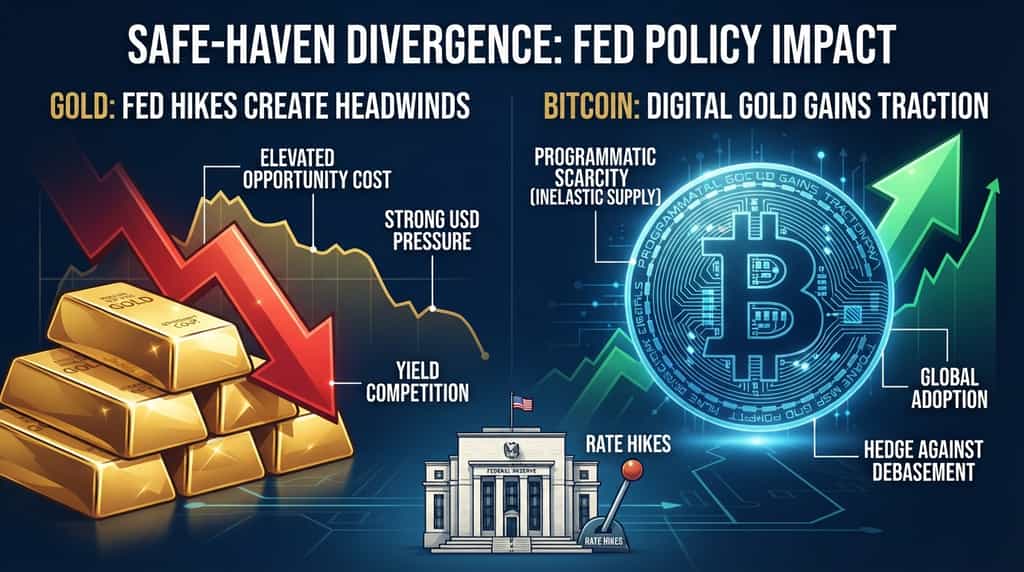
Gold's traditional role as a premier safe-haven asset has recently lost its edge compared to Bitcoin, with the Federal Reserve's persistently hawkish monetary policy playing a central role in this shift. While investors historically turned to physical bullion during times of economic uncertainty or currency debasement, the current high-interest-rate environment created by the US central bank has altered the calculus. The Fed's fight against inflation has elevated the opportunity cost of holding non-yielding assets like gold, while simultaneously strengthening the US Dollar, creating significant headwinds for the metal.
Conversely, Bitcoin, often characterized as "digital gold," has navigated these same macroeconomic pressures with a different set of market dynamics. Although not immune to Fed-induced volatility, Bitcoin's structural supply inelasticity and its growing adoption as a global, decentralized treasury asset have begun to decouple its long-term trajectory from traditional commodities. As of late November 2026, this evolving divergence has led some market observers to conclude that Bitcoin is increasingly capturing the capital flows and narrative previously reserved for gold during periods of monetary stress.
Key Takeaways
-
Elevated Opportunity Cost: The Federal Reserve's high-interest-rate policy means investors can earn a substantial, risk-free yield by holding US Treasuries or cash equivalents. Because gold generates no income, the cost of holding it instead of yield-bearing assets is significantly higher now than in a zero-rate environment.
-
Strong US Dollar: The Fed's tight monetary policy has underpinned a strong US Dollar, in which gold is globally priced. A strong dollar makes gold more expensive for foreign investors, muting demand and capping its upside potential even when economic risks are present.
-
Divergent Asset Class Narratives: While gold is viewed primarily as a hedge against inflation and currency risk, Bitcoin functions as both a hedge and a high-growth technology asset. Its programmatic supply cap—the "halving" cycle—and its role in decentralized finance (DeFi) attract different capital pools that are less sensitive to short-term interest rate fluctuations.
-
Institutional Adoption: Major institutions, including corporations and some sovereign entities, are integrating Bitcoin into their balance sheets as a strategic reserve asset. This structural, long-term demand provides price support that gold, with its more fragmented ownership base, often lacks during periods of monetary tightening.
How the Federal Reserve's Monetary Policy Creates Headwinds for Gold
The Federal Reserve's primary mandate of maintaining price stability through interest rate management exerts a profound, direct influence on the valuation of precious metals. When the Fed raises the federal funds rate to combat inflation, it changes the fundamental attractiveness of different asset classes.
Gold is a non-yielding asset; it pays no dividends, coupons, or interest. Its value is derived from its scarcity, historical role as money, and status as an alternative to fiat currencies. In a low-interest-rate or negative-real-rate environment, the lack of yield on gold is not a significant penalty because cash and bonds also offer poor returns.
However, in a high-interest-rate environment, the situation reverses. When the Fed funds rate is, for example, 4.5% to 4.75%, as it was for much of 2026, investors can purchase short-term government bonds that offer a virtually risk-free return above 4%. An investor holding gold is not just missing out on this potential income; they are effectively paying this difference as an "opportunity cost" to maintain their position in bullion.
This mechanism triggers significant capital reallocation. Institutional investors, pension funds, and hedge funds often rotate out of non-yielding assets like gold and into high-yielding, secure government debt. This selling pressure dampens gold's price performance, preventing it from acting as the effective inflation hedge that theory suggests it should be. The Fed’s success in raising real yields—nominal yields minus inflation expectations—is therefore directly correlated with gold’s underperformance during its tightening cycles.
Why the "Digital Gold" Narrative is Gaining Traction Over Physical Bullion
Bitcoin is frequently compared to gold due to its scarcity and decentralized nature. Both assets exist outside the direct control of any central bank or government. However, Bitcoin possesses several key structural advantages that have caused its safe-haven narrative to gain prominence over gold in the digital age.
-
Supply Inelasticity and Predictability
Gold's supply is not perfectly inelastic. When the price of gold rises, it becomes profitable for mining companies to extract lower-grade ore, increasing the global supply. Furthermore, vast amounts of above-ground gold are held in central bank reserves, and this supply can be sold into the market, influencing prices.
Bitcoin's supply is governed by a rigid, mathematically enforced protocol. There will never be more than 21 million bitcoins. The rate of new issuance is cut in half roughly every four years in an event known as the "halving." This makes Bitcoin's future supply schedule perfectly predictable, regardless of price. This absolute scarcity is a fundamental property that gold, as a physical commodity subject to mining economics and central bank policy, cannot replicate.
-
Portability and Divisibility
As a physical asset, gold is difficult and expensive to transport, secure, and verify. Moving substantial amounts of wealth across borders requires specialized logistics, insurance, and regulatory approvals. It is also difficult to divide a physical gold bar for smaller transactions.
Bitcoin is purely digital. Any amount of Bitcoin, from a fraction of a satoshi (the smallest unit) to billions of dollars' worth, can be transferred anywhere in the world in minutes, with cryptographic verification. This portability makes Bitcoin a far superior vehicle for wealth transfer and storage in a global, interconnected economy.
-
Growing Institutional and Corporate Adoption
Bitcoin's emergence as a treasury reserve asset is a critical differentiator. In the 2020s, numerous publicly traded companies, private firms, and even a few municipal and national governments began adding Bitcoin to their balance sheets. This strategic accumulation creates a structural bid for the asset that is independent of short-term macroeconomic sentiment.
This corporate and institutional adoption signals a belief that Bitcoin serves as a superior long-term store of value compared to cash and traditional reserves. While central banks hold significant gold reserves, the coordinated, forward-looking accumulation of Bitcoin by corporate entities represents a new paradigm for a reserve asset, reinforcing its haven status.
The Failure of Gold and Bitcoin as Short-Term Hedges in 2026
It is important to note that during specific periods of intense market volatility in 2026, neither gold nor Bitcoin acted as reliable short-term safe havens. In moments of acute systemic liquidity crises—such as the "everything crash" scenario—investors often sell their most liquid, high-performing assets to cover margin calls and raise cash.
During such events, both Bitcoin and gold have experienced sharp, correlated drawdowns as capital flees to the ultimate haven: the US Dollar. This short-term correlation can confuse analysts, leading them to declare that "Bitcoin failed as a hedge" or "gold is dead."
The critical distinction, however, lies in the recovery and the long-term thesis. Bitcoin's narrative is not that it protects against a Monday-morning liquidity crunch, but that it protects against the long-term, structural debasement of fiat currencies caused by persistent government deficit spending and central bank monetization of debt. While the Fed's rate hikes have compressed Bitcoin's valuation relative to its tech-stock peers, the fundamental argument for Bitcoin as a non-sovereign, censorship-resistant asset remains intact, whereas gold's utility in a digital economy is increasingly questioned.
| Feature | Physical Gold | Bitcoin (BTC) |
| Nature | Physical Commodity | Digital Asset / Protocol |
| Supply Dynamics | Elastic; mining increases with price; central bank reserves | Inelastic; strictly capped at 21M; predictable issuance |
| Yield | None | Staking/DeFi yields possible (with counterparty risk) |
| Portability | Difficult, expensive, regulated | Instant, global, permissionless |
| Correlation to USD | Strong negative correlation | Varies; long-term inverse correlation emerging |
| Primary Use Case | Inflation hedge; jewelry; industrial component | Store of value; medium of exchange; settlement network |
| Valuation Driver | Market sentiment; jewelry demand; central bank buying | Network adoption; hashrate; scarcity; macro liquidity |
Conclusion
The Federal Reserve's commitment to high interest rates has created a challenging environment for all non-yielding assets. Gold, as a traditional store of value, has suffered disproportionately because it competes directly with the high, risk-free yields offered by US government debt.
Bitcoin, while also pressured by the high-rate environment, has demonstrated resilience rooted in its unique technological properties and growing role as a global reserve asset. Its superior portability, divisibility, and predictable scarcity have allowed it to capture the imagination—and capital—of a new generation of investors who view it as "digital gold" fit for the 21st century.
As institutional adoption continues and the global economy grapples with sovereign debt loads, the divergence between gold and Bitcoin is likely to persist. While gold remains a significant asset class, its status as the premier haven appears to be yielding to the structural advantages of Bitcoin, a process that the current Federal Reserve cycle has only accelerated.
FAQs
Why does a high-interest-rate environment hurt gold prices?
Gold does not pay interest or dividends. When central banks raise interest rates, investors can earn a secure return by holding cash or government bonds. This increases the "opportunity cost" of holding gold, causing investors to sell bullion in favor of yield-bearing assets.
Is Bitcoin really "digital gold"?
Bitcoin shares key characteristics with gold, such as scarcity (a capped supply), durability, fungibility, and decentralization. However, Bitcoin is digital, portable, and divisible, which many investors believe makes it a superior store of value for the modern, digital economy.
How does the US Dollar affect the price of gold?
Gold is globally priced in US Dollars. When the Federal Reserve's tight monetary policy strengthens the US Dollar, gold becomes more expensive for foreign buyers, which reduces global demand and puts downward pressure on its price.
Does Bitcoin always act as a safe haven during market crashes?
No. In the immediate aftermath of a systemic liquidity crisis, investors often sell all liquid assets, including both Bitcoin and gold, to raise cash. Bitcoin is not a reliable hedge against short-term market panic but is increasingly seen as a long-term hedge against currency debasement.
Why are institutions buying Bitcoin instead of gold?
Institutions are attracted to Bitcoin's digital nature, which allows for easy custody and transfer, and its programmatic scarcity. Additionally, Bitcoin's potential for significant long-term appreciation, driven by network adoption, offers a different risk-return profile than the more stable, traditional asset of gold.
Disclaimer: This general market information may come from third-party, commercial, or sponsored sources and is provided for informational and educational purposes only. It does not constitute financial or investment advice, an offer, a solicitation, or a guarantee. We assume no responsibility for the accuracy, completeness, or reliability of this information or for any losses arising from its use. Investing and trading involve risks. Past performance does not guarantee future results. Users should conduct their own research, exercise sound judgment, and take full responsibility for their decisions. For more information, please refer to KuCoin's Terms of Use and Risk Disclosure.