

Gold Price Surge Driven by Speculative Flows, Citi Warns of Jackson Hole Volatility
2026/08/30 09:05:08
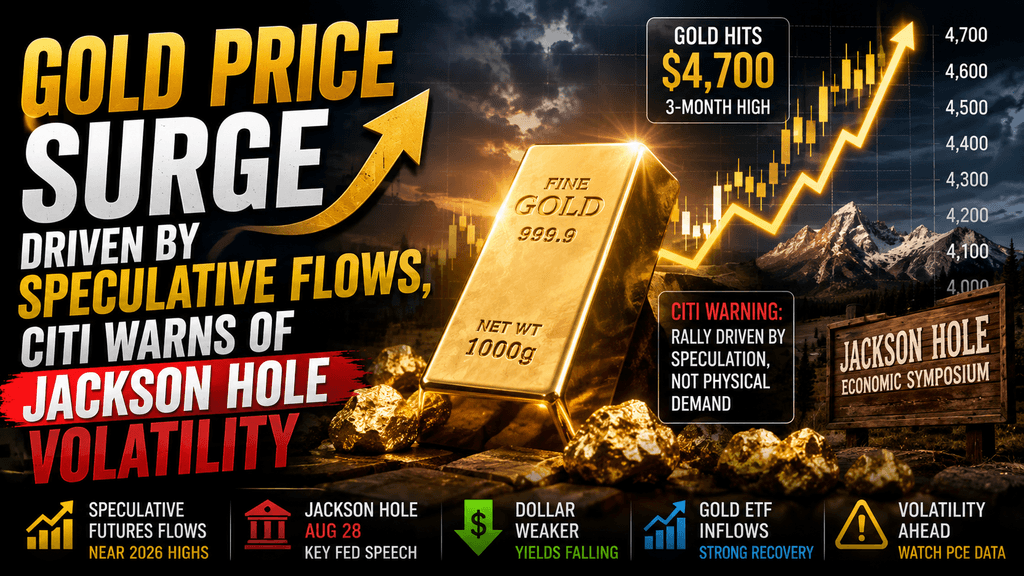
Gold has staged a powerful comeback, climbing to its highest level in more than three months as a weaker U.S. dollar, falling long-term Treasury yields and renewed investment demand pushed prices toward the $4,700-per-ounce region. The breakout has strengthened bullish sentiment across precious metals, but Citi is warning that the composition of the rally may leave gold unusually vulnerable to the next major macroeconomic surprise.
According to Citi, much of the latest advance has been driven by speculative futures flows rather than a broad acceleration in physical demand. Gold-backed ETFs are also attracting capital, providing evidence of genuine financial investment demand, but retail buying in major physical markets remains uneven. With Federal Reserve Chair Kevin Warsh scheduled to speak at the Jackson Hole Economic Policy Symposium on August 28, the market is approaching a potential turning point: a dovish signal could reinforce the breakout, while a hawkish surprise could trigger rapid profit-taking among crowded futures positions.
Why Is the Gold Price Surging?
Gold's latest rally accelerated after the metal established a floor near $4,000 per ounce during late June and July. Prices recovered through August, consolidated around the 100-day moving average near $4,380 and then broke decisively higher. Spot gold reached a more than three-month high above $4,680 on August 24 and briefly climbed as high as about $4,696 on August 25 before encountering resistance near the psychologically important $4,700 level.
Several forces have worked together. The U.S. dollar weakened after a period of concern over government debt and Treasury-market intervention, while long-term bond yields eased. Gold-backed investment products have also seen renewed interest, and broader concerns about fiscal sustainability have strengthened the appeal of assets that are not liabilities of governments or corporations. At the same time, the technical breakout attracted momentum traders who had been waiting for gold to escape the range that dominated much of the summer.
| Gold Market Driver | Current Signal |
| U.S. dollar | Softer than recent highs |
| Long-term Treasury yields | Easing |
| Gold ETF demand | Improving |
| Futures positioning | Strongly bullish |
| Chinese physical demand | Mixed |
| Indian physical market | Improving but still price-sensitive |
The combination has created a strong price trend, but the sources of demand are not equally supportive. That distinction is the foundation of Citi's warning: a rally dominated by futures and momentum flows may behave differently from one supported simultaneously by investment, jewelry, bar-and-coin and central-bank demand.
Why Citi Says the Rally Is Speculation-Driven
Citi argues that the recent breakout has been "largely driven by spec flows," particularly futures inflows. The bank points to rising managed-money positioning in gold futures and the concentration of recent gains during U.S. trading hours. Technical indicators have also strengthened: Citi noted that MACD and DMI remained constructive, while RSI was around 72, showing a market that had become stretched without yet reaching the most extreme levels seen during previous rallies.
The mechanism is familiar in commodity markets. Once gold breaks a major resistance level, trend-following funds and momentum traders can increase long exposure. The resulting buying pushes prices higher, validating the breakout and attracting another group of traders. Rising prices can then trigger additional systematic buying, creating a self-reinforcing cycle even before underlying physical demand meaningfully changes. Futures speculation is therefore capable of powering a genuine rally, but the resulting market can become highly sensitive to unexpected changes in rates, the dollar or central-bank policy expectations.
Citi also noted that managed-money net length is close to its 2026 highs, although it remains below the more extreme positioning seen during parts of 2024 and 2025. That distinction matters. The bank is not arguing that gold has necessarily reached a speculative top; rather, it is warning that a growing share of the latest upside is coming from investors who may be quicker to reverse positions if the macro narrative changes.
Why Physical Gold Demand Is Lagging
Citi's second concern is that the physical market has not fully confirmed the latest price surge. The bank characterized Chinese retail demand as weak, with buyers tending to trade ranges rather than chase the breakout. Indian prices have also remained below import parity at times, a sign that abundant domestic supply and price sensitivity can reduce the urgency of fresh imports when international gold prices rise sharply.
The picture is more nuanced than saying Asian demand has collapsed. World Gold Council data show that Chinese gold ETFs attracted roughly RMB5 billion in July and continued receiving inflows through much of August, while official-sector buying also remained supportive. India has shown signs of recovering jewelry and investment demand following June's correction, with ETF inflows continuing and imports rebounding in July. The key distinction is between financial gold demand in Asia and immediate physical retail demand.
For the breakout to become more broadly based, Citi wants physical demand to catch up with financial-market enthusiasm. Stronger purchases of jewelry, bars and coins at higher price levels would demonstrate that buyers are willing to accept the new valuation rather than simply waiting for a correction. Without that confirmation, the rally remains more dependent on investors whose positions may respond quickly to changing interest-rate expectations.
Gold ETF Inflows Tell a Different Story
The speculative argument does not mean only short-term traders are buying gold. Gold-backed ETFs have also experienced a notable recovery. World Gold Council data show that global physically backed gold ETFs added about $3 billion in July, reversing two consecutive months of outflows, with total holdings increasing by 23 tonnes to 4,068 tonnes. Year-to-date inflows reached approximately $11 billion by the end of July.
Asian demand has been especially notable. Chinese gold ETFs attracted about $744 million in July, with another roughly eight tonnes added in early August as price momentum improved. Indian gold ETFs recorded approximately $163 million of net inflows in July and an estimated additional $124 million during the first two weeks of August. These flows complicate any simple claim that gold's rally is purely speculative.
The more accurate interpretation is that gold demand is strong in financial markets but uneven in physical markets. Futures traders may be responsible for a disproportionate share of the short-term price acceleration, while ETF investors are simultaneously increasing strategic exposure. That combination gives the rally more support than futures positioning alone, but it still leaves the market waiting for broader physical buying to validate higher prices.
How Treasury Buybacks Helped Gold Break Higher
One of the most important catalysts came from an unexpected part of the financial system: the U.S. Treasury market. On August 19, the Treasury announced that it would at least double the size of liquidity-support buybacks for longer-dated nominal securities. Beginning September 9, the maximum size of operations in the 10-to-20-year and 20-to-30-year sectors will rise from $2 billion to at least $4 billion per operation, with the larger program scheduled to continue through November 4.
The announcement mattered because long-term government yields had been under intense upward pressure. Greater Treasury support for long-duration bond liquidity helped push yields lower and contributed to dollar weakness. Gold benefits from that combination because it does not pay interest: when bond yields fall, the opportunity cost of holding bullion declines. A weaker dollar can also make dollar-denominated gold less expensive for buyers using other currencies.
The market therefore developed a powerful macro chain: larger Treasury buybacks supported long bonds, lower yields weakened the dollar, and both moves improved the relative appeal of gold. Reuters also noted that concerns about U.S. fiscal sustainability remained an important part of the broader gold narrative. The risk is that this favorable setup depends partly on yields staying contained—something the Federal Reserve can influence through its policy guidance.
Why Jackson Hole Is a Major Risk for Gold
That is why Citi views Jackson Hole as a potentially binary event for the gold market. Federal Reserve Chair Kevin Warsh is scheduled to deliver keynote remarks at the symposium at 10:00 a.m. on Friday, August 28, according to the Federal Reserve's official calendar. Gold is approaching that speech with higher speculative positioning, strong recent momentum and a market narrative that increasingly depends on contained yields and a relatively soft dollar.
A hawkish message could challenge those assumptions. If Warsh emphasizes persistent inflation, the need to keep monetary policy restrictive or the possibility of additional tightening, Treasury yields could rebound and the dollar could strengthen. Because speculative long positioning is already elevated, an adverse policy surprise could produce more than ordinary profit-taking: futures traders may reduce exposure simultaneously, stop-loss orders could be triggered and the resulting position unwinding could amplify the initial decline. Citi said it would still view a pullback into the low-$4,000s as an opportunity to rebuild exposure, underscoring that its warning is primarily tactical rather than a long-term bearish call.
The opposite outcome could be particularly powerful. If Warsh signals patience on further tightening or greater concern about growth and financial conditions, rate expectations could fall, pushing yields and the dollar lower. Citi described a genuinely dovish surprise as potentially "ultra-bullish" for gold. In that scenario, macro demand, ETF allocations and momentum buying could reinforce each other and encourage another attempt to break above the $4,700 region.
Why PCE Inflation Matters for Gold
Jackson Hole is not the only macro catalyst facing the market. Investors are also focused on the Federal Reserve's preferred inflation measure, the Personal Consumption Expenditures price index. Gold was trading around $4,627 on August 26 as investors waited for the July PCE release, after the metal had reached a three-month high during the previous session. Markets were pricing a greater probability that the Fed would leave rates unchanged at its next meeting, but the inflation data could materially change those expectations.
The transmission mechanism is relatively straightforward. A hotter-than-expected PCE reading would strengthen concerns that inflation remains persistent, potentially increasing expectations for tighter policy and pushing Treasury yields and the dollar higher. That combination would normally create pressure on gold. Softer inflation could do the reverse by reducing the perceived need for further tightening, lowering yields and supporting the precious metal.
The interaction between the two events is what makes the setup particularly important. PCE can change the market's inflation assumptions, while Jackson Hole can reveal how the Fed intends to respond to those assumptions. Gold therefore enters the period exposed to both an economic-data surprise and a policy-communication surprise at a time when speculative positioning is already elevated.
Is the Gold Rally Becoming Too Crowded?
Gold's technical setup supports the bullish case, but it also highlights increasing short-term risk. Citi placed RSI near 72 around the breakout, while managed-money positioning had moved toward 2026 highs. The metal had also rallied through its 100-day moving average and approached resistance near $4,700 within a relatively short period. These conditions make gold attractive to momentum strategies but simultaneously increase the number of investors who may have similar positions.
A crowded trade is not automatically a bearish trade. Strong assets can remain technically overbought for long periods, particularly when a major macroeconomic narrative supports them. The problem arises when crowded positioning meets an unexpected catalyst. If most speculative traders are already long gold when a hawkish Fed surprise arrives, there may be relatively few incremental buyers available to absorb selling immediately.
The risk can then become self-reinforcing in the opposite direction: gold falls, leveraged longs reduce positions, stop-losses trigger and futures selling accelerates the decline. Conversely, if Jackson Hole confirms the bullish macro narrative, crowded positioning could become even more crowded and fuel another breakout. Citi's warning is therefore fundamentally about potential volatility, not certainty that gold has reached a peak.
Does Fiscal Risk Support Gold Long Term?
The longer-term gold story increasingly extends beyond the next Federal Reserve decision. Rising government debt and elevated sovereign borrowing costs have revived discussion of fiscal dominance, a situation in which the scale of public debt potentially influences the choices available to monetary policymakers. The concern is that governments facing increasingly expensive debt service may eventually prefer monetary conditions that keep financing costs manageable, even when inflation would otherwise argue for tighter policy.
For gold investors, the issue matters because bullion does not depend on the creditworthiness of a corporation or sovereign issuer. If investors become more concerned about fiscal sustainability, central-bank independence or the long-term purchasing power of fiat currencies, gold can serve as a portfolio hedge against those risks. Recent market discussion around Treasury buybacks has contributed to this broader narrative, with both gold and Bitcoin benefiting from renewed concerns about currency debasement and government debt.
That does not mean fiscal dominance is inevitable or that Treasury buybacks themselves represent monetary financing. The Treasury describes the expanded program as liquidity support for less-liquid long-dated securities. Still, the market's interpretation matters. If investors increasingly view policy through the lens of maintaining manageable government financing conditions, gold's long-term investment case could gradually shift from a simple rate-cut trade toward a wider fiscal credibility and currency-debasement hedge.
Is the Gold Breakout Sustainable?
The evidence is mixed enough that neither an aggressively bullish nor bearish conclusion is justified. Gold has genuine macro support: the dollar has softened, long-term yields have eased, ETF investors are returning and fiscal concerns remain elevated. World Gold Council research also shows that central-bank accumulation and investment demand continue to provide an underlying structural foundation. At the same time, the latest leg of the rally has been unusually dependent on futures momentum, while physical buying has not strengthened everywhere at the same pace.
| Bullish Factors | Bearish Risks |
| Stronger ETF demand | Crowded futures positioning |
| Softer U.S. dollar | Higher RSI / stretched momentum |
| Lower long-term yields | Hawkish Fed surprise |
| Fiscal sustainability concerns | Physical demand lagging price |
| Central-bank accumulation | Yield and dollar rebound |
The bullish case strengthens if ETF inflows persist, Treasury yields remain contained, the dollar stays weak and physical buyers become more willing to purchase at elevated prices. A supportive Fed message would reinforce that setup. Under those conditions, speculative activity would be sitting on top of increasingly broad fundamental demand rather than carrying the rally by itself.
The bearish case would become more compelling if Jackson Hole pushes yields and the dollar sharply higher while futures investors begin reducing long positions. Continued weak physical buying would leave fewer natural buyers available during a correction. The most balanced conclusion is therefore that gold's breakout is technically real, but the durability of the move depends on whether broader demand catches up with speculative momentum.
What to Watch Next for Gold
The immediate focus is Jackson Hole and the Fed's interpretation of inflation. Markets will watch not only Warsh's language on rates but also how Treasury yields and the dollar respond after the speech. A policy message that appears neutral on the surface can still be bullish or bearish for gold if it produces a meaningful move in real yields. The reaction of the bond and currency markets may therefore provide more useful information than individual words from the speech.
ETF flows and futures positioning are the next layer. If gold remains near record territory while ETFs continue attracting capital and futures positioning stabilizes rather than becoming substantially more crowded, the market structure would look healthier. A rally driven almost entirely by additional leveraged futures buying would make Citi's warning increasingly relevant.
Finally, physical demand in China and India deserves attention. Gold does not need every source of demand to strengthen simultaneously, but a durable advance would look more convincing if jewelry, bar-and-coin and other physical buyers become comfortable purchasing at higher prices. The healthiest confirmation would be a transition from a financial-market-led breakout to a more broadly supported global gold rally.
Conclusion
Gold's move toward $4,700 has a stronger foundation than the phrase “speculation-driven rally” might initially suggest. Falling long-term yields, a softer dollar, renewed ETF inflows, fiscal concerns and central-bank demand all provide meaningful support. Citi's warning is more specific: the latest acceleration has been driven heavily by futures and momentum positioning, while physical demand has not yet matched the enthusiasm visible in financial markets.
That imbalance makes Jackson Hole particularly important. A hawkish surprise could reverse the yield and dollar conditions that helped gold break higher and trigger rapid futures position unwinding. A dovish message could instead reinforce the current trend and attract another wave of investment demand. The real test is therefore not whether gold can briefly trade above another resistance level, but whether ETF demand, physical buying and the macro environment can broaden enough to sustain the breakout after speculative momentum eventually cools.
FAQs
Why Does Gold Usually Rise When the U.S. Dollar Falls?
Gold is priced globally in U.S. dollars, so a weaker dollar can make it less expensive for buyers using other currencies. The relationship is common but not guaranteed.
What Is the Difference Between Spot Gold and Gold Futures?
Spot gold reflects the current market price of bullion, while gold futures are contracts to buy or sell gold at a specified price and future date.
What Does a Negative Gold Premium Mean?
A negative premium, or discount, means local gold prices are below the cost of imported bullion. It can indicate ample supply or weaker immediate demand.
Do Central Banks Buy Physical Gold or Gold ETFs?
Central banks generally hold gold bullion as part of official reserves rather than gaining exposure through retail gold ETFs.
Is Gold Traded 24 Hours a Day?
Gold trades almost continuously during the global business week as activity moves between Asian, European and U.S. markets, although individual exchanges have specific trading hours.
Can Gold Rise When Interest Rates Are High?
Yes. Rates are only one influence on gold. Real yields, inflation expectations, the dollar, geopolitical risk, fiscal concerns and investment demand can all affect prices.
🔥 KuCoin Offers A More Stable Option in A Volatile Market
If you worry about the frequent ups and downs in the market, and pursue a more stable option to earn money passively, KuCoin is the right place to come:

Simple Earn: Deposit and withdraw tokens anytime, earning stable returns.
Kucoin Earn: Earn stable profits with professional asset management.
Hold to Earn: Earn rewards by holding assets in Funding, Trading, Margin, Futures, Mining, and Unified Accounts.
Staking: Unlock the earning potential of on-chain assets.
Advanced Investments: Advanced Investments offer a variety of structured products to help your money grow in any market.
Shark Fin: Principal Protection and Guaranteed Gains
Dual Investment: Buy low and sell high with transparent return calculations.
Snowball: High yields, with price protection.
Discount Buy: Buy crypto at discount prices.
KCS Loyalty: Level up to enjoy exclusive perks by staking ≥ 1 KCS.
KuCoin Wealth: Discover future value and begin your smart investing journey.
KCS Benefits: Hold and stake KCS to access benefits across the platform.
KCS Staking 2.0: Participate in KCS on-chain governance to earn yield.
Disclaimer: This content is for informational purposes only and does not constitute investment advice. Cryptocurrency investments carry risk. Please do your own research (DYOR).