

Dell Raises AI Server Revenue Guidance to $78 Billion as Q3 Earnings Beat Expectations
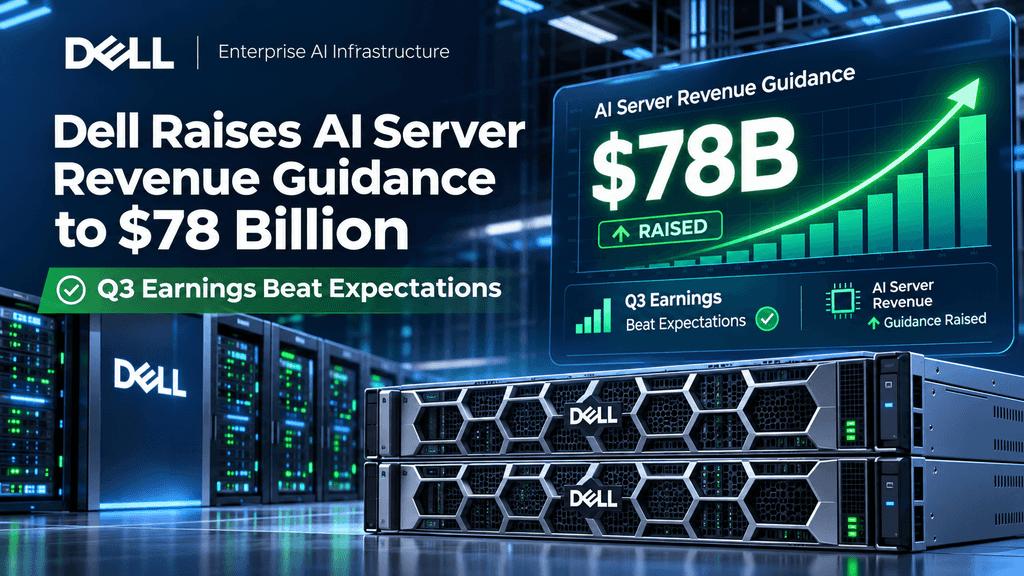
Dell Technologies is strengthening its position in the artificial intelligence infrastructure market after reporting record fiscal third-quarter results and raising its annual AI server revenue forecast to $78 billion. The November 24 earnings announcement highlights growing demand for high-performance computing as cloud providers, enterprises, and sovereign AI initiatives expand data center investments. With $60.2 billion in new AI server orders and a record $132.3 billion backlog, Dell's results provide further evidence of the expanding AI infrastructure market, although supply constraints and rising component costs remain important challenges.
Key Takeaways
-
AI server revenue guidance increased: Dell raised its FY2027 AI-optimized server revenue forecast from $74 billion to $78 billion, reflecting stronger customer demand.
-
Record AI server backlog: The company reported $132.3 billion in outstanding AI server orders at the end of Q3, indicating substantial potential future deliveries.
-
Strong financial performance: Q3 revenue reached $54.94 billion, increasing 103% year over year, while non-GAAP diluted EPS rose 265% to $9.45.
-
AI infrastructure demand is broadening: Enterprise AI deployments, neocloud providers, and sovereign AI projects are supporting demand for integrated computing systems.
-
Supply-chain risks remain: Memory shortages, component costs, delivery capacity, and the sustainability of AI capital expenditure could influence future profitability.
Dell Q3 FY2027 Earnings: Revenue and Profit Exceed Expectations
Dell announced its fiscal 2027 third-quarter financial results on November 24, reporting record revenue and earnings as demand for AI infrastructure accelerated. Total revenue reached $54.94 billion, representing 103% year-over-year growth. GAAP diluted earnings per share increased 287% to $8.82, while non-GAAP diluted EPS reached $9.45, up 265%. The results exceeded analyst expectations, with quarterly revenue above the approximately $49.32 billion consensus estimate and adjusted EPS surpassing expectations of approximately $6.59. Operating cash flow also increased to approximately $4.46 billion, compared with $1.17 billion a year earlier, demonstrating stronger cash generation alongside business expansion.
The Infrastructure Solutions Group (ISG) was the primary contributor to this performance, generating approximately $42 billion in revenue, up 198% year over year, while operating income increased 308% to approximately $7.1 billion. AI-optimized servers generated $22 billion in revenue, representing 291% growth, while traditional servers and networking contributed approximately $15 billion. Storage revenue reached $4.9 billion, increasing 24%. By comparison, Dell's Client Solutions Group (CSG), which includes PCs and related products, generated $12.9 billion in revenue, up only 3%, while operating income declined 6%. This divergence illustrates how AI infrastructure is becoming a more important source of growth and profitability than Dell's traditional client computing business.
| Q3 FY2027 financial indicator | Reported result | Year-over-year change |
| Total revenue | $54.94 billion | 1.03 |
| GAAP operating income | $7.44 billion | 2.51 |
| GAAP net income | $5.67 billion | 2.66 |
| Non-GAAP diluted EPS | $9.45 | 2.65 |
| Operating cash flow | $4.46 billion | — |
| ISG revenue | Approximately $42 billion | 1.98 |
| CSG revenue | $12.9 billion | 0.03 |
The financial results reveal more than a strong quarterly performance. Dell's infrastructure business is expanding rapidly, while its traditional PC operations are growing at a considerably slower pace. This changing business mix is important because it suggests that the company's future financial performance will increasingly depend on enterprise computing investment, AI server demand, and the broader development of data center infrastructure.
Why Dell Raised Its AI Server Revenue Forecast to $78 Billion
The most significant development in Dell's earnings announcement was its decision to increase its FY2027 AI-optimized server revenue forecast from $74 billion to $78 billion. The $4 billion revision represents an approximately 5.4% increase over the previous target, while the updated forecast implies roughly 216% year-over-year growth. The adjustment reflects stronger demand from cloud infrastructure providers and enterprise customers seeking computing capacity for AI training and inference. Dell's management expects this demand to remain strong through the remainder of the fiscal year, although the forecast remains a projection rather than realized revenue.
The company's order figures provide further evidence of the expanding market. Dell received $60.2 billion in new AI server orders during Q3 and recognized approximately $22 billion in AI server revenue. Its outstanding AI server backlog reached a record $132.3 billion at quarter-end. These indicators must be distinguished: orders represent new customer commitments, revenue represents products and services already delivered and recognized, and backlog represents outstanding orders awaiting fulfillment. Therefore, the backlog is an indicator of potential future business, not an equivalent amount of confirmed revenue or immediately available cash. The increase from the previous quarter's approximately $95 billion backlog also suggests that new commitments are continuing to accumulate despite substantial deliveries.
| AI server indicator | Q2 FY2027 | Q3 FY2027 |
| New AI server orders | $60.9 billion | $60.2 billion |
| AI server revenue | $16.4 billion | $22.0 billion |
| AI server backlog | $95 billion | $132.3 billion |
The composition of demand is also becoming more diversified. Neocloud providers are expanding GPU-based computing capacity for AI developers, sovereign AI initiatives are creating demand for domestically controlled infrastructure, and enterprises are investing in private and hybrid AI environments. Dell reported more than 7,500 customers deploying its AI Factory solutions, suggesting that demand is extending beyond a small group of hyperscale technology companies. However, converting these orders into revenue requires sufficient financing, available components, data center capacity, and customer readiness. These conditions will determine how quickly the $132.3 billion backlog can translate into actual deliveries.
Dell AI Factory and the Expansion of Enterprise AI Infrastructure
Dell's AI Factory strategy is central to its efforts to capture a larger share of the AI infrastructure market. Instead of supplying only individual servers, the company offers integrated systems that combine computing hardware, networking, storage, software, and deployment services. Modern AI data centers require GPUs and CPUs for processing, high-bandwidth memory for intensive workloads, high-speed networking to connect computing nodes, and storage systems to support large datasets. Power delivery and cooling infrastructure are equally important because high-density AI servers consume substantial electricity and generate significant heat. By integrating these components, Dell can reduce the complexity enterprises face when building and managing AI environments.
The expansion of AI inference is another factor supporting demand for integrated infrastructure. Earlier investment cycles concentrated heavily on training large AI models, but commercial deployment increasingly requires continuous computing resources to operate trained models. Enterprise assistants, automated workflows, AI agents, and customer-facing applications can generate recurring inference workloads. AI agents may further increase infrastructure requirements because they can execute multiple tasks, interact with external tools, and make repeated model calls. Nevertheless, demand growth will depend on the balance between expanding AI adoption and improvements in model efficiency, hardware utilization, and inference optimization. More efficient computing could reduce the resources required for individual tasks even as overall AI usage increases.
NVIDIA and Dell: How AI Server Growth Supports the Semiconductor Supply Chain
Dell's AI server expansion is closely connected to NVIDIA's GPU ecosystem. NVIDIA supplies processors and computing technologies used in many high-performance AI systems, while Dell integrates these components into PowerEdge servers and larger data center configurations. The relationship illustrates how AI infrastructure demand extends across several parts of the technology supply chain. Semiconductor manufacturers such as TSMC provide advanced chip fabrication, memory suppliers produce HBM and server DRAM, and networking companies provide the high-speed connectivity required to link large computing clusters. Dell's role is to combine these components into complete systems that customers can deploy.
Higher Dell AI server revenue may therefore support demand for GPUs, server processors, memory modules, networking equipment, storage, and cooling technologies. However, Dell's reported AI server revenue should not be interpreted as equivalent to NVIDIA GPU revenue because the value of a complete server system includes multiple components and integration services. This distinction matters when evaluating the financial impact on individual suppliers. Stronger Dell sales provide evidence of broader infrastructure investment, but the benefits will vary according to component pricing, supply availability, and each manufacturer's position in the value chain. For investors following the wider technology market, indicators such as semiconductor demand, data center capital expenditure, and enterprise infrastructure spending provide useful context alongside Dell's results.
Risks Facing Dell's AI Server Revenue Growth
Despite its strong results, Dell faces several operational challenges that could influence whether its higher AI server revenue forecast translates into sustainable profitability. Memory availability is one of the most immediate concerns. AI servers require substantial quantities of HBM and advanced server DRAM, while increasing demand from data centers is placing pressure on semiconductor production capacity. Dell management has indicated that memory supply constraints could continue into 2027. If component prices rise faster than server manufacturers can adjust product pricing, profit margins may narrow even as revenue expands. Higher hardware costs could also increase the overall expense of AI infrastructure deployments, potentially affecting customer purchasing decisions.
Backlog conversion and data center readiness present additional challenges. The $132.3 billion backlog represents substantial potential business, but outstanding orders must progress through manufacturing, delivery, installation, and revenue recognition. Large deployments require suitable facilities, electricity connections, cooling systems, networking infrastructure, and customer financing. Delays in any of these areas could extend delivery schedules and affect the timing of reported revenue. The sustainability of AI capital expenditure is equally important. Major technology companies are investing heavily in computing infrastructure, but these investments ultimately need to generate commercial returns through cloud services, enterprise AI applications, and productivity improvements. If monetization falls short of expectations, customers may reconsider future infrastructure spending.
Competition could also influence Dell's pricing power. Established manufacturers such as Hewlett Packard Enterprise and Supermicro are competing for enterprise and hyperscale AI server contracts. Customers increasingly evaluate suppliers based on performance, energy efficiency, cooling requirements, delivery speed, and total cost of ownership. As the market expands, hardware performance alone may not be sufficient to maintain competitive advantages. Dell will need to balance rapid growth with supply-chain efficiency, product differentiation, and operating margin management.
Dell's FY2027 Outlook: What Investors Should Watch
Following its third-quarter performance, Dell raised its full-year FY2027 revenue forecast from $192 billion to $202 billion and increased its non-GAAP diluted EPS guidance from $25.50 to $29.68. Its GAAP diluted EPS forecast was also raised from $24.37 to $28.24. The revised AI-optimized server revenue target stands at $78 billion, compared with the previous $74 billion estimate. For the fourth quarter, Dell expects revenue of approximately $56.3 billion, non-GAAP diluted EPS of $8.40, and AI server revenue of approximately $23.5 billion. These projections indicate management's expectation that AI infrastructure demand will remain strong, although actual performance will depend on delivery schedules and customer deployment readiness.
Investors should monitor quarterly AI server revenue, backlog trends, memory prices, GPU availability, and data center construction activity to assess the sustainability of this growth. Capital expenditure plans from major cloud providers will also remain important because changes in infrastructure investment can influence demand throughout the semiconductor and server supply chains. Dell additionally approved a $25 billion increase in its share repurchase authorization, following $4.9 billion returned to shareholders through dividends and buybacks during Q3. The authorization represents capacity for future repurchases rather than an immediate commitment to spend the entire amount. Overall, the next stage of Dell's performance will depend on whether strong customer commitments can be converted into revenue while maintaining acceptable profitability.
Conclusion
Dell's FY2027 third-quarter results highlight the growing importance of AI infrastructure to the global technology industry. Record revenue, $60.2 billion in new AI server orders, and a $132.3 billion backlog support its decision to raise the annual AI server revenue forecast to $78 billion. The results also demonstrate how demand is expanding beyond GPUs toward integrated data center systems. However, memory constraints, delivery capacity, competition, and the commercial returns from AI investment remain important uncertainties. Dell's ability to convert its backlog into sustainable revenue and profitability will be a key indicator of the broader AI infrastructure market's development.
FAQs
How much AI server backlog did Dell report in Q3 FY2027?
Dell reported $132.3 billion in AI server backlog at the end of Q3 FY2027, compared with approximately $95 billion in the previous quarter. The figure represents outstanding orders awaiting fulfillment rather than revenue already recognized.
How does NVIDIA benefit from Dell's AI server growth?
NVIDIA supplies GPUs and AI computing technologies used in many Dell server configurations. Higher demand for these systems can support demand for NVIDIA processors and related data center components, although Dell's total AI server revenue includes multiple hardware and integration components.
What is Dell AI Factory?
Dell AI Factory is an integrated infrastructure approach combining AI servers, GPUs, storage, networking, software, and deployment services. It helps enterprises and other organizations build and operate AI environments for model training, inference, and business applications.
What risks could affect Dell's AI server business?
Key risks include memory shortages, rising component costs, delayed data center construction, customer financing constraints, competitive pricing, and potential reductions in AI infrastructure spending. These factors could affect order fulfillment, revenue growth, and operating profitability.
Disclaimer: This general market information, possibly from third-party, commercial, or sponsored sources, is provided for reference and educational purposes only and does not constitute financial or investment advice, an offer, solicitation, or guarantee. We disclaim liability for its accuracy, completeness, reliability, and any resulting losses. Investments/trading are risky; past performance doesn’t guarantee future results. Users should research, judge prudently, and take full responsibility. For further details, please consult KuCoin’s Terms of Use and Risk Disclosure.