

Cashback vs Rewards Points: Which Reward Model Works Better for Everyday Spending?
2026/08/18 17:32:00
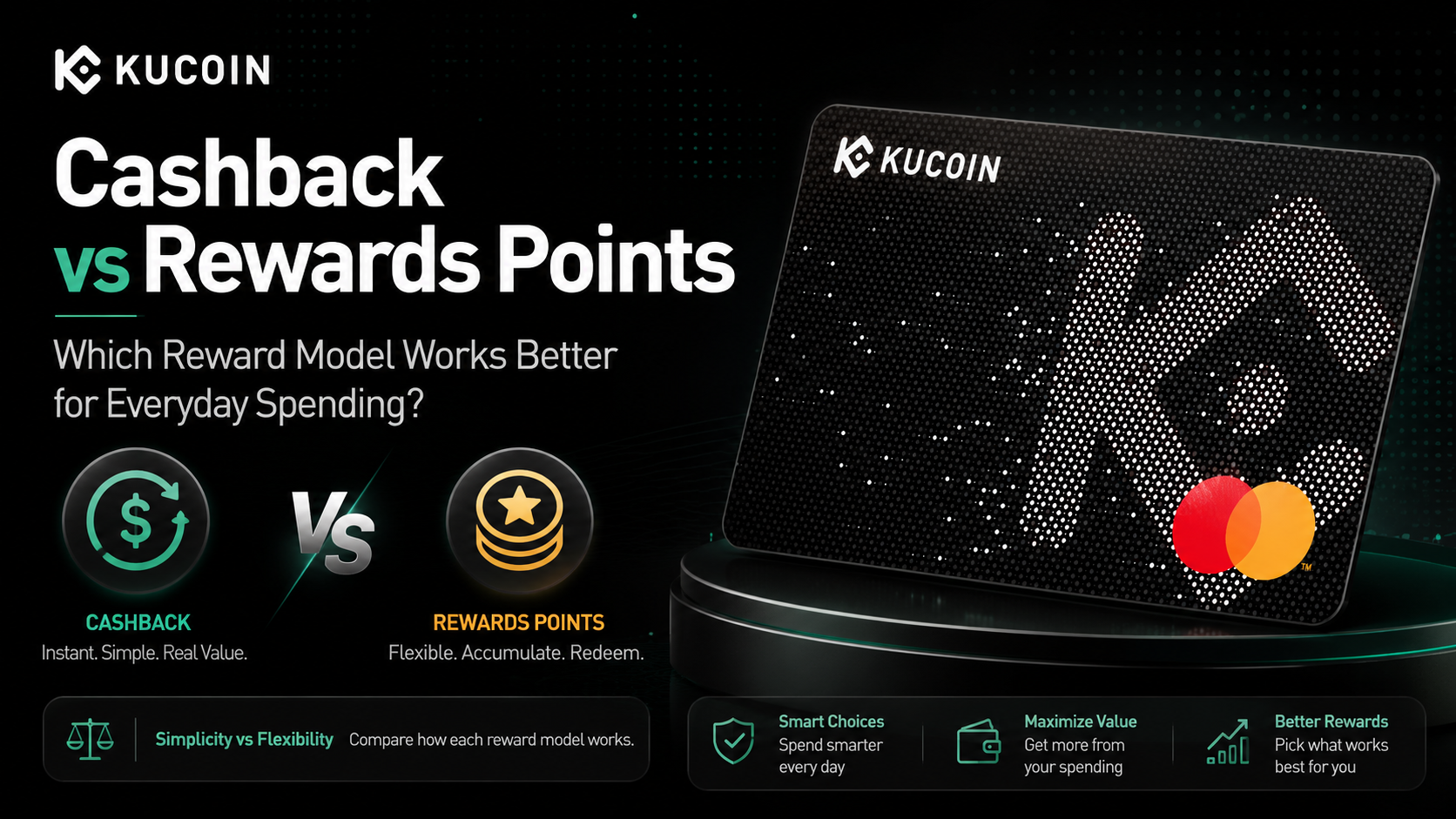
Card rewards can make everyday spending a little more rewarding, but the way that value reaches you can vary considerably. Some programs return part of your eligible spending as cashback, while others award points that can later be redeemed for cash-style rewards, digital assets, vouchers or other benefits. That difference may seem small at first, yet it can shape everything from how easy a reward is to understand to how much effort it takes to use.
The distinction is becoming increasingly relevant in the crypto card space as well. In Australia, for example, KuCard transitioned from its previous Cashback Program to a Rewards Points Program on July 16, 2026, meaning eligible transactions now earn Rewards Points rather than new cashback balances. The change offers a useful real-world example of the trade-off between the two models: cashback prioritises simplicity, while rewards points can introduce more choice. So, when it comes to everyday spending, which approach actually works better?
What Is Cashback and How Does It Work?
Cashback is one of the easiest card rewards to understand. When an eligible purchase qualifies for a certain cashback rate, part of the amount spent is returned as a reward. If a card offers 1% cashback on an eligible $100 purchase, for example, the reward would generally be worth $1 under that program's rules.
Its main advantage is transparency. Users can usually understand the value of their reward without calculating point conversions or comparing different redemption options. Cashback may also require relatively little ongoing management, making it appealing to people who simply want a reward to accumulate alongside purchases they were already planning to make.
That simplicity does not mean every cashback program works in the same way. Eligible purchases, reward caps, settlement periods, redemption methods and promotional rates can all vary. A headline cashback percentage therefore tells only part of the story; the rules determining when and where that percentage applies still matter.
What Are Rewards Points and How Do They Work?
Rewards points add an extra stage between making a purchase and receiving the final benefit. Instead of an eligible transaction directly generating a monetary reward, the transaction earns points. Those points accumulate in a rewards balance and can later be exchanged through the options supported by the program.
The basic journey can be thought of as spend → earn points → track → redeem. This additional step gives a program more room to offer different types of rewards. Depending on the provider, points might be exchanged for cash-equivalent rewards, travel benefits, vouchers, merchandise, cryptocurrencies or other incentives.
The trade-off is that points usually require more attention. Their value may depend on the redemption option selected, and users may need to keep track of processing times, expiry periods or minimum redemption amounts. For someone who enjoys choosing how to use rewards, that flexibility can be useful. For someone who prefers a reward that works largely in the background, it may feel like extra management.
Cashback vs Rewards Points: What’s the Real Difference?
Neither model is automatically more valuable. The more useful comparison is how each model delivers value and how closely that process matches a user's spending spending habits.
| Factor | Cashback | Rewards Points |
| Value transparency | Usually easy to understand | May depend on redemption value |
| Redemption process | Often more direct | Requires a separate redemption step |
| Reward choice | Usually more limited | Can support multiple reward types |
| Management effort | Generally lower | Often requires more tracking |
| Flexibility | Usually lower | Potentially higher |
| Expiry and restrictions | Depends on the program | Particularly important to check |
| Best suited to | Users who value simplicity | Users who value redemption choice |
Cashback therefore tends to answer the question “How much did I get back?”, while a points program adds another question: “What do I want to do with the points I earned?” That extra choice can be an advantage, but only when the available rewards are things the user actually intends to use.
Which Is Better for Everyday Spending?
Cashback May Work Better If You Value Simplicity
Cashback can be attractive for people who do not want to spend much time managing rewards. Its value is generally easier to recognise, and there may be less need to compare redemption options before deciding what to do with a balance. For routine expenses such as groceries, dining or online shopping, that straightforward experience may be more important than having a long catalogue of rewards.
Rewards Points May Work Better If You Value Choice
Points can make more sense when flexibility matters. A user who is comfortable checking a rewards balance and comparing available redemption options may prefer having the ability to decide how accumulated value is used. The usefulness of that flexibility, however, depends on the quality of the redemption options and the rules attached to them.
Rewards Should Complement Spending, Not Drive It
Whichever model is used, the most practical value usually comes from purchases that would have happened anyway. Spending more solely to reach a reward threshold can quickly offset the value of the reward itself. A 2% or 3% benefit does not make an unnecessary purchase economically worthwhile. For everyday spending, a useful rewards program should fit into existing habits rather than give users a reason to create additional expenses.
How KuCard Has Shifted From Cashback to Rewards Points
KuCard Australia provides a timely example of the difference between the two reward structures. On July 16, 2026, KuCoin AU announced that its existing KuCard Cashback Program would be upgraded to the KuCard Rewards Points Program. Eligible KuCard transactions made under the new structure generate Rewards Points instead of new cashback rewards. Cashback accumulated before the transition remains subject to a separate redemption window.
The change illustrates the central trade-off discussed above. Under a cashback model, the reward is relatively direct. Under a points model, spending first produces an intermediate reward currency that can later be used through supported redemption options. The process is slightly more involved, but it creates room for a broader rewards ecosystem.
That distinction became more visible with the subsequent launch of Limited‑Time Campaign for KuCard Rewards Points on July 23, 2026. Rather than positioning points purely as a balance waiting to be converted, the mall adds another destination where eligible users can consider how they want to use accumulated rewards.
How KuCard Rewards Points Work With Everyday Spending
Earning Points
Under the current KuCard AU structure, eligible transactions generate points according to a straightforward calculation:
Points Earned = Spending Amount × Reward Rate × 1,000
For example, KuCoin AU illustrates that an eligible 100 USDC purchase made at a 3% reward rate would generate 3,000 Rewards Points. The applicable reward rate uses a dual mechanism based on the user's KuCoin VIP Level and Monthly Spending Tier, with the system applying whichever tier provides the higher rate. Monthly spending is tracked in real time, while a newly reached spending tier takes effect from the following day under the current program structure.
What Counts as Eligible Spending?
The program is designed primarily around eligible KuCard purchases, with KuCoin AU giving ordinary retail spending such as groceries, dining and fuel, together with online shopping, as examples. At the same time, not every card transaction earns rewards. Refunded or reversed transactions, financial services and cash-equivalent transactions, certain currency conversion activity and specified high-risk Merchant Category Codes are among the exclusions under the current rules.
That distinction matters when comparing any points program with cashback. A reward rate should not simply be applied to all card spending when estimating future rewards. Eligibility rules can have as much impact on actual value as the percentage displayed in a rewards table.
Why Points Require More Attention Than Cashback
Points May Not Be Available Immediately
An eligible purchase does not necessarily produce instantly redeemable points. KuCoin AU states that Rewards Points are issued after the relevant transaction has been completed and settled, with an additional verification stage before they become available. This means a recent card transaction may appear before its associated rewards are ready to use.
Points Can Expire
Timing also matters after the points become available. KuCard AU Rewards Points currently remain valid for 90 days from the date they become available. A large accumulated balance therefore does not tell the whole story; users also need to know how much is actually available and when those points were credited.
This highlights a broader difference between cashback and points. A points program can provide additional flexibility at the redemption stage, but that flexibility is most useful when users understand the program's processing, eligibility and expiry rules. Tracking rewards occasionally can therefore be more important than simply looking at the headline earning rate.
How the KuCard Rewards Points Mall Expands Redemption Choice
The additional step in a points system becomes more meaningful when there is more than one useful way to redeem the balance. KuCard users in Australia can currently redeem eligible Rewards Points through supported options such as USDC and USDT, and KuCoin AU states a standard reference rate of 1,000 Points for the equivalent value of 1 USDC, unless otherwise specified. The redemption interface allows users to check their Payment Points balance, select an available reward and confirm the amount they want to redeem.
The Rewards Points Mall expands that redemption layer. KuCoin AU announced the mall on July 23, 2026, with USDC and USDT cash-style redemption remaining accessible alongside additional premium rewards. This is where the practical distinction between cashback and points becomes clearer: cashback generally determines the form of the reward earlier, whereas a points balance can preserve the decision until redemption.
| KuCard Rewards Journey | What Happens |
| Spend | Make an eligible KuCard purchase |
| Earn | Rewards Points are calculated using the applicable reward rate |
| Process | The transaction completes, settles and passes verification |
| Track | Available Rewards Points can be viewed through KuCoin AU |
| Redeem | Choose from currently supported redemption options |
| Use | Points can be converted through eligible rewards, including available Points Mall options |
The existence of more options does not automatically make a points program better. Its real advantage depends on whether users find those choices more useful than receiving a single, predefined reward.
Cashback or Points: Which Should You Choose?
For someone who wants rewards to operate quietly in the background, cashback may still be the more intuitive model. There is less abstraction between spending and reward value, which makes it easier to understand what has been earned without actively managing a loyalty balance.
Points may be more appealing to people who value choice and are willing to spend a little more time monitoring rewards. When a program combines cash-style redemption with a broader reward catalogue, users can decide which option fits their priorities rather than receiving the same type of benefit every time.
The important question is therefore not simply whether cashback or points offers the larger headline percentage. It is whether the reward is easy enough to earn, valuable enough to redeem and relevant enough that you will actually use it.
What to Consider Before Choosing a Card Rewards Program
Reward structure should be evaluated as a whole rather than by one percentage. Before deciding whether a cashback or points program fits your everyday spending, consider how the earning and redemption process works from beginning to end.
| What to Check | Why It Matters |
| Reward rate | Shows the potential earning level |
| Eligible spending | Determines which purchases actually qualify |
| Reward caps | May limit the amount that can be earned |
| Redemption value | Shows what points or cashback are really worth |
| Redemption options | Determines how flexible the reward is |
| Processing time | Affects when rewards become usable |
| Expiry | Can reduce the value of unused rewards |
| Fees and terms | May affect the net value received |
| Regional availability | Programs can differ by jurisdiction |
KuCard is one example of why the final point matters. The Rewards Points structure discussed here relates specifically to KuCard Australia, and users should refer to the rules applicable to their own region before assuming that reward rates, redemption choices or eligibility conditions are identical elsewhere.
Conclusion
Cashback and rewards points ultimately approach the same goal in different ways. Cashback emphasises simplicity: eligible spending produces a reward whose value is usually easier to recognise. Points introduce another stage, requiring users to earn, track and redeem a separate balance, but that extra step can also make room for more reward choices.
KuCard Australia's move from cashback to Rewards Points illustrates this trade-off in practice. Eligible everyday spending now feeds into a points-based system, while the KuCard Rewards Points Mall expands the range of ways those accumulated points can be used.
For everyday spending, however, the best rewards model is not necessarily the one with the largest headline rate or the longest reward catalogue. It is the one that gives you useful value from purchases you already intended to make, with rules you understand and rewards you are actually likely to redeem.
⚡️ Bring Crypto Into Everyday SpendingConnect crypto with everyday payments through KuCard and explore a simpler way to use your assets beyond the crypto wallet. >> Apply for KuCard
|
FAQs
Is Cashback Better Than Rewards Points?
Neither is universally better. Cashback generally offers simpler and more transparent reward value, while points can provide greater flexibility at redemption. The better choice depends on whether you prioritise simplicity or a wider range of ways to use your rewards.
What Is the Difference Between Cashback and Rewards Points?
Cashback generally returns value more directly after eligible spending. Rewards points create an intermediate balance: users earn points first and then redeem them through the options supported by the program. This can provide more choice, but it may also require more active tracking.
Do KuCard Rewards Points Expire?
Yes. Under the current KuCard Australia Rewards Points Program, points remain valid for 90 days from the date they become available. Points are issued only after qualifying transactions have completed the required settlement and verification process.
Can KuCard Rewards Points Be Converted Into Cashback Rewards?
KuCoin AU currently states that eligible KuCard Rewards Points can be redeemed for cashback rewards at a standard reference rate of 1,000 Points for the equivalent value of 1 USDC, unless otherwise specified. The exact available reward options and applicable conversion details should be checked at the time of redemption.
What Is the KuCard Rewards Points Mall?
The KuCard Rewards Points Mall is a limited‑time campaign for KuCard Rewards Points in Australia. Launched on July 23, 2026, it adds premium reward choices while existing USDC and USDT cash-style redemption remains accessible.
Disclaimer: This content is for informational purposes only and does not constitute investment advice. Cryptocurrency investments carry risk. Please do your own research (DYOR).