

Canto Incognito Malware Targets Kryptex: How 3,400 AI Servers Were Hijacked for Cryptojacking
Introduction
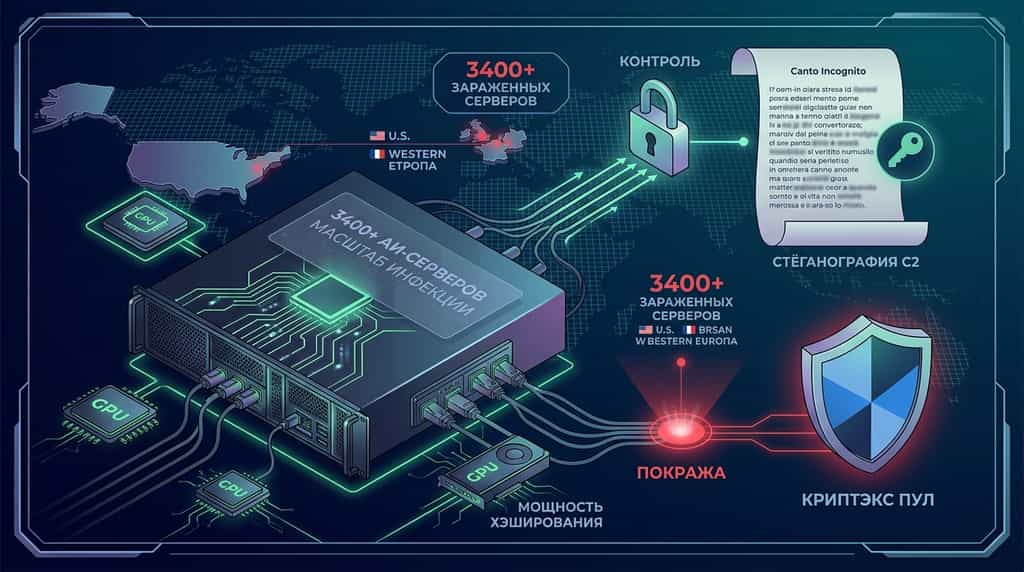
Over 3,400 exposed artificial intelligence (AI) and Large Language Model (LLM) servers globally have been compromised in a sophisticated cryptojacking campaign dubbed Canto Incognito. According to cybersecurity researchers at Lumen Black Lotus Labs, bad actors deployed a novel malware malware strain known as PoeLLM to install hidden XMRig and Iron mining software on compromised corporate infrastructure. The hijacked compute power was subsequently directed to Kryptex, a prominent Russian-language mining platform, to generate unauthorized cryptocurrency revenue.
The attack campaign stands out due to its advanced Command and Control (C2) obfuscation mechanism. Rather than relying on static IP addresses or domain names, the attackers encoded their C2 server locations within steganographic poems published on a public GitHub repository. This ongoing threat highlights the growing vulnerability of exposed enterprise AI deployments and open-source utility software to stealthy resource-hijacking malware.
What Is the Canto Incognito Malware Attack on Kryptex?
The Canto Incognito campaign is a targeted cryptojacking operation designed to covertly hijack high-performance enterprise server infrastructure for unauthorized cryptocurrency mining. Active since April 2026, the campaign leverages open-source AI microservices and web utility tools as entry points to gain initial access to cloud and enterprise environments.
Once inside a victim's network, the primary malware payload, PoeLLM, deploys tailored crypto-mining software—specifically XMRig for Monero (XMR) and specialized miners for Iron—to harness CPU and GPU resources. The mined rewards are routed to accounts hosted on Kryptex, a well-known Russian mining pool and automated crypto-payout service.
Key operational parameters of the Canto Incognito campaign include:
-
Infection Scale: Over 3,400 individual servers compromised worldwide, with a peak concurrent infection count of roughly 2,200 servers during mid-June 2026.
-
Geographic Distribution: Attacks are heavily concentrated across enterprise data centers in the United States and Western Europe.
-
Target Vulnerabilities: Compromised endpoints consist largely of internet-facing software including LiteLLM (AI proxy layer), Gotenberg (document conversion service), Gitea (code repository hosting), and Ivanti Sentry (mobile security gateway).
-
Botnet Propagation: In addition to crypto-mining, infected servers are recycled as secondary scanning nodes to probe the broader internet for unpatched systems, expanding the botnet's overall footprint.
How Does PoeLLM Malware Use GitHub Poems for Command and Control (C2)?
PoeLLM utilizes a novel, highly resilient C2 discovery method called Poem-Based Steganographic IP Encoding. Traditional botnets rely on hardcoded IP addresses or Dynamic Domain Name System (DDNS) infrastructure, which cybersecurity team members can easily block or sinkhole. In contrast, Canto Incognito hides its control infrastructure within open-source code repositories.
The C2 operational cycle functions through a structured four-step process:
-
Poetic Steganography: The threat actors created a public GitHub repository with an initial commit logged on April 13, 2026. Inside, they published an Italian-language poem ("Canto Incognito" or "Unknown Song").
-
Dynamic Key Swapping: Whenever the attackers migrate or reassign their C2 infrastructure, they modify specific words within the poem via regular GitHub commits.
-
Decryption on Target: Upon execution on a compromised server, PoeLLM fetches the latest commit from GitHub, reads the text, and applies an algorithmic key extraction formula based on the altered words to derive the operational IP address of the C2 server.
-
Resilience Against Takedowns: Because GitHub is a legitimate development platform used globally, firewall rule sets rarely block outbound connections to GitHub repository endpoints, allowing the malware to bypass traditional network defense barriers.
According to cybersecurity research engineering data from Lumen Technologies, this obfuscation technique makes tracking and neutralizing C2 channels significantly more challenging for threat intelligence analysts.
Why Are AI and LLM Infrastructure Primary Targets for Cryptojacking?
Enterprise artificial intelligence infrastructure represents an exceptionally high-value target for cryptojacking threat actors due to its massive computational bandwidth and loose default security configurations. As companies rapidly deploy Large Language Models (LLMs) and supporting microservices, security protocols often lag behind development speed.
AI management tools such as LiteLLM allow organizations to unify API calls across multiple provider models. When these services are exposed directly to the public internet without proper access control lists (ACLs) or authentication barriers, attackers scan and exploit open ports within minutes.
Furthermore, because AI workloads consume extensive processing power by default, system administrators may not immediately recognize the elevated CPU/GPU utilization caused by background XMRig or Iron mining processes, granting attackers extended dwell time on compromised host machines.
Technical Comparison: Canto Incognito Campaign Metrics
To evaluate the operational scope and risk profile of the Canto Incognito campaign, key attributes documented by network security researchers are outlined below.
| Campaign Metric | Details & Technical Parameters | Impact Level |
| Primary Payload | PoeLLM malware deploying XMRig and Iron crypto miners | High |
| Mining Pool Target | Kryptex (Russian-language mining service) | Medium |
| Total Compromised Hosts | >3,400 enterprise servers globally | High |
| Peak Active Infections | ~2,200 servers simultaneously (Mid-June 2026) | High |
| C2 Obfuscation Method | GitHub steganography using dynamically modified Italian poetry | Critical |
| Initial Commit Date | April 13, 2026 | Informational |
| Target Infrastructure | LiteLLM, Gotenberg, Gitea, Ivanti Sentry enterprise tools | Critical |
| Target Geographic Regions | United States and Western Europe | High |
| Attributed Actor Origin | Italian-speaking cybercrime group (based on traffic analysis) | Medium |
How to Protect Enterprise Infrastructure from Cryptojacking Malware
Preventing PoeLLM and similar cryptojacking threats requires a proactive defense strategy focused on network visibility, vulnerability management, and infrastructure hardening. Organizations deploying open-source AI microservices must audit their external attack surface systematically.
-
Secure Exposed AI Services and Middleware
Never deploy utility services like LiteLLM, Gotenberg, or Gitea directly to the open internet without robust authentication layers. Enforce strict Zero Trust Architecture (ZTA), isolate services within virtual private clouds (VPCs), and place administrative interfaces behind secure Virtual Private Networks (VPNs) or Identity-Aware Proxies.
-
Implement Outbound Network Egress Filtering
Restrict outbound network traffic from production AI servers. Production workloads rarely require unrestricted outbound HTTP/HTTPS access to external code hosting platforms like GitHub. By filtering egress traffic and blocking unknown IP destinations, enterprise teams prevent malware from pulling live C2 addresses from external repositories.
-
Monitor Process Execution and System Metrics
Deploy Endpoint Detection and Response (EDR) solutions to monitor for unauthorized process creation. Flag any unauthorized spawning of process binaries related to
xmrig, iron-miner, or unknown background scripts executing from temporary system directories (such as /tmp or /var/tmp).-
Patch Vulnerable Enterprise Software
Regularly audit and patch internet-facing network applications, including Ivanti Sentry, code repositories, and containerized microservices. Applying security patches promptly eliminates the known remote code execution (RCE) vectors that threat actors exploit for initial access.
Beyond the Headlines: What KuCoin 5.0 Means for You
Market news moves fast — but where you act on it matters just as much. This October, KuCoin launches KuCoin 5.0, transforming KuCoin into a rebuilt platform. Here's what actually changes for you:
-
One account for everything. Older platforms split your money across separate "spot," "margin," and "futures" accounts and expected you to understand why. KuCoin 5.0's unified account removes that entirely — deposit once, and everything is simply there (only available to VIPs for now).
-
Stocks, indices, and commodities. KuCoin 5.0 expands beyond crypto into global markets. When crypto chops sideways and equities rally (or the reverse), you rotate in minutes instead of opening a brokerage account and waiting days for fiat rails.
-
Real-world assets (RWA). Tokenized exposure to traditional assets like commodities, right inside your crypto account. One of the fastest-growing segments in global finance is no longer reserved for institutions — you access it from the same balance you trade with.
-
Earn while you learn. Not ready to trade? KCUSD lets your stablecoins earn daily, auto-compounding interest. The lowest-stress way to put your idle deposit to work for 4% yield.
-
An AI assistant in plain language. Ask questions, get market context, understand what you're looking at — built into the platform, no jargon required.
-
An app that doesn't overwhelm. Faster, cleaner, and consistent — intuitive from the first tap, not after a tutorial.
-
Safety you can check, not just trust. A MiCAR-licensed EU entity, Proof of Reserves you can verify yourself, and internationally certified security (SOC 2 Type II, ISO 27001:2022).
Create your account in minutes — and start on the platform built for where crypto is going, not where it's been.
Conclusion
The Canto Incognito malware campaign highlights a major evolution in cybercrime strategy, where threat actors actively target exposed AI and LLM server infrastructure to perform stealth cryptojacking. By deploying the PoeLLM malware and routing hijacked hash power to the Russian mining platform Kryptex, the attackers have successfully compromised over 3,400 systems across the United States and Western Europe.
What sets this campaign apart is its novel Command and Control (C2) mechanism, which uses steganographic poems hosted on GitHub to dynamically update C2 server IP addresses and evade standard security blocks. As enterprise adoption of artificial intelligence and microservice architectures accelerates, securing public API endpoints, restricting outbound network egress, and patching vulnerable software like LiteLLM and Ivanti Sentry are vital steps to prevent resource exploitation.
Navigating the evolving digital asset landscape requires staying informed on security developments while choosing reliable platforms for trading and holding assets. KuCoin remains committed to maintaining industry-leading security standards, providing global users with a secure environment to trade Bitcoin, Ethereum, and hundreds of crypto assets safely.
Frequently Asked Questions (FAQs)
What is the main goal of the Canto Incognito malware campaign?
The main goal of the Canto Incognito campaign is unauthorized cryptojacking, which involves hijacking the CPU and GPU processing power of infected servers to mine cryptocurrencies like Monero and Iron for financial gain through the Kryptex mining platform.
How does the PoeLLM malware evade security detection?
PoeLLM evades security detection by retrieving its Command and Control (C2) IP addresses from steganographic Italian poems hosted on a public GitHub repository, modifying key words in the poem to dynamically compute new IP addresses without relying on traditional domain names or static IPs.
Which software applications are primarily targeted by Canto Incognito?
The campaign primarily targets internet-exposed enterprise applications and microservices, including LiteLLM (an AI proxy tool), Gotenberg (a document conversion engine), Gitea (a self-hosted code repository service), and Ivanti Sentry (a mobile network security gateway).
What is Kryptex, and was the platform directly hacked in this attack?
Kryptex is a Russian-language cryptocurrency mining platform and automated payout service; it was not hacked itself, but rather used as the mining pool recipient where threat actors directed stolen hash power generated from compromised servers.
How can network administrators determine if an AI server is compromised by PoeLLM?
Administrators can identify potential infections by checking for unexpected spikes in CPU/GPU utilization, inspecting system processes for unauthorized miners like XMRig, and monitoring outbound network traffic for suspicious connections to external code repositories or unverified IP addresses.
Disclaimer
This article is for informational purposes only and does not constitute financial, legal, or investment advice. Always conduct your own research before interacting with digital assets or engaging in cryptocurrency trading on any platform.