

BofA Survey: Most Investors Believe AI Bull Market Has Not Peaked – Spending Boom to Continue into H2 2026
2026/07/26 14:13:00
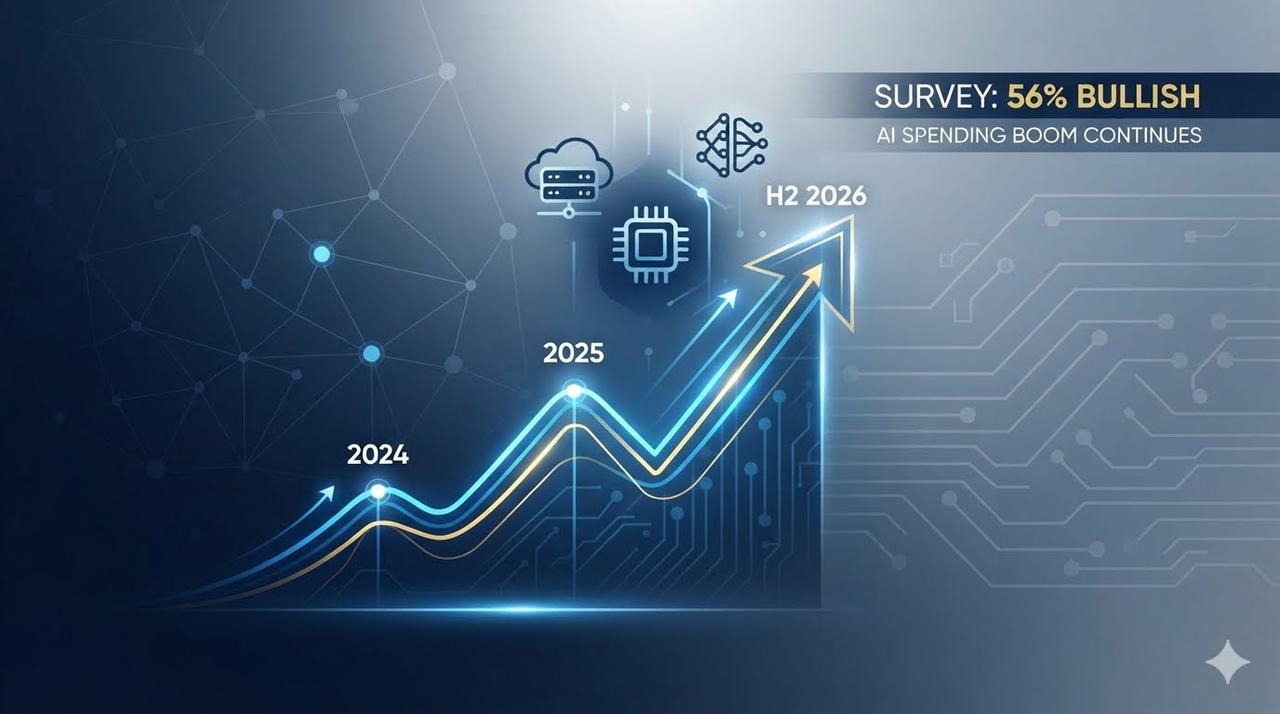
The latest Bank of America Global Fund Manager Survey underscores sustained institutional confidence in artificial intelligence as a transformative force across global markets. Conducted in recent months, the survey of fund managers overseeing hundreds of billions of dollars in assets found that a clear majority view the current AI cycle as a boom driven primarily by momentum and fear of missing out (FOMO), rather than a market entering its final stages. This sentiment shows the belief that AI adoption is still in its early phases, with significant room for expansion across cloud computing, enterprise software, semiconductor manufacturing, and data center infrastructure. The findings also align with broader market trends, as major technology companies continue committing substantial capital to AI infrastructure despite elevated equity valuations and increasingly crowded positioning in semiconductor-related stocks.
Large cloud providers and hyperscalers remain focused on expanding computing capacity to meet rising demand for AI training and inference workloads, reinforcing expectations that infrastructure spending will remain a key driver of industry growth. Institutional investors broadly believe the AI bull market still has a meaningful runway, with capital expenditure on AI infrastructure and supporting technologies expected to accelerate further through the second half of 2026. Strong enterprise adoption, growing demand for advanced AI models, and expectations of long-term productivity gains continue to support this outlook. At the same time, many investors acknowledge that risks remain, including market concentration, high valuations, and uncertainty over how quickly companies can translate AI investments into sustained financial returns. These factors are likely to remain important considerations as the sector continues to mature.
Institutional Sentiment Shifts Strongly Toward AI Optimism in Mid-2026 Surveys
Bank of America’s June and July 2026 surveys captured a notable uptick in bullishness among global fund managers. Approximately 56% selected “boom” to describe the AI stock cycle stage, emphasizing accelerating momentum and FOMO pulling in additional participants, while only 21% labeled it “euphoria.” Cash allocations dropped to exceptionally low levels around 3.6%, and the Bull & Bear Indicator reached extreme readings near 9.4, signaling high conviction but also prompting tactical caution. Managers raised exposure to U.S. equities and sectors tied to technology and industrials, reflecting expectations of a “no landing” economic scenario favored by a record 54% of respondents. This optimism stems from visible progress in AI deployment across data centers, cloud services, and enterprise applications, where hyperscalers report robust backlogs and utilization rates. For instance, demand for advanced computing capacity continues to outstrip immediate supply, reinforcing the view that the cycle has further room to expand.
Industry context shows AI-related investments contributing measurably to GDP growth, with U.S. tech investment as a share of GDP surpassing prior peaks. Logical examples include major cloud providers scaling operations to meet enterprise needs for AI workloads, driving revenue growth in the mid-20% range for leading platforms. Analysts note that while semiconductor stocks represent the most crowded trade, cited by over 80%, many participants still anticipate sustained gains rather than an imminent reversal, provided earnings delivery matches spending. This environment encourages continued allocation toward AI enablers, even as some trimming occurs in response to valuation concerns. The data paints a picture of disciplined enthusiasm, where investors weigh strong fundamentals against the risks of overconcentration.
Survey Data Highlights Persistent FOMO Driving AI Equity Participation
Fear of missing out remains a dominant narrative in the BofA findings, with participants pointing to it as a key mechanism sustaining participation in AI-related equities. This dynamic has drawn fresh capital into the sector even after substantial prior gains, as managers observe real-world adoption accelerating across industries. Semiconductor indices have posted strong year-to-date performance, with several leading names delivering triple-digit returns fueled by data center demand. The survey’s timing, spanning periods of market volatility, underscores resilience in sentiment, as optimism around AI capex and a potentially dovish policy backdrop outweighed short-term geopolitical or inflationary pressures. Investors increased allocations to healthcare and industrials alongside technology, indicating a broadening base of support beyond pure AI plays.
Detailed responses reveal that 61% do not expect hyperscalers to cut capital spending, supporting projections of elevated infrastructure outlays. This confidence translates into portfolio decisions favoring long positions in enabling technologies, where supply constraints continue to support pricing power and margins. Practical analysis shows how companies with heavy AI exposure have expanded workforces and invested in talent, complementing rather than displacing labor in many cases. Market implications include potential for further multiple expansion if productivity metrics improve, though crowded trades necessitate active risk management. The combination of survey metrics and observable spending trends provides a robust foundation for viewing the current phase as expansionary rather than terminal.
Hyperscaler Capital Expenditure Plans Signal Extended AI Infrastructure Buildout
Major technology companies have significantly raised their 2026 capital expenditure guidance, collectively approaching or exceeding $700-800 billion across leading hyperscalers, with substantial portions directed toward AI infrastructure. Amazon, Microsoft, Alphabet, and Meta have outlined aggressive plans, often doubling prior-year levels to address computing, power, and data center needs. This spending boom reflects confidence in long-term returns, as executives cite strong customer demand and backlogs that current capacity cannot fully satisfy. Power procurement deals, including nuclear and renewable arrangements, underscore the scale of physical infrastructure requirements. Analysts project continued growth into 2027, potentially surpassing $1 trillion annually, highlighting the multi-year nature of the cycle. In this context, bitcoin price dynamics and broader digital asset correlations sometimes reflect investor sentiment toward innovative technologies.
Industry data indicates that memory and logic chips, critical for AI, are driving semiconductor revenues toward the $1 trillion milestone in 2026, with high-bandwidth memory seeing particularly sharp demand. Logical examples include cloud providers reporting utilization improvements and new service offerings tailored to generative AI and agentic systems. The buildout supports not only training but increasingly inference workloads, which are expected to dominate future demand. While free cash flow pressures emerge for some players, strong balance sheets and revenue growth provide buffers. This sustained investment cycle aligns with survey findings that most managers see no near-term peak, positioning the sector for ongoing momentum through H2 2026 and beyond. Verification across earnings calls and guidance updates confirms the commitment, offering tangible evidence for the boom narrative.
Semiconductor Sector Positioning Reflects AI Demand Concentration Risks and Opportunities
Long global semiconductor stocks stand out as the most crowded trade in BofA’s survey, cited by record percentages of respondents, yet many investors maintain exposure due to structural tailwinds. The Philadelphia Semiconductor Index has delivered substantial gains, propelled by AI accelerators and memory demand. Companies like TSMC report strong revenue growth from advanced nodes, with AI chips contributing a growing share of output. Supply constraints in high-end manufacturing persist, supporting pricing and margins even as capacity expansions ramp up. This concentration creates both upside from demand surges and downside from potential digestion periods. Broader market context shows AI driving overall semiconductor revenues past $1 trillion for the first time, with computing and storage segments leading growth.
Practical analysis reveals how custom silicon development by hyperscalers complements GPU leadership, fostering a diverse ecosystem. Employment data linked to AI-adopting firms indicates workforce expansion rather than contraction in many cases, suggesting complementary effects. Investors monitor metrics such as backlog conversion and return on invested capital closely, as these will determine whether current valuations prove sustainable. The survey’s boom characterization implies room for further participation, tempered by awareness of crowding. Updated forecasts from industry trackers reinforce expectations of robust demand through the remainder of 2026.
Cloud Computing Revenue Growth Underpins AI Infrastructure Economics
Cloud computing revenue continues to provide one of the strongest indicators that investments in artificial intelligence infrastructure are translating into tangible business growth. Major cloud providers have reported sustained double-digit revenue expansion in recent quarters, with AI-related services contributing meaningfully to higher demand for computing power, storage, and advanced software offerings. Generative AI models, enterprise AI platforms, and inference workloads require significant cloud resources, allowing providers to charge premium prices for specialized infrastructure. At the same time, large order backlogs and capacity constraints suggest that customer demand still exceeds available supply in several areas, supporting continued investment in new data centers, networking equipment, and AI accelerators.
The long-term investment case is further supported by the growing adoption of AI across industries, as businesses integrate intelligent systems into customer service, software development, data analytics, cybersecurity, and operational workflows. While questions remain about how quickly companies will generate returns from these substantial capital expenditures, cloud providers have consistently emphasized that AI monetization is expected to strengthen as adoption expands and workloads mature. Investors continue to monitor revenue growth, operating margins, and capital spending to assess whether infrastructure investments are producing sustainable financial returns. Reports and management guidance from leading hyperscalers have generally reinforced confidence that demand for AI-powered cloud services remains resilient, supporting the view that today's infrastructure buildout is establishing the foundation for long-term growth rather than reflecting short-lived market enthusiasm.
Valuation Concerns and Bubble Risks Remain Top of Mind for Managers
While optimism surrounding artificial intelligence remains strong, valuation concerns continue to shape how institutional investors approach the sector. In Bank of America's latest fund manager survey, the possibility of an AI-driven market bubble remained one of the most frequently cited tail risks, reflecting caution about elevated stock valuations and the concentration of gains among a relatively small group of technology companies. Even so, most respondents did not view current market conditions as outright speculative. Instead, many believe that the earnings growth, cash generation, and competitive advantages of leading AI companies provide a reasonable foundation for their valuations. This perspective has encouraged investors to remain invested while becoming more selective about where they allocate capital.
Rather than treating the AI rally as a repeat of previous technology bubbles, many portfolio managers are focusing on company fundamentals to distinguish sustainable opportunities from speculative ones. They continue to monitor valuation metrics such as price-to-earnings multiples, earnings guidance, capital expenditure efficiency, and revenue growth to assess whether businesses can justify continued investment. Companies with established AI products, strong profitability, and clear monetization strategies are generally viewed more favorably than firms whose commercial prospects remain uncertain. The survey's distinction between a long-term AI investment boom and outright market euphoria reflects this measured outlook, suggesting that investors remain aware of the risks while relying on corporate results and broader economic conditions to guide their decisions.
Enterprise Adoption Patterns Shape AI Market Direction
Artificial intelligence adoption across enterprise environments continues to shift from small-scale pilot programs toward broader production deployments as organizations seek measurable improvements in productivity and operational efficiency. Rather than testing isolated use cases, many businesses are embedding AI into customer support, software development, data analysis, marketing, and internal knowledge management. This transition reflects growing confidence in the technology's ability to deliver practical value when integrated into existing workflows. While implementation timelines and adoption rates differ by industry, organizations increasingly view AI as a long-term business capability rather than an experimental initiative. As a result, demand for AI infrastructure, cloud computing resources, and advanced semiconductor technologies continues to expand alongside enterprise deployment.
Despite this momentum, businesses still face challenges related to workforce training, governance, data security, and integrating AI into legacy systems. Many organizations are addressing these issues by investing in employee upskilling, establishing internal AI policies, and partnering with technology providers to streamline deployment. Early results from sectors such as healthcare, finance, manufacturing, and retail point to improved operational efficiency, faster decision-making, enhanced customer service, and more effective research and development processes. These practical outcomes reinforce confidence in continued AI investment, creating a cycle where successful enterprise adoption encourages additional spending on infrastructure, software, and innovation, while also supporting broader optimism among technology investors and industry participants.
Supply Chain Dynamics in AI Hardware and Components
The growth of artificial intelligence has increased pressure across the global semiconductor supply chain, particularly for advanced chips, high-bandwidth memory (HBM), packaging technologies, and data center infrastructure. Leading semiconductor foundries continue to operate at high capacity as demand for AI processors outpaces available supply. While major manufacturers have announced capacity expansions and new fabrication facilities, these projects require significant investment and often take several years to become fully operational. At the same time, demand for advanced packaging, networking equipment, and reliable power infrastructure has intensified, creating additional constraints that can influence production schedules, delivery timelines, and overall project costs for AI developers and cloud providers.
Beyond manufacturing capacity, the AI supply chain also depends on stable access to specialized materials, memory components, and supporting infrastructure. Prices for advanced memory products have strengthened in response to sustained demand from AI applications, benefiting suppliers while increasing procurement costs for technology companies investing heavily in AI systems. Industry participants are responding by diversifying suppliers, expanding production capacity, improving manufacturing efficiency, and investing in next-generation technologies to reduce future bottlenecks. Although these efforts are expected to strengthen supply resilience over time, current constraints remain an important factor shaping investment decisions, deployment schedules, and competitive positioning across the broader AI hardware ecosystem.
Corporate Earnings Delivery as Key Validator for AI Thesis
Quarterly results and guidance from major technology companies serve as critical real-time tests of spending efficacy in the ongoing AI buildout. Strong performance in AI-related segments, including cloud revenue acceleration, improved margins on high-value workloads, and backlog conversion rates, directly reinforces institutional sentiment captured in the Bank of America surveys. For instance, hyperscalers have consistently reported cloud growth in the mid-20% range or higher, with AI contributing an increasing share of incremental revenue as customers scale deployments for training and inference tasks. This data validates the multi-year investment thesis by demonstrating that capital expenditures are translating into tangible top-line expansion and operational leverage over time.
Analysts closely scrutinize metrics such as return on invested capital, utilization rates for new data centers, and the journey of free cash flow after heavy spending periods. Broader context reveals how earnings beats in semiconductor suppliers and cloud providers create positive feedback loops, encouraging further allocation and sustaining the boom narrative. Companies highlight not only current revenue but also pipeline visibility extending into 2027 and beyond, underscoring structural demand rather than cyclical hype. Practical examples include AWS, Azure, and Google Cloud reporting record AI service uptake, with enterprises integrating generative tools into core business processes at accelerating rates. Challenges such as rising energy costs or component inflation are acknowledged, yet offset by pricing power and efficiency gains.
Global Dimensions of the AI Investment Boom
International participation and complex global supply chains add important layers to the AI investment story, extending far beyond U.S.-centric hyperscalers. Regional variations in adoption rates, regulatory environments, and infrastructure readiness significantly influence the overall direction and pace of the boom. While North America leads in absolute capex and model development, Asia-Pacific markets, particularly Taiwan, South Korea, and China, play indispensable roles in semiconductor manufacturing and component supply. TSMC’s advanced node production, for example, remains heavily booked for AI accelerators, with 2026 revenue forecasts reflecting sustained demand from global clients. European firms contribute through specialized applications in automotive, healthcare, and industrial automation, often leveraging sovereign AI initiatives to build localized capacity. Emerging markets show faster uptake in consumer-facing AI tools and cost-efficient inference solutions, broadening the total addressable market.
BofA survey respondents incorporate these global factors when assessing tail risks, noting that diversified sourcing and friend-shoring efforts help mitigate concentration concerns. Adoption patterns vary meaningfully: high-income economies capture the bulk of productivity gains, estimated in trillions annually, whereas middle- and low-income regions focus on accessible applications that drive inclusive growth. This geographic spread supports the survey’s bullish outlook by creating multiple demand engines less susceptible to single-region slowdowns. As H2 2026 progresses, monitoring international earnings, trade data, and capacity announcements will offer clearer signals on the boom’s durability. Companies with global footprints benefit from diversified revenue streams, while policymakers balance innovation incentives with security considerations.
Conclusion
The BofA surveys from mid-2026 provide compelling evidence that institutional investors largely believe the AI bull market has considerable room to run, with the current boom phase supported by robust hyperscaler capital expenditure plans, accelerating enterprise adoption, and emerging productivity gains that are expected to strengthen through the second half of 2026 and into subsequent years. This outlook rests on verifiable trends, including combined AI-related capex guidance approaching or exceeding $700-800 billion among leading players, strong semiconductor demand pushing industry revenues past the $1 trillion mark, and consistent revenue growth in cloud segments tied to AI workloads.
FAQs
What does the latest BofA Global Fund Manager Survey reveal about investor views on the current stage of the AI market?
The June and July 2026 iterations of Bank of America’s Global Fund Manager Survey indicate that a majority of respondents, around 56%, describe the AI stock rally as being in a “boom” phase rather than euphoria or profit-taking stages. This assessment highlights ongoing momentum driven by fear of missing out, which continues to attract new capital even after significant prior gains in related equities. Cash allocations among managers fell to low levels near 3.6%, reflecting high conviction, while the Bull & Bear Indicator reached extreme bullish readings. A record 54% anticipate a “no landing” economic scenario, supported by optimism around AI capital spending and accommodative policy expectations.
How are hyperscalers’ capital expenditure plans shaping the AI infrastructure outlook for the remainder of 2026?
Leading cloud providers, including Amazon, Microsoft, Alphabet, and Meta, have outlined significantly elevated 2026 capital expenditure budgets, collectively approaching or surpassing $700-800 billion, with the bulk allocated to AI data centers, accelerators, power infrastructure, and custom silicon. Amazon has guided toward approximately $200 billion, Microsoft near $190 billion, and others in comparable high ranges, representing substantial year-over-year increases. These commitments reflect strong customer demand, backlogs, and the need to scale computing capacity for both training and inference workloads.
What productivity impacts are currently being observed from AI adoption across enterprises?
AI implementation is delivering measurable productivity improvements at the task and individual level, with users reporting time savings, enhanced output quality, and the ability to tackle previously complex work. Studies document gains such as 14-40% improvements in specific functions like customer support, coding, and analytical tasks, though aggregate macroeconomic effects remain modest in the short term due to integration and complementary investment requirements. Internal deployments at large organizations, including financial institutions, show efficiency benefits like reduced support tickets and faster development cycles.
What are the primary risks highlighted by investors in relation to the ongoing AI boom?
Institutional respondents in BofA surveys consistently rank an AI bubble or overinvestment as a leading tail risk, alongside concerns about concentration in technology and semiconductors, which remain the most crowded trade. Valuation multiples, execution challenges in capex deployment, and the pace of return realization feature prominently in discussions. Despite these worries, the majority maintain that the cycle is in a boom phase with further potential, distinguishing it from euphoria. Supply chain constraints, energy demands, and potential digestion periods after heavy spending add layers of uncertainty.
What role do trading platforms play for investors interested in AI and technology themes?
Investors seeking exposure to AI-related volatility or diversified digital assets can utilize established platforms for efficient access and risk management tools. Features like margin trading and comprehensive price tracking enable informed participation in correlated markets. This complements traditional equity strategies by offering additional liquidity and hedging options. As AI themes influence broader sentiment, including crypto correlations at times, such platforms serve as practical utilities for portfolio management.
What should investors monitor closely for the AI sector through the end of 2026?
Key metrics include quarterly capex execution and efficiency, cloud revenue growth, semiconductor supply-demand balances, and enterprise adoption indicators such as utilization rates and productivity case studies. Corporate earnings delivery on AI monetization will serve as critical validation points, alongside updates on power infrastructure and chip availability. BofA-style sentiment surveys and industry forecasts provide ongoing context, while watching valuation dispersion and crowding levels helps gauge risk appetite.
Join KuCoin 9th Anniversary Trading Campaign
KuCoin is celebrating its 9th anniversary with a special platform campaign filled with exclusive rewards, trading activities, and limited-time offers. Don’t miss the chance to participate and enjoy the benefits as the exchange marks nine years of growth and innovation. Visit the official campaign page now:

Disclaimer
The information provided on this page may originate from third-party sources and does not necessarily represent the views or opinions of KuCoin. This content is intended solely for general informational purposes and should not be considered financial, investment, or professional advice. KuCoin does not guarantee the accuracy, completeness, or reliability of the information, and is not responsible for any errors, omissions, or outcomes resulting from its use. Investing in digital assets carries inherent risks. Please carefully evaluate your risk tolerance and financial situation before making any investment decisions. For further details, please consult KuCoin’s Terms of Use and Risk Disclosure.