

Bitcoin Falls Below $83K: Why Inflation Fears and Treasury Yields Are Pressuring BTC
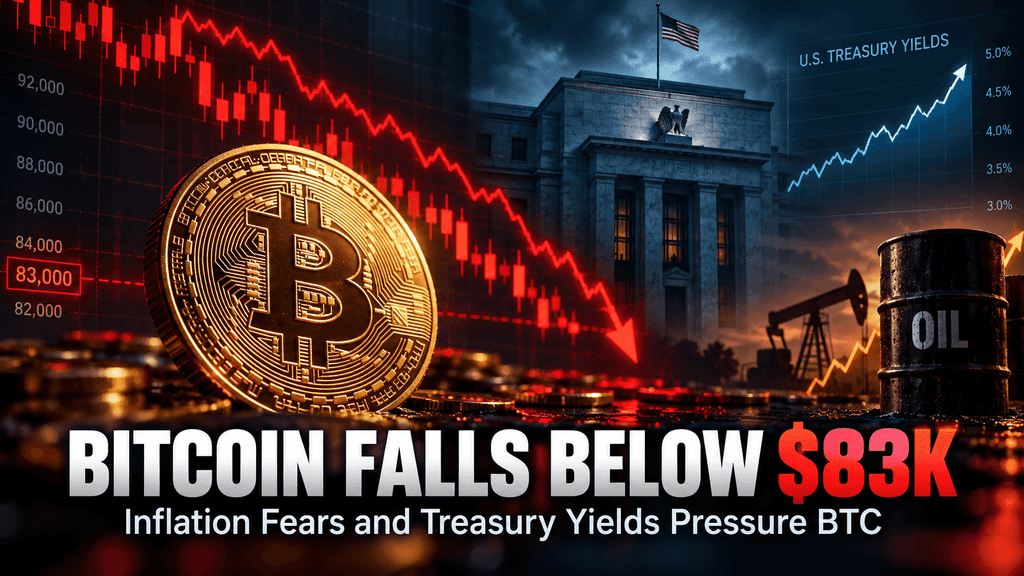
Bitcoin has fallen below $83,000 as renewed inflation concerns, rising US Treasury yields, and a stronger dollar pressure cryptocurrency markets. After approaching $87,000 earlier in October 2026, BTC lost momentum and declined to approximately $82,265 on October 8, marking a two-and-a-half-week low. The selloff coincided with Brent crude oil climbing above $100 per barrel, the US 10-year Treasury yield exceeding 5.2%, and growing uncertainty surrounding the Federal Reserve's monetary policy outlook.
The decline highlights Bitcoin's increasing sensitivity to global financial conditions. Although the Fed is widely expected to leave rates unchanged at its October meeting, investors remain concerned about persistent inflation and restrictive monetary policy. Meanwhile, Bitcoin ETF outflows, limited spot demand, and leveraged liquidations have intensified selling pressure. Understanding how these factors interact is essential for evaluating the latest BTC price movements and whether Bitcoin can recover before the next Federal Reserve decision.
Why Did Bitcoin Fall Below $83K?
Bitcoin's latest decline followed several unsuccessful attempts to establish a sustained breakout above $85,000. Earlier in October, the cryptocurrency approached $87,000, encouraging expectations that improving sentiment could support another advance. However, buyers struggled to absorb selling pressure near the upper trading range, and BTC subsequently retreated as financial markets reacted to rising energy prices and Treasury yields.
On October 7, Barron's reported that Bitcoin had declined approximately 2.7% to $83,323. Ethereum and XRP also recorded notable losses, falling roughly 5% and 5.5%, respectively. By October 8, Bitcoin had slipped to approximately $82,265, according to The Wall Street Journal, reflecting a broader withdrawal from risk-sensitive assets rather than an isolated cryptocurrency event. Crypto-related equities, including Coinbase, Robinhood, and Strategy, also experienced selling pressure.
The timing is particularly important. Bitcoin weakened as Brent crude moved above $100 per barrel, the US 10-year Treasury yield reached approximately 5.284%, and the US Dollar Index approached an 18-month high. These developments increased concerns about inflation, financing costs, and the attractiveness of speculative investments. Although no single indicator can fully explain Bitcoin's decline, their combined movement suggests that changing macroeconomic conditions played an important role in the selloff.
How Are Rising Oil Prices Fueling Inflation Fears?
Oil Above $100 Raises the Risk of Persistent Inflation
The latest increase in oil prices has become an important source of uncertainty for financial markets. On October 7, Brent crude surpassed $100 per barrel amid concerns about Middle Eastern energy supplies and geopolitical disruptions. Higher oil prices can affect inflation through transportation expenses, industrial production costs, and household energy spending, potentially increasing prices across the wider economy.
However, the relationship between oil and consumer inflation is not immediate or uniform. A temporary increase in crude prices may have a limited effect if supply conditions normalize quickly. A prolonged disruption, by contrast, can raise production costs and encourage businesses to pass additional expenses to consumers. Investors are therefore watching whether the energy shock will remain concentrated in fuel prices or contribute to more persistent inflation across goods and services.
These concerns are particularly relevant because US inflation remains above the Federal Reserve's 2% objective. The September FOMC meeting minutes, released on October 7, showed that policymakers were already evaluating the risk of energy-related price increases spreading into broader inflation. If sustained, such pressures could complicate the Fed's ability to pause monetary tightening or begin reducing interest rates in the future.
Why Is Bitcoin Falling Instead of Acting as an Inflation Hedge?
Bitcoin is frequently described as digital gold because its supply is limited and its monetary issuance follows a predetermined schedule. These characteristics support the argument that BTC may provide long-term protection against currency debasement. However, fixed supply does not guarantee that Bitcoin prices will increase whenever inflation expectations rise.
In the short term, investors often treat Bitcoin as a volatile risk asset. When inflation concerns push interest rates and bond yields higher, market participants may reduce exposure to cryptocurrencies in favor of cash or interest-bearing securities. Higher volatility can also encourage leveraged traders to close positions, increasing downward pressure on BTC.
The distinction is between long-term scarcity and short-term market behavior. Bitcoin's supply characteristics remain unchanged during inflationary episodes, but its market price depends on demand, liquidity, leverage, and investor confidence. The October selloff demonstrates why a cryptocurrency can possess an inflation-resistant supply structure while remaining vulnerable to the financial consequences of inflation.
Why Are Rising Treasury Yields Pressuring Bitcoin?
The US 10-Year Yield Becomes a Major Market Headwind
One of the most significant developments accompanying Bitcoin's decline has been the sharp rise in US government bond yields. On October 7, the 10-year Treasury yield reached approximately 5.284%, reflecting a broader selloff in government bonds. Rising yields indicate that bond prices are falling and can signal changing expectations about inflation, economic growth, monetary policy, and compensation for long-term investment risks.
For Bitcoin investors, higher Treasury yields matter because they change the relative attractiveness of financial assets. US government bonds offer contractual interest payments, while Bitcoin does not generate interest income simply through ownership. When yields increase substantially, some investors may demand greater expected returns before allocating capital to volatile assets.
Higher yields can also tighten financing conditions throughout the economy. Companies face higher borrowing costs, leveraged investors encounter more expensive funding, and portfolio managers may reassess risk exposure. These adjustments can reduce capital available for speculative investments, including cryptocurrencies.
Real Yields and Term Premiums Matter Beyond Fed Rate Decisions
Not every increase in Treasury yields represents expectations of another immediate Federal Reserve rate hike. Long-term government bond yields incorporate anticipated short-term rates, inflation compensation, and term premiums. The term premium represents the additional compensation investors may demand for holding longer-maturity securities rather than repeatedly investing in shorter-term instruments.
This distinction is particularly important in October 2026. Markets have reduced their expectations for another Fed increase at the October meeting, yet longer-term yields have remained elevated. Persistent inflation concerns, rising government borrowing requirements, and uncertainty about future financial conditions can keep long-term yields high even when near-term policy expectations become less aggressive.
Real Treasury yields also deserve attention. When inflation-adjusted yields rise, the opportunity cost of holding assets without contractual income can increase. However, Bitcoin's historical relationship with real yields is not perfectly stable. Market structure, liquidity conditions, and institutional demand can strengthen or weaken that relationship over time. Investors should therefore treat Treasury yields as an important macroeconomic indicator rather than a mechanical Bitcoin price predictor.
What Do the Latest Fed Minutes Mean for BTC?
September's Rate Hike Keeps Monetary Policy Restrictive
The Federal Reserve raised its benchmark federal funds target range by 25 basis points to 3.75%–4.00% on September 16, 2026. The decision reflected concerns that inflation remained elevated despite relatively resilient economic activity. According to the official meeting minutes, policymakers unanimously supported the increase, although they expressed different views about the degree of additional tightening required.
Some officials viewed higher rates as protection against the possibility that inflation might remain above target because of stronger demand or supply disruptions. Others considered additional restraint necessary under their central economic projections. The committee also discussed inflationary pressures associated with energy markets and investment demand related to artificial intelligence infrastructure.
Importantly, most participants considered another rate increase before the end of 2026 potentially appropriate, while emphasizing that future decisions would depend on incoming data. This guidance reinforced expectations that the Federal Reserve was not necessarily finished tightening monetary policy.
Why Is Bitcoin Falling When October Rate Hike Odds Are Declining?
A notable feature of the recent Bitcoin selloff is that market expectations for an immediate October rate hike have actually decreased. By October 7, CME FedWatch estimates indicated approximately a 17.2% probability of another increase, leaving the market strongly oriented toward unchanged rates at the October 27–28 meeting.
At first glance, this may appear favorable for cryptocurrencies. However, a pause in October does not necessarily signal the end of restrictive monetary policy. The Federal Reserve could maintain elevated borrowing costs for an extended period or consider another increase in December if inflation fails to improve.
Moreover, Bitcoin responds to broader financial conditions rather than a single meeting's policy outcome. Rising long-term yields, a stronger dollar, and weaker market liquidity can outweigh the potential benefits of a near-term pause. The current situation illustrates why falling Fed rate-hike probabilities do not automatically translate into higher Bitcoin prices.
How Is the Stronger US Dollar Affecting Crypto Markets?
The US dollar has strengthened alongside rising Treasury yields and renewed concerns about global inflation. On October 8, the US Dollar Index approached 102.3, near its highest level in approximately 18 months. A stronger dollar can reflect demand for US assets, relatively attractive dollar-denominated yields, or investors seeking liquidity during uncertain market conditions.
Because Bitcoin is predominantly quoted in US dollars, exchange-rate developments can influence international demand. When the dollar appreciates against other currencies, purchasing the same amount of BTC can become more expensive for investors whose funds are denominated elsewhere, assuming the dollar Bitcoin price remains unchanged. Currency hedging costs and cross-border capital flows can also affect institutional investment decisions.
Nevertheless, the relationship between Bitcoin and the dollar is not consistently inverse. BTC has sometimes risen alongside the dollar when cryptocurrency-specific demand was sufficiently strong. During the current selloff, however, dollar strength has coincided with elevated Treasury yields and a decline in broader risk appetite. Investors following the Bitcoin price should therefore evaluate currency movements together with liquidity and capital flows rather than interpreting the dollar index in isolation.
Are Bitcoin ETF Outflows and Liquidations Deepening the Selloff?
Spot Bitcoin ETF Outflows Raise Demand Concerns
US spot Bitcoin exchange-traded funds have become an important source of cryptocurrency exposure for traditional investors. Their daily subscriptions and redemptions provide useful insight into institutional and brokerage-channel demand, although ETF flows do not capture every Bitcoin transaction or investor allocation.
Recent figures suggest that this demand has become less consistent. According to Farside Investors, US spot Bitcoin ETFs recorded approximately $102.7 million in net inflows on October 1 and $189.9 million on October 2, followed by $89.8 million in net outflows on October 5. Inflows returned to approximately $118.8 million on October 6, before net outflows reached approximately $484.9 million on October 7.
| Date | US Spot BTC ETF Net Flow |
| October 1, 2026 | +$102.7 million |
| October 2, 2026 | +$189.9 million |
| October 5, 2026 | −$89.8 million |
| October 6, 2026 | +$118.8 million |
| October 7, 2026 | −$484.9 million |
The October 7 outflow highlights how quickly institutional demand indicators can deteriorate during periods of financial stress. However, ETF redemptions and falling Bitcoin prices can influence one another, making it difficult to establish causality from daily figures alone. Sustained outflows accompanied by declining spot trading activity would provide stronger evidence of weakening demand than an isolated negative session.
Liquidations and Weak Spot Demand Amplify Selling Pressure
Leverage adds another layer of risk to Bitcoin's market structure. Cryptocurrency traders frequently use futures and perpetual contracts to increase their exposure with borrowed funds. When BTC falls sharply, leveraged long positions may reach liquidation thresholds, forcing exchanges to close positions and potentially accelerating the decline.
October's volatility has coincided with substantial liquidations across cryptocurrency derivatives markets. However, liquidation estimates vary by data provider, reporting window, and exchange coverage. They should not be confused with actual spot market withdrawals or treated as a direct measure of capital leaving the cryptocurrency ecosystem.
Glassnode's October 7 report, A Rally Running Light, provides additional context. The firm estimated combined Bitcoin spot and US spot ETF turnover at approximately $6.8 billion per day on a seven-day average, below around 90% of daily observations since January 2024. It also identified substantial short-term holder profit-taking during the earlier move above $85,000. These conditions suggest that the market entered the latest macroeconomic shock with relatively weak spot participation. When strong selling pressure meets limited available buying interest, leveraged liquidations can contribute to unusually large price movements.
Could Bitcoin Fall Toward $80K?
Key Bitcoin Support and Resistance Levels
Following the decline below $83,000, traders are focusing on whether Bitcoin can stabilize around historical liquidity concentrations and regain previously lost resistance levels. Glassnode's October 7 market snapshot identified buying interest around $81,000–$81,250, while selling orders were concentrated near $86,500–$86,750. These observations describe historical order-book conditions, which can change quickly as participants modify or cancel orders.
The $83,000 area has become psychologically significant because of the recent breakdown, while the $85,500 region represents a previously important breakout area. A recovery above that level accompanied by stronger spot demand could suggest that sellers are losing momentum. Conversely, a sustained move below historical bids near $81,000 could expose the market to additional selling and renewed attention on the $80,000 psychological threshold.
| BTC Price Level | Market Significance |
| $86,500–$87,000 | Recent selling resistance |
| $85,500 | Previously lost breakout region |
| $83,000 | Recent breakdown threshold |
| $81,000–$81,250 | Historical order-book buying interest |
| $80,000 | Major psychological price level |
These levels should not be interpreted as guaranteed support, resistance, or price targets. Their relevance depends on current market liquidity, trading volume, derivatives positioning, and wider financial conditions.
Bullish, Neutral, and Bearish Bitcoin Scenarios
In a bullish scenario, easing energy prices and declining Treasury yields could improve financial conditions, while renewed Bitcoin ETF inflows support stronger spot demand. If BTC reclaims $85,500 and absorbs selling around $86,500–$87,000, market sentiment could improve, although further gains would still require sustained purchasing activity.
A neutral scenario would involve Bitcoin consolidating between approximately $81,000 and $85,500 while investors await additional economic information. Such a range could reflect uncertainty about monetary policy, institutional allocations, and whether the recent selling represents a temporary adjustment or a broader decline in risk appetite.
In a bearish scenario, persistent inflation pressure, elevated Treasury yields, continued ETF redemptions, and additional leveraged liquidations could weaken demand further. A decisive loss of the $81,000 buying region might bring $80,000 into focus. These scenarios are conditional assessments, not precise forecasts, and the relevant liquidity zones may change before they are tested.
What Should Bitcoin Investors Watch Next?
The next major macroeconomic catalyst is the September Consumer Price Index report, scheduled for October 14, 2026, at 8:30 a.m. Eastern Time. Investors will evaluate both headline and core inflation to determine whether energy-related pressures are becoming more widespread. A stronger-than-expected report could revive concerns about additional Federal Reserve tightening, while softer inflation could help ease pressure on Treasury yields.
The September Producer Price Index follows on October 15, offering further insight into production costs and potential inflation transmission. The Federal Reserve's October 27–28 meeting will then provide an opportunity to assess whether policymakers remain comfortable holding rates steady and how they evaluate the risks of another increase later in the year.
🔥 Beyond the Headlines: What KuCoin 5.0 Means for You
Market news moves fast — but where you act on it matters just as much. This October, KuCoin launches KuCoin 5.0, transforming KuCoin into a rebuilt platform. Here's what actually changes for you:
-
One account for everything. Older platforms split your money across separate "spot," "margin," and "futures" accounts and expected you to understand why. KuCoin 5.0's unified account removes that entirely — deposit once, and everything is simply there (only available to VIPs for now).
-
Stocks, indices, and commodities. KuCoin 5.0 expands beyond crypto into global markets. When crypto chops sideways and equities rally (or the reverse), you rotate in minutes instead of opening a brokerage account and waiting days for fiat rails.
-
Real-world assets (RWA). Tokenized exposure to traditional assets like commodities, right inside your crypto account. One of the fastest-growing segments in global finance is no longer reserved for institutions — you access it from the same balance you trade with.
-
Earn while you learn. Not ready to trade? KCUSD lets your stablecoins earn daily, auto-compounding interest. The lowest-stress way to put your idle deposit to work for 4% yield.
-
An AI assistant in plain language. Ask questions, get market context, understand what you're looking at — built into the platform, no jargon required.
-
An app that doesn't overwhelm. Faster, cleaner, and consistent — intuitive from the first tap, not after a tutorial.
-
Safety you can check, not just trust. A MiCAR-licensed EU entity, Proof of Reserves you can verify yourself, and internationally certified security (SOC 2 Type II, ISO 27001:2022).
Create your account in minutes — and start on the platform built for where crypto is going, not where it's been.
Conclusion
Bitcoin's decline below $83,000 reflects the interaction between renewed inflation fears, rising Treasury yields, a stronger dollar, and uncertainty over the Federal Reserve's future policy decisions. Although traders increasingly expect the Fed to pause in October, elevated long-term borrowing costs and restrictive financial conditions continue to challenge risk-sensitive assets.
Meanwhile, ETF outflows, subdued spot activity, and leveraged liquidations have made the cryptocurrency market more vulnerable to external shocks. Whether BTC stabilizes or faces further selling will depend not only on monetary policy expectations but also on the return of sustained buying demand. The October CPI report, Treasury yield movements, and institutional capital flows will be especially important in evaluating Bitcoin's next direction.
FAQs
Is Bitcoin a Reliable Hedge Against Inflation?
Bitcoin's fixed maximum supply supports its long-term scarcity narrative, but it has not consistently provided short-term protection against inflation. Its performance also depends on liquidity, interest rates, market sentiment, and investor demand.
Why Do Bitcoin and US Stocks Sometimes Fall Together?
Both can be affected by changes in financial conditions and investors' willingness to take risk. During broad market stress, institutions may reduce exposure to multiple volatile assets simultaneously, increasing their short-term correlation.
Can Bitcoin Recover While Treasury Yields Remain High?
Yes. Strong cryptocurrency-specific demand, substantial institutional buying, or improving investor sentiment could support Bitcoin even when bond yields are elevated. However, higher yields may continue to create a challenging investment environment.
How Do Investors Track Real US Treasury Yields?
Investors commonly monitor Treasury Inflation-Protected Securities, or TIPS, whose yields provide a market-based indication of real borrowing costs. The US Treasury publishes daily real yield curve rates.
Are Bitcoin Liquidations the Same as ETF Outflows?
No. Liquidations generally involve the forced closure of leveraged derivatives positions, while ETF outflows represent net redemptions from investment funds. They reflect different market mechanisms and should not be combined as a single capital-flow measure.
Does a Stronger Dollar Always Cause Bitcoin Prices to Fall?
No. Although a stronger dollar can create unfavorable conditions for Bitcoin, the relationship varies across market cycles. Institutional demand, regulatory developments, and cryptocurrency-specific liquidity can sometimes outweigh currency movements.
What Is the Difference Between a Fed Pause and a Fed Pivot?
A pause means the Federal Reserve leaves interest rates unchanged at a particular meeting. A policy pivot generally refers to a more substantial change in the direction or strategy of monetary policy. One unchanged-rate decision does not necessarily indicate the beginning of a rate-cutting cycle.
Disclaimer: This content is for informational purposes only and does not constitute investment advice. Investments carry risk. Please do your own research (DYOR).