

APEC 2026 Outlook: AI Investment Drives Asia-Pacific Growth as IMF Warns of Inflation Risks
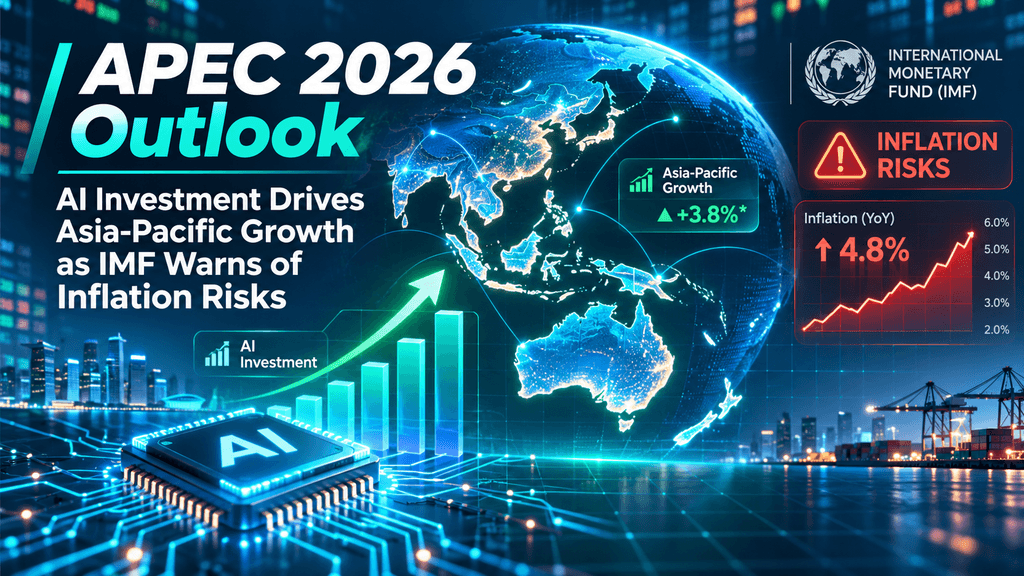
Asia-Pacific economic growth is receiving support from artificial intelligence investment and stronger technology-related trade, but rising energy costs and inflation are creating new challenges. At the November 2026 APEC Summit in Shenzhen, regional leaders highlighted digital transformation and productivity as priorities for long-term development, while IMF Managing Director Kristalina Georgieva warned that AI-related demand and energy supply shocks were adding to global inflationary pressures. With APEC projecting 3.4% regional growth in 2026 before a slowdown in 2027, the central question is whether AI investment can deliver sustainable productivity gains without intensifying economic instability.
Key Takeaways
-
APEC projects regional economic growth of 3.4% in 2026, moderating to 3.1% in 2027 as external pressures increase.
-
AI infrastructure investment and semiconductor demand are supporting Asia-Pacific exports, manufacturing, and technology-related capital expenditure.
-
IMF research indicates that AI is reshaping labor demand and skill requirements, although productivity gains will depend on how effectively businesses adopt the technology.
-
Energy supply disruptions and AI-related demand are contributing to inflationary pressures, complicating monetary policy decisions.
-
Uneven technology adoption, geopolitical tensions, elevated borrowing costs, and fiscal constraints could limit the region's long-term growth potential.
What Did the APEC Summit and IMF Reveal About Regional Economic Growth?
The 33rd APEC Economic Leaders' Meeting took place in Shenzhen, China, on November 18–19, 2026, under the theme "Building an Asia-Pacific Community to Prosper Together." The summit brought together leaders from 21 member economies to discuss regional economic cooperation, trade connectivity, technological innovation, and economic resilience. Artificial intelligence featured prominently in discussions about future productivity, digital infrastructure, and industrial transformation. The meeting also emphasized openness, innovation, and cooperation as priorities for maintaining regional economic development amid increasing geopolitical and economic uncertainty.
The latest APEC Regional Trends Analysis, published on November 15, provides the economic context for these discussions. APEC raised its 2026 regional growth forecast to 3.4%, compared with its previous estimate of 3.2% and growth of 3.3% in 2025. However, the organization expects growth to moderate to 3.1% in 2027 as higher energy prices, trade restrictions, and tighter financial conditions weigh on economic activity. The improvement in the 2026 forecast reflects stronger technology-related investment and trade, particularly demand for semiconductors, data centers, and computing capacity.
The IMF presents a broadly similar outlook while using a wider Asia-Pacific regional scope. Its October 2026 Regional Economic Outlook projects growth of 4.8% in 2026 and 4.4% in 2027, down from 5% in 2025. The IMF identifies three major forces shaping the region: the energy shock associated with the Middle East conflict, the AI-driven technology boom, and trade reconfiguration following earlier tariff increases. These figures should not be directly compared with APEC's forecasts because the institutions use different geographic coverage and economic aggregates. Nevertheless, both assessments indicate that technology demand is supporting growth while external risks are becoming more difficult to manage.
| Economic Indicator | APEC Forecast |
| Regional GDP growth, 2025 | 3.30% |
| Regional GDP growth, 2026 | 3.40% |
| Regional GDP growth, 2027 | 3.10% |
| Inflation, 2026 | 3.20% |
| Inflation, 2027 | 2.80% |
| Inflation, 2028 | 2.50% |
The figures suggest that Asia-Pacific economies remain relatively resilient, but the sources of growth are becoming increasingly concentrated. Technology investment is supporting selected industries and export markets, while other sectors face higher operating costs and weaker external demand. This divergence is important because strong regional headline growth does not necessarily indicate that households, smaller businesses, and traditional industries are experiencing equally favorable conditions.
Why Is AI Becoming a Major Driver of Asia-Pacific Economic Growth?
Artificial intelligence is creating a new investment cycle across the Asia-Pacific region. The development of generative AI, large-scale computing systems, and enterprise automation requires substantial investment in semiconductors, memory chips, data centers, networking equipment, and electricity infrastructure. As technology companies expand their computing capacity, demand spreads across multiple stages of the regional supply chain, creating additional opportunities for manufacturers, equipment suppliers, and infrastructure providers.
The semiconductor industry is particularly important to this process. AI data centers require advanced processors and high-bandwidth memory to support model training and inference. South Korea and Japan occupy important positions in semiconductor manufacturing and related equipment supply, while other regional economies participate in electronics assembly, component production, and data center development. China's expanding technology investment and Southeast Asia's growing role in manufacturing and digital infrastructure also contribute to the broader regional trend. The IMF notes that strong AI infrastructure demand accelerated semiconductor exports and investment during the first half of 2026.
APEC's trade figures demonstrate the scale of this expansion. Merchandise export values across the region increased 22.5% year over year in the first half of 2026, compared with 6.5% during the same period a year earlier. Export volumes rose 10.8%, indicating that the increase was not solely attributable to higher prices. Import values also increased 17.7%, while import volumes expanded 11.9%, reflecting stronger demand for goods and production inputs. However, APEC expects export volume growth for goods and services to slow from 6.9% in 2026 to 3.8% in 2027 as trade uncertainty and geopolitical disruptions persist.
| Trade Indicator | H1 2025 | H1 2026 |
| Merchandise export value growth | 6.50% | 22.50% |
| Merchandise export volume growth | 8.10% | 10.80% |
| Merchandise import value growth | 6.20% | 17.70% |
| Merchandise import volume growth | 8.30% | 11.90% |
These figures show why AI investment has become an important component of the regional economic outlook. Unlike technology spending confined to software companies, AI infrastructure investment generates demand for physical products, industrial equipment, construction services, electricity, and international logistics. This creates a broader economic multiplier, although the benefits depend on how much of the investment translates into productive capacity rather than simply expanding the supply of computing equipment.
Can AI Investment Translate Into Sustainable Productivity Gains?
The expansion of AI infrastructure does not automatically mean that productivity is increasing across the broader economy. Productivity measures how efficiently businesses and workers convert labor, capital, and other resources into economic output. AI can potentially improve this efficiency by automating repetitive tasks, accelerating research, improving forecasting, and reducing administrative workloads. However, businesses must integrate these tools into existing operations before the benefits become visible in measurable economic output.
For example, an enterprise adopting AI-powered customer service may reduce the time required to handle routine inquiries, but the actual efficiency gain depends on system accuracy, integration costs, employee supervision, and the number of cases requiring human intervention. Similar challenges apply to manufacturing, financial services, logistics, and healthcare. Companies may need to redesign workflows, invest in employee training, and improve data infrastructure before AI generates meaningful productivity improvements. Consequently, capital expenditure on AI systems should not be treated as equivalent to realized productivity growth.
The IMF's October 2026 regional analysis provides another important perspective through its examination of labor market changes. Drawing on approximately 40 million online job postings across 19 Asian economies, the research found that employer demand for occupations more exposed to AI had fallen by nearly 10% relative to less-exposed occupations. However, the IMF noted that this effect appeared to have stabilized despite continued improvements in AI capabilities. The findings suggest that AI is changing the composition of labor demand and increasing the importance of technical skills rather than simply eliminating employment across entire industries.
The distribution of productivity gains will also depend on access to technology. Large companies generally have greater financial resources, proprietary data, and technical expertise to deploy AI at scale. Smaller businesses may face higher implementation costs, limited digital infrastructure, and shortages of skilled workers. This creates a risk that AI adoption could widen productivity differences between companies and economies unless governments and businesses invest in digital education, accessible infrastructure, and workforce development. APEC's AI Initiative for 2026–2030 similarly emphasizes responsible adoption, digital literacy, resilient infrastructure, and broader participation in technological development.
Why Is the AI Boom Also Creating Inflation Risks?
The growing AI investment cycle presents a potential challenge for monetary policymakers because the expansion of technology infrastructure can increase demand for energy, industrial materials, and computing equipment. Large data centers require continuous electricity, cooling systems, and reliable power connections. As companies compete to expand computing capacity, demand for electricity infrastructure and specialized equipment can rise faster than available supply. These pressures may increase costs for technology companies and other industries that depend on the same resources.
At the November 19 APEC Summit, IMF Managing Director Kristalina Georgieva warned that global inflation had accelerated to 4.7%, with energy supply shocks and AI-related demand contributing to the pressure. She called for tighter monetary policy in many economies. Her comments highlight an important distinction: AI can improve productivity over time, but the investment required to build its infrastructure can create additional demand and cost pressures before efficiency gains become widespread. The inflation figure should therefore not be interpreted as evidence that AI alone is responsible for the increase.
Energy prices have become an additional source of pressure. APEC reported that since July 2026, crude oil prices had increased 35.9%, liquefied natural gas prices had risen 40.2%, and coal prices had advanced 14%. These increases raise transportation, manufacturing, and electricity costs, affecting both households and businesses. APEC consequently expects regional inflation to reach 3.2% in 2026 before easing to 2.8% in 2027 and 2.5% in 2028. More than one-third of APEC member economies had also raised benchmark interest rates in recent weeks to contain inflationary pressures.
The combination of stronger technology investment and higher energy costs creates a difficult policy environment. Central banks must consider whether inflation is driven by temporary supply disruptions or more persistent demand pressures. Raising interest rates can help contain inflation expectations, but higher borrowing costs may also discourage investment and weaken household consumption. Conversely, maintaining excessively accommodative monetary conditions could allow inflation to become more persistent. The appropriate policy response therefore depends on domestic inflation dynamics, labor market conditions, and the credibility of each economy's monetary framework.
Why Are AI-Driven Growth Benefits Uneven Across Asia?
Although AI is supporting regional economic activity, its benefits are not distributed equally across Asia-Pacific economies. Differences in semiconductor capabilities, digital infrastructure, access to capital, workforce skills, and energy security influence how effectively countries can participate in the technology supply chain. Economies with established technology industries may capture a larger share of AI-related export growth, while those with weaker infrastructure may struggle to attract investment or develop domestic applications.
| Economy | AI and Economic Exposure | Key Consideration |
| South Korea | Semiconductor and memory-chip exports | Strong exposure to AI hardware demand |
| Japan | Semiconductor equipment, materials, and advanced manufacturing | Benefits from technology investment, with a different export structure |
| China | AI infrastructure, electronics, and advanced manufacturing | Technology investment coexists with weak domestic demand and property-sector pressures |
| Indonesia | Domestic consumption and industrial development | Growth remains sensitive to energy and financing conditions |
| Vietnam | Export diversification and foreign direct investment | Manufacturing integration supports technology-related trade |
The IMF's October outlook illustrates these differences. South Korea benefits disproportionately from the AI boom through memory and logic chip production, while Japan also gains from technology demand but has a different export composition. China's 2026 growth forecast was revised to 4.5%, although weak domestic demand and persistent property-sector difficulties remain significant challenges. Indonesia's growth is projected at approximately 5.1%, while Vietnam benefited from export diversification and foreign direct investment. These country-level assessments underline why the same global technology cycle can produce different economic outcomes across the region.
For developing economies, the central challenge is to move beyond participating in lower-value manufacturing and gradually build stronger technological capabilities. This requires investment in education, reliable electricity, telecommunications, research, and digital infrastructure. Without these foundations, countries may remain dependent on external suppliers for advanced computing systems and capture only a limited portion of the productivity gains generated by AI. Broader access to technology and stronger regional cooperation will therefore be essential to making AI-driven growth more inclusive.
What Risks Could Undermine the Asia-Pacific Economic Outlook?
The first major risk is that AI investment expectations may exceed the economic returns ultimately generated by the technology. Semiconductor demand and data center construction have supported corporate investment and technology-related equity valuations, but these expectations depend on sustained demand for AI services and measurable productivity improvements. If companies reduce capital expenditure because returns fall short of expectations, technology exports, equipment suppliers, and related investment could weaken. APEC has specifically warned that elevated technology stock valuations could become vulnerable to correction if anticipated productivity gains fail to materialize or investor sentiment deteriorates.
Geopolitical and trade uncertainty present another challenge. Export restrictions, changing tariff policies, and supply-chain disruptions can increase costs and reduce the predictability of international business operations. APEC reported that 1,591 trade remedies and trade-restrictive measures were in force across its economies in the latest available 2025 data, nearly three times the 562 trade-facilitating measures. Disruptions affecting the Persian Gulf and Red Sea have also complicated maritime transport, while weather-related delays have increased pressure on major shipping routes. These factors could weaken the trade environment that currently supports regional growth.
Fiscal constraints further limit governments' ability to respond to economic shocks. APEC projects regional public debt at approximately 108%–112% of GDP in the near term, while higher sovereign bond yields are increasing borrowing costs. Governments facing elevated debt-servicing expenses may have less capacity to finance digital infrastructure, education, energy diversification, and social protection. At the same time, extreme weather events and food price increases could create additional inflationary and fiscal pressures. The challenge is to maintain investment in long-term productivity while preserving enough financial flexibility to respond to unexpected disruptions.
What Does the APEC Outlook Mean for Investors and Businesses?
For investors, the latest economic outlook suggests that AI exposure should be assessed across the broader supply chain rather than limited to major technology companies. Semiconductor manufacturers, memory suppliers, data center operators, networking equipment providers, and electricity infrastructure companies all participate in the expansion of AI computing capacity. However, valuations should be evaluated against earnings growth, capital expenditure requirements, and the possibility that demand may normalize as the current investment cycle matures.
Energy infrastructure is another area worth monitoring. Data center expansion requires dependable electricity, making power generation, grid modernization, cooling technology, and energy storage increasingly important to the AI ecosystem. Businesses capable of improving energy efficiency may also benefit as electricity availability becomes a more significant constraint on digital infrastructure development. Nevertheless, higher energy prices can create cost pressures for traditional manufacturers and service providers, particularly in economies that depend heavily on imported fuels.
For policymakers and businesses, the more important long-term issue is how to convert AI investment into broad productivity improvements. This requires workforce retraining, support for small and medium-sized enterprises, responsible data governance, and better access to digital infrastructure. APEC's cooperation agenda places particular emphasis on digital transformation, cross-border connectivity, and technology adoption. These measures could help ensure that AI creates economic opportunities across a wider range of industries rather than concentrating gains among a relatively small group of technology companies.
Conclusion
The 2026 APEC outlook highlights AI as an increasingly important driver of Asia-Pacific economic growth, particularly through semiconductor demand, infrastructure investment, and technology-related trade. However, the transition from capital expenditure to sustainable productivity gains remains uncertain. Rising energy costs, inflation, geopolitical tensions, and uneven access to technology could limit the region's progress. The long-term economic impact will depend on how effectively businesses integrate AI, governments strengthen digital infrastructure, and policymakers maintain macroeconomic stability. Ultimately, AI's contribution to regional prosperity will be measured by lasting efficiency improvements rather than investment spending alone.
FAQs
What Is APEC's Economic Growth Forecast for 2026?
APEC projects regional economic growth of 3.4% in 2026, up from its previous forecast of 3.2%. Growth is expected to moderate to 3.1% in 2027.
How Is AI Affecting Asia-Pacific Economic Growth?
AI is increasing demand for semiconductors, data centers, computing equipment, and digital infrastructure. These investments support exports and capital expenditure, although productivity gains depend on broader business adoption.
Why Did the IMF Warn About AI-Related Inflation?
IMF Managing Director Kristalina Georgieva said energy supply shocks and AI-related demand were contributing to global inflation reaching 4.7%. Higher technology and energy demand can increase costs before long-term productivity benefits become widespread.
Will AI Replace Jobs Across Asia?
AI is changing labor demand and increasing the importance of technical skills, but it does not necessarily eliminate entire occupations. IMF research found weaker employer demand in more AI-exposed occupations, suggesting that workforce adaptation and retraining will be important.
What Are the Main Risks to Asia-Pacific Economic Growth?
Key risks include energy price volatility, geopolitical tensions, trade restrictions, elevated public debt, tighter financial conditions, and the possibility that AI investment fails to generate expected productivity returns.
Disclaimer: This general market information, possibly from third-party, commercial, or sponsored sources, is provided for reference and educational purposes only and does not constitute financial or investment advice, an offer, solicitation, or guarantee. We disclaim liability for its accuracy, completeness, reliability, and any resulting losses. Investments/trading are risky; past performance doesn’t guarantee future results. Users should research, judge prudently, and take full responsibility. For further details, please consult KuCoin’s Terms of Use and Risk Disclosure.