

Anthropic IPO: ANT Stock Ticker, November Listing Timeline, and the $1.5 Trillion Valuation Question
Introduction
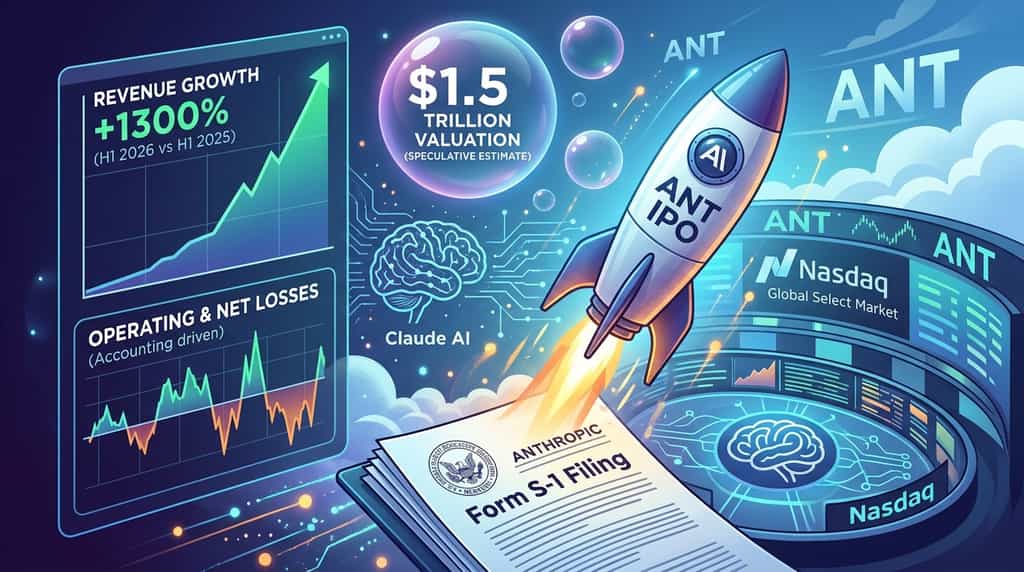
Anthropic, the developer of Claude AI, filed a public registration statement with the U.S. Securities and Exchange Commission (SEC) on October 26, 2026, marking a major step toward its proposed initial public offering (IPO). The company intends to list its Class A common stock on the Nasdaq Global Select Market under the ticker symbol ANT. However, the IPO price range, number of shares offered, and final valuation have not yet been determined in the company's official announcement.
The potential November debut and a valuation near $1.5 trillion have attracted attention, but investors should distinguish market expectations from confirmed offering terms. Anthropic's official IPO announcement confirms the filing and proposed ticker, not a final listing date or valuation.
The company's SEC Form S-1 provides more detail on its revenue growth, operating expenses, financing structure, and business risks. These disclosures offer a starting point for understanding the potential ANT stock listing and the questions investors should examine before public trading begins.
Is Anthropic Really Targeting a $1.5 Trillion IPO Valuation?
A $1.5 trillion valuation should be treated as an unconfirmed market estimate, not an official IPO price target. Anthropic's October 26, 2026, announcement did not disclose a final valuation, and its initial S-1 filing leaves the proposed share-price range and share count incomplete.
The valuation question is important because private-market valuations and public-market valuations are not directly interchangeable. A private funding round may value a company using negotiated terms, preferred-share rights, and other conditions that differ from the common shares offered to public investors. An IPO valuation, by contrast, will depend on the offering price, the number and types of shares included in the capitalization calculation, and the final terms disclosed in the prospectus.
Investors should also distinguish between a company's enterprise value and its equity value. Equity value generally reflects the market value of its shares, while enterprise value adjusts for items such as debt and cash. These measures can produce materially different results, especially for a company with significant financing arrangements and infrastructure commitments.
What Would a $1.5 Trillion Valuation Mean for Anthropic?
At a hypothetical equity valuation of $1.5 trillion, investors would be assigning an enormous value to Anthropic's expected future revenue, margins, competitive position, and ability to fund its AI infrastructure. The figure is a scenario for analysis, not a confirmed IPO valuation or an indication of where ANT shares would trade.
A useful starting point is to compare a hypothetical valuation with reported revenue. According to Anthropic's SEC Form S-1, filed October 26, 2026, the company generated $16.286 billion in revenue during the six months ended June 30, 2026. Dividing a hypothetical $1.5 trillion equity value by that six-month revenue produces a ratio of approximately 92 times six-month revenue. This is not a standard annual revenue multiple; it illustrates how much the valuation depends on expectations about future growth.
Investors should not simply double six-month revenue and assume the result represents a reliable full-year forecast. Revenue growth may change as the business scales, and expenses, infrastructure commitments, competition, and financing needs can affect the value ultimately attributed to shareholders. A meaningful valuation analysis will require the final share count, offering price, updated financial disclosures, and a clear understanding of the company's capital structure.
How Fast Is Anthropic Growing, According to Its SEC Filing?
Anthropic's reported revenue increased sharply in the first half of 2026, but its filing also shows substantial operating expenses and a large accounting-driven net loss. Both sides of the financial picture matter when evaluating the potential IPO.
According to the company's October 26, 2026, S-1 registration statement, Anthropic reported the following historical results:
| Period | Revenue | Operating loss | Net loss |
| Full year 2024 | $386 million | $2.980 billion | $8.309 billion |
| Full year 2025 | $4.585 billion | $8.060 billion | $41.965 billion |
| First half 2025 | $1.163 billion | $2.135 billion | $12.969 billion |
| First half 2026 | $16.286 billion | $693 million | $80.748 billion |
The first-half revenue comparison indicates substantial commercial expansion. Revenue rose from $1.163 billion in the first half of 2025 to $16.286 billion in the first half of 2026, equivalent to growth of approximately 1,300% year over year. However, a growth rate from a smaller starting base can be difficult to sustain as the business becomes larger. Anthropic itself cautions in the filing that recent growth rates may not continue.
The operating loss provides a different perspective. Anthropic reported a $693 million operating loss in the first half of 2026, compared with $2.135 billion in the same period of 2025. That indicates a narrower operating loss despite increased spending, although the company still reported an operating deficit.
The net loss was much larger because it included non-operating accounting effects. The filing attributes approximately $72.4 billion of the first-half 2026 loss to changes in the fair value of convertible notes, derivative liabilities, and simple agreements for future equity. Those changes were primarily associated with increases in the estimated value of the company's financing instruments as its enterprise valuation rose. Consequently, the reported $80.748 billion net loss should not be interpreted as equivalent to $80.748 billion of cash consumed by ordinary operations.
For IPO analysis, investors should separate operating performance from changes in the accounting value of financing instruments. Revenue growth, operating costs, cash flow, debt obligations, and the terms of convertible securities all help explain the company's financial position.
What Does Anthropic's Business Model Mean for ANT Stock?
Anthropic's business depends on developing AI models and providing access to those models through products, platforms, and commercial relationships. Its ability to turn AI adoption into recurring revenue is central to the potential public-market valuation.
Claude is the company's AI model family, serving individual users and organizations. The business can generate revenue through paid products, enterprise usage, API access, and partnerships that distribute its models through third-party cloud platforms. These channels can expand customer access, but they also introduce dependencies on infrastructure suppliers and distribution partners.
Anthropic's filing shows how important cloud distribution has become. According to its S-1, sales through cloud service provider marketplaces represented approximately 47% of total revenue in 2025 and 48% in the first half of 2026. These platforms can help make models available to enterprise customers, while also creating exposure to partner terms, fees, and changes in distribution relationships.
The company also relies on significant computing resources to train, develop, and serve AI models. Its filing describes a multi-chip approach involving AWS Trainium, Google TPUs, NVIDIA GPUs, and AMD GPUs. Using several computing architectures may provide flexibility in allocating workloads, but it does not remove the cost or complexity of securing enough capacity to meet demand.
For shareholders, the key business question is whether Anthropic can maintain customer growth while improving the economics of delivering its models. Revenue expansion is valuable only to the extent that the company can manage computing costs, operating expenses, and financing commitments over time. Public investors will need to assess these factors against the valuation eventually set for ANT shares.
What Are the Biggest Risks for Anthropic IPO Investors?
Anthropic's main investment risks include high computing costs, continued operating losses, intense competition, dependence on external infrastructure, and uncertainty about future revenue growth. The S-1 filing describes these risks directly, making it an essential document for evaluating the proposed IPO.
-
Computing costs and infrastructure commitments. Developing and operating advanced AI models requires substantial computing capacity, data-center resources, and energy. Anthropic's ability to secure adequate infrastructure at sustainable costs will affect its margins and cash requirements. Long-term commitments may also create financial obligations even if customer demand changes.
-
Competition and changing customer demand. The AI market is developing quickly, and customers can compare models based on performance, price, reliability, and available features. Anthropic must continue improving its products while maintaining a compelling value proposition. Strong historical growth does not guarantee that demand or market share will continue expanding at the same rate.
-
Financing and dilution. Anthropic's filing reports $6.2 billion in outstanding indebtedness as of June 30, 2026, relating to convertible promissory notes issued to Amazon. The company also describes additional financing arrangements connected to infrastructure. The conversion of existing securities into shares can affect ownership percentages, so investors should review the post-offering capitalization and dilution disclosures when the final terms become available.
-
Accounting and profitability. The difference between Anthropic's operating loss and net loss demonstrates why investors should examine the full financial statements. Changes in the fair value of financing instruments can produce large accounting gains or losses that do not directly reflect cash generated or consumed by ordinary operations. Operating performance, cash flow, debt, and future financing needs should be evaluated separately.
-
Governance and corporate structure. Anthropic is incorporated as a public benefit corporation. Its stated purpose and governance arrangements are designed to balance shareholder interests with broader considerations related to its mission. The S-1 describes multiple share classes and governance mechanisms, so investors should examine voting rights, board structure, and the influence different shareholders may have after the offering.
These risks do not determine the IPO's eventual performance, but they establish why the final prospectus and subsequent financial disclosures matter. Investors should evaluate both the company's growth opportunity and the obligations required to support it.
Conclusion
Anthropic's October 26, 2026, S-1 filing is a major step toward its proposed IPO, with the company intending to list its Class A common stock on Nasdaq under the ticker ANT. However, the initial announcement does not confirm the final offering price, share count, valuation, or trading date. A November debut and a $1.5 trillion valuation should therefore be treated as unconfirmed expectations until official offering terms are published.
The company's financial disclosures show rapid revenue expansion, alongside substantial operating costs, financing obligations, and a large net loss influenced by accounting changes in the value of financing instruments. These details make it important to distinguish revenue growth from sustainable profitability and cash generation.
The eventual investment case will depend on Anthropic's ability to retain customers, expand commercial use of Claude, manage computing costs, and maintain a competitive position as the AI market develops. Governance structure, convertible securities, and potential dilution also deserve close attention. Investors following the proposed ANT stock listing should prioritize the SEC registration statement, subsequent amendments, and final prospectus over headline valuations. The IPO may create a new way to assess Anthropic through public-market disclosures, but the appropriate valuation and investment risks will depend on the final terms and the company's performance over time.
FAQs
1. What is Anthropic's stock ticker?
Anthropic intends to list its Class A common stock on the Nasdaq Global Select Market under the ticker ANT, according to its official announcement dated October 26, 2026. The proposed listing remains subject to the registration process.
2. Has Anthropic confirmed a $1.5 trillion IPO valuation?
No. The initial S-1 filing does not establish a final valuation or offering price. A $1.5 trillion figure should be treated as an unconfirmed estimate until Anthropic publishes official offering terms.
3. How much revenue did Anthropic generate in the first half of 2026?
According to its SEC Form S-1, Anthropic reported $16.286 billion in revenue for the six months ended June 30, 2026, compared with $1.163 billion in the same period of 2025.
4. Why did Anthropic report a large net loss despite rapid revenue growth?
The company reported a net loss of $80.748 billion for the first half of 2026, including approximately $72.4 billion in changes in the fair value of convertible notes, derivative liabilities, and simple agreements for future equity. These accounting effects were primarily associated with increases in the estimated value of financing instruments and should be distinguished from operating expenses and cash flow.
5. What should investors review before evaluating ANT stock?
Investors should examine the final IPO valuation, revenue growth, operating performance, cash flow, computing commitments, debt, share classes, voting rights, and potential dilution. The official SEC filing and final prospectus are the primary documents for assessing these factors.
Disclaimer
This general market information, possibly from third-party, commercial, or sponsored sources, is provided for reference and educational purposes only and does not constitute financial or investment advice, an offer, solicitation, or guarantee. We disclaim liability for its accuracy, completeness, reliability, and any resulting losses. Investments/trading are risky; past performance doesn’t guarantee future results. Users should research, judge prudently, and take full responsibility. For further details, please consult KuCoin’s Terms of Use and Risk Disclosure.