

Anthropic Eyes $2 Trillion Valuation in October IPO: Is the AI Investment Boom Entering Bubble Territory?
2026/08/17 10:59:00
Introduction
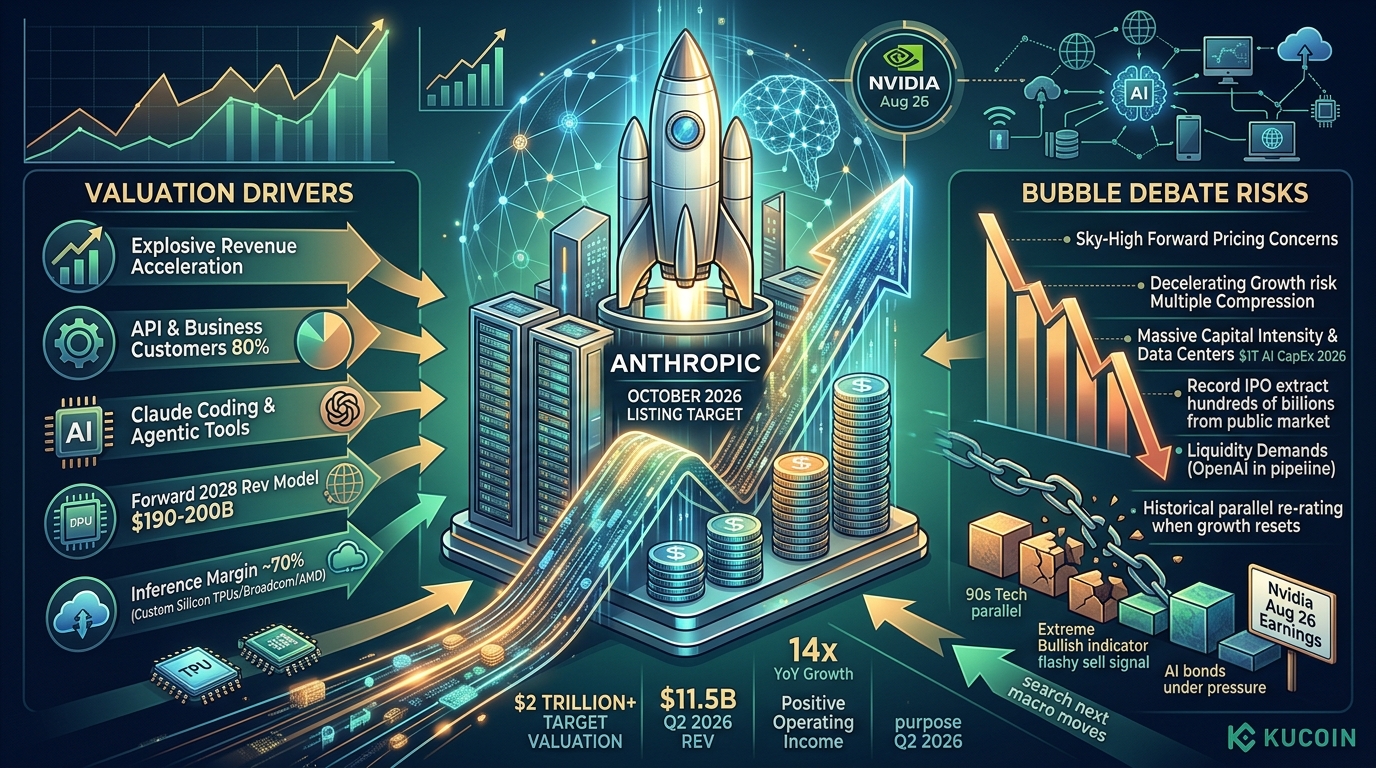
Anthropic’s projected October 2026 IPO could value the Claude AI maker at $2 trillion or more, potentially the largest listing in history and eclipsing SpaceX’s recent debut. This surge, driven by explosive revenue growth, has reignited debate over whether AI investment has entered bubble territory.
According to recent reports, investors now model the company on forward 2028 revenue of $190–200 billion while questioning if current multiples can hold if growth decelerates. The answer is nuanced: Anthropic’s fundamentals show real commercialization progress, yet the combination of sky-high forward pricing, massive capital intensity, and liquidity demands from a record IPO signals elevated risk of overheating across the sector.
What Is Driving Anthropic’s Path to a $2 Trillion Valuation?
Anthropic’s valuation trajectory rests on unprecedented revenue acceleration rather than pure speculation. In May 2026 the company closed a financing round at approximately $965 billion. Secondary-market trades have since pushed implied values higher, with some platforms reporting levels between $1.2 trillion and $1.5 trillion in July and August 2026. Backers now expect an October listing at $2 trillion or above—more than double the May mark and larger than SpaceX’s $1.77 trillion IPO.
The growth underpinning these figures is concrete. Preliminary second-quarter 2026 revenue exceeded $11.5 billion. That represents a more than 14-fold increase from the $787 million recorded in the same period of 2025 and more than double the $4.73 billion of the first quarter. Annualized run-rate revenue stood above $47 billion in May; investors now project $100–120 billion by year-end 2026. The company also posted positive adjusted operating income in Q2, a milestone few frontier AI labs have reached.
Enterprise demand, particularly for Claude’s coding and agentic tools, accounts for the bulk of this expansion. Roughly 80 percent of revenue now comes from API and business customers rather than consumer subscriptions. Supporters argue these metrics reflect genuine commercial penetration and justify premium multiples relative to projected 2028 revenue of $190–200 billion, as detailed in a Reuters exclusive on August 15.
How Does Anthropic’s Profitability Challenge the “AI Only Burns Cash” Narrative?
Anthropic’s recent numbers directly counter the long-standing claim that leading AI model developers only consume capital without generating sustainable income. Q2 revenue of more than $11.5 billion and the shift to positive adjusted operating income demonstrate that scale can produce operating leverage. Inference gross margins have improved substantially, rising from roughly 38 percent a year earlier toward levels above 70 percent in recent periods, according to analyses tied to the company’s investor materials.
The margin expansion stems primarily from a shift in compute strategy. Training remains heavily dependent on Nvidia GPUs, but inference workloads are increasingly migrating to custom silicon. Google TPUs co-developed with Broadcom, along with other specialized chips, deliver lower total cost of ownership for high-volume inference. Large-scale deals involving Google TPU capacity—structured through special-purpose vehicles and backed by Broadcom guarantees—have enabled Anthropic to secure gigawatts of capacity while improving unit economics. AMD also committed $5 billion in access to its chips in a recent agreement.
These developments show that revenue growth is no longer purely offset by compute costs. However, the absolute scale of required infrastructure remains enormous. Any sustained slowdown in customer adoption or rise in energy and chip prices could reverse the margin gains. Market participants therefore watch whether the profitability inflection holds once the company reports under public-market accounting standards.
Why Do Critics Argue the $2 Trillion Price Tags a Bubble?
Skeptics contend that a $2 trillion valuation prices in two years of future revenue at optimistic multiples while ignoring execution and liquidity risks. Pricing the company on 2028 revenue of $190–200 billion means today’s investors pay for growth that has not yet occurred. If annual growth cools from the current multi-fold pace to a more mature 2x trajectory, the multiple compresses sharply and the valuation becomes difficult to support.
Capital intensity compounds the concern. Global AI-related investment is projected to reach approximately $1 trillion in 2026, according to Goldman Sachs Research published in early August, with U.S. hyperscaler and private spending forming the bulk. Anthropic and peers continue to commit tens of billions to data centers, custom chips, and training runs. Negative free cash flow at several hyperscalers underscores the gap between infrastructure outlays and near-term returns.
Liquidity represents an additional pressure point. A record IPO of this size would extract hundreds of billions of dollars from public markets. OpenAI remains in the pipeline for a possible later listing, raising the prospect of successive mega-offerings that could strain available capital. Historical parallels to the late-1990s technology boom show that dominant companies can deliver strong fundamentals yet still experience sharp re-ratings when growth expectations reset.
Key near-term signals include Nvidia’s second-quarter fiscal 2027 earnings, scheduled for August 26, 2026. Investors will scrutinize any commentary on inference demand and custom-chip competition. Equally important will be the revenue and margin figures Anthropic discloses when it files its public S-1, which must align with the preliminary numbers already shared with prospective investors.
What Investment Approach Does Bank of America Recommend in the Current AI Environment?
Bank of America Securities chief strategist Michael Hartnett argues that the optimal strategy inside an AI bubble is to hold both the leading technology names and long-neglected “humiliation” assets that historically benefit from late-cycle spillover. In his latest Flow Show report referenced in mid-August 2026 coverage, Hartnett advises going long AI tech leaders while simultaneously adding exposure to under-owned cyclical or consumer-oriented assets, and shorting AI-related bonds.
The Bank of America Bull & Bear Indicator stood at 9.3 in the most recent reading, down slightly from 9.7 yet still deep in extreme-bullish territory and flashing a sell signal. Private-client equity allocations reached a record 66.4 percent. Technology stocks recorded their largest weekly outflow in seven weeks, while capital has rotated structurally toward gold and commodities. Hartnett notes that more than $1 trillion in AI capital expenditure combined with negative cash flows at many participants will pressure related bond issuance.
Historical bubble patterns support the dual approach. In prior episodes, assets left behind during the main surge often captured residual nominal-GDP momentum just before the dominant theme peaked. Hartnett currently identifies the consumer sector as the most likely candidate for that spillover role. The strategy seeks to capture upside from continued AI leadership while positioning for a potential broadening of market participation or eventual rotation.
KuCoin Offers A More Stable Option in A Volatile Market
If you worry about the frequent ups and downs in the market, and pursue a more stable option to earn money passively, KuCoin is the right place to come:
-
Simple Earn: Deposit and withdraw tokens anytime, earning stable returns.
-
Kucoin Earn: Earn stable profits with professional asset management.
-
Hold to Earn: Earn rewards by holding assets in Funding, Trading, Margin, Futures, Mining, and Unified Accounts.
-
Staking: Unlock the earning potential of on-chain assets.
-
Advanced Investments: Advanced Investments offer a variety of structured products to help your money grow in any market.
-
Shark Fin: Principal Protection and Guaranteed Gains
-
Dual Investment: Buy low and sell high with transparent return calculations.
-
Snowball: High yields, with price protection.
-
Discount Buy: Buy crypto at discount prices.
-
KCS Loyalty: Level up to enjoy exclusive perks by staking ≥ 1 KCS.
-
KuCoin Wealth: Discover future value and begin your smart investing journey.
-
KCS Benefits: Hold and stake KCS to access benefits across the platform.
-
KCS Staking 2.0: Participate in KCS on-chain governance to earn yield.

Conclusion
Anthropic’s rapid ascent toward a potential $2 trillion October IPO rests on verifiable revenue growth—Q2 2026 sales above $11.5 billion, positive operating income, and improving inference margins enabled by custom chips. These results demonstrate that AI model companies can generate substantial commercial traction. At the same time, pricing the firm on distant 2028 revenue, the enormous capital required to sustain growth, and the liquidity demands of a record listing keep the bubble debate alive.
Bank of America’s Hartnett framework of pairing AI leaders with neglected assets while shorting related bonds offers one practical way to navigate the current environment. Near-term catalysts—Nvidia’s August 26 earnings and Anthropic’s formal filing—will provide clearer evidence of whether the growth trajectory can support today’s valuations or whether a broader re-rating lies ahead. Investors should remain focused on fundamentals, capital intensity, and market liquidity rather than narrative momentum alone.
FAQs
Is Anthropic already profitable?
Yes. Preliminary figures for the second quarter of 2026 show positive adjusted operating income alongside revenue exceeding $11.5 billion.
When is Anthropic expected to go public?
Investors and media reports in August 2026 point to an October listing window following the confidential S-1 filing made in June.
What role do custom chips play in Anthropic’s margins?
Google TPUs developed with Broadcom and other specialized silicon have lowered inference costs, helping lift gross margins well above levels seen a year earlier.
What is the main risk if Anthropic lists at $2 trillion?
A slowdown in revenue growth below the extreme rates currently projected would compress the multiple applied to future earnings and could pressure both the stock and broader AI-related assets.